
The Indonesian Longan from Vietnam supply chain is one of the most precisely managed processes in Vietnam’s tropical fruit export sector and buyers who understand it gain a measurable sourcing advantage. Longan (Dimocarpus longan), known in Vietnam as “nhãn,” thrives in the specialized growing regions of Hung Yen, Son La, and the Mekong Delta, where climate conditions produce fruit with high sugar content, firm flesh, and extended shelf life. At Fado Agri, established in 2016 with 10+ years of export experience and 500+ containers shipped annually, the longan supply chain is built on one principle: every step from harvest to delivery must be transparent, traceable, and fully compliant with the destination market’s import standards.
This guide is written for B2B importers, wholesale distributors, and procurement teams who need more than a product listing, they need to understand the supply chain behind the fruit before committing to a long-term sourcing relationship.
1. What Is Indonesian Longan, and Why Is It Sourced Through Vietnam?
Indonesian Longan is a longan variety prized for its relatively large fruit size, balanced sweetness-to-acidity ratio, and durability during extended cold-chain transit, making it well suited for export markets across the Middle East, China, Japan, South Korea, Malaysia, and Australia.
While the variety carries the “Indonesian” designation by cultivar classification, commercial quantities of this longan type are grown and processed in Vietnam under strictly controlled agricultural conditions. Vietnam’s established agri-export infrastructure, including GLOBALG.A.P-certified growing zones, HACCP-compliant pack houses, FDA-registered export facilities, and direct freight connectivity to major global ports, makes it a more reliable sourcing point than many alternative origins.
Buyers often ask: Why source Indonesian Longan from Vietnam rather than directly from Indonesia? The answer lies in supply chain depth. Vietnam’s longan export network is backed by government-regulated phytosanitary controls, robust cold storage capacity, and established compliance pathways into demanding markets like Japan, the United States, and the European Union, infrastructure advantages that translate directly into lower customs rejection risk and more consistent quality on arrival.
Read more: Why Indonesian Longan is becoming a preferred choice for global fruit importers?
2. The Indonesian Longan from Vietnam Supply Chain: Stage by Stage
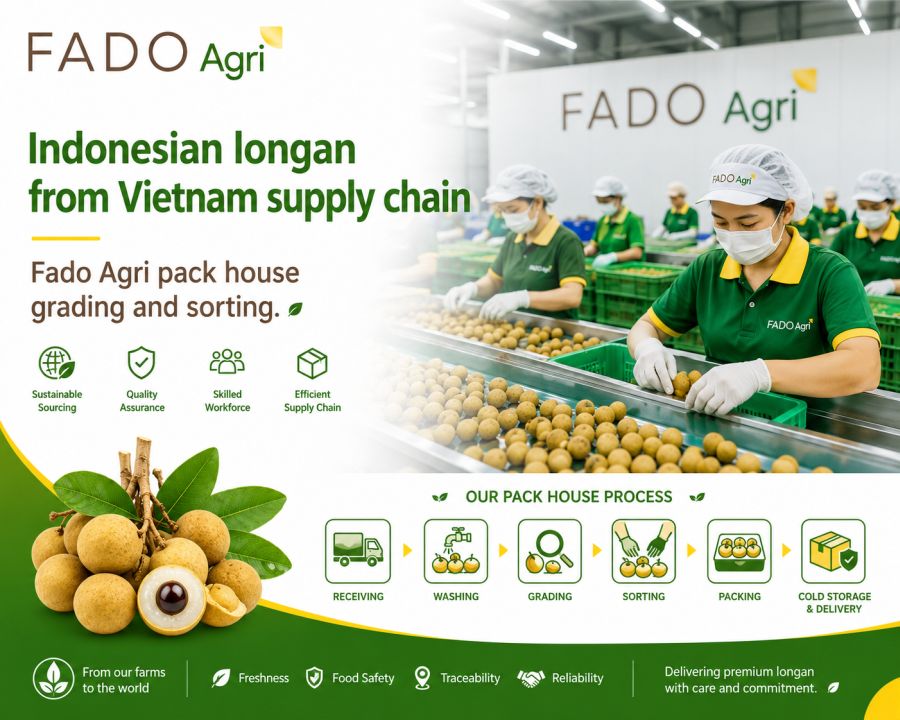
Understanding the Indonesian Longan from Vietnam supply chain means following the fruit from field selection through to container loading. Fado Agri operates a 10-step transparent supply chain designed to give importers full visibility and eliminate quality gaps between origin and destination.
2.1 Farm Selection and Agricultural Compliance
Sourcing begins at the farm level. Fado Agri works exclusively with growers operating under GLOBALG.A.P standards, meaning field records, fertilizer and pesticide logs, and harvest schedules are audited before any fruit is accepted. Longan growing zones in Son La (northern Vietnam) and Hung Yen are selected for consistent fruit sizing and brix levels above 18°.
2.2 Harvest Timing and Field Quality Control
Longan is harvested at optimal maturity, typically when shell color reaches a uniform tan-to-brown and fruit detaches cleanly from the cluster. Fado Agri’s field quality controllers conduct random Brix and weight sampling at harvest. Fruit that falls outside specification is separated at the point of harvest, not at the pack house, a critical step that protects downstream processing efficiency and reduces waste.
2.3 Post-Harvest Handling and Cooling
Within four hours of harvest, longan clusters are transported to Fado Agri’s HACCP-certified facilities for:
- Initial cooling to 4–6°C (rapid cooling to suppress respiratory rate)
- Fungicide-free sulphur dioxide (SO₂) fumigation where market protocols permit, or alternative preservation treatment for markets requiring SO₂-free product
- Trimming of damaged or undersized fruit from clusters
- Grading by size: typically 80–100 fruits/kg, 100–120 fruits/kg, or by specific market spec
2.4 Packaging and Export Format Options
Export packaging is determined by the destination market’s requirements, the distribution channel (wholesale vs. retail-ready), and any OEM/ODM branding specifications the buyer requires.
Standard export formats include:
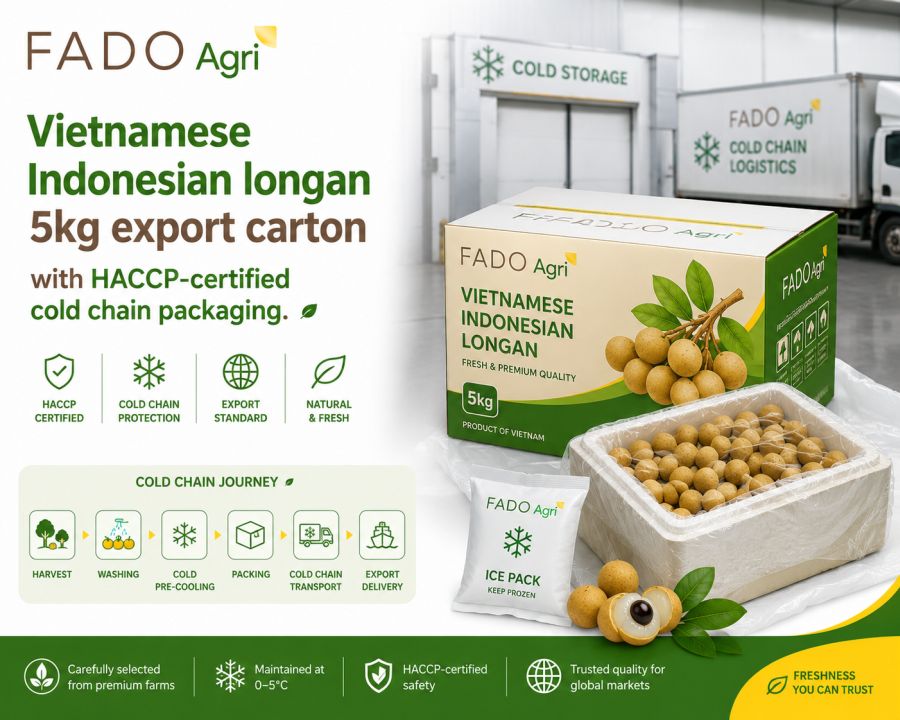
- 5 kg carton, most common for wholesale and redistribution markets (Middle East, Southeast Asia)
- 10 kg carton, used for bulk trading and food processing buyers
- Retail-ready punnet (500g / 1kg) inside a master carton, for supermarket-direct supply in Japan, South Korea, and Australia
- OEM branded packaging, available for importers who supply under their own label; Fado Agri’s ODM team handles carton printing, insert design, and labeling compliance per destination market
All cartons are ventilated for cold-chain airflow and lined with food-grade PE film. Net weight tolerance: ±2%.
2.5 Cold Chain Logistics and Container Loading
Longan is shipped under controlled atmosphere or conventional refrigerated (reefer) container conditions at 2–4°C, with relative humidity maintained at 90–95%. Container loading is supervised by Fado Agri’s logistics team and third-party inspection is available upon request (SGS, Bureau Veritas, or equivalent).
Shipping terms available: FOB (Ho Chi Minh City / Hai Phong) or CIF to major destination ports.
Standard lead time for Indonesian Longan: average 2–3 days per container for stable supply scheduling; custom volume and packaging configurations may require 5–7 days additional preparation.
3. Export Documentation: What Importers Receive with Every Shipment
A clean export documentation package is not optional, it is the baseline for any professional longan supply relationship. Fado Agri prepares and provides the following documents as standard:
- Commercial Invoice, itemized with HS code, unit price (FOB/CIF), and net/gross weight
- Packing List, carton count, pallet configuration, individual and total weights
- Bill of Lading (B/L), original or telex release per buyer preference
- Phytosanitary Certificate, issued by Vietnam’s Plant Protection Department, confirming pest and disease freedom to importing country standards
- Certificate of Origin (CO), Form D (ASEAN) or Form B (general), as applicable
- Health Certificate, where required by destination market (Japan, South Korea, Australia, UAE)
- Fumigation Certificate, where SO₂ or methyl bromide treatment has been applied
- Cold Storage Record, temperature log from pack house to port (available on request)
Buyers importing into the United States also receive product traceability documentation aligned with FDA import compliance requirements.
4. Quality Standards and Certification Coverage
Fado Agri’s longan supply chain is audited and certified at multiple points:
| Certification | Scope | Relevance to Buyers |
| GLOBALG.A.P | Farm-level, growing practices, traceability | Required for EU, Japan, and premium retail buyers |
| HACCP | Pack house, hazard control in processing | Required for food safety-regulated markets |
| FDA Registration | Facility-level, US import compliance | Required for all US-bound shipments |
Buyers often ask whether Fado Agri can provide laboratory testing results for pesticide residues. Yes, MRL (Maximum Residue Level) test reports from accredited Vietnamese laboratories are available per shipment upon request, or as a standing arrangement for contract buyers.
5. B2B Partnership Terms and Minimum Order Volumes
Fado Agri works with importers who need consistent quality, flexible OEM/ODM packaging, and export documentation that holds up at every customs checkpoint. We don’t just fill orders, we build sourcing relationships designed to scale.
5.1 Minimum Order Quantity (MOQ)
- Standard orders: 1 x 40ft reefer container (approximately 18–20 metric tons, depending on packaging format)
- Trial orders: Available for new partners, contact Fado Agri’s export team to discuss reduced-volume sampling arrangements
5.2 Payment Terms
Standard terms: L/C (Letter of Credit) at sight or T/T (Telegraphic Transfer), 30% deposit upon order confirmation, 70% against B/L copy. Flexible arrangements available for verified long-term partners.
5.3 OEM/ODM Packaging
Fado Agri’s ODM capability means importers can supply Indonesian Longan under their own brand identity. This includes custom carton artwork, multi-language labeling (English, Arabic, Chinese, Korean, Japanese), and market-specific net weight configurations.
Read more: Taiwan Guava Grown in Vietnam: Export Specifications & Buyer Guide
Frequently Asked Questions (FAQ)
What is Indonesian Longan from Vietnam, and how does it differ from other longan varieties?
Indonesian Longan is a cultivar of Dimocarpus longan valued for its larger fruit size, firm texture, and high sugar content (Brix 18° and above). When sourced through Vietnam’s certified supply chain, it benefits from GLOBALG.A.P and HACCP-controlled growing and processing conditions, which distinguish it from longan sourced through less regulated supply chains.
Which markets currently import Vietnamese Indonesian Longan?
Major importing markets include China, Japan, South Korea, the UAE, Saudi Arabia, Malaysia, Australia, and the United States. Each market has specific phytosanitary and documentation requirements that Fado Agri manages as part of its standard export process.
Does Fado Agri offer SO₂-free longan for markets that prohibit sulphur dioxide treatment?
Yes. Fado Agri’s post-harvest team applies SO₂ treatment only where destination market protocols permit it. For markets such as Japan or buyers sourcing for organic distribution channels, SO₂-free preservation and packaging protocols are available. Contact Fado Agri’s export team to confirm the appropriate treatment for your destination.
What certifications does Fado Agri hold for longan export?
Fado Agri holds FDA registration (United States), GLOBALG.A.P certification at the farm level, and HACCP certification at the pack house level. MRL pesticide residue test reports are available upon request from accredited Vietnamese laboratories.
What is the minimum order for a trial shipment of Indonesian Longan?
Standard orders begin at one 40ft reefer container. Fado Agri works with new importers on reduced-volume trial arrangements, reaching out directly to discuss what works for your first shipment.
How does Fado Agri handle cold chain continuity between Vietnam and the destination port?
All longan is shipped at 2–4°C in ventilated reefer containers with 90–95% relative humidity. Cold storage temperature logs are maintained from pack house to port and are available to buyers upon request. Third-party inspection by SGS, Bureau Veritas, or an importer-nominated surveyor is available at origin.
Can Fado Agri supply longan under my brand (OEM/ODM)?
Yes. Fado Agri’s ODM team handles custom carton design, multi-language labeling, and market-specific packaging configurations. OEM supply is available for importers supplying supermarket chains, wholesale distributors, or private-label retail programs.
Conclusion
The Indonesian Longan from Vietnam supply chain, when managed to professional export standards, delivers consistent quality, complete documentation, and cold-chain integrity that meets the demands of the world’s most regulated import markets. At Fado Agri, that supply chain is not theoretical, it is the operational reality behind 500+ containers exported each year across 10+ certified markets, backed by GLOBALG.A.P, HACCP, and FDA-registered facilities.
If you are an importer, distributor, or procurement specialist looking to add Indonesian Longan from Vietnam to your sourcing portfolio, Fado Agri’s export team is ready to discuss your volume requirements, packaging specifications, and documentation needs.
Contact Fado Agri:
- Hotline: (+84) 908 479 339
- Email: [email protected]
- Website: fadoagri.com