
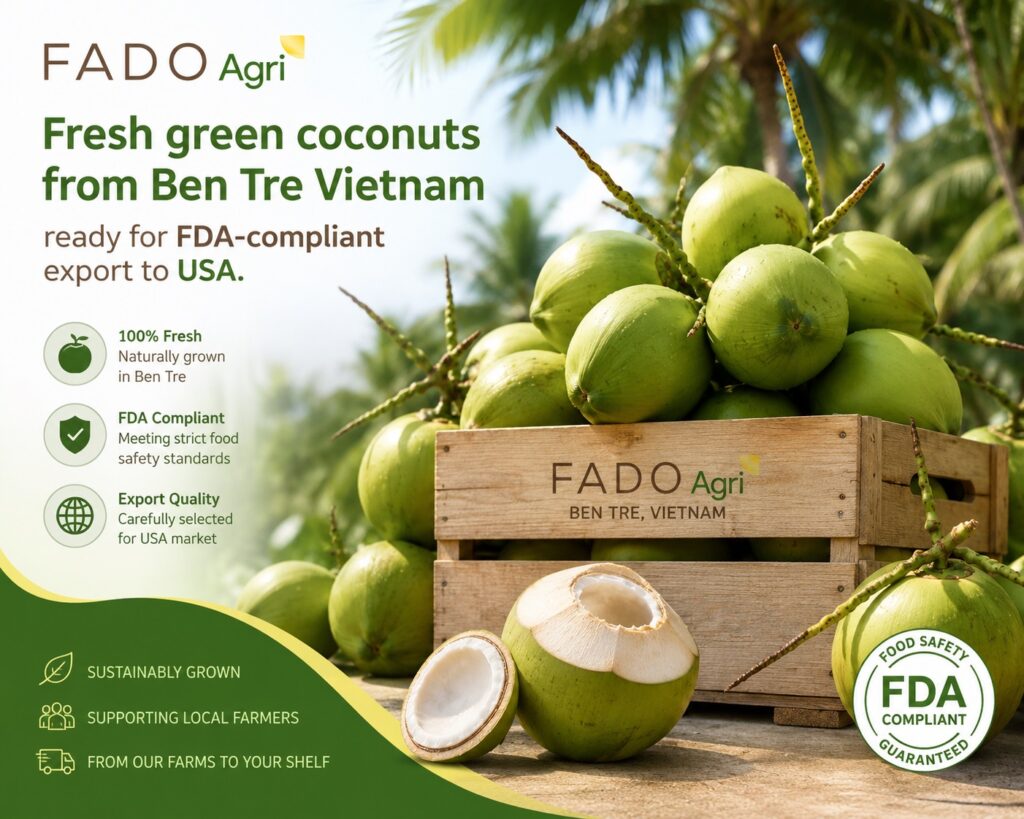
Vietnam exports over one billion fresh coconuts annually and demand from the United States is accelerating faster than most supply chains are prepared to meet. For B2B importers bringing Vietnam coconut to USA, the challenge is rarely finding a supplier; it’s finding one that can consistently deliver FDA-registered, properly documented, cold-chain-maintained product at commercial scale. Fado Agri, established in 2016 and operating 500+ containers per year across 10+ internationally certified markets, is built specifically for that standard. This article breaks down exactly what FDA-compliant coconut export from Vietnam to the US looks like, from sourcing in Ben Tre’s growing zones to arrival at a US port of entry.
1. What Makes Vietnam the Right Source for Coconuts Destined for the US Market
Vietnam’s coconut industry is concentrated in two provinces that together define the country’s export quality: Ben Tre and Tien Giang. These are not simply farming regions, they are specialized growing zones where soil composition, humidity, and harvest timing converge to produce coconuts with consistent water content, flesh density, and shelf life. For US importers, that consistency is non-negotiable.
1.1 Ben Tre and Tien Giang: Vietnam’s Premium Coconut Belts
Ben Tre alone accounts for the majority of Vietnam’s fresh coconut output for export. Fado Agri sources exclusively from certified farms in Ben Tre and Tien Giang, where harvest is chemical-free and quality control begins in the field, not the factory. Farmers are trained to select by hand: size, shell integrity, and water sound are evaluated before a coconut ever reaches a collection point.
This upstream quality discipline is what allows Fado Agri to commit to the lead times and compliance documentation that US buyers require. A minimum lead time of 5 days for fresh coconut is not an estimate, it is a supply chain commitment grounded in controlled sourcing.
1.2 Six Cut Types Designed for US Retail and Distribution
US retail and foodservice buyers source coconuts for different end uses, from fresh beverage counters to grocery displays to wholesale distribution. Fado Agri produces fresh coconut in six standardized cut formats to meet each segment’s needs:
- Conical Peeling, clean visual presentation for retail shelf display
- Whole, minimal processing, maximum shelf life, suited for traditional markets
- Diamond Cut, distinctive faceted finish for premium fresh produce sections
- Easy Open, scored for consumer convenience at point of sale
- Bald, fully peeled, compact, optimized for cold chain and freight efficiency
- Lid On, pre-cut top for immediate drinking, popular in foodservice and hospitality supply
Each format is produced under GLOBALG.A.P and HACCP-certified conditions and is available with OEM/ODM packaging to carry a distributor’s private label.
Read more: Breaking Down Vietnam’s Coconut Export Requirements: From Safety to Certification
2. Vietnam Coconut to USA: FDA Compliance Requirements Explained
Exporting Vietnam coconut to USA means operating under two intersecting regulatory frameworks: the US Food and Drug Administration (FDA) and the USDA/APHIS phytosanitary inspection system. Buyers often ask whether Vietnamese coconuts can enter the US without irradiation treatment and the short answer is yes, provided the exporter maintains the correct documentation and facility registrations. The longer answer is what separates compliant suppliers from risky ones.
2.1 Key FDA Requirements for Importing Fresh Coconuts into the US
Fresh coconut imported into the United States must satisfy the following requirements:
- FDA Facility Registration, the exporting facility must be registered with the FDA under the Bioterrorism Act (21 CFR Part 1, Subpart H). Registration must be renewed biennially.
- Prior Notice, all food shipments to the US require prior notice submission to the FDA before the product arrives at the US port of entry.
- FSMA Compliance, under the Food Safety Modernization Act (FSMA), foreign suppliers must meet the Foreign Supplier Verification Program (FSVP) standards. US importers bear responsibility for verifying their supplier’s compliance.
- Phytosanitary Certificate, issued by Vietnam’s Plant Protection Department (PPD), confirming the product is free from pests and diseases.
- Certificate of Origin (CO), required for customs clearance and tariff classification under the Harmonized Tariff Schedule (HTS).
- Commercial Invoice and Bill of Lading (B/L), standard trade documents that must accurately reflect product description, weight, and HS code.
2.2 How Fado Agri Ensures Full FDA Readiness
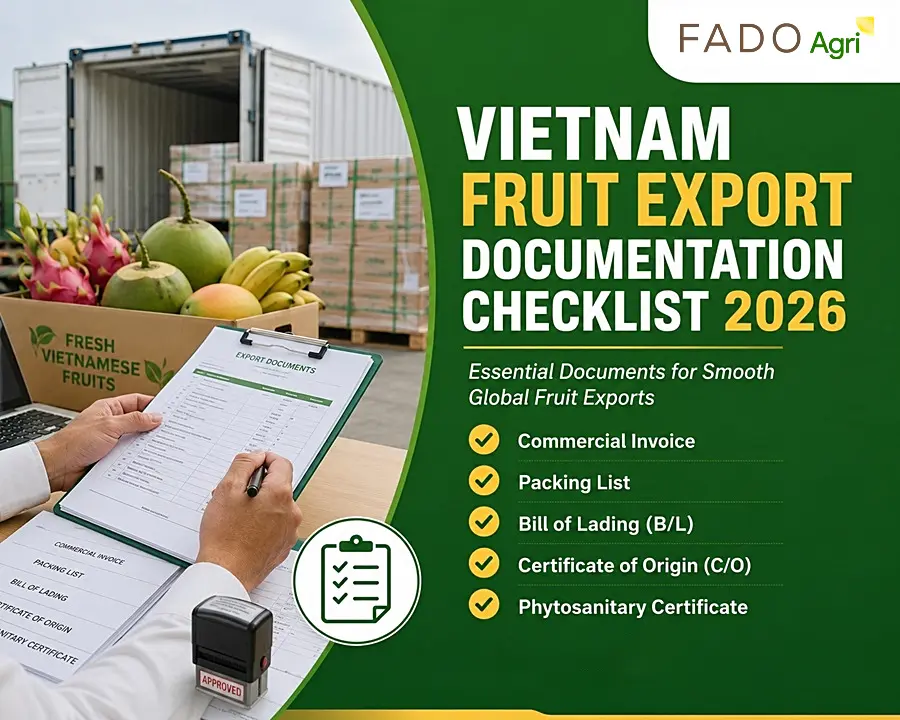
Fado Agri holds active FDA registration and operates under HACCP-certified food safety management systems across its processing facilities. Every export shipment is accompanied by a full documentation package: Phytosanitary Certificate, CO, B/L, Commercial Invoice, Packing List, and Prior Notice confirmation reference. Buyers do not need to chase paperwork, it is prepared as a standard deliverable for every container.
Fado Agri’s compliance posture is built on the principle that transparent at every stage is not a marketing phrase, it is an operational standard. US importers who have previously experienced customs holds due to missing or incorrect documentation consistently identify documentation readiness as a key reason they switch suppliers.
3. The 10-Step Supply Chain: Farm to US Port of Entry
Fado Agri operates a documented 10-step supply chain process that gives B2B buyers full traceability from harvest point to container loading. For US importers subject to FSVP requirements, this traceability is not optional, it is a compliance asset.
3.1 Traceability Starts at the Farm, Not the Factory
The 10-step process begins with farm selection and certification (Step 1) and raw material inspection at the growing zone (Step 2). Fado Agri works with 20 strategic farming partners across Ben Tre and Tien Giang, each operating under GLOBALG.A.P guidelines. Field-level records, harvest date, farm ID, chemical use log, are maintained and available to buyers on request.
Steps 3 through 6 cover collection, transport to the processing facility, factory-level quality inspection, and cutting/processing to the specified format. Each batch is labeled with a traceable lot code that links back to the originating farm record.
3.2 Cold Chain and Packaging Standards for the US Market
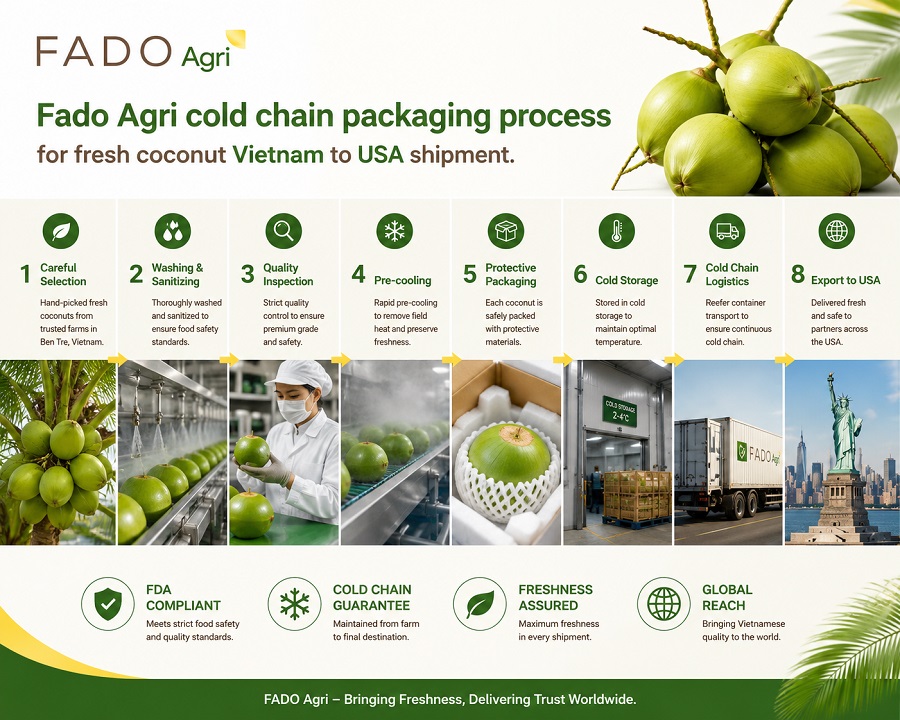
Fresh coconuts destined for the US market require cold chain management from post-harvest through container loading. Fado Agri’s process (Steps 7-10) covers:
- Pre-cooling and cold storage at the facility before packaging
- Export packaging in cartons or mesh bags per buyer specification, with moisture-resistant lining where required
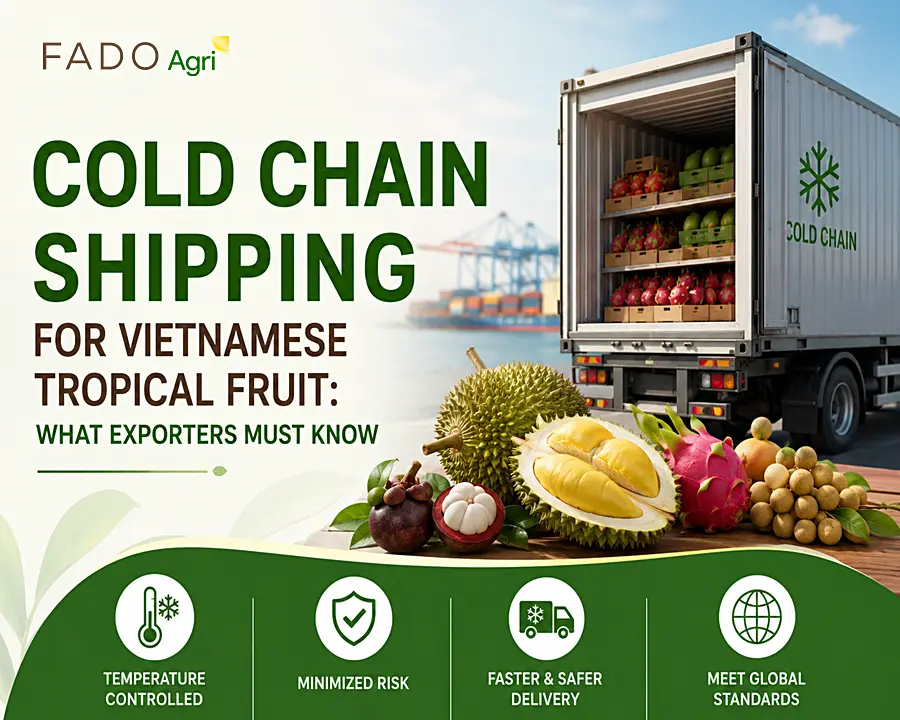
- Container loading under controlled temperature, reefer containers for fresh coconut shipments are standard
- Container sealing and document finalization, including phytosanitary inspection sign-off before the container departs the facility
Average stable supply readiness runs at 2-3 days per container for planned shipments, with a minimum of 5 days for fresh coconut from order confirmation to container handover.
4. Logistics and Lead Times: What US Importers Need to Know
4.1 Shipping Terms, Ports, and Transit Considerations
Fado Agri offers both FOB (Free on Board) and CIF (Cost, Insurance, and Freight) terms for US-bound shipments. FOB is the more common arrangement for established import relationships; CIF is available for buyers who prefer Fado Agri to manage freight and marine insurance to the US destination port.
Primary loading port is Ho Chi Minh City (HCMC/Saigon Port), with connections to US ports including Los Angeles (LA/LB), Seattle, and the East Coast via transhipment. Transit times from HCMC to the US West Coast average 14-18 days under current shipping schedules; East Coast routes via the Panama Canal typically run 25-30 days.
4.2 OEM/ODM Packaging for US Importers
US importers supplying supermarket chains or wholesale networks often require private-label packaging. Fado Agri’s OEM/ODM capability allows buyers to specify: carton design and labeling, country-of-origin text placement (compliant with US labeling regulations), net weight declaration in US customary and metric units, and barcode/PLU sticker integration.
Packaging specifications are confirmed during the sample approval stage, before bulk production begins. This eliminates last-minute label compliance issues at the US customs checkpoint, a problem that disproportionately affects buyers working with exporters who lack in-house packaging control.
Read more: Why Vietnamese Fresh Coconuts Are Dominating Global Markets in 2026
5. Frequently Asked Questions: Importing Vietnam Coconuts to the USA
Does fresh coconut from Vietnam require irradiation to enter the US?
No. Fresh whole coconuts from Vietnam are not currently on the USDA/APHIS mandatory irradiation list for US entry. They do require a valid Phytosanitary Certificate and must comply with FDA Prior Notice requirements. Buyers should confirm current APHIS pest risk review status with their licensed customs broker before each shipment.
What certifications should I verify when sourcing Vietnam coconut for the US market?
At minimum, verify that your supplier holds active FDA facility registration, HACCP-certified processing, and can provide GLOBALG.A.P farm-level certification. Fado Agri holds all three and provides documentation copies upon request.
What is the minimum order quantity (MOQ) for fresh coconut shipments to the US?
Fado Agri’s standard shipment unit is one 40-foot reefer container. Volume and frequency commitments are discussed during the initial buyer qualification process. OEM packaging orders may carry additional lead time for print production.
How does Fado Agri handle FSMA Foreign Supplier Verification Program (FSVP) requirements?
Fado Agri supports US importer FSVP compliance by providing full supplier documentation: facility registration certificate, HACCP plan summary, food safety audit records, farm certification copies, and historical inspection records. This documentation package is maintained and updated annually.
Can Fado Agri supply multiple coconut cut types in the same container?
Yes. Mixed-format containers are available for buyers testing multiple SKUs or supplying diverse retail channels. Carton-level segregation and labeling ensure accurate inventory management upon arrival at the US distribution center.
What shipping terms does Fado Agri offer for US-bound coconut shipments?
Both FOB and CIF terms are available. FOB (Ho Chi Minh City) is the standard for experienced importers managing their own freight. CIF is offered to buyers who prefer end-to-end Fado Agri logistics management, including marine cargo insurance to the US named port.
Closing: A Supplier Built for the US Standard
The US fresh produce market does not allow for compliance shortcuts. From FDA Prior Notice to FSMA FSVP documentation, every step of the import process carries real liability for the buyer and that liability starts with the supplier they choose. Fado Agri was built to absorb that compliance burden on behalf of its partners, with 10+ years of export experience, 500+ containers per year, and a transparent 10-step supply chain that holds up at every checkpoint.
If you are evaluating suppliers to move Vietnam coconut to USA at commercial scale, with consistent quality, verified FDA compliance, and the flexibility of OEM/ODM packaging, Fado Agri is ready to begin the conversation.
Contact Fado Agri:
- Hotline: (+84) 908 479 339
- Email: [email protected]
- Website: fadoagri.com
Rooted in the land, rigorous in standards – from Vietnam’s growing regions to the world’s demanding markets.