
When a fresh coconut reaches supermarket shelves in Dubai, Tokyo, or Sydney, what stands behind it is more than a supply chain, it is a structured system of export requirements that must be met at every stage. From farm-level practices to processing, documentation, and final shipment, each step is governed by strict international standards designed to ensure food safety, traceability, and regulatory compliance. “Breaking Down Vietnam’s Coconut Export Requirements” is not about listing certifications alone, but about understanding how safety protocols, quality controls, and compliance frameworks work together to make global trade possible.
At Fado Agri, established in 2016 and now exporting over 500 containers of fresh coconuts annually to more than 10 certified international markets, these requirements are not treated as formalities. They form the operational backbone of our supply chain, ensuring consistency, reliability, and long-term trust with every partner we serve.
1. Why Certifications Matter More Than Price in Coconut Export
Buyers in the UAE, Japan, South Korea, and the United States consistently tell us the same thing: price gets you a conversation, but documentation gets you through customs.
For fresh coconuts, a perishable product with a tight post-harvest window, a rejected shipment at port isn’t just a financial loss. It damages supplier relationships, disrupts downstream retail supply chains, and creates regulatory flags that affect future import approvals.
International food safety certifications serve three critical functions for coconut importers:
- Regulatory clearance, Certifications like FDA registration ensure shipments are pre-cleared in destination markets with documented compliance.
- Risk mitigation, Standards like HACCP systematically identify and control biological, chemical, and physical hazards before the product leaves the factory.
- Traceability, Programs like GLOBALG.A.P link every shipment to a specific farm, growing practice, and harvest record, the kind of documentation that increasingly defines “trusted supplier” status for global retailers.
Understanding which certification does what, and demanding all three from your supplier, is the difference between a smooth import operation and a costly compliance failure.
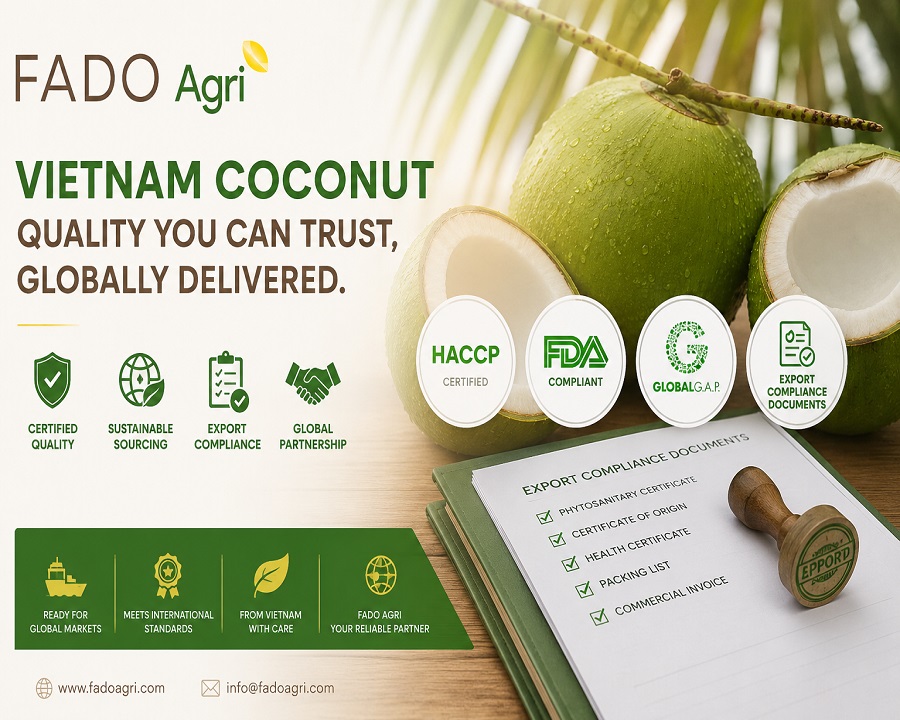
Vietnam coconut certifications HACCP FDA GLOBALG.A.P export compliance documents Fado Agri.
Read more: Why Vietnamese Fresh Coconuts Are Dominating Global Markets in 2026
2. Breaking Down Vietnam’s Coconut Export Requirements: The Three Core Standards
2.1 HACCP – Hazard Analysis and Critical Control Points
What it is: HACCP is an internationally recognized food safety management system that identifies potential hazards in the production process and establishes critical control points (CCPs) where those hazards must be prevented, eliminated, or reduced to an acceptable level.
For fresh coconut processing, HACCP covers:
- Biological hazards: microbial contamination during peeling, cutting, and washing
- Chemical hazards: residual pesticides, cleaning agent contamination, and water quality used in processing
- Physical hazards: foreign material (shell fragments, metal particles) from cutting equipment
What HACCP looks like on the factory floor at Fado Agri:
Our processing facilities apply HACCP protocols at every stage of the coconut’s journey through the factory – from the receiving dock where incoming fruit is inspected and temperature-logged, through the peeling and cutting stations where equipment is sanitized between shifts, to the cold chain holding area where pre-export coconuts are stored at controlled temperatures. Every CCP is monitored, every deviation is documented, and every corrective action is recorded.
HACCP is not a certification you earn once. It requires continuous monitoring, internal audits, and a documented management system that regulators and buyers can review at any time.
2.2 FDA Registration – U.S. Food and Drug Administration Compliance
What it is: Under the U.S. Food Safety Modernization Act (FSMA), all food facilities that manufacture, process, pack, or hold food intended for consumption in the United States must register with the FDA. This registration is renewed every two years and can be suspended if a facility is found to pose a serious risk to public health.
For coconut exporters, FDA registration signals:
- The facility operates under Current Good Manufacturing Practices (cGMP)
- The exporter has a verified U.S. Agent and a documented food safety plan
- The facility is subject to potential FDA inspection, meaning it is built to withstand scrutiny, not just pass paperwork
Why this matters beyond the U.S. market:
Many buyers in the Middle East, Australia, and Asia-Pacific explicitly require FDA-registered suppliers, even when the product is not destined for the U.S. FDA registration has become a global proxy for manufacturing rigor.
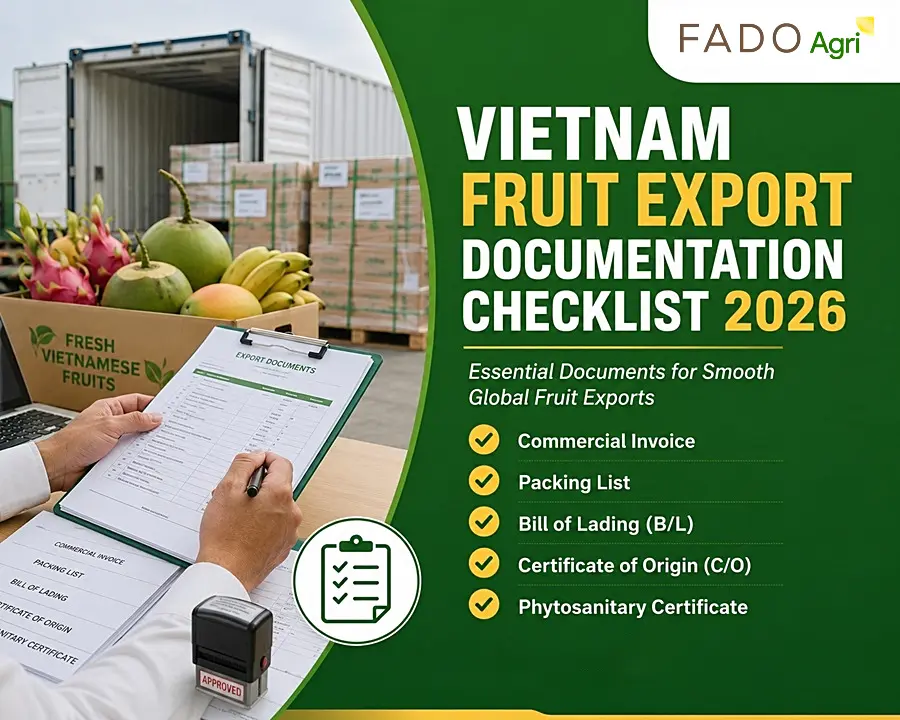
At Fado Agri, our FDA registration is current and publicly verifiable. We include the facility registration number in our export documentation packages alongside our Bill of Lading (B/L), Certificate of Origin (CO), and Phytosanitary Certificate, giving our buyers complete, audit-ready compliance files for every shipment.
2.3 GLOBALG.A.P – Farm-Level Certification
What it is: GLOBALG.A.P (Good Agricultural Practices) is a private-sector body that sets voluntary standards for the certification of agricultural products around the world. Unlike HACCP and FDA, which focus primarily on processing and manufacturing, GLOBALG.A.P operates at the farm level, certifying that the growing, harvesting, and post-harvest handling of crops meet internationally recognized benchmarks for food safety, environmental sustainability, and worker welfare.
For coconut farming in Vietnam, GLOBALG.A.P certification covers:
- Soil and water management: restrictions on synthetic chemical use, irrigation water quality testing
- Integrated Pest Management (IPM): protocols for pest control that minimize chemical residues on harvested fruit
- Harvest and post-harvest handling: hygiene practices, traceability documentation, and cold chain initiation at the field level
- Worker health, safety, and welfare: legally compliant labor practices across the farm operation
The traceability advantage:
GLOBALG.A.P certification creates a documented chain of custody that begins in the growing field , not the factory gate. For importers whose retail customers are demanding farm-to-shelf transparency, this is no longer a “nice to have.” It is a listing requirement with an increasing number of European and Asian supermarket chains.
Fado Agri sources fresh coconuts from GLOBALG.A.P-certified farms in Ben Tre and Tien Giang, Vietnam’s two primary coconut-producing provinces, where the fruit is grown in alluvial soil conditions along the Mekong Delta river system. Our sourcing relationships with these farms include direct farm visits, pre-harvest quality assessments, and chemical-free harvest protocols that begin in the field.
3. Supporting Documentation That Completes the Compliance Package
Certifications set the standard. Export documentation proves the standard has been met, for each specific shipment.
3.1 Phytosanitary Certificate
Issued by Vietnam’s Plant Protection Department, this government-verified document confirms that the exported coconuts have been inspected and are free from pests and diseases that could harm the agriculture of the destination country. Required by virtually all import markets.
3.2 Certificate of Origin (CO)
Confirms that the product originates from Vietnam, which may entitle buyers to preferential tariff rates under bilateral or multilateral trade agreements (e.g., ASEAN FTA, VIFTA, CEPA with the UAE).
3.3 Health Certificate
Issued by the relevant Vietnamese authority, confirming the product is fit for human consumption and complies with the food safety regulations of the destination market.
3.4 Cold Chain and Temperature Records
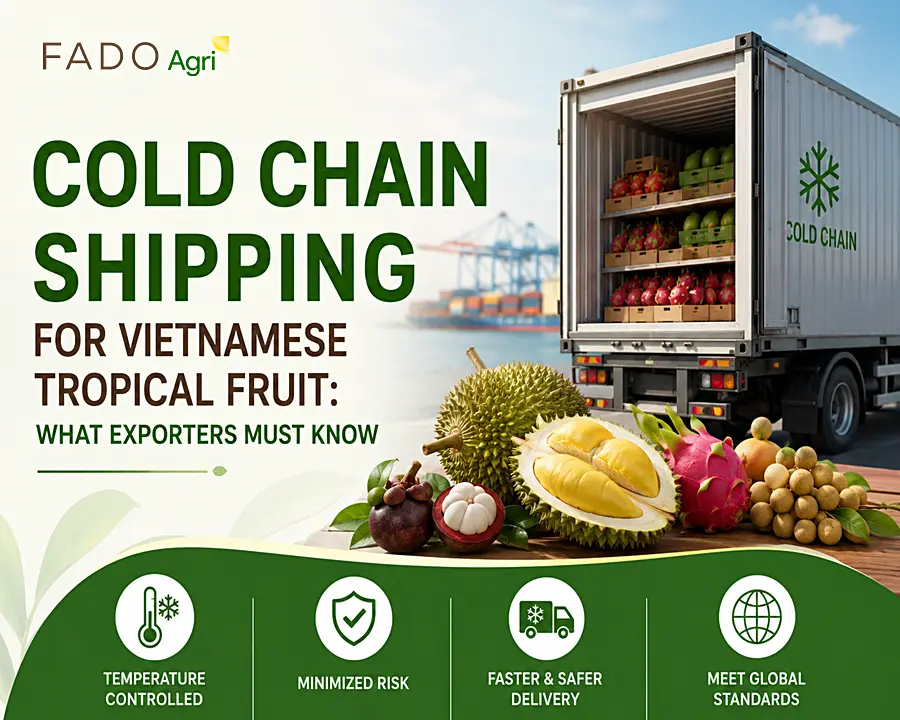
For fresh coconuts shipped under refrigerated conditions, temperature logs from the processing facility through to the reefer container are a compliance requirement in markets including Japan, South Korea, and Australia. Fado Agri provides these records as standard documentation on all temperature-sensitive shipments.
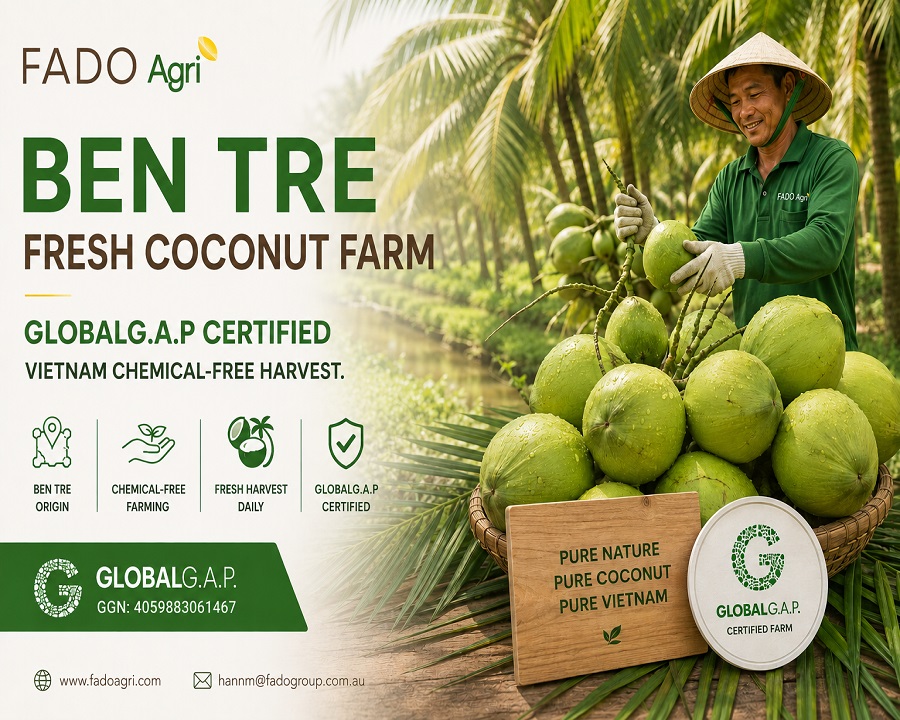
Ben Tre fresh coconut farm GLOBALG.A.P certified Vietnam chemical-free harvest.
Read more: Vietnam Coconut Exporter to UAE: Shipping, Documentation & Distribution
4. How Fado Agri Structures the Full Compliance Package for Importers
Buyers often ask whether they need to manage documentation collection themselves. With Fado Agri, the answer is no.
Our export operations team prepares a complete, shipment-specific compliance file for every order, including:
- HACCP certification documentation (facility-level)
- FDA facility registration confirmation
- GLOBALG.A.P farm certification records (linked to the specific sourcing farms for that order)
- Phytosanitary Certificate (issued per shipment by Vietnamese authorities)
- Certificate of Origin (Form D, Form AI, or applicable format for destination market)
- Health Certificate
- Bill of Lading and Packing List
- Temperature and cold chain records (where applicable)
- Product specification sheet (weight, cut type, size grade, packaging)
- OEM/ODM packaging documentation (where applicable)
This 10-point compliance package is designed to pass customs clearance in our established markets, the Middle East (UAE, Saudi Arabia, Kuwait), Japan, South Korea, China, Malaysia, Australia, India, and the United States, without importer-side chasing or gaps.
Shipments can be arranged on FOB or CIF terms, with stable lead times of minimum 5 days for fresh coconut and an average container readiness of 2-3 days under our standard supply schedule.
5. Frequently Asked Questions
Do all Vietnamese coconut exporters hold HACCP, FDA, and GLOBALG.A.P certifications?
No. These three certifications represent a meaningful compliance investment that many smaller or mid-tier Vietnamese exporters have not made. Buyers should request copies of current certification documents, not just claims, and verify registration numbers directly with the issuing bodies before committing to a supplier.
Is GLOBALG.A.P certification required for exporting fresh coconuts to Europe?
GLOBALG.A.P is not a legal requirement for European market access, but it is increasingly a de facto commercial requirement. Most major European retail chains, and many distributors supplying them, require GLOBALG.A.P certification as a supplier listing prerequisite. For exporters targeting European markets, the certification is effectively mandatory.
How often are HACCP certifications renewed?
HACCP certification is typically audited annually by an accredited third-party certification body. Between audits, facilities are expected to maintain continuous internal monitoring, corrective action records, and management system documentation. A current HACCP certificate with a valid audit date is the minimum buyers should accept.
What is the difference between an FDA-registered facility and an FDA-approved facility?
The FDA does not “approve” food facilities. Registration with the FDA means the facility has submitted the required information to the FDA and is subject to inspection. Buyers sometimes misread “registered” as a lower standard, in practice, FDA registration plus HACCP is the standard compliance baseline for export to the U.S. and many other markets.
Can Fado Agri provide OEM-packaged coconuts with private labels while maintaining full certification compliance?
Yes. Fado Agri’s OEM and ODM packaging services are fully integrated into our certified production workflow. Certification compliance is maintained regardless of the packaging format, private label products carry the same HACCP, FDA, and GLOBALG.A.P-backed supply chain as our standard export products.
Which coconut cut types does Fado Agri export, and are all formats covered by the same certifications?
Fado Agri exports fresh coconuts in six cut formats: Conical Peeling, Whole, Diamond Cut, Easy Open, Bald, and Lid On. All six formats are produced within the same HACCP-controlled, FDA-registered processing facility and sourced from the same GLOBALG.A.P-certified farms in Ben Tre and Tien Giang. Certification coverage is not format-specific, it is facility and supply chain-wide.
How can I verify Fado Agri’s certifications before placing an order?
All certification documentation is available on request during the buyer onboarding process. FDA facility registration can be independently verified through the FDA’s public database. GLOBALG.A.P certificates include a unique Certificate of Conformance number verifiable through the GLOBALG.A.P database. We encourage buyers to verify, it is how trust is built correctly.
Conclusion
Breaking Down Vietnam’s Coconut Export Requirements is ultimately a story about accountability, the kind that can be documented, verified, and relied upon across thousands of kilometers of supply chain. HACCP controls the process. FDA registration confirms the facility. GLOBALG.A.P traces the farm. And together, they create the compliance foundation that serious importers require and that global retail increasingly demands.
At Fado Agri, rooted in the land and rigorous in standards, we have built our entire operation around this accountability framework, so that when your shipment clears customs in Dubai, Osaka, or Sydney, the certification behind it is not just a document. It is a promise kept, from Ben Tre’s coconut groves to your final destination.
To request our full certification documentation pack or discuss import requirements for your market, contact our team directly:
📞 Hotline: (+84) 908 479 339
✉️ Email: [email protected]
🌐 Website: fadoagri.com