Vietnam ships over 1.3 billion fresh coconuts per year. Behind that number is an industrial infrastructure, processing factories, cold chains, certification systems, and OEM/ODM capabilities, that most importers never see. If you are a distributor, retail chain, or brand owner looking to launch your own coconut label, private label coconut manufacturing in Vietnam gives you one of the most cost-effective, quality-assured entry points in the global market today.
This guide walks you through how the process actually works: from sourcing in Ben Tre and Tien Giang, through factory processing and custom packaging, to export-ready shipment under your brand name.
1. What Is Private Label Coconut Manufacturing?
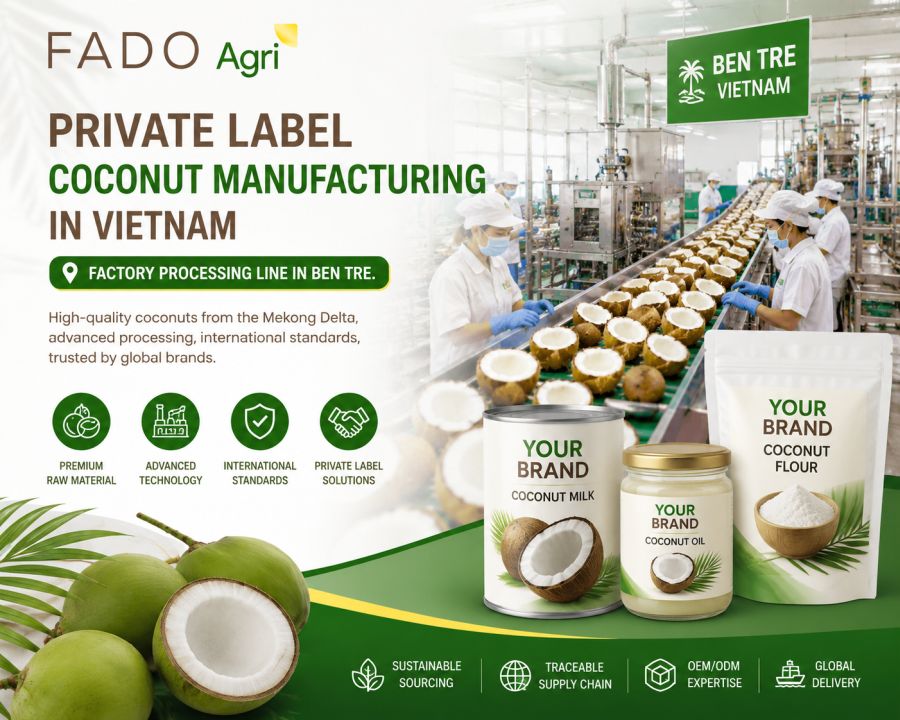
Private label coconut manufacturing means a buyer commissions a Vietnamese manufacturer to produce, process, and package coconut products, fresh, processed, or by-product, under the buyer’s own brand identity. The manufacturer handles everything from raw material sourcing and quality control to packaging design execution and export documentation. The buyer owns the brand; the manufacturer owns the process.
This model is widely used across the coconut value chain, covering:
- Fresh coconuts, branded in custom mesh bags, carton boxes, or retail-ready sleeves
- Coconut water, bottled or tetra-packed under a private label
- Desiccated coconut, coconut milk, coconut cream, bulk or retail packaging
- Coconut by-products, coir fiber, coconut shell charcoal, coconut oil, under OEM specifications
In Vietnam’s context, OEM (Original Equipment Manufacturer) and ODM (Original Design Manufacturer) are both available. OEM means you provide the design and the factory executes it. ODM means the manufacturer also helps develop the packaging format and product specification, useful for buyers entering the category for the first time.
Read more: HACCP & FDA Compliance for Vietnam Coconut Exports
2. Why Vietnam and Specifically Ben Tre and Tien Giang?
Vietnam’s coconut belt is concentrated in two provinces: Ben Tre and Tien Giang in the Mekong Delta. These are not interchangeable with other Southeast Asian origins. The combination of alluvial soil, tropical humidity, and multi-generational farming expertise produces coconuts with a distinctive flavor profile, sweeter water, thicker flesh, higher natural sugar content, that export markets actively request.
2.1 Scale and consistency
Ben Tre alone accounts for over 40% of Vietnam’s total coconut output. The density of growers in this region means manufacturers like Fado Agri can source across hundreds of farms within a short radius, maintaining supply consistency even during seasonal fluctuations. Fado Agri exports 500+ containers per year, supported by an average processing cycle of 2–3 days per container for stable supply categories.
2.2 Regulatory readiness
Vietnamese coconut manufacturers operating at export scale maintain certifications that matter at the customs level: FDA (United States Food and Drug Administration), GLOBALG.A.P (farm-level agricultural practice certification), and HACCP (Hazard Analysis Critical Control Points for food safety). These certifications are not just compliance checkboxes, they are what make a private label product sellable in supermarket chains in the UAE, Japan, South Korea, the United States, and Australia.
2.3 Cost structure
Labor, logistics, and raw material costs in Vietnam remain competitive relative to Thailand and the Philippines. For a brand owner calculating landed cost per unit, this translates to a higher margin when the product hits retail shelves, without compromising on the certification standards that premium markets demand.
3. Private Label Coconut Manufacturing in Vietnam: How the Process Works Step by Step
Understanding the production workflow helps buyers set realistic timelines, ask the right questions, and avoid common sourcing mistakes. Here is how Fado Agri structures its OEM/ODM process from first inquiry to shipment.
3.1 Initial brief and specification alignment
The buyer submits a product brief: target market, SKU format (retail unit size, carton configuration), brand assets (logo files, Pantone colors, label dimensions), and compliance requirements (FDA, EU, GCC, etc.). Fado Agri’s team reviews these against current factory capabilities and certifications, then confirms feasibility with a formal quotation.
3.2 Sourcing and farm-level selection
Raw materials are sourced from Fado Agri’s network of contracted farms in Ben Tre and Tien Giang. Farm-level quality control begins here: coconuts are selected by maturity, size, and weight. Chemical-free harvest practices are standard across Fado Agri’s supply base, quality control begins in the field, not the factory.
3.3 Factory intake and grading
Coconuts arriving at the processing facility go through a multi-stage intake process: visual inspection, weight grading, and pathogen screening aligned with HACCP protocols. Reject rates at this stage are tracked and reported, buyers with audit requirements can request this data.
3.4 Processing and cut format execution
For fresh coconuts, Fado Agri produces six cut formats: Conical Peeling, Whole, Diamond Cut, Easy Open, Bald, and Lid On. Each format serves a different end-use, foodservice, retail, juice bar, or hotel hospitality. The buyer selects the format that matches their channel. For processed by-products (desiccated coconut, coconut water, coconut oil), processing follows product-specific HACCP protocols.
3.5 Private label packaging execution
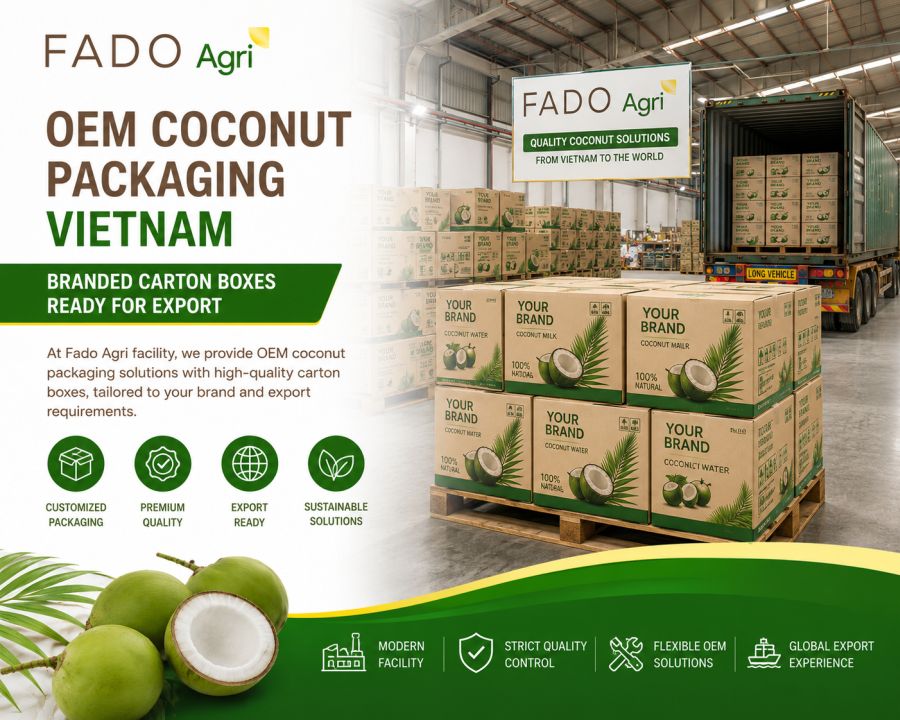
This is where your brand comes to life. Packaging materials are sourced to the buyer’s specification, carton print, bag type, label material, retail-ready display configuration. Fado Agri coordinates with approved packaging suppliers to execute artwork across production runs. Pre-production samples are sent for buyer approval before any full run begins.
3.6 Quality inspection and documentation
Before loading, every shipment undergoes a final quality check. Export documentation is prepared in parallel: Phytosanitary Certificate, Certificate of Origin (CO), Bill of Lading (B/L), commercial invoice, and packing list. Buyers requiring third-party inspection (SGS, Intertek) can arrange this at the pre-loading stage.
3.7 Export on FOB or CIF terms
Fado Agri ships on both FOB (buyer arranges freight from Vietnamese port) and CIF (Fado Agri arranges freight and insurance to destination port) terms. Lead time for fresh coconut private label orders is a minimum of 5 days from order confirmation. Lime and dragon fruit OEM orders run 4–5 days.
4. What to Look for in a Private Label Coconut Manufacturer in Vietnam
Buyers often ask how to evaluate a manufacturer before committing. The answer is not a checklist of vague promises. it is specific, verifiable criteria:
Certifications on file. Request current FDA, GLOBALG.A.P, and HACCP certificates. Check issue dates and covered product categories. A certificate that only covers desiccated coconut does not automatically apply to fresh coconut exports.
Volume track record, A manufacturer exporting 500+ containers per year has systems: procurement networks, cold chain protocols, and documentation processes that a smaller operator does not. Ask for annual export volume as a qualifying question.
OEM/ODM experience, Ask to see samples of previous private label work. This reveals packaging quality, print accuracy, and the manufacturer’s ability to execute a brand identity precisely.
Market access, A manufacturer already shipping to your target market has cleared that country’s import requirements before. Fado Agri ships to 10+ internationally certified markets including the UAE, Saudi Arabia, Kuwait, Japan, South Korea, Malaysia, China, India, Australia, and the United States.
Communication and account management, Private label relationships require responsive, bilingual coordination. Fado Agri operates with a team of 150 global staff across offices in Vietnam, UAE (Ajman), Malaysia (Penang), and Australia (NSW), meaning local support is available in the same time zone as your business.
Read more: GLOBALG.A.P Certified Vietnam Coconut: What It Means for Importers
5. Common Questions Buyers Ask Before Starting a Private Label Coconut Program
Is there a minimum order quantity (MOQ) for private label?
MOQ depends on the product format and packaging specification. For fresh coconuts, Fado Agri works with importers on a per-container basis, typically a 20-foot or 40-foot container. Contact Fado Agri directly at [email protected] to discuss your volume and timeline.
Can I use my own packaging design?
Yes. OEM means your brand, our supply chain. Buyers supply print-ready artwork files; Fado Agri’s team reviews for production compatibility and coordinates with approved packaging suppliers for execution. Pre-production samples are standard before any full run.
What certifications will appear on my private label product?
Products are manufactured under Fado Agri’s FDA, GLOBALG.A.P, and HACCP certifications. Export documentation including Phytosanitary Certificate and Certificate of Origin is issued per shipment. Buyers whose target market requires additional certifications (organic, Halal, etc.) should raise this in the initial brief.
How long does the first private label order take?
For fresh coconuts, the minimum lead time is 5 days from order confirmation for the production and packing stage. First-time orders with custom packaging require additional lead time for packaging procurement and pre-production sample approval, typically 2–3 weeks total for the first run.
Does Fado Agri also handle processed coconut products under private label?
Yes. In addition to fresh coconuts, Fado Agri offers private label for coconut by-products including desiccated coconut, coconut oil, coir fiber, and coconut shell charcoal. Specifications and lead times vary by product, contact the team for a product-specific brief.
Which markets does Fado Agri currently export private label products to?
Fado Agri ships private label and OEM orders to buyers in the Middle East (UAE, Saudi Arabia, Kuwait), Asia-Pacific (Japan, South Korea, Malaysia, China), and Western markets (USA, Australia, India). All export destinations are served with full documentation compliance.
Build Your Coconut Brand with a Partner Who Knows the Process
Private label coconut manufacturing in Vietnam is not simply a matter of finding a factory and printing a logo on a box. It requires a manufacturer with the farm network to guarantee raw material consistency, the certification infrastructure to clear customs in demanding markets, and the account management capability to execute your brand identity accurately across every production run.
Fado Agri has been building this infrastructure since 2016. With 500+ containers exported annually, 20 strategic partners worldwide, and offices in Vietnam, the UAE, Malaysia, and Australia, we work with importers who need more than a supplier, they need a partner who is transparent at every stage, from Ben Tre’s coconut groves to the final destination port.
If you are ready to explore a private label coconut program, reach out to the Fado Agri team directly:
- Hotline: (+84) 908 479 339
- Email: [email protected]
- Website: www.fadoagri.com