

Coconut is one of Vietnam’s most regulated and most demanded agricultural exports and for good reason. Importers in the United States, Japan, Australia, and the Middle East are not simply buying fresh fruit; they are accepting legal responsibility for the safety of every product that crosses their border. That responsibility begins long before the shipment arrives. HACCP & FDA Compliance for Vietnam Coconut Exports determines whether a container clears customs in 24 hours or gets detained, sampled, and refused. At Fado Agri, compliance is not a checklist, it is the architecture of our entire supply chain.
1. What Is HACCP & FDA Compliance for Vietnam Coconut Exports?
1.1 Defining HACCP in the Context of Coconut Processing
HACCP stands for Hazard Analysis and Critical Control Points. It is an internationally recognized, science-based food safety management system that identifies potential biological, chemical, and physical hazards at every stage of food production and then establishes critical control points (CCPs) to prevent those hazards before they reach the consumer.
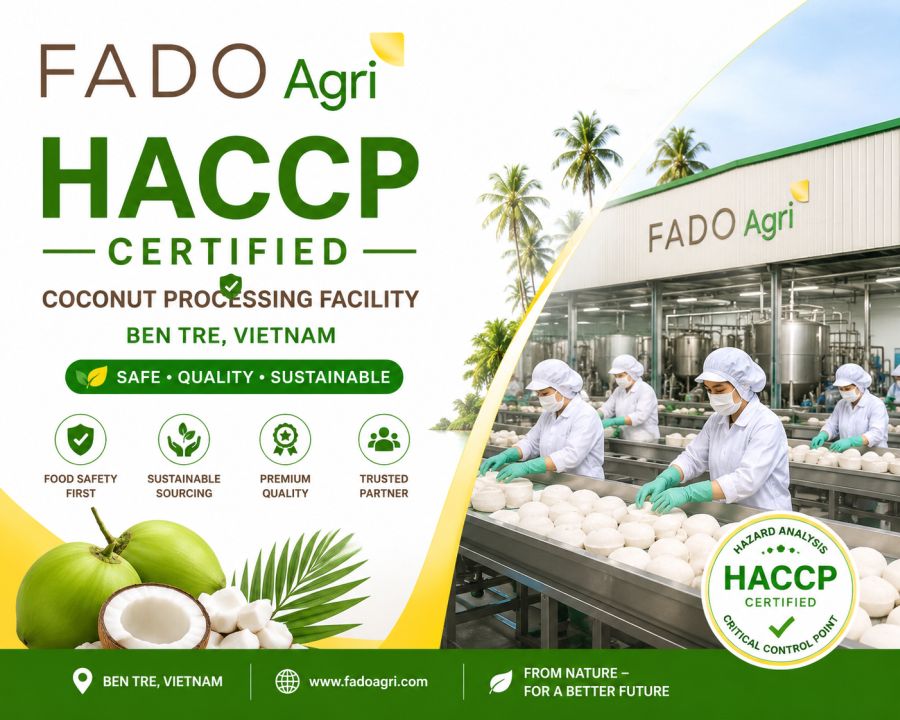
For fresh coconut exports from Vietnam, HACCP applies from the moment fruit is harvested in Ben Tre or Tien Giang to the moment it is loaded onto a refrigerated container. A HACCP-certified coconut processing facility must document every risk (microbial contamination, pesticide residue, physical foreign matter) and demonstrate, with measurable monitoring records, that each risk is controlled. No documentation, no certification. No certification, no access to high-compliance markets.
1.2 FDA Compliance Requirements for Vietnam Coconut Exporters
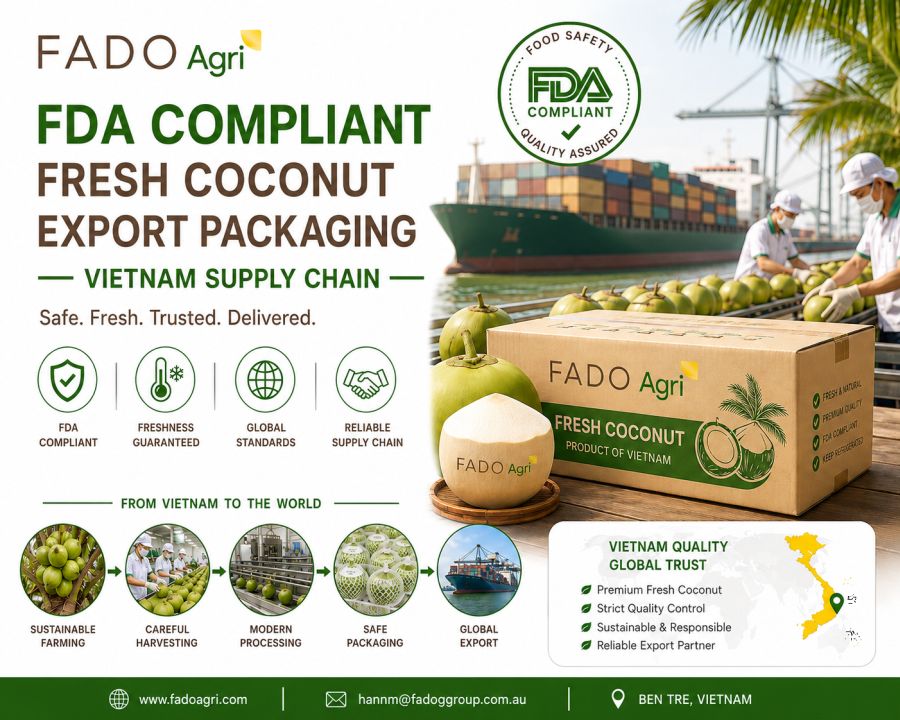
The U.S. Food and Drug Administration (FDA) requires all foreign food facilities exporting to the United States to be registered under the Food Safety Modernization Act (FSMA). This registration must be renewed every two years. Beyond registration, FSMA mandates that suppliers follow Preventive Controls for Human Food rules, which overlap significantly with HACCP principles but add additional requirements around supply chain programs, environmental monitoring, and recall procedures.
For Vietnamese coconut exporters, FDA compliance means:
- FDA Facility Registration, the processing plant must hold an active FDA registration number
- Prior Notice, every US-bound shipment requires electronic prior notice submitted to FDA before arrival
- Preventive Controls Plan, a written food safety plan covering hazard analysis, preventive controls, monitoring, corrective actions, and verification
- Foreign Supplier Verification Program (FSVP), US importers must verify that their Vietnamese supplier meets FDA standards; a compliant supplier makes this process significantly simpler
- Accurate Labeling, all packaging must meet FDA labeling requirements, including country of origin, net weight, and applicable allergen declarations
Buyers often ask whether HACCP certification automatically satisfies FDA requirements. The answer is: HACCP compliance strongly supports FDA readiness, but they are not identical. A facility can hold HACCP certification and still require additional documentation for FSMA compliance. Fado Agri holds both, which is why our US-bound shipments move through FDA review without recurring holds.
Read more: GLOBALG.A.P Certified Vietnam Coconut: What It Means for Importers
2. Fado Agri’s Compliance Infrastructure: Certified at Every Stage
2.1 Certifications Held
Fado Agri, established in 2016 with 10+ years of export experience, operates with three core certifications across its coconut supply chain:
- FDA Registration (USA), active facility registration enabling direct export to the US market
- HACCP Certification, applied at our processing facilities handling fresh coconut in six cut formats: Conical Peeling, Whole, Diamond Cut, Easy Open, Bald, and Lid On
- GLOBALG.A.P Certification, covers good agricultural practices at farm level, ensuring chemical-free harvest protocols, water management, and traceability back to the growing plot
These are not certificates on a wall. They are verified through annual third-party audits and require continuous documentation across our 10-step supply chain process.
2.2 The 10-Step Supply Chain: Where Compliance Is Built In
Compliance is often treated as a final-stage exercise, a paper check before a shipment leaves. At Fado Agri, compliance is built into every step of the supply chain. Here is how that works in practice:
- Farm Selection & Audit, sourcing partners in Ben Tre and Tien Giang are screened against GLOBALG.A.P standards before any commercial relationship begins
- Pre-Harvest Monitoring, field records track irrigation, fertilizer application, and pest management to rule out chemical residue risk
- Harvest & Primary Sorting, fruit is harvested manually and sorted at the farm gate; damaged or underripe coconuts are rejected before entering the cold chain
- Transport to Processing Facility, temperature-monitored transit to prevent microbial growth during the farm-to-factory leg
- Intake Inspection & HACCP CCP 1, incoming fruit is re-inspected and logged; this is the first documented Critical Control Point
- Processing (Cutting, Trimming, Cleaning), all six cut formats are processed under HACCP-controlled conditions; equipment sanitation logs are maintained
- Microbiological Testing, samples from each batch are tested for E. coli, Salmonella, and yeast/mold counts before packaging approval
- Packaging & Labeling, OEM and ODM packaging is applied with correct FDA-compliant labeling; export lot numbers are assigned for traceability
- Cold Storage & Pre-Shipment Inspection, finished product is held at controlled temperature while phytosanitary inspection and CO (Certificate of Origin) documentation is prepared
- Loading & Export Documentation, FDA Prior Notice is filed; Bill of Lading (B/L), Phytosanitary Certificate, Health Certificate, and Certificate of Origin are compiled for the destination port
This structured, documented process is what allows Fado Agri to export 500+ containers per year across 10+ internationally certified markets with a consistent pass rate at customs.
3. Why HACCP & FDA Compliance Matters for Your Sourcing Decision
3.1 Compliance Protects the Importer
When a US importer brings Vietnamese coconuts into the country, the Foreign Supplier Verification Program (FSVP) places legal responsibility on the importer to verify that their supplier meets FDA standards. Choosing a supplier that already holds FDA registration and HACCP certification is not just a quality preference, it is legal risk management. If a non-compliant shipment is detained at a US port, the importer bears the cost of re-inspection, storage, and potential destruction of goods.
Working with a certified supplier like Fado Agri shifts that burden. Our documentation package, FDA registration, HACCP records, microbiological test results, phytosanitary certificates, and CO, is prepared as a standard deliverable for every export order, not assembled on request.
3.2 What Non-Compliance Looks Like (and Why It Happens)
Many Vietnamese coconut exporters are skilled at growing and processing fruit, but lack the administrative infrastructure to maintain the continuous records that FDA and HACCP certification require. Common failure points include:
- Incomplete pest control logs at the farm level
- Gaps in CCP monitoring records during processing
- Expired FDA facility registrations (must be renewed every two years)
- Labeling that does not meet US FDA requirements for imported fresh produce
- Inability to provide microbiological test results from an accredited laboratory
Any one of these gaps can result in an FDA Import Alert, a public, searchable record that can damage a buyer-supplier relationship and trigger automatic detention of future shipments from the same facility.
3.3 Compliance Across Other Key Markets
The United States is not the only market with strict import requirements. Fado Agri’s export compliance extends across every market we serve:
- Japan & South Korea: Require pesticide residue testing results and phytosanitary certificates aligned with national plant protection standards
- Australia: Biosecurity Act requirements for fresh coconut imports, including mandatory inspection at the border
- UAE & Middle East: Halal certification is not required for fresh coconut, but health certificates from Vietnam’s NAFIQPM (National Agro-Forestry-Fisheries Quality Assurance Department) are standard requirements
- China: GACC (General Administration of Customs China) registration required for the exporting facility
Fado Agri’s global offices in Ajman (UAE), Penang (Malaysia), and New South Wales (Australia) allow us to coordinate compliance documentation with local import authorities, a practical advantage that purely Vietnam-based exporters cannot offer.
Read more: Tien Giang Coconut & Tropical Fruit Region: Sourcing Guide
4. Frequently Asked Questions: HACCP & FDA Compliance for Vietnam Coconut Exports
Does every Vietnamese coconut exporter need to be FDA-registered?
Yes. Any food facility outside the United States that manufactures, processes, packs, or holds food for consumption in the US must be registered with the FDA under the Bioterrorism Act and FSMA. This registration must be renewed every two years during even-numbered years. Importers should verify that their Vietnamese supplier’s FDA registration is current before placing orders destined for the US market.
What documents does an importer need for FDA clearance of Vietnamese fresh coconut?
The standard documentation set for FDA clearance includes: FDA Prior Notice confirmation, Bill of Lading (B/L), Phytosanitary Certificate issued by Vietnam’s PPQS (Plant Protection and Quarantine Service), Certificate of Origin (CO), Commercial Invoice, Packing List, and the supplier’s FDA registration number. Microbiological test results from an accredited laboratory strengthen the clearance file but are not always mandatory unless the shipment is selected for examination.
Is HACCP the same as ISO 22000?
They are related but not identical. HACCP is a component of ISO 22000, which is a broader food safety management system standard. A facility can be HACCP-certified without holding ISO 22000 certification. For most B2B coconut importers, HACCP certification combined with FDA registration and GLOBALG.A.P is a sufficient and recognized compliance package. Fado Agri operates under this combination.
How does Fado Agri ensure HACCP compliance at the farm level, not just the factory?
Farm-level compliance is managed through our GLOBALG.A.P certification, which covers pre-harvest practices including chemical input records, water source testing, and worker hygiene protocols. HACCP at the processing facility then picks up from the point of intake. The result is an unbroken compliance chain from the Ben Tre and Tien Giang growing regions to the export container, what we describe as transparent at every stage.
What happens if my shipment is detained by the FDA?
If a shipment is detained, it is held at the port of entry for examination. The importer has the option to relabel, re-examine, destroy, or re-export the goods. Detention costs, including storage, re-inspection fees, and potential destruction, are borne by the importer. Working with a pre-certified supplier significantly reduces detention risk; Fado Agri’s US-bound shipments come with a complete compliance documentation package that supports fast clearance.
Can Fado Agri provide OEM packaging that meets FDA labeling requirements?
Yes. Fado Agri offers OEM and ODM packaging with FDA-compliant labeling as standard. This includes correct country of origin declaration, net weight in US measurements, and all applicable label elements required for fresh produce sold at retail or wholesale in the United States.
5. Conclusion: Compliance Is the Foundation of a Lasting Partnership
HACCP & FDA Compliance for Vietnam Coconut Exports is not a bureaucratic hurdle, it is the foundation on which reliable B2B trade is built. For importers in the United States, Japan, Australia, and beyond, working with a supplier who cannot demonstrate continuous, auditable compliance is a supply chain liability. For those who demand consistent quality and documentation that holds up at every customs checkpoint, Fado Agri’s certified supply chain, 500+ containers per year, 10+ years of export experience, FDA registration, HACCP, and GLOBALG.A.P, is built for exactly that standard.
We don’t just sell produce, we partner with buyers every step of the way, from farm to final destination.
To discuss compliance documentation, request a product sample, or get a quote for fresh coconut export to your market, contact Fado Agri directly:
📞 Hotline: (+84) 908 479 339
📧 Email: [email protected]
🌐 Website: www.fadoagri.com