

Why Canada Is Becoming a Priority Market for Vietnamese Agricultural Exporters in 2026
Canada represents one of the most underutilized opportunities in Vietnamese agri export strategy. While exporters focus heavily on China, the UAE, and Australia, Canada offers a stable, high-purchasing-power market with a growing multicultural population that actively demands tropical and Southeast Asian produce. The Canada-Vietnam bilateral relationship under the Comprehensive and Progressive Agreement for Trans-Pacific Partnership (CPTPP) has been reshaping tariff structures since the agreement entered into force for Canada in December 2018, with staged reductions continuing through the mid-2020s.
For Canadian importers, Vietnam offers a compelling combination: competitive FOB Vietnam pricing, improving phytosanitary compliance standards, and a diverse product basket that includes fresh coconut, dragon fruit, seedless lime, and longan. This guide maps out exactly what both sides need to know to make a Vietnam–Canada trade relationship work in 2026.
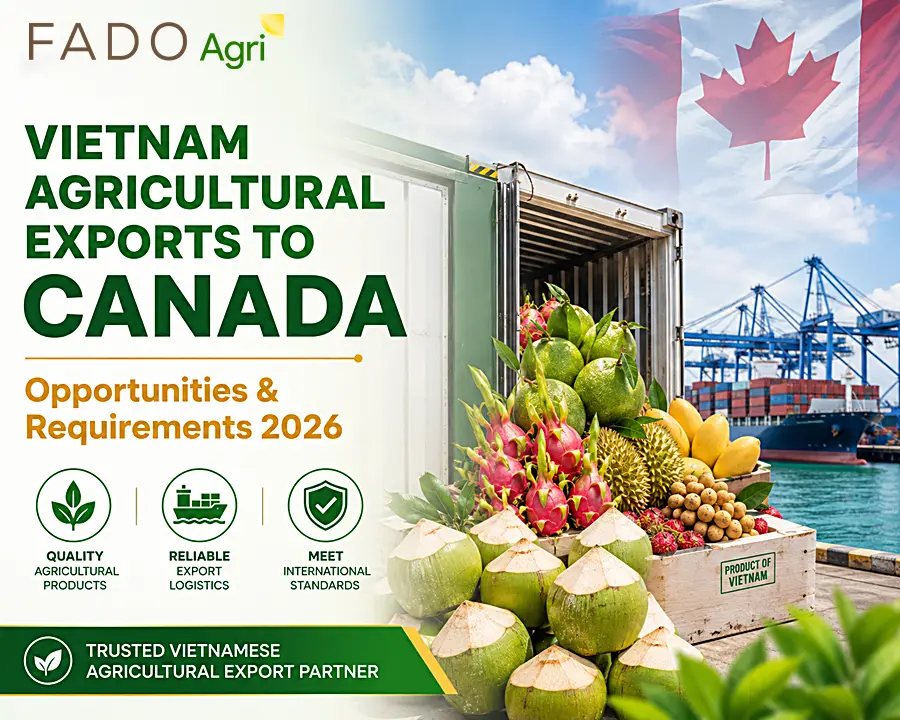
CPTPP Tariff Benefits: What Vietnamese Exporters Actually Save
The CPTPP is the single biggest structural advantage Vietnam holds over non-member competitors when shipping agricultural goods to Canada. Under the agreement, the majority of Vietnamese agri tariffs to Canada are on a scheduled reduction path toward zero, with many categories already fully eliminated by 2026 [source: Global Affairs Canada / to be confirmed by product HS code].
For fresh tropical fruits — a core export category for suppliers like Fado Agri — the tariff movement has been particularly favorable. Products classified under HS Chapter 08 (edible fruit and nuts) and Chapter 20 (processed fruit preparations, coconut-based products) have benefited from reductions that non-CPTPP competitors such as India simply cannot access. This gives Vietnamese exporters a measurable price advantage at the Canadian customs stage.
| Product | Pre-CPTPP Tariff (MFN) | CPTPP Tariff 2026 (Estimated) | Approximate Saving per Shipment |
|---|---|---|---|
| Fresh Coconut | 0% | 0% | Structural advantage via phyto compliance |
| Dragon Fruit (fresh) | 8–10% | 0–2% (staged) | Significant on volume shipments |
| Seedless Lime | 8% | 0–2% (staged) | Meaningful at container scale |
| Longan (fresh/frozen) | 8% | 0% (eliminated) | Full tariff removal advantage |
| Desiccated Coconut | 8–12% | 0–2% (staged) | Strong competitive edge vs. non-CPTPP origins |
| Banana (Cavendish) | 0% | 0% | Competition on quality and consistency |
Note: Confirm exact HS codes and current rates with a Canadian customs broker before finalizing pricing. Tariff schedules are subject to annual review. Non-CPTPP origins such as India face full MFN rates, giving Vietnamese suppliers a structural cost advantage on tariff-applicable lines.
CFIA Requirements: What Canada Demands from Vietnamese Fruit Importers
The Canadian Food Inspection Agency (CFIA) is the primary regulatory authority governing fresh fruit imports, and it has specific pest risk and documentation requirements that Vietnamese exporters must satisfy before a shipment clears the border.
Phytosanitary Certificates and Pest Risk
Every shipment of fresh fruit from Vietnam must be accompanied by a phytosanitary certificate issued by the Plant Protection Department under Vietnam’s Ministry of Agriculture and Rural Development (MARD). The certificate must confirm freedom from regulated pests — particularly fruit flies of the Bactrocera genus, which are endemic to Southeast Asia and are a primary CFIA concern. In our experience, shipments that arrive with incomplete or incorrectly formatted phytosanitary documentation face holds at Canadian ports of entry, causing significant cold chain disruption.
Approved Treatment Protocols
For certain fresh fruit categories, CFIA may require approved pre-shipment treatments such as cold disinfestation, methyl bromide fumigation, or irradiation, depending on the product and pest risk profile. Dragon fruit exports to Canada, for example, have historically been subject to irradiation treatment requirements. Exporters should verify the current Import Requirements Database (AIRS) entry for each product before booking a container.
Labeling Requirements for the Canadian Market
Canada has bilingual labeling requirements under the Safe Food for Canadians Regulations (SFCR): all retail-level food products must carry both English and French labeling. For fresh produce sold at wholesale or foodservice level, bilingual country-of-origin declarations are required. Processed products such as desiccated coconut or coconut-based preparations must also carry a full ingredient list, net quantity, nutritional facts panel (in both languages), and an importer-of-record name and address based in Canada. Fado Agri’s OEM/private label capability allows Canadian importers to specify compliant labeling at the packing stage in Vietnam, avoiding costly relabeling at destination.
Which Vietnamese Products Have the Strongest Demand in Canada?
Canada’s multicultural demographic structure is the defining factor in tropical produce demand. The Vietnamese-Canadian community (concentrated in Toronto, Vancouver, and Montreal) drives direct consumption of Southeast Asian produce, while the broader South Asian, Caribbean, and Middle Eastern diaspora communities create parallel demand for coconut, tropical citrus, and exotic fruits.
| Product | Demand Level in Canada | Key Certifications Needed | Primary Competition |
|---|---|---|---|
| Fresh Coconut (multiple cuts) | High — consistent year-round | GLOBALG.A.P, Phytosanitary Cert, HACCP | Thailand, Sri Lanka, Philippines |
| Red Dragon Fruit | High — strong in Asian grocery channel | GLOBALG.A.P, Irradiation treatment cert | Mexico (proximity advantage) |
| Seedless Lime | Medium-High — foodservice and retail | GLOBALG.A.P, Phytosanitary Cert | Mexico, USA domestic supply |
| Longan (fresh/frozen) | Medium-High — Asian grocery niche | HACCP, CFIA import permit | Thailand, China |
| Desiccated Coconut | Medium — food manufacturing input | HACCP, FDA-equivalent SFCR compliance | Philippines, Sri Lanka, India |
| Cavendish Banana | Very High — commodity category | GLOBALG.A.P | Ecuador, Colombia, Philippines |
| Taiwan Guava | Low-Medium — niche, growing | GLOBALG.A.P, Phytosanitary Cert | Taiwan, Thailand |
Fresh coconut stands out as the highest-fit product for Canadian market entry. Canada imports significant volumes of fresh drinking coconut year-round, and Vietnamese coconuts from Ben Tre — the province where Fado Agri’s primary sourcing base is located — are recognized for their water volume and sweetness profile. The six cut formats Fado Agri offers (Conical Peeling, Whole, Diamond Cut, Easy Open, Bald, and Lid On) allow Canadian retail and foodservice buyers to specify the exact presentation format their channel requires. For more on coconut export compliance, see our detailed guide at HACCP and FDA Compliance for Vietnam Coconut Exports.
Key Canadian Cities and Regions for Tropical Produce Distribution
Toronto (Greater Toronto Area) and Vancouver (Metro Vancouver) are the two primary entry points and distribution hubs for tropical produce in Canada. Toronto serves as the gateway to Ontario’s large South Asian, Caribbean, and Vietnamese communities, with a dense network of ethnic grocery retailers and foodservice importers concentrated in the Mississauga and Brampton corridors. Vancouver’s proximity to Asia and its established Chinese-Canadian and Vietnamese-Canadian communities make it the natural Pacific Coast entry point.
Montreal is the third major market, where French-language labeling compliance becomes operationally critical. Calgary and Edmonton are growing secondary markets, with increasing demand driven by immigration-driven demographic shifts in Alberta. For logistics efficiency, most Vietnamese fresh produce entering Canada arrives via Vancouver Port (Pacific route) or is transshipped through US West Coast ports before trucking across the border — a routing decision that has customs classification implications.
Shipping Logistics: Vietnam to Canada — Transit Times and Port Options
Cold chain integrity across the Pacific is the single biggest operational challenge for Vietnamese exporters shipping fresh produce to Canada. The standard routing from Ho Chi Minh City or Cat Lai port to Vancouver takes approximately 18–24 days by sea, depending on the carrier and any transhipment hub used (typically Singapore, Busan, or Shanghai). Toronto-bound cargo adds 5–7 days of inland rail transit after Vancouver port discharge, bringing total transit to approximately 25–30 days.
For temperature-sensitive fresh fruit, reefer containers set at 7–12°C (product-dependent) are standard. Longan and dragon fruit have tighter cold chain tolerance than coconut; exporters must confirm shelf life compatibility with total transit time before booking. Some Canadian importers of dragon fruit and longan prefer frozen formats precisely to bypass this constraint. Air freight to Toronto Pearson or Vancouver YVR is viable for premium or time-sensitive shipments but is economically practical only for high-value, low-weight cargo. For a detailed comparison of logistics approaches for different markets, see our Vietnam fruit exporter to Australia guide, which covers similar Pacific routing considerations.
How Vietnam Competes Against Thailand and Philippines for Canadian Buyers
Thailand and the Philippines are Vietnam’s primary competitors for tropical produce shelf space in Canada, and each has a distinct competitive profile. Thailand benefits from decades of brand recognition in Canadian ethnic grocery channels and strong relationships with established importers. The Philippines holds a cost advantage in coconut-based processed goods due to its mature processing industry and economies of scale. Vietnam’s competitive position rests on three pillars: CPTPP tariff access (which Thailand does not have for Canada), the quality and volume consistency of Ben Tre coconut production, and the growing capability of exporters like Fado Agri to offer FOB Vietnam full-service logistics including OEM packaging and private label.
In our experience working with buyers in multiple markets, Canadian importers are increasingly prioritizing supply chain traceability and certification documentation. Vietnam’s improving GLOBALG.A.P farm certification coverage and the MARD phytosanitary system’s ongoing upgrades are closing the compliance gap with Thai exporters. On price per container at landed cost, the CPTPP tariff differential on products like longan and processed coconut effectively offsets Thailand’s logistical maturity advantage.
For context on how Vietnam positions itself competitively in other Western markets, see our analysis of Vietnamese fruit exports to Australia and our guide on Vietnamese agricultural exports to the EU in 2026.
How to Find a Canadian Importer or Distributor for Vietnamese Produce
The most effective channels for connecting with legitimate Canadian importers are trade missions organized by VIETRADE (Vietnam Trade Promotion Agency) and participation in Canadian trade events such as SIAL Canada (held in Montreal and Toronto alternately). The Canadian Produce Marketing Association (CPMA) annual convention is the primary fresh produce trade event in Canada and is attended by major importers, wholesalers, and retailers.
For processed agricultural products such as desiccated coconut and coconut shell charcoal, Canadian food manufacturers and industrial buyers can be reached through the Canadian Food and Beverage Show and through ITC Trade Map buyer databases. Vietnamese exporters should ensure they have an English-language product specification sheet, certificate of analysis, and current phytosanitary compliance documentation ready before initial outreach — Canadian importers conduct compliance due diligence early in the evaluation process. Fado Agri works with 20+ strategic partners across multiple markets and can guide Canadian buyers through the full qualification process from initial inquiry to first FOB shipment.
Frequently Asked Questions
Does CPTPP eliminate all tariffs on Vietnamese fresh fruit exported to Canada?
Not all at once. CPTPP tariff reductions are staged across multiple years. Many fresh fruit lines have reached zero or near-zero tariff by 2026, but some processed product categories still carry residual rates depending on the HS code. Vietnamese exporters should verify their specific product’s current CPTPP rate on Global Affairs Canada’s tariff schedule before pricing a Canadian shipment.
What phytosanitary documents are required for fresh fruit from Vietnam to Canada?
A phytosanitary certificate issued by Vietnam’s Plant Protection Department (under MARD) is mandatory for all fresh fruit shipments. Some products — notably dragon fruit — require evidence of an approved disinfestation treatment (such as irradiation) before CFIA will allow entry. Exporters should check the CFIA AIRS database for the specific import conditions applicable to their product and Vietnamese origin.
Does Canada require bilingual labeling on imported agricultural products?
Yes. Canada requires both English and French labeling on all retail food products under the Safe Food for Canadians Regulations. Country of origin, net quantity, importer name and address, and ingredient declarations must be bilingual. Wholesale and bulk-format produce has more flexibility, but any consumer-facing packaging must comply. Fado Agri’s OEM service can produce Canada-compliant bilingual labeling at the Vietnam packing stage.
What certifications should Vietnamese fruit exporters hold to supply Canadian buyers?
The baseline requirements most Canadian importers expect are GLOBALG.A.P farm certification, HACCP for processing facilities, and a valid phytosanitary certificate per shipment. For exporters supplying major Canadian retailers, additional food safety schemes such as SQF or BRC may be requested. Fado Agri holds GLOBALG.A.P, HACCP, and FDA certifications, which satisfy the core requirements of Canadian commercial buyers.
How large is Canada’s tropical fruit import market?
Canada is a significant net importer of tropical fruit given its climate. Total fresh fruit import volumes run into the hundreds of thousands of tonnes annually [source: Statistics Canada / to be confirmed by year]. The Asian grocery channel — dominated by major chains in Toronto and Vancouver — is the fastest-growing segment for specialty tropical produce, driven by sustained immigration from Southeast Asia and South Asia.
Which Vietnamese product has the best immediate fit for the Canadian market?
Fresh coconut is the highest-confidence entry point for Vietnamese exporters targeting Canada. Demand is consistent year-round, the competitive set from CPTPP non-member origins faces tariff disadvantages, and the product has low regulatory complexity compared to fruit fly host commodities like dragon fruit. Desiccated coconut and coconut shell charcoal are strong secondary opportunities for exporters with processed goods capability.
What is the typical shipping transit time from Vietnam to Canada?
Sea freight from Ho Chi Minh City to Vancouver takes approximately 18–24 days. Toronto-bound cargo adds 5–7 days of inland transit after Vancouver discharge, for a total of roughly 25–30 days. Exporters must verify that product shelf life is compatible with this total transit window, particularly for fresh dragon fruit and longan. Cold chain integrity throughout — at 7–12°C depending on the commodity — is non-negotiable.
How does Vietnam’s coconut compare to Thai or Philippine coconut for Canadian buyers?
Vietnamese Ben Tre coconuts are recognized for high water content and a clean, mildly sweet flavor profile that suits the fresh drinking coconut segment. Thai young coconuts dominate North American supermarket shelves due to established supply chains, but Vietnam’s CPTPP tariff access and improving compliance standards are creating room for Vietnamese product to compete on landed cost. Philippine coconuts face the same tariff disadvantage as Thailand relative to Vietnam under CPTPP.
Starting Your Vietnam–Canada Agricultural Trade Relationship
The CPTPP window is open, Canadian consumer demand for tropical produce is growing, and Vietnam’s supply capability — backed by traceable supply chains, phytosanitary compliance, and multi-certification facilities — is stronger than at any point in the country’s export history. Whether you are a Canadian importer looking for a reliable fresh coconut or dragon fruit supplier, or a Vietnamese exporter mapping your next market, the structures are in place for a productive trade relationship in 2026 and beyond.
If you are evaluating Vietnam as a sourcing origin for the Canadian market, Fado Agri offers full FOB Vietnam service including product specification, phytosanitary compliance documentation, OEM labeling, and cold chain logistics coordination. Reach out to our team to discuss your volume requirements, target SKUs, and certification needs — and we will provide a detailed capability profile matched to Canadian market entry requirements.
For related reading, explore our guides on Vietnam coconut exports to the USA and HACCP and FDA compliance for Vietnamese coconut exporters.