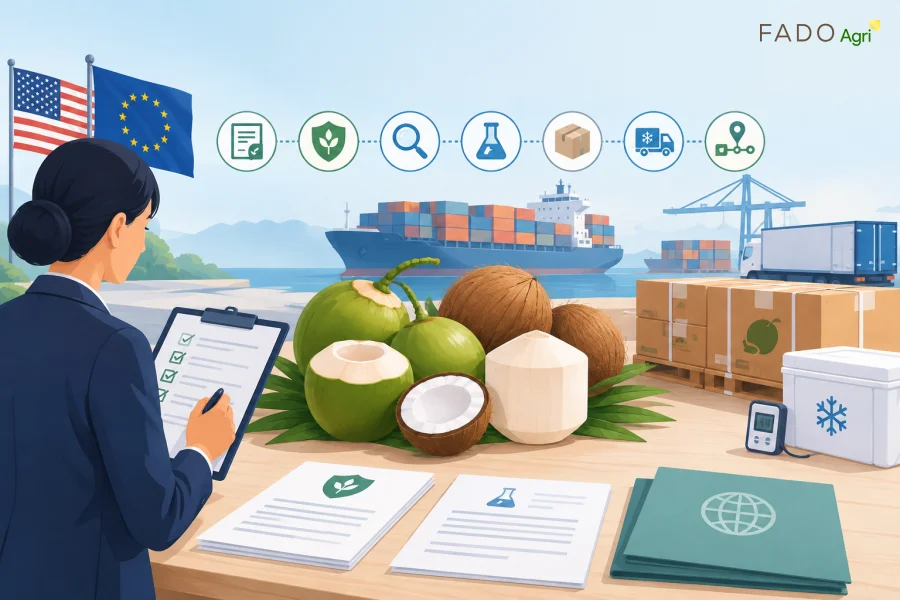
Fresh Coconut Export Standards for the US and EU: A Buyer’s Guide
A practical guide for importers to assess fresh coconut documentation, phytosanitary controls, MRLs, packaging, traceability and cold-chain requirements for US and EU shipments.


A practical guide for importers to assess fresh coconut documentation, phytosanitary controls, MRLs, packaging, traceability and cold-chain requirements for US and EU shipments.

While Thailand leads the premium market with Nam Hom coconuts, Vietnam is rapidly gaining global market share through large scale, competitive pricing, diverse varieties (Siamese, Red, and Wax Coconuts), and improving supply chains.

Fado Agri drives sustainability through GAP-certified eco-farming, local farmer empowerment, eco-friendly processing and packaging, and full trace-to-farm supply chain transparency.

Vietnam ranks 2nd globally in dragon fruit, durian, and coconut exports, driven by ideal climate, year-round production, strategic trade agreements, and modern logistics.

Halal and Kosher certifications help Vietnamese exporters access high-value global markets by ensuring strict compliance with religious dietary standards and cross-contamination-free supply chains.

ISO 22000 certification enhances Vietnamese agricultural exports by establishing a globally recognized food safety management system based on HACCP principles, full supply chain traceability, and continuous quality control.

For every export container shipped in August 2026, Fado Agri sponsors one School Starter Package for a child in Vietnam — at no extra cost to buyers.

EUDR requires Vietnamese fruit exporters to prove zero deforestation and provide GPS-based plot traceability to access the EU market.

Organic certification enhances Vietnamese agricultural exports by ensuring compliance with global standards (USDA, EU Organic, JAS) via chemical-free farming, full traceability, and strict audits.

Vietnam exports premium pomelo varieties, such as Green Skin and Da Xanh, to major Asian, European, and US markets by adhering to GlobalGAP farming, rigorous phytosanitary standards, and strict cold-chain logistics.