

Vietnam ships over 500 containers of fresh coconuts every year to markets across the Middle East, Asia, North America, and Australia, and the demand is still climbing. If you are a fruit importer, wholesaler, or retail buyer considering Vietnam as your coconut supply source, this guide gives you the complete picture: Where the best coconuts come from, what specifications matter, how the export process works, and what separates a reliable Vietnam fresh coconut exporter from one that will cost you margin, time, and credibility.
1. Why Vietnam Is a Leading Source for Fresh Coconut Exports?
Vietnam’s dominance in the global fresh coconut trade is not a recent development, it is the result of geography, agricultural heritage, and a maturing export infrastructure that now meets the requirements of the world’s most demanding markets.
1.1. The Ben Tre and Tien Giang Advantage
The Mekong Delta provinces of Ben Tre and Tien Giang are the heartland of Vietnam’s coconut industry. Ben Tre alone is home to more than 70,000 hectares of coconut cultivation, earning it the title of “Coconut Kingdom” among Vietnamese farmers and trade professionals alike. The combination of alluvial soil, tropical humidity, and year-round river irrigation creates growing conditions that produce coconuts with high water content, natural sweetness, and consistent size, qualities that importers in the Middle East, China, and Southeast Asia actively seek.
Unlike regions where coconut farming is seasonal, Ben Tre and Tien Giang supply a near-continuous harvest, enabling exporters to maintain stable shipment schedules throughout the year. For importers managing retail supply chains or hotel and food-service contracts, this consistency is not a bonus, it is a baseline requirement.
1.2. Certifications That Open Market Doors
Vietnam fresh coconut exporters operating at a professional level hold certifications that directly affect which markets they can supply. The key certifications to look for are:
- FDA registration – required for shipments to the United States.
- GLOBALG.A.P – the international benchmark for responsible farm practices, recognized by European and premium Asian buyers.
- HACCP – food safety system certification covering handling, processing, and packing.
Fado Agri, founded in 2016 and now one of Vietnam’s established fresh coconut exporters, holds all three certifications and exports to over 20 strategic partners across 8+ international markets. These credentials are verifiable and matter directly to your customs clearance, retail compliance, and private-label requirements.
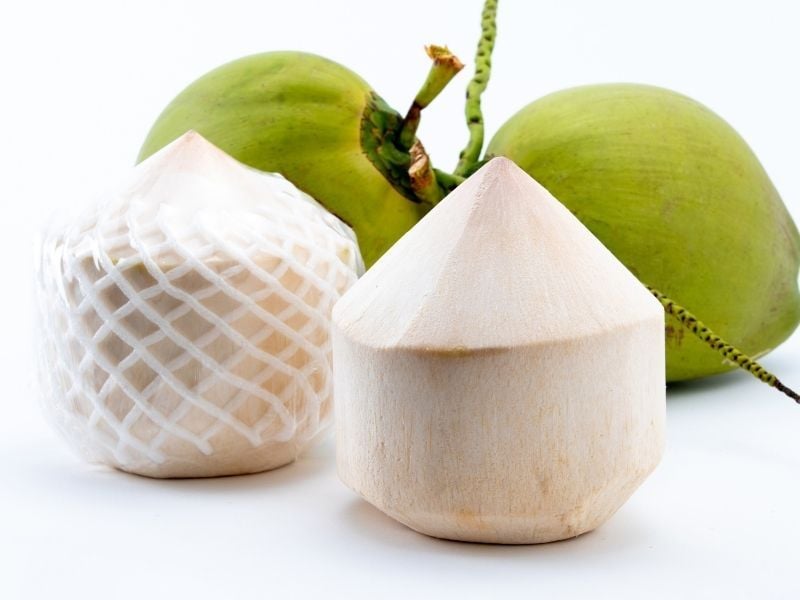
2. Understanding Fresh Coconut Cut Types: What Importers Need to Know
One of the most common sourcing mistakes importers make is treating “fresh coconut” as a single, undifferentiated product. In reality, the cut type determines shelf life, transport efficiency, presentation, and the end market it serves.
Fado Agri supplies six cut types of fresh coconut. Here is what each means for your business:
The 6 Fresh Coconut Cut Types
- Round Cut (Full Husk) – The whole coconut with husk trimmed to a round shape. Preferred in markets where the “tropical” aesthetic is part of the product value — beach clubs, hospitality, outdoor markets. Heavier per unit but high visual appeal.
- Trimmed Oval Cut – A more compact oval shape, reducing husk volume and improving container load efficiency. Widely used for retail and wholesale distribution in the Middle East and Southeast Asia.
- Pointed Top Cut (King Coconut Style) – A clean triangular or pyramid top cut that makes drinking easy without a straw. High demand in juice bars and premium food service.
- Half Trimmed – Husk removed from the top half, exposing the shell. Common for markets where consumers want to see the shell quality before purchase.
- Fully Husked / Shell-Only – The complete husk removed, leaving only the hard shell. Suitable for processing, further value-added production, or markets with strict biosecurity rules on husk importation.
- Young Coconut (Drinking Coconut) – Harvested at 6-8 months, before the meat fully develops. High water content, mild sweetness. The dominant format in the Middle East, China, and Southeast Asian convenience markets.
Buyers often ask whether they can order mixed cut types in a single container. The answer is yes, Fado Agri accommodates mixed orders, subject to minimum quantities per cut type.
3. The Export Process: From Farm to Your Port
Understanding how a professional Vietnam fresh coconut exporter manages the supply chain helps importers assess risk, plan lead times, and negotiate terms with confidence. Here is how Fado Agri’s 10-step transparent supply chain works:
- Farm sourcing – Direct relationships with certified growers in Ben Tre and Tien Giang. No middlemen between the farm and the export facility.
- Harvest scheduling – Coordinated with importer lead times to ensure coconuts are at the right maturity stage upon shipment.
- Field inspection – Quality checked at harvest: size, water volume, skin condition.
- Transport to facility – Same-day refrigerated or ambient transport from farm to processing facility to preserve freshness.
- Washing and sanitization – Industrial washing with food-safe solutions, meeting HACCP standards.
- Cutting and trimming – Skilled workers apply the specified cut type. Fado Agri’s 500+ factory workers are trained for consistency across all six formats.
- Grading and sorting – Sorted by size (diameter, weight) according to buyer specifications. Standard grades: Small (<1.2 kg), Medium (1.2-1.5 kg), Large (>1.5 kg).
- Packing – Mesh bags, cartons, or custom OEM packaging per buyer preference. Each unit is labeled with origin, grade, and batch traceability code.
- Pre-shipment inspection – Third-party or buyer-nominated inspection available before container sealing.
- Loading and documentation – FOB or CIF terms. Export documentation includes phytosanitary certificate, certificate of origin, commercial invoice, and packing list.
Lead time: Fresh coconut minimum lead time is 5 days from order confirmation to container-ready. Stable supply rhythm: 1 container every 2-3 days.
4. Pricing and Commercial Terms: What to Expect
Fresh coconut FOB prices from Vietnam vary by cut type, size grade, volume, and seasonal fluctuation. While this guide does not publish fixed prices (they change with market conditions), importers should understand the primary cost drivers:
- Cut type: More labor-intensive cuts (pointed top, fully husked) carry a higher per-unit cost.
- Size grade: Large-grade coconuts command a premium in the Middle East and Chinese markets.
- Volume: Container-level orders (typically 800-1,200 units per pallet, 16-20 pallets per 40HQ container) unlock better unit pricing.
- Packaging: OEM custom packaging adds cost but supports retail shelf differentiation.
- Shipping terms: FOB (you arrange freight) vs. CIF (Fado Agri arranges freight to your nominated port) affects your landed cost calculation.
Buyers often ask whether a trial order smaller than a full container is possible. Fado Agri can discuss LCL (Less-than-Container-Load) options for first-time buyers to reduce risk on an initial order, subject to minimum value thresholds.
5. How to Evaluate a Vietnam Fresh Coconut Exporter?
Not every supplier claiming to be a Vietnam fresh coconut exporter operates at the same standard. Before committing to a sourcing partner, importers should apply this qualification checklist:
- Certifications on file: FDA, GLOBALG.A.P, HACCP – ask for copies, not just claims.
- Farm traceability: Can they name the farms? Can they show GPS coordinates or farm registration documents?
- Processing facility: Request a video or photo walkthrough of the cutting and packing facility. Look for sanitation standards, worker practices, and cold chain infrastructure.
- References: A credible exporter has importers in multiple markets who can be contacted.
- Export volume and regularity: Ask for container count per month and shipping records. 500+ containers per year is a meaningful indicator of logistical capability.
- Certifications for your market: If you import into the US, FDA registration is non-negotiable. If you import into Europe, GLOBALG.A.P matters. Confirm your supplier’s certifications match your destination market’s requirements.
- Communication responsiveness: This is underrated. A supplier that takes 48 hours to answer a pre-sale inquiry will not improve when there is a shipment problem.
6. Why Importers Choose Fado Agri as Their Vietnam Coconut Supplier?
Fado Agri was founded in 2016 with a clear mandate: bring Vietnamese agricultural products to global markets without compromising on traceability, quality standards, or grower welfare. Eight years later, the company exports 500+ containers per year, maintains global offices in Vietnam, the UAE (Ajman), Malaysia (Penang), and Australia (NSW), and serves 20+ strategic partners across the Middle East, Asia, and Western markets.
What makes the difference for importers is not just what Fado Agri ships – it is how. Every fresh coconut container is backed by direct farm sourcing in Ben Tre and Tien Giang, a documented 10-step supply chain, and a team of 150 global staff plus 500+ factory workers who execute with consistency.
Rooted in the land, rigorous in standards – that is not just a phrase. It describes how Fado Agri has built its reputation over 8 years and why importers return container after container.
7. Frequently Asked Questions: Sourcing Fresh Coconuts from Vietnam
What is the minimum order quantity for fresh coconut export from Vietnam?
Most professional Vietnam fresh coconut exporters, including Fado Agri, work on a full-container-load (FCL) basis, typically a 40HQ container. This translates to approximately 16,000-20,000 units depending on cut type and size. LCL (less-than-container-load) options may be available for first-time buyers, contact Fado Agri directly to discuss.
What certifications should I require from a Vietnam coconut exporter?
At minimum, require FDA registration (for US imports), GLOBALG.A.P (for European and premium Asian markets), and HACCP (food safety). Fado Agri holds all three. Always request original or notarized copies, not screenshots, before placing an order.
How long does it take to ship fresh coconuts from Vietnam to the Middle East or China?
Sea freight from Ho Chi Minh City or Cat Lai port to Dubai typically takes 12-16 days. Shipping to China (Guangzhou, Shanghai) ranges from 5-10 days depending on the port. Fado Agri has a minimum lead time of 5 days from order confirmation to container-ready, giving you clear planning windows.
What fresh coconut cut types can I order from Vietnam?
Fado Agri offers six cut types: Round Cut, Trimmed Oval, Pointed Top, Half Trimmed, Fully Husked, and Young Drinking Coconut. Mixed-cut containers are available. The right cut depends on your end market, food service, retail, or processing.
Can I request OEM or custom packaging for fresh coconuts?
Yes. Fado Agri provides OEM and ODM packaging options, allowing importers to brand the product under their own label. This includes custom cartons, net bags, and stickers with private-label design. Minimum quantities apply for OEM runs.
How does Fado Agri ensure fresh coconut quality during transport?
Freshness is maintained through harvest scheduling aligned with shipment windows, same-day transport from farm to facility, HACCP-compliant washing and packing, and optional pre-shipment third-party inspection. Cold chain options are available for markets requiring refrigerated transport.
Which markets does Vietnam export fresh coconuts to?
Vietnam’s fresh coconut export markets include the UAE, Saudi Arabia, Kuwait, China, Japan, South Korea, Malaysia, India, the USA, and Australia. Fado Agri actively supplies importers in the Middle East and Asia-Pacific regions.
8. Start Sourcing Fresh Coconuts from Vietnam
Vietnam’s fresh coconut industry has matured well beyond opportunistic trading. Professional exporters like Fado Agri now operate with the certifications, infrastructure, and supply chain transparency that serious importers require. Whether you are sourcing your first trial container or looking to switch from an underperforming supplier, the process starts with a conversation.
Reach Fado Agri’s sourcing team directly:
- 📞 Hotline: (+84) 908 479 339
- 📧 Email: [email protected]
- 🌐 Website: fadoagri.com
From farm to final destination – let’s build something that lasts.