

What Brexit Actually Changed for Vietnamese Fruit Exporters Shipping to the UK
Since January 2021, the United Kingdom operates its own independent import framework — fully separate from EU customs, phytosanitary rules, and tariff schedules. For Vietnamese agricultural exporters, this means the UK is no longer an extension of the EU market. It is a distinct regulatory jurisdiction with its own free trade agreement, its own food safety authority, and its own border inspection protocols. Understanding this separation is the first step to exporting Vietnamese tropical fruit to the UK profitably and compliantly.
The good news is that the UK-Vietnam Free Trade Agreement (UKVFTA), which entered into force on 1 May 2021, preserved and in some cases improved tariff access for Vietnamese agricultural products. Combined with the UK’s strong appetite for tropical produce, this creates a genuine commercial opportunity for exporters who prepare correctly.
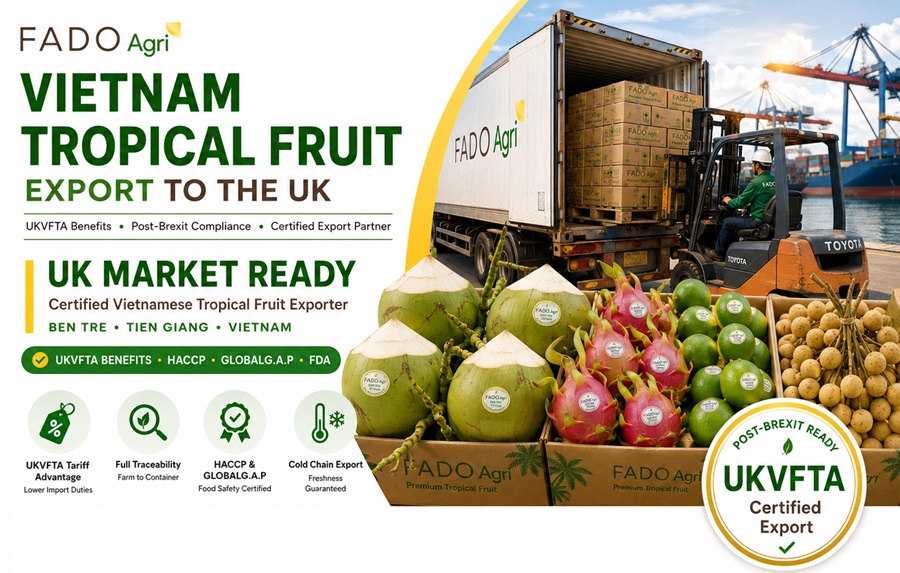
UKVFTA Tariff Benefits: What Vietnamese Tropical Fruit Exporters Actually Gain
The UKVFTA provides staged tariff elimination for most Vietnamese fresh and processed agricultural goods entering the UK market. Unlike the EU-Vietnam FTA (EVFTA), which has its own separate schedule, the UKVFTA was negotiated specifically for UK conditions and contains distinct staging timelines and quota arrangements. This distinction matters when you are pricing FOB Vietnam offers for UK buyers.
Fresh coconuts, dragon fruit, limes, and bananas from Vietnam all benefit from reduced or zero MFN tariff rates under the UKVFTA. The specific staging — whether immediate elimination or phased over 7 to 10 years — depends on the HS code classification of the product. Exporters should confirm current applicable rates with HMRC’s UK Global Tariff tool or with a licensed UK customs broker before quoting.
| Product | HS Code (indicative) | EVFTA Tariff (EU) | UKVFTA Tariff (UK) | MFN Tariff (UK without FTA) |
|---|---|---|---|---|
| Fresh Coconut | 0801.19 | 0% (immediate) | 0% (immediate) | 0% |
| Red Dragon Fruit | 0810.90 | Staged to 0% | Staged to 0% | Approx. 9–12% [to be confirmed] |
| Fresh Lime / Seedless Lime | 0805.50 | Staged reduction | Staged reduction | Approx. 3.2% [to be confirmed] |
| Cavendish Banana | 0803.90 | Quota-based | Quota-based | Approx. 12–16% [to be confirmed] |
| Desiccated Coconut | 0801.12 | 0% (immediate) | 0% (immediate) | 2.5% [to be confirmed] |
Note: Tariff rates above are illustrative and based on publicly available UKVFTA schedules. Always verify current staging and quota thresholds with HMRC or a certified trade consultant before contract negotiation. If you are also supplying EU markets, see our dedicated coverage on Vietnamese agricultural exports to the EU in 2026 for the EVFTA equivalent details.
Pre-Brexit vs Post-Brexit: What the Import Framework Looks Like Now
The most important operational change for Vietnamese exporters is that the UK no longer accepts EU phytosanitary certificates, EU health marks, or EU border inspection clearance as valid for UK entry. Each shipment must comply independently with UK-specific documentation and border control requirements administered by DEFRA and the Animal and Plant Health Agency (APHA).
| Requirement Area | Pre-Brexit (UK as EU Member) | Post-Brexit (UK Independent) |
|---|---|---|
| Phytosanitary Certificate | EU-standard, accepted at EU BIPs | UK-specific phyto certificate issued by Vietnam MARD/PPCD |
| Border Inspection | EU Border Inspection Posts (BIPs) | UK Border Control Posts (BCPs) — DEFRA-designated |
| Tariff Schedule | EU Common External Tariff | UK Global Tariff (UKGT) + UKVFTA preferential rates |
| Food Safety Authority | EFSA (European Food Safety Authority) | FSA/FSS (Food Standards Agency / Food Standards Scotland) |
| Plant Health Rules | EU Regulation 2016/2031 | UK Plant Health Order 2020 (largely aligned but diverging) |
| Certificate of Origin | EUR.1 / REX for EU FTA | UK-specific proof of origin for UKVFTA (Form A or Statement) |
| Pre-notification | TRACES (EU system) | IPAFFS (UK’s Import of Products, Animals, Food and Feed System) |
In our experience working across multiple export corridors, the IPAFFS pre-notification system is one of the most common compliance gaps for Vietnamese exporters new to the UK market. Pre-notification must be submitted by the UK importer — not the Vietnamese exporter — but the exporter must provide complete and accurate documentation well before vessel arrival to allow this to happen on time.
DEFRA and Phytosanitary Compliance: Does the UK Still Follow EU Plant Health Rules?
The UK initially maintained close alignment with EU plant health regulations after Brexit, but the two frameworks are progressively diverging as of 2025-2026. UK plant health policy is governed by the Plant Health Order 2020, administered by APHA, and it covers pest interception lists, prohibited goods, and inspection frequency — which are reviewed independently of EU decisions [source: DEFRA, to be confirmed for 2026 updates].
For Vietnamese tropical fruit specifically, phytosanitary certificates issued by Vietnam’s Plant Protection Department (MARD/PPD) must accompany every consignment. These certificates must declare that the fruit is free from regulated pests including fruit flies (Bactrocera spp.), which are a consistent concern for UK border authorities inspecting tropical produce from Southeast Asia.
Cold chain integrity is non-negotiable in this context. Maintaining sub-13°C temperature throughout the supply chain is required for several tropical fruit categories and forms part of phytosanitary mitigation protocols. Fado Agri’s export operations follow GLOBALG.A.P and HACCP-compliant cold chain protocols from farm gate in Ben Tre and Tien Giang through to reefer container loading — a standard that UK importers increasingly ask to verify before committing to a supply relationship.
UK Ports of Entry for Vietnamese Fresh Produce
Fresh produce from Vietnam arriving in the UK must enter through a DEFRA-designated Border Control Post (BCP). The principal BCPs handling fresh fruit and vegetables from Southeast Asia include Tilbury (Port of London), Felixstowe (Suffolk), and Bristol (Avonmouth). Each operates with different throughput capacity and inspection appointment systems.
Tilbury and Felixstowe handle the majority of containerised reefer cargo from Asia and are generally the most practical ports for Vietnamese exporters routing via major transhipment hubs such as Singapore or Port Klang. Importers should confirm BCP appointment availability for their specific product category through IPAFFS before booking cargo, as inspection slots for regulated fresh produce can be limited during peak seasons.
Unlike under EU rules, exporters can no longer route through Rotterdam or Antwerp and then clear UK customs — all regulated fresh produce must now enter through a UK BCP on first arrival. This adds transit planning complexity and, in some cases, additional freight cost compared to the pre-2021 logistics model.
Which Vietnamese Tropical Fruits Have the Strongest UK Demand?
UK demand for Asian tropical produce has expanded steadily, driven by a growing South Asian and Southeast Asian diaspora population, increased health-conscious retail purchasing, and foodservice category innovation. Fresh coconut, dragon fruit, and seedless lime are among the highest-interest categories from Vietnamese origin.
Fresh Coconut
Fresh coconut from Vietnam — particularly from Ben Tre province — is well-positioned for the UK retail and foodservice markets. UK consumers are familiar with fresh coconut through Asian grocery channels and increasingly through mainstream supermarkets offering exotic fruit ranges. Fado Agri supplies fresh coconut in multiple cut formats including Easy Open and Bald cuts suited to UK retail shelf presentation. For a detailed look at Vietnamese coconut supply chain specifics, see our coverage of Vietnamese coconut exports to the Netherlands for comparable European market context.
Red Dragon Fruit
Vietnamese red-flesh dragon fruit (Hylocereus costaricensis varieties) commands a premium in UK specialty retail and foodservice. The UK market distinguishes clearly between white-flesh and red-flesh varieties, with red commanding a higher price point. Vietnam’s growing season and air-freight capability make consistent year-round supply feasible, though shelf-life management in sea freight channels remains a challenge that requires close cold chain coordination.
Seedless Lime
Seedless lime from Vietnam finds strong demand in UK foodservice — particularly in the drinks, cocktail, and restaurant sector — where seedless presentation is a practical advantage. The UK imports limes from multiple origins, so Vietnamese exporters need to compete on consistency, certification, and UKVFTA tariff efficiency to be competitive against established Latin American suppliers.
UK Retail vs Foodservice: Two Different Entry Strategies
UK retail and foodservice channels have fundamentally different requirements for Vietnamese tropical produce, and treating them as interchangeable is a common mistake for exporters entering this market for the first time.
UK retail — particularly the major grocery multiples — requires supplier audits, agreed minimum shelf-life windows on arrival, EDI ordering integration, and often private label packaging capability. GLOBALG.A.P certification is near-mandatory for retail supply in the UK. Fado Agri offers OEM and private label packaging services that can meet UK retail specifications.
Foodservice and wholesale channels (including ethnic grocery distributors, cash-and-carry operators, and food manufacturers) are more accessible as an entry point but operate on tighter margins and higher volume expectations. In our experience, Vietnamese exporters often find foodservice and wholesale a more practical first step into the UK market, building toward retail access as volume and relationship confidence grow.
UK vs EU Demand: How the Markets Compare for Vietnamese Exports
The EU remains a significantly larger total import market for Vietnamese agricultural products by volume, given its population of 450 million versus the UK’s 68 million. However, the UK market offers distinct advantages: a single customs jurisdiction, English as the working trade language, UKVFTA preferential access, and a well-developed retail infrastructure for exotic and ethnic produce.
UK per-capita consumption of tropical fruit is comparable to or exceeding several major EU markets, and the concentration of purchasing through major retail buying groups means volume can scale quickly once a supply relationship is established. For exporters already serving EU markets through EVFTA, adding the UK requires separate UKVFTA documentation and DEFRA compliance but does not require building an entirely new product or quality infrastructure. Detailed EU-specific export strategy is covered in our article on Vietnamese agricultural exports to the EU.
Certifications the UK Now Requires Independently
UK market access for fresh fruit from Vietnam requires a combination of exporter-side certifications and importer-side compliance registrations. On the exporter side, GLOBALG.A.P (or equivalent UK-recognised schemes) is essential for retail access and strongly preferred for foodservice. FDA certification supports Vietnamese exporters also serving US markets and signals production standards to UK buyers, though it is not a UK import requirement per se.
HACCP-based food safety management is required under UK food law (Food Safety Act 1990 and associated regulations), and importers bear legal responsibility for ensuring product they place on the UK market meets these standards. In practice, this means UK importers will require evidence of HACCP implementation from their Vietnamese suppliers as part of supplier qualification. Fado Agri holds FDA, GLOBALG.A.P, and HACCP certifications across its export operations, documentation that UK buyers can verify during supplier onboarding.
How to Find a UK Importer or Broker for Vietnamese Tropical Fruit
Finding the right UK import partner is the most critical step for Vietnamese exporters entering this market. The UK has a well-established fresh produce import broker ecosystem, with specialists in exotic and ethnic produce concentrated in London, Birmingham, and Bristol trading hubs. Trade directories through the Fresh Produce Consortium (FPC) and UK-based trade shows such as London Produce Show provide structured access to verified buyers.
Vietnamese exporters with UKVFTA-compliant documentation, traceable supply chain records, and third-party certifications (GLOBALG.A.P, HACCP) are significantly more attractive to UK brokers than those presenting on price alone. UK importers absorb regulatory risk on behalf of their supplier — they need confidence that their Vietnamese partner can deliver consistent quality with full phytosanitary documentation on every container.
If you are exploring UK market entry for Vietnamese tropical fruit and want to discuss supply capability, certifications, or documentation requirements, the Fado Agri export team is available to support both UK importers and Vietnamese producers navigating this corridor.
Frequently Asked Questions
Is UKVFTA different from EVFTA for Vietnamese exporters?
Yes, UKVFTA and EVFTA are separate agreements with different tariff schedules, staging timelines, and certificate of origin requirements. Exporters supplying both UK and EU markets must maintain separate documentation streams and cannot use one certificate of origin for both markets. Always verify the applicable rates under each agreement independently with a customs consultant.
Does Vietnam need a special phytosanitary certificate for the UK after Brexit?
Yes. The UK no longer accepts EU-format phytosanitary certificates or EU border inspection clearance. A UK-specific phytosanitary certificate must be issued by Vietnam’s Plant Protection Department (MARD/PPD) for each consignment entering the UK, and the UK importer must pre-notify via the IPAFFS system before arrival.
Which UK ports accept fresh tropical fruit from Vietnam?
The main DEFRA-designated Border Control Posts for fresh produce from Southeast Asia are Tilbury (London), Felixstowe (Suffolk), and Bristol (Avonmouth). All regulated fresh fruit must clear UK customs and phytosanitary inspection at one of these BCPs on first arrival into the UK — routing through EU ports for clearance is no longer permitted.
What certifications does a Vietnamese fruit exporter need to supply UK retail?
For UK retail supply, GLOBALG.A.P certification is near-mandatory and HACCP-based food safety management is required under UK food law. Many UK retailers also request additional audits (such as BRCGS or equivalent) as part of their own supplier qualification process. Fado Agri holds GLOBALG.A.P, HACCP, and FDA certifications applicable to its export products.
Can Vietnamese exporters ship to the UK via Rotterdam or Antwerp?
No. Post-Brexit, fresh produce from Vietnam cannot clear UK customs via EU ports. All consignments must arrive directly at a UK Border Control Post for inspection and clearance. This is a significant operational change from pre-2021 logistics models and adds to transit planning requirements.
Which Vietnamese tropical fruits have the strongest demand in the UK?
Fresh coconut, red dragon fruit, seedless lime, and longan show the strongest interest from UK buyers sourcing from Vietnamese origin. Fresh coconut has broad retail and foodservice applicability. Red dragon fruit commands premium positioning in specialty retail. Seedless lime is a practical favorite in the UK’s active foodservice and hospitality sector.
Is UK per-capita tropical fruit consumption comparable to the EU?
UK per-capita consumption of tropical and exotic fruit is competitive with major EU markets and is growing, driven by demographic diversity and retail category expansion. While the EU is a larger total market by volume, the UK’s single customs jurisdiction and English-language trading environment make it a practical and efficient entry point for Vietnamese exporters new to Western markets.
How long does UK customs clearance take for fresh produce from Vietnam?
Clearance timelines depend on documentation completeness, BCP inspection workload, and whether the consignment is flagged for physical or documentary inspection. In our experience, well-prepared shipments with complete IPAFFS pre-notification, valid phytosanitary certificates, and accurate HS code declarations typically clear within 24–48 hours of arrival at the BCP. Incomplete documentation is the most common cause of delays.
Starting Your UK Market Entry for Vietnamese Tropical Fruit
The UK represents a genuinely distinct and commercially attractive market for Vietnamese tropical fruit exporters who invest in understanding its post-Brexit regulatory requirements. UKVFTA tariff access, a receptive consumer base, and a professional import broker ecosystem all work in your favor — provided your documentation, certifications, and cold chain protocols are in order before the first container ships.
At Fado Agri, we have been exporting Vietnamese agricultural products since 2016 across 10+ certified markets, including to buyers in Australia, the UAE, and Asia — and we are equipped to support UK market entry with full phytosanitary compliance documentation, GLOBALG.A.P and HACCP-certified produce, and OEM/private label capability for UK retail specifications. Whether you are a UK importer sourcing Vietnamese fresh coconut, dragon fruit, or seedless lime, or a Vietnamese producer looking for an experienced export partner for the UK corridor, we welcome the conversation. For comparison on how we approach the Australian market, see our article on Vietnam fruit exports to Australia.