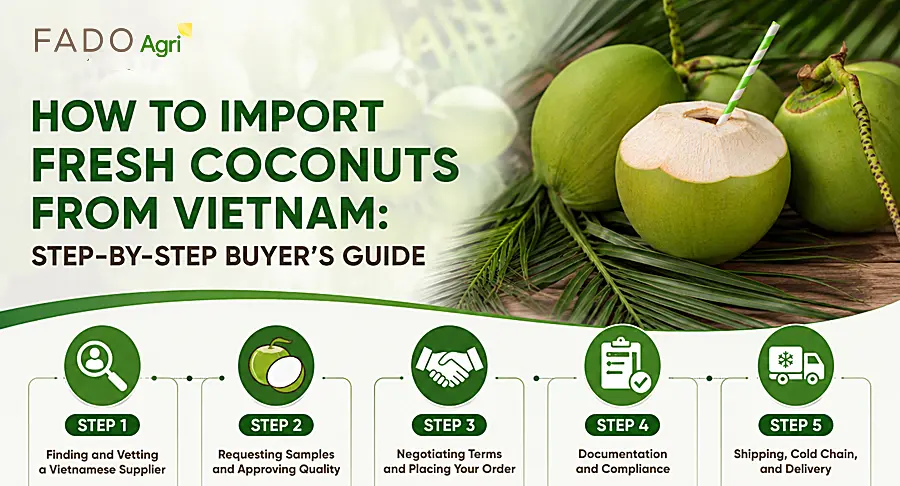

Vietnam ships millions of whole young coconuts every year, and the buyers who source consistently well all share one thing in common: they know exactly what to ask for before the first container moves. This guide covers everything an importer needs to evaluate whole young coconut from Vietnam: how the best fruit is grown and graded in Ben Tre and Tien Giang, what specifications to lock into a purchase agreement, how a container is loaded and sealed to preserve freshness, and what documentation to expect at every customs checkpoint. At Fado Agri, we’ve handled 500+ containers per year across 10+ internationally certified markets, and this article reflects what we’ve learned doing it for 10+ years.
1. What Is Whole Young Coconut from Vietnam?
1.1 Defining “Young Coconut” in the Export Context
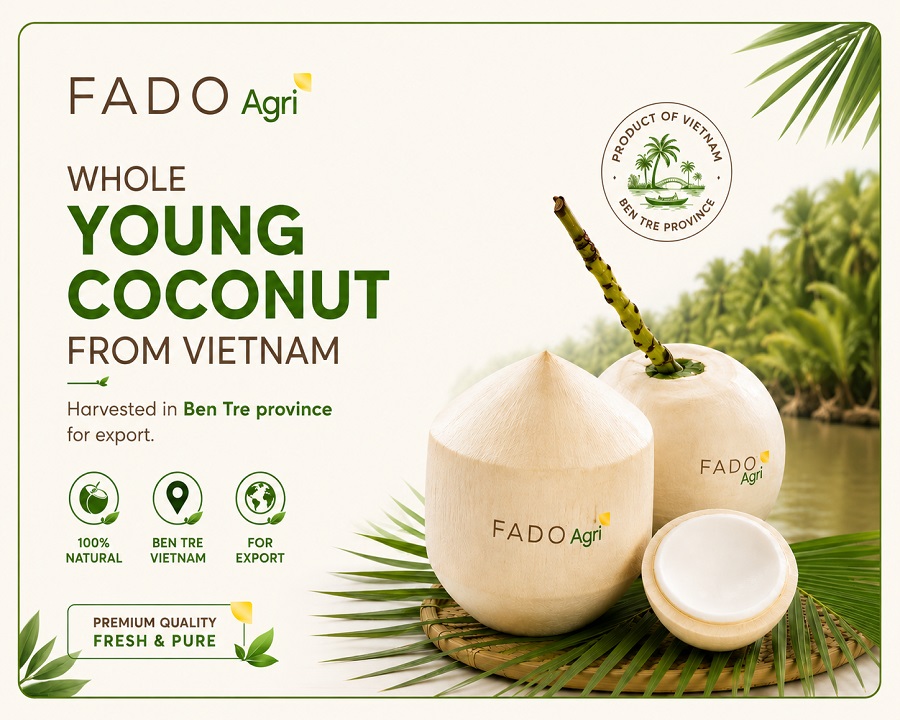
A whole young coconut is harvested at 6-8 months of age, before the white meat has hardened and while the internal water content is at its peak. For export purposes, “whole” means the husk is fully or partially retained, providing a natural protective shell during transport and an extended shelf life compared to trimmed or peeled formats.
Buyers often ask whether young coconuts are the same product as “green coconuts.” The answer depends on the trimming method. In whole format, the outer green husk is kept largely intact. The fruit’s internal water volume typically ranges from 250-350 ml per nut, with a thin, jelly-like meat layer that is the hallmark of premium young fruit. Vietnamese young coconuts, particularly from the Ben Tre and Tien Giang provinces, are consistently recognized for superior water sweetness and meat texture, driven by the Mekong Delta’s mineral-rich soil and subtropical climate.
1.2 Why Ben Tre and Tien Giang Set the Standard
Ben Tre is Vietnam’s coconut capital, accounting for the majority of the country’s commercial coconut output. The province’s coconut belt sits along the Mekong River’s distributaries, where alluvial soil, consistent humidity, and natural tidal irrigation create ideal growing conditions. Tien Giang, adjacent to Ben Tre, provides a complementary supply base, extending harvest windows and ensuring volume stability across the year.
Fado Agri sources from certified farms in both provinces. Harvest is chemical-free, and quality control begins in the field, not the factory. Field supervisors inspect fruit at the tree before any harvesting tool is applied, rejecting immature, over-mature, or pest-affected nuts on-site. This upstream gatekeeping is what makes the difference between a consistent container and a high-return-rate shipment.
Read more: Bald (Shaved) Coconut Vietnam: Specifications & B2B Wholesale Supply
2. Sourcing Process: From Certified Farms to the Packing Floor
2.1 Farm Selection and Harvest Protocols
Fado Agri does not purchase from open markets. All coconut supply runs through a network of contracted farms and cooperative partners who operate under GLOBALG.A.P-aligned growing standards. Farm onboarding includes soil testing, pesticide-use audits, and traceability registration, every farm is mapped and coded into Fado Agri’s internal tracking system.
Harvest timing is managed to a 6-8 day cycle, ensuring fruit is consistently at the right maturity stage. Harvested nuts are transported to the packing facility within 24 hours of picking, a tight window that directly impacts the freshness profile arriving at destination ports.
2.2 Post-Harvest Handling and Grading at the Factory
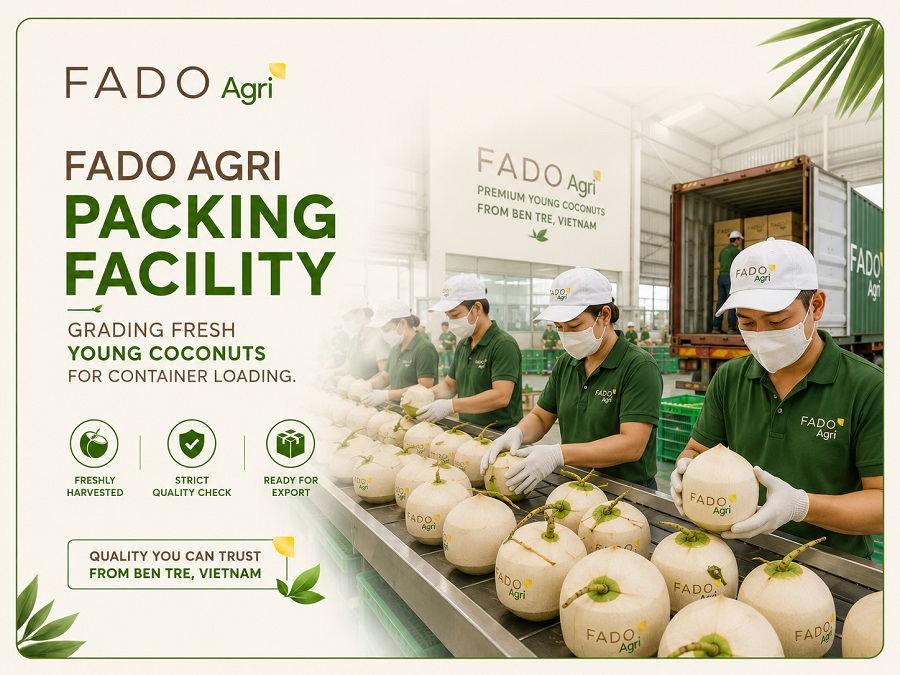
At the packing facility, incoming fruit goes through a 4-stage grading line:
- Visual inspection, skin integrity, husk condition, color uniformity
- Weight sorting, separation by weight class (typically 0.8 kg-1.5 kg per nut, depending on buyer specification)
- Water-shake test, auditory and tactile check for adequate water volume inside the fruit
- Surface treatment, natural wax coating applied where required for moisture retention and shelf-life extension during long-haul shipping
Only fruit passing all four stages proceeds to packing. Rejection rates at this stage average 8-12%, which reflects rigorous standards rather than high defect rates at origin, because field-level screening has already removed the worst candidates upstream.
3. Product Specifications: What Importers Lock Into Contracts
3.1 Size, Weight, and Quality Parameters
Whole young coconut from Vietnam exported by Fado Agri is available within the following verified specification ranges:
| Parameter | Standard Range | Notes |
| Fruit age at harvest | 6-8 months | Confirmed by farm harvest log |
| Individual weight | 0.8 kg – 1.5 kg | Buyer-specified weight class |
| Water volume | 250-350 ml/nut | Measured by batch sampling |
| Husk condition | Intact, no deep cuts | Protects fruit during transit |
| Shelf life (refrigerated) | 30-45 days | At 10-13°C with adequate ventilation |
| Certifications | FDA (US), GLOBALG.A.P, HACCP | Available upon request |
OEM packaging is available for buyers who require custom branding, including branded mesh bags, poly-wrapped trays, and carton printing. Minimum order quantities and packaging lead times are confirmed at the contract stage.
3.2 Available Cut Types and Packaging Formats
Fado Agri supplies fresh coconut in six formats: Conical Peeling, Whole, Diamond Cut, Easy Open, Bald, and Lid On. For whole young coconut specifically, the most common export formats are:
- Whole (full husk retained), preferred for Middle East, China, and Southeast Asian markets
- Bald (outer husk partially removed), common for retail-ready presentation in Japan and South Korea
- Easy Open (pre-scored top), increasingly requested for foodservice and convenience retail channels
Packaging per carton: 6, 8, 9, or 12 fruits per carton depending on weight class and buyer preference. Net weight per carton is typically 8-12 kg.
4. Container Loading Whole Young Coconut from Vietnam: Configurations and Cold Chain
4.1 Standard Container Configurations
Loading whole young coconut from Vietnam correctly is as important as sourcing it correctly, misloaded containers cause pressure damage, accelerated fermentation, and compressed return claims.
Fado Agri’s standard container configurations for whole young coconut:
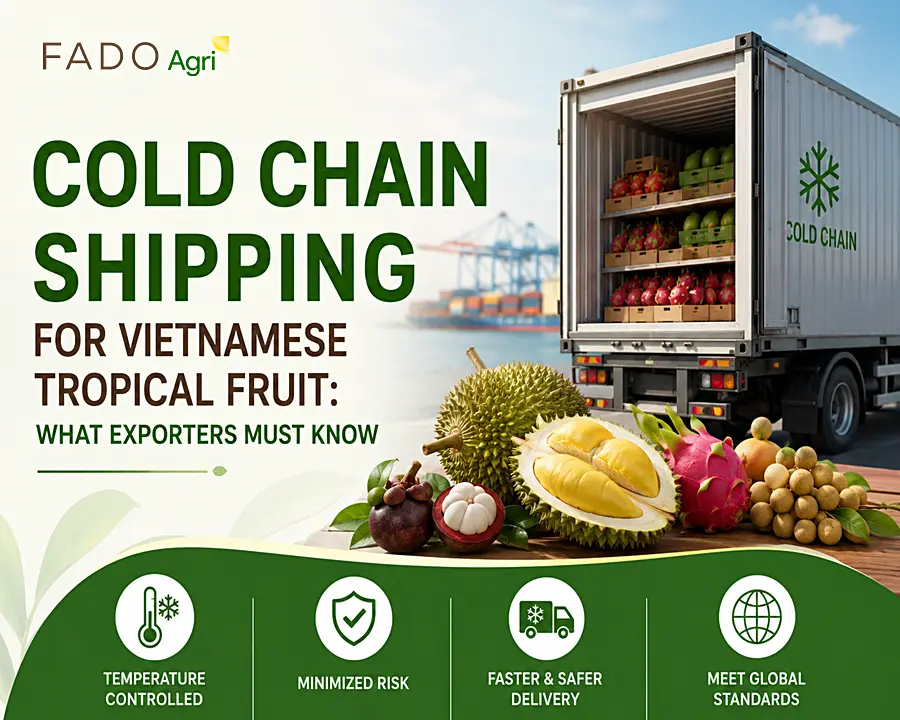
- 20-foot reefer container: approximately 1,600-1,800 cartons (depending on carton size and stacking pattern)
- 40-foot reefer container: approximately 3,200-3,600 cartons
- Temperature setting: 10-13°C with 85-90% relative humidity
- Loading pattern: palletized with cross-stacking to allow airflow between carton rows; pallet count per 40-footer is typically 20 standard EUR pallets
Cartons are stacked no more than 8 layers high to prevent bottom-row compression. Load cells are spot-checked during packing. A loading report with photographic documentation of container fill, sealing, and temperature logger placement is provided to buyers as part of the standard shipment file.
4.2 Reefer Settings and Transit Management
For long-haul routes to the Middle East, UAE, Saudi Arabia, and Australia, transit times range from 12 to 28 days depending on routing. Fado Agri configures reefer units with calibrated temperature loggers that record conditions every 30 minutes throughout transit. Buyers receive the logger readout as part of post-shipment documentation, a practice that supports insurance claims if cold chain deviation is ever alleged at destination.
Read more: Conical Peeling Coconut: Vietnam’s Signature Pre-Trimmed Young Coconut
5. Export Documentation and Compliance
5.1 Standard Document Set for Each Shipment
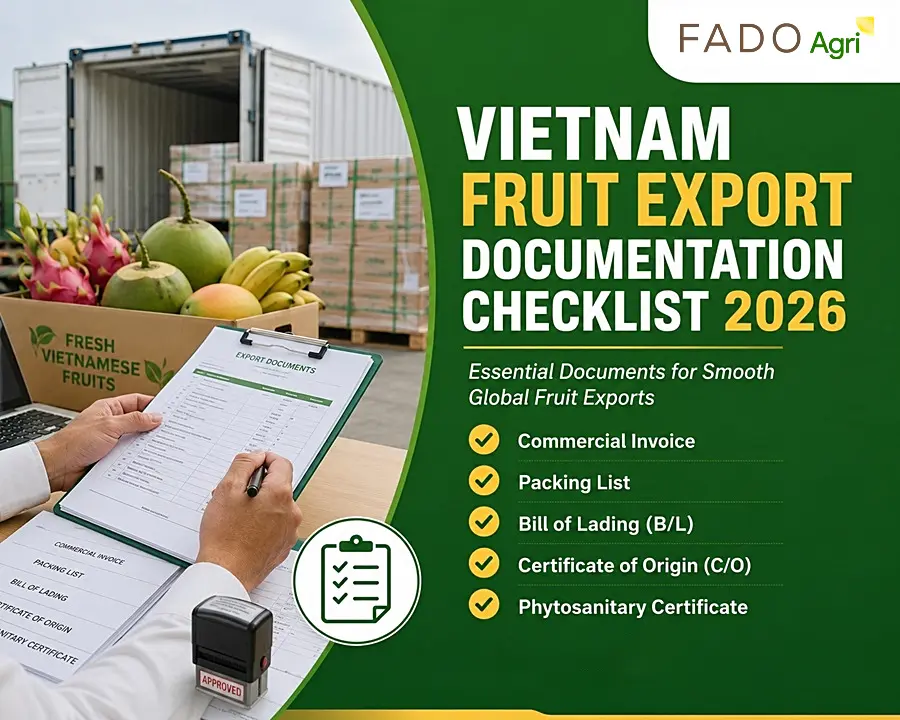
Every Fado Agri whole young coconut shipment is shipped with a verified document package including:
- Commercial Invoice, with HS code, unit price, and total FOB/CIF value
- Packing List, carton count, gross/net weight per container
- Bill of Lading (B/L), issued by the nominated shipping line
- Phytosanitary Certificate, issued by Vietnam’s Plant Protection Department (PPD)
- Certificate of Origin (CO), Form E (ASEAN-China), Form D (ASEAN), or standard CO depending on buyer’s country
- GLOBALG.A.P / HACCP Certificate, available per lot if requested
- Temperature Logger Report, provided post-arrival
For buyers importing into the United States, FDA prior notice is filed by Fado Agri’s designated agent as part of the standard service.
5.2 Trade Terms Available
Fado Agri operates on FOB (Ho Chi Minh City or Cat Lai Port) as the primary trade term. CIF is available for established partners. For buyers requiring DDP (Delivered Duty Paid) arrangements into specific markets, Fado Agri can facilitate through its UAE (Ajman) and Malaysia (Penang) offices.
Frequently Asked Questions
What is the minimum order quantity for whole young coconut from Vietnam?
Fado Agri’s minimum order is one full 20-foot reefer container of whole young coconut. Smaller trial orders may be considered for new partners at confirmed market rates, subject to commercial discussion. Contact our team to discuss your specific volume requirements.
How long does it take to prepare a container of whole young coconut?
Lead time for fresh young coconut is a minimum of 5 days from purchase order confirmation to container sealing. This includes farm harvest scheduling, factory grading, packing, and pre-shipment inspection. Buyers with recurring orders benefit from a pre-scheduled harvest calendar, reducing lead time variability.
Are Fado Agri’s coconuts certified organic?
Fado Agri’s coconuts are grown chemical-free and comply with GLOBALG.A.P standards. Certified organic designation under USDA-NOP or EU organic regulation is available for select farm lots, please specify this requirement at the inquiry stage so the appropriate farm source can be allocated.
What markets does Fado Agri currently export whole young coconut to?
Active markets include the UAE, Saudi Arabia, Kuwait, China, Japan, South Korea, Malaysia, Australia, and the United States. Fado Agri holds the relevant import compliance documentation for each of these markets.
Can I use my own brand packaging on Fado Agri coconuts?
Yes. OEM packaging is available, your brand label, our supply chain. This applies to carton printing, poly-wrap branding, and mesh bag labeling. Artwork files and lead times for custom packaging are confirmed during the contract stage.
How does Fado Agri ensure freshness over long transit routes?
Reefer containers are set to 10-13°C with calibrated temperature loggers. With a shelf life of 30-45 days under proper cold chain conditions, whole young coconut reaches most destination markets well within its freshness window, including routes to the Middle East (12-18 days) and Australia (10-14 days).
What happens if there is a quality dispute at destination?
Fado Agri provides post-arrival temperature logger data, batch grading records, and loading photos as part of every shipment file. These documents form the basis of any dispute resolution process. Our team in UAE (Ajman) and Malaysia (Penang) can assist with on-the-ground follow-up for regional markets.
Closing: Sourcing Whole Young Coconut from Vietnam with Confidence
For importers who need reliable volume, traceable sourcing, and documentation that holds up at every customs checkpoint, whole young coconut from Vietnam, sourced through a certified, transparent supply chain, represents one of the most consistent opportunities in the tropical fruit trade. Fado Agri, established in 2016 and exporting 500+ containers per year across 10+ internationally certified markets, is structured to support buyers from first inquiry through recurring annual contracts.
We don’t just sell produce, we partner with buyers every step of the way, from farm to final destination.
Ready to request specifications or a container quote? Contact Fado Agri’s export team directly:
- 📞 Hotline: (+84) 908 479 339
- 📧 Email: [email protected]
- 🌐 Website: fadoagri.com