

Vietnam ships hundreds of millions of fresh coconuts to global markets every year and the overwhelming majority of them originate from a single province nestled in the heart of the Mekong Delta. When experienced importers ask why Ben Tre coconut consistently outperforms other sourcing origins in terms of water volume, flesh quality, and shelf life, the answer is not branding, it is geography, agronomy, and decades of farming knowledge concentrated in one place. At Fado Agri, our sourcing operations are rooted in Ben Tre and neighboring Tien Giang for reasons that hold up under the most rigorous buyer scrutiny.
1. What Makes Ben Tre the Coconut Capital of Vietnam
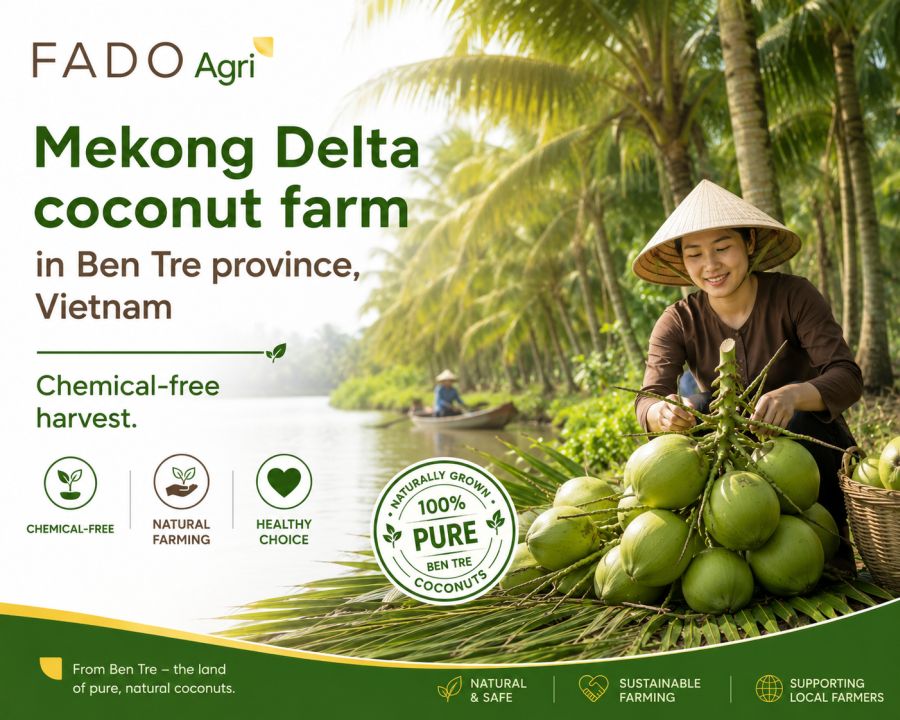
Ben Tre Province is located at the northern edge of the Mekong Delta, where the Mekong River divides into nine distributaries before reaching the South China Sea. This geography creates a landscape of interlocking rivers, canals, and alluvial plains and it is precisely this environment that has made Ben Tre the undisputed center of Vietnam’s coconut production for over a century.
1.1 The Soil and Water Advantage
The alluvial soil of Ben Tre is continuously refreshed by seasonal flooding from the Mekong River system. Rich in organic sediment, low in heavy metals, and naturally well-drained despite high moisture content, this soil profile produces coconut trees that are notably more productive and longer-lived than palms grown in inland or highland conditions. The province’s average annual rainfall of 1,200–1,500 mm, combined with its proximity to tidal waterways, ensures that trees receive consistent irrigation without the salt stress common in coastal growing zones.
Buyers often ask whether the coconut water quality differs by origin. The answer is yes, measurably. Coconuts grown in Ben Tre’s alluvial belt consistently yield a higher volume of coconut water per nut, with naturally balanced sweetness and lower acidity compared to fruit sourced from sandy coastal soils or upland regions.
1.2 A Monoculture Built Over Generations
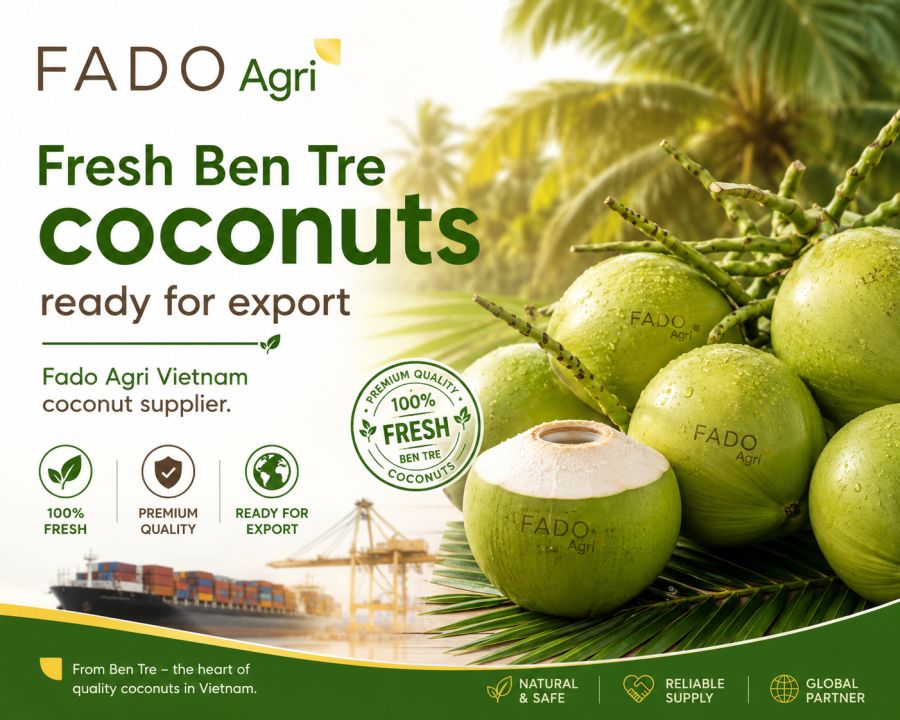
Ben Tre has cultivated coconuts as its primary crop for generations. Unlike provinces where coconut is grown as a secondary or intercrop, Ben Tre’s farming families have developed specialized knowledge around variety selection, harvest timing, and post-harvest handling. The dominant variety grown for export, the Tall Green Coconut (Dừa Xiêm), is selected precisely for its water-to-flesh ratio, the thickness and whiteness of its flesh, and its ability to maintain freshness across 21–28 days of transit, which is the minimum requirement for most Middle East and Asia-Pacific import routes.
Read more: Indonesian Longan from Vietnam Supply Chain: Export Format Guide
2. Why Ben Tre Coconut Meets Global Import Standards
Sourcing from a high-quality origin means nothing if the supply chain cannot consistently deliver fruit that passes customs, meets food safety requirements, and arrives in sellable condition. This is where Ben Tre’s infrastructure advantage becomes equally important.
2.1 Proximity to Processing Facilities
Ben Tre and neighboring Tien Giang province together host the highest concentration of coconut processing and export facilities in Vietnam. Fado Agri’s partner factories in this region operate to FDA, GLOBALG.A.P, and HACCP certification standards. The short distance between farm and facility, often less than 30 kilometers, means harvested coconuts move from tree to cold storage within hours. This dramatically reduces the temperature abuse and microbial load that can compromise shelf life.
2.2 Documentation-Ready Supply Chain
Importers shipping into the United States, Japan, South Korea, the UAE, and Australia face strict phytosanitary requirements. Every shipment of fresh coconut from Fado Agri is accompanied by a full documentation package: Phytosanitary Certificate, Certificate of Origin (CO), Bill of Lading (B/L), and all applicable food safety compliance records aligned with FDA import regulations and GLOBALG.A.P traceability protocols.
Fado Agri exports 500+ containers per year, and our lead time for fresh coconut is a minimum of 5 days per order, a commitment built on the short supply chain distance between Ben Tre farms and Ho Chi Minh City ports.
3. Six Cut Formats – Tailored for Every Market
One of the most practical reasons global importers prefer working with a structured Ben Tre coconut supplier rather than sourcing ad hoc is cut format flexibility. Different markets have different retail and food service requirements, and coconuts that arrive in the wrong format for a market simply do not sell.
Fado Agri offers fresh coconuts from Ben Tre in six certified cut formats:
- Conical Peeling, The most common export format; husk partially removed in a conical shape for easy drinking. Preferred in the Middle East and Southeast Asia.
- Whole, Full husk intact; ideal for long-distance shipping and markets that prefer minimal processing.
- Diamond Cut, Decorative husk trimming for premium retail and hospitality channels.
- Easy Open, Pre-scored top for effortless consumer access; increasingly popular in convenience retail.
- Bald, Fully husked; compact for high-density packing and industrial or food-service buyers.
- Lid On, Husked with a lid retained for hygiene and presentation; favored in Japanese and Korean premium retail.
OEM and ODM packaging is available across all formats, allowing distributors and supermarket chains to apply their own branding to Fado Agri’s supply.
4. Ben Tre Coconut By-Products: The Full-Value Chain
Beyond fresh coconuts, Ben Tre’s production ecosystem supports a complete range of coconut by-products, an important factor for importers who want to consolidate sourcing across multiple coconut-derived categories.
4.1 What By-Products Are Available
Fado Agri sources and exports the following Ben Tre-origin coconut by-products:
- Desiccated coconut, Dried, shredded coconut flesh used in confectionery and food manufacturing
- Coir fiber, Natural fiber extracted from coconut husks; used in horticulture, mattress manufacturing, and erosion control
- Coconut shell charcoal, High-carbon activated charcoal for industrial and water filtration applications
- Coconut cream and coconut milk, Processed from fresh Ben Tre coconut flesh under HACCP-controlled conditions
This diversification means buyers can build a multi-SKU coconut program with a single, certified supplier rather than managing separate sourcing relationships for each category.
4.2 Sustainability and Waste Reduction
Ben Tre’s coconut industry has long operated on near-zero-waste principles, a structural reality, not a marketing claim. Every component of a coconut harvested in Ben Tre has an established downstream use. Husks become coir. Shells become charcoal or crafts. Water and flesh go into food and beverage channels. For buyers whose procurement teams are reporting on sustainability metrics, this traceable, low-waste supply chain is a quantifiable advantage.
5. How Fado Agri Sources Ben Tre Coconuts: A 10-Step Supply Chain
Fado Agri’s transparent supply chain covers every stage from field selection to container loading. Here is how it works:
- Farm selection and registration, Only farms meeting GLOBALG.A.P pre-qualification standards enter our sourcing network
- Variety and maturity assessment, Agronomists confirm harvest readiness based on water content and husk condition
- Field harvest, Chemical-free harvest conducted by trained farmers; fruit handled without ground contact
- Transport to facility, Refrigerated or shade-covered transport within hours of harvest
- Incoming quality inspection, Random sampling for water volume, flesh thickness, and microbial load
- Processing and cutting, Husk trimming and cutting to buyer-specified format in HACCP-certified facilities
- Quality grading and sorting, Manual and visual inspection; non-conforming fruit rejected
- Packaging, OEM or standard Fado Agri packaging; carton labeling to market-specific requirements
- Pre-shipment inspection, Third-party or buyer-appointed inspection available on request
- Container loading and documentation, FOB or CIF terms; complete documentation package issued within 24 hours of loading
Transparent at every stage, this is not a promise. It is a process built to withstand the scrutiny of FDA, GLOBALG.A.P, and the customs authorities of 10+ internationally certified markets.
Read more: Why Indonesian Longan is becoming a preferred choice for global fruit importers?
Frequently Asked Questions About Ben Tre Coconut
Why is Ben Tre famous for coconuts?
Ben Tre Province in Vietnam’s Mekong Delta has cultivated coconuts as its primary crop for over a century. The province’s alluvial soil, consistent rainfall, and proximity to river systems produce coconuts with superior water volume, flesh quality, and shelf life. Ben Tre accounts for the largest share of Vietnam’s fresh coconut export volume.
What makes Ben Tre coconuts better for export? Ben
Tre coconuts are prized for their high coconut water content, naturally sweet flavor profile, and thick white flesh, qualities shaped by the Mekong Delta’s alluvial growing conditions. Combined with short farm-to-factory distances and certified processing facilities (FDA, GLOBALG.A.P, HACCP), Ben Tre coconuts consistently meet the food safety and shelf life requirements of demanding import markets.
Does Fado Agri export fresh coconuts from Ben Tre?
Yes. Fado Agri sources fresh coconuts from Ben Tre and Tien Giang provinces and exports them to markets including the UAE, Saudi Arabia, Kuwait, China, Japan, South Korea, Malaysia, the United States, and Australia. We offer six cut formats and OEM/ODM packaging options, with a minimum lead time of 5 days per container.
What certifications cover Fado Agri’s Ben Tre coconut supply chain?
Fado Agri’s coconut supply chain operates under FDA (United States), GLOBALG.A.P, and HACCP certifications. All shipments are accompanied by Phytosanitary Certificates, Certificate of Origin (CO), and Bill of Lading (B/L) documentation.
Can I order coconut by-products alongside fresh coconuts?
Yes. Fado Agri supplies coconut by-products including desiccated coconut, coir fiber, coconut shell charcoal, coconut cream, and coconut milk, all sourced from Ben Tre’s production ecosystem. Buyers can consolidate fresh and processed coconut sourcing into a single supply relationship.
What is the minimum order quantity for Ben Tre fresh coconuts?
Fado Agri operates at export container scale, shipping FOB or CIF terms. For precise MOQ, pricing, and container specifications, contact our team directly: (+84) 0908 479 339 | [email protected].
Why Ben Tre Coconut Remains the Standard for Serious Importers
When procurement teams evaluate tropical fruit suppliers, they are not just buying a product, they are buying supply chain reliability, documentation integrity, and a partner who understands what it takes to move fresh produce across three time zones without a quality failure. Why Ben Tre coconut continues to dominate Vietnam’s export volumes is not a mystery: it is the result of the right soil, the right farming knowledge, and the right infrastructure, all concentrated in one province and connected to global markets through suppliers like Fado Agri who have built 10+ years of export experience around this origin.
If your importing operation requires consistent Ben Tre coconut supply, whether fresh, by-product, or a combination, Fado Agri is ready to build that program with you.
Contact Fado Agri:
- Hotline: (+84) 908 479 339
- Email: [email protected]
- Website: fadoagri.com