

Why Coconut Shell Charcoal from Vietnam Deserves a Closer Look
If you are sourcing charcoal for hookah lounges, BBQ retail brands, or industrial carbon applications, the raw material beneath the product matters more than most buyers realize. Coconut shell charcoal — made from the hard inner shell of the coconut — consistently outperforms wood-based charcoals in heat output, burn duration, and ash purity. Vietnam, as one of the world’s largest coconut-producing countries, sits at the center of this supply chain with a growing export infrastructure built around both hookah-grade and industrial-grade product lines.
At Fado Agri, coconut shell charcoal is part of a fully integrated supply model. The same coconut that we export as fresh fruit generates shells that feed our by-product processing stream — a traceable supply chain that starts in the plantations of Ben Tre and Tien Giang provinces. This article is a practical reference for importers evaluating Vietnam as a supplier for coconut charcoal at any grade or volume.
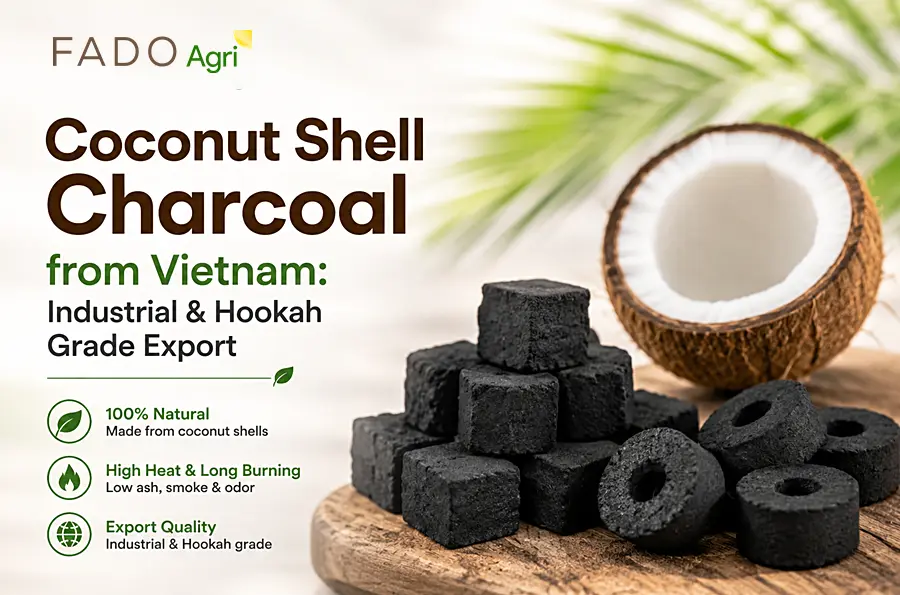
What Is Coconut Shell Charcoal and How Is It Made?
Coconut shell charcoal is produced by pyrolysis — the controlled combustion of coconut shells in low-oxygen kilns at temperatures typically between 700°C and 900°C. This process drives off moisture and volatile compounds, leaving behind a dense carbon structure with very low ash content and high calorific value. The raw shells used are a by-product of coconut processing: after the meat, water, and husk are extracted for other uses, the hard inner shell is carbonized rather than discarded.
From Shell to Charcoal: The Processing Steps
After kiln carbonization, the raw charcoal is ground and mixed with a natural binder — typically tapioca starch — then compressed into specific shapes using industrial briquette presses. Common shapes include finger/stick (for hookah), cube (for hookah and BBQ), hexagonal pillow (for BBQ retail), and flat disc. Briquettes are then dried, cooled, quality-tested, and packed according to the buyer’s specification. The entire production cycle from raw shell to export-ready briquette typically takes 10–15 days depending on volume and drying conditions.
For industrial activated carbon applications, the process is different: carbonized shell material is further processed through steam or chemical activation at temperatures up to 1,000°C, dramatically increasing surface area and porosity. This activated form is used in water filtration, air purification, gold recovery, and pharmaceutical manufacturing — a separate product category with its own certification and specification requirements.
Hookah Charcoal vs BBQ Briquette vs Activated Carbon: What Actually Differs
These three end-use categories share the same raw material but diverge sharply in processing, specification, and market compliance requirements. Understanding the differences is the first step to sourcing the right grade.
| Type | Shape | Ash % | Burn Time | Heat Output | Primary Market |
|---|---|---|---|---|---|
| Hookah / Shisha Charcoal | Finger, Cube (25mm–33mm) | <3% | 45–90 min | 7,000–8,000 kcal/kg | Middle East, Europe, USA |
| BBQ Briquette | Hex Pillow, Cube, Log | 3–8% | 90–120 min | 6,500–7,500 kcal/kg | EU, North America, Australia |
| Industrial / Activated Carbon | Granule, Pellet, Powder | Varies by grade | N/A (not combustion use) | N/A | USA, EU, Japan, South Korea |
| Raw Carbonized Shell | Irregular lump | 5–10% | 60–80 min | 6,000–7,000 kcal/kg | Industrial re-processors |
What Quality Specs Define Premium Hookah Charcoal?
Premium hookah charcoal is defined by three non-negotiable parameters: ash content below 3%, a clean odorless burn with no chemical smell, and consistent ignition within 3–5 minutes. Buyers in the UAE and Saudi Arabia in particular apply strict retail shelf standards — charcoal that produces visible white ash quickly, leaves dark residue on the bowl, or emits any chemical odor will be rejected regardless of price. Fixed carbon content of 75–80% or higher is the benchmark for hookah-grade product. Moisture content must typically stay below 8% to ensure reliable ignition in humid retail environments.
Heat output in the 7,000–8,500 kcal/kg range ensures that a single piece of hookah charcoal maintains the bowl temperature needed for a 45–90 minute session. In our experience, buyers sourcing for premium shisha lounge chains require lab reports confirming calorific value, ash content, and volatile matter before committing to a container order. We recommend requesting a COA (Certificate of Analysis) from any Vietnamese supplier before approving a sample.
Certifications Required for EU and Middle East Charcoal Import
Phytosanitary compliance for coconut charcoal varies significantly by destination market and end use. For the EU, BBQ charcoal sold to consumers must comply with EN 1860-2 standard, which governs charcoal and charcoal briquettes for barbecuing — this covers ash content, moisture, and labeling requirements including a prohibition on chemical lighter fluid additives. For hookah charcoal, the EU does not have a specific unified standard, but individual country labeling laws and REACH chemical compliance apply.
What About Middle East Market Requirements?
In the Gulf Cooperation Council (GCC) markets — UAE, Saudi Arabia, Kuwait — imported charcoal must typically comply with GSO standards and may require a Certificate of Conformity, a phytosanitary certificate from Vietnam’s MARD-authorized agencies, and a fumigation certificate confirming the product is pest-free. Halal certification is generally not required for charcoal but may be requested for activated carbon used in food-adjacent applications. Fado Agri holds FDA, GLOBALG.A.P, and HACCP certifications, and our export documentation is aligned with multi-market compliance requirements across our 10+ certified export destinations.
Vietnam vs Indonesia: Which Country Supplies Better Coconut Shell Charcoal?
Vietnam and Indonesia are the two dominant origins for coconut shell charcoal in global trade, and the honest answer is that both can supply quality product — the difference lies in supply chain depth, traceability, and production consistency.
| Factor | Vietnam | Indonesia |
|---|---|---|
| Coconut Shell Supply | High — Ben Tre & Tien Giang major hubs | Very high — Sulawesi, Java, Sumatra |
| Charcoal Quality Consistency | Strong — integrated processing from known farms | Variable — many small independent producers |
| Traceability | Higher — shorter supply chain from farm to factory | Lower on average — complex trader intermediary layers |
| Export Infrastructure | Established — Ho Chi Minh City and Mekong Delta ports | Established — Surabaya, Jakarta major ports |
| Price Competitiveness (FOB) | Competitive — comparable per MT basis | Often slightly lower on bulk lump charcoal |
| Certifications | FDA, HACCP, GLOBALG.A.P available from integrated exporters | Available but certification coverage is less uniform |
| MOQ Flexibility | 1 FCL from larger integrated exporters | 1 FCL — similar; smaller MOQs from traders |
| Lead Time | 25–40 days typical from order confirmation | 25–45 days typical |
Vietnam’s core advantage is supply chain integration. Because the largest coconut shell charcoal producers in Ben Tre and Tien Giang operate within the same ecosystem as fresh coconut processing — learn more about why Ben Tre is Vietnam’s coconut heartland — the shell supply is more consistent and traceable. Indonesia produces larger volumes overall, but the fragmented structure of small independent producers makes batch-to-batch quality more variable for buyers who need lab-verifiable specifications per shipment.
Packaging Formats: From 1kg Retail to Bulk Ton Bags
Packaging selection directly impacts landed cost, retail positioning, and customs classification in some markets. Vietnamese charcoal exporters typically offer the following format options.
Retail-Ready Packaging
Hookah charcoal destined for Middle East or European retail is typically packed in 1kg boxes (72–120 pieces depending on shape) or 500g promotional formats. Custom OEM packaging with buyer brand, barcode, language-specific labeling, and shelf-ready carton design is available from integrated suppliers. Fado Agri provides OEM and private label services for buyers seeking their own branded charcoal line without manufacturing their own product.
Foodservice and Lounge Supply Formats
Hookah lounges and food service operators typically order in 10kg master cartons containing multiple retail units, or in 5kg catering packs. BBQ briquettes for restaurant or catering use are often packed in 3–5kg kraft paper bags, bundled into 12–15kg export cartons. These formats reduce packaging cost versus retail while remaining manageable at the point of use.
Bulk Industrial Formats
For industrial activated carbon or bulk re-processing buyers, the standard export format is 25kg woven PP bags on pallets, or 1,000kg jumbo/bulk bags (super sacks). Moisture-barrier inner lining is standard for quality-conscious suppliers given charcoal’s hygroscopic nature during sea freight. Cold chain requirements do not apply to charcoal, but container loading must avoid contact with moisture-heavy cargo.
MOQ, Lead Time, and FOB Vietnam Price Guidance
For buyers planning their first inquiry, realistic figures from the Vietnamese market as of mid-2026 are as follows. Minimum order quantities for hookah charcoal briquettes from integrated suppliers typically start at one full container load (FCL), equivalent to approximately 14–18 metric tons depending on packaging density. Smaller trial orders below one FCL are sometimes available through consolidated shipments but at higher per-unit cost.
Price Range FOB Vietnam
FOB Vietnam pricing for hookah-grade coconut shell charcoal briquettes (finger or cube, <3% ash, premium specification) ranges from approximately USD 650–950 per metric ton depending on volume, shape complexity, and OEM packaging requirements [figures indicative, to be confirmed with current supplier quotes]. BBQ-grade briquettes with standard hexagonal shape and no retail packaging typically come in lower, in the USD 450–650 per metric ton range. Industrial-grade activated carbon is a distinct pricing category entirely, typically quoted per specification of iodine number, surface area (m²/g), and particle size — not comparable to combustion charcoal on a per-ton basis.
Lead time from order confirmation to vessel loading is typically 25–40 days for first-time orders requiring OEM packaging setup, and 20–30 days for repeat orders with existing packaging specifications. If you are importing into the UAE, Saudi Arabia, or Kuwait — markets where Fado Agri maintains active trade relationships — documentation turnaround for certificates of origin, phytosanitary compliance, and fumigation certificates is well-established.
How to Test Charcoal Quality Before Committing to a Full Order
Requesting a sample before placing a container order is standard practice and any reputable Vietnamese supplier will provide this. The meaningful tests to apply to a hookah or BBQ charcoal sample fall into two categories: practical burn tests and laboratory analysis.
Practical Burn Testing
Light a single piece and time the ignition — premium hookah charcoal should reach full glow within 4–5 minutes on an open flame or electric coil. Observe the color of the ash: it should be white-grey and minimal in volume. Smell the smoke — any sulphur, chemical, or wood-resin odor indicates impure raw material or chemical binder use, which will fail many market regulations and disappoint end consumers. The piece should hold its shape without crumbling for the full burn duration.
Laboratory Analysis
Request a COA covering at minimum: fixed carbon %, ash %, moisture %, volatile matter %, and calorific value (kcal/kg). For EU-bound product, heavy metal content testing (lead, cadmium, mercury) is increasingly requested by retailers even when not legally mandated. Reputable Vietnamese exporters working in certified facilities can provide third-party lab reports from accredited testing laboratories within Vietnam or can facilitate testing at buyer-nominated international labs prior to shipment.
Which Vietnamese Regions Supply the Best Coconut Shells for Charcoal?
The quality of coconut shell charcoal begins with the shell itself — and not all coconut-growing regions produce shells of equal density and carbon potential. Ben Tre and Tien Giang provinces in the Mekong Delta are Vietnam’s premier coconut regions and the source of the hardest, most mature shells available in the country. Mature coconut shells from these provinces — particularly from older, high-yield varieties — produce higher fixed carbon content and lower ash after carbonization compared to shells from younger trees or coastal sandy-soil regions. You can read more about what makes this region distinctive at Tien Giang’s role in Vietnam’s tropical fruit and coconut ecosystem.
Integrated processors who source shells directly from their own fresh coconut processing lines have a supply quality advantage — they control the maturity stage and variety of the shell entering the kiln. At Fado Agri, our supply chain for by-products including shells flows from the same farms that supply our fresh coconut export program, a model we describe in more detail in our farm-to-global-shelf export process overview.
Frequently Asked Questions
What is the difference between coconut shell charcoal and wood charcoal for hookah?
Coconut shell charcoal produces significantly lower ash (typically under 3%) compared to wood charcoal (often 8–15%), burns longer, and emits no wood-flavour compounds that interfere with shisha taste. It is the industry standard for premium hookah markets globally and commands a price premium over wood-based alternatives.
Is coconut shell charcoal the same as activated carbon?
No — they share the same raw material but are different products. Coconut shell charcoal is carbonized and compressed for combustion use (hookah, BBQ). Activated carbon undergoes an additional activation step that creates a highly porous surface structure used in filtration and industrial applications. They have separate supply chains, certifications, and pricing structures.
What certifications should I ask a Vietnamese charcoal supplier to provide?
For most export markets, request: a phytosanitary certificate from MARD-authorized agencies, a fumigation certificate, a Certificate of Origin (Form D for ASEAN, or Form B), and a Certificate of Analysis from an accredited lab. For EU BBQ products, EN 1860-2 compliance documentation is important. For GCC markets, a Certificate of Conformity to relevant GSO standards may be required by customs authorities.
What is a realistic MOQ for hookah charcoal from Vietnam?
Most integrated Vietnamese exporters set MOQ at one FCL (approximately 14–18 metric tons for hookah briquettes in retail packaging). Some suppliers offer consolidated shipments for smaller trial quantities at a higher per-unit rate. Custom OEM packaging typically requires a minimum print run quantity that may require 2–3 FCLs to be cost-effective.
Can I order custom shapes or sizes for my brand?
Yes — Vietnamese manufacturers with modern briquette presses can typically produce custom dimensions within standard tooling ranges. Common hookah shapes (finger 25x25mm, finger 33x33mm, cube) require no custom tooling. Unusual shapes may require tooling investment, which is typically a one-time cost recovered over repeated orders. OEM labeling and private label carton design are standard services from integrated exporters including Fado Agri.
How does sea freight affect coconut charcoal quality?
Coconut shell charcoal is hygroscopic — it absorbs moisture readily. Improperly sealed packaging or high-humidity container conditions can raise moisture content above acceptable levels, affecting ignition performance at destination. Buyers should specify moisture-barrier inner packaging (PE liner or foil laminate) and ensure containers are loaded in dry conditions. Transit times from Vietnam to Middle East ports are typically 14–21 days, and to European ports 25–35 days.
What is the price difference between hookah grade and BBQ grade FOB Vietnam?
Hookah-grade briquettes (under 3% ash, odorless, precision-cut shapes, often with retail packaging) typically price 25–45% higher per metric ton than standard BBQ-grade briquettes in bulk packaging. The premium reflects tighter raw material selection, additional QC steps, and packaging complexity rather than fundamentally different raw material costs.
How long does it take from order to delivery in Dubai or Jeddah?
From order confirmation to arrival at UAE or Saudi port, buyers should plan for approximately 45–65 days total: 25–40 days production and documentation in Vietnam, plus 14–21 days vessel transit. First-time orders requiring new OEM packaging setup may add 7–10 days. Fado Agri’s established trade relationships in UAE and GCC markets facilitate efficient documentation processing for these destinations.
Sourcing Coconut Shell Charcoal from Vietnam: Next Steps
Vietnam’s coconut shell charcoal sector offers importers a genuine combination of traceable raw material, integrated processing, and multi-market export capability that is difficult to match from fragmented supply bases. Whether you are building a private label hookah brand for Middle East retail, supplying premium BBQ briquettes to European distributors, or sourcing industrial-grade activated carbon precursors, the starting point is a supplier with documented supply chain integration and verifiable lab specifications.
If you are evaluating Vietnam as an origin for coconut shell charcoal, Fado Agri welcomes direct inquiry. We supply sample sets with COA documentation and can provide detailed specification sheets across hookah, BBQ, and industrial grades. Reach out through our website or contact details below to begin the conversation — no commitment required at the inquiry stage.