

Every coconut that arrives at a supermarket shelf in Dubai, Tokyo, or Sydney… began somewhere specific, a grove in Ben Tre or Tien Giang, Vietnam, where farmers harvest before the heat of the day and quality control starts before any factory sees the fruit. Understanding this journey from farm to global shelf is essential for any serious importer. It explains why Vietnamese coconuts consistently command confidence in demanding markets and why sourcing decisions made at the farm level determine everything that follows.
At Fado Agri, established in 2016 and operating with 10+ years of verified export experience, we have built a supply chain that makes this journey visible, traceable, and repeatable, 500+ containers per year, delivered across 10+ internationally certified markets.
1. From Farm to Global Shelf: Where the Journey Begins
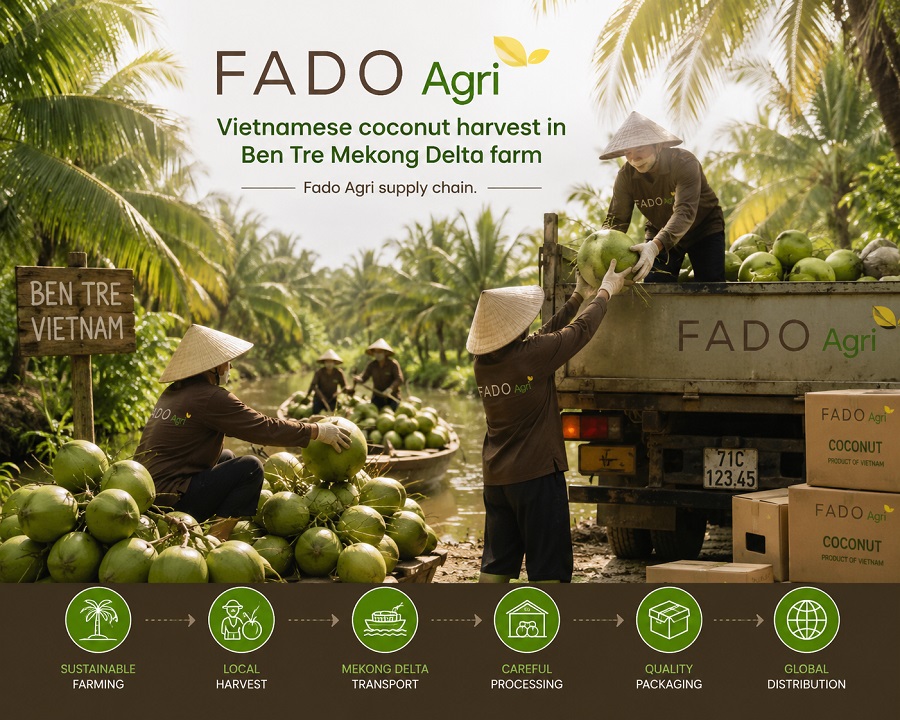
1.1 Vietnam’s Coconut Belt – Ben Tre and Tien Giang
Vietnam’s two primary coconut-producing provinces, Ben Tre and Tien Giang, are not interchangeable with any other growing region in Southeast Asia. The Mekong Delta geography, with its network of rivers, alluvial-rich soil, and consistent tropical climate, produces coconuts with a distinct water-to-flesh ratio and natural sweetness that buyers in the Middle East, Japan, and China have come to specify by origin.
Ben Tre alone accounts for a significant portion of Vietnam’s annual coconut output. Fado Agri sources exclusively from certified growing zones within these provinces, where farm-level compliance is verified before any harvest agreement is signed.
1.2 Chemical-Free Harvest Practices
Buyers often ask whether Vietnamese coconuts are grown under controlled pesticide standards. The answer, for Fado Agri’s sourcing zones, is yes, and it is verifiable. Our partner farms operate under GLOBALG.A.P certification standards, which govern the entire growing process: soil management, water usage, pesticide exclusion policies, and harvester training.
Harvest itself is manual and timed, coconuts are picked at precise maturity windows to ensure optimal water content and shell integrity for export. This is not a romantic detail; it is a compliance standard that directly affects shelf life and importer acceptance rates at destination ports.
Read more: Vietnam Coconut to South Korea: Buyer’s Sourcing Guide
2. The 10-Step Supply Chain: Transparent at Every Stage
Fado Agri’s export process follows a documented 10-step supply chain, a competitive differentiator that allows buyers to trace each container back to its field origin. Below is the framework that moves a coconut from grove to global shelf.
Step 1 – Farm Sourcing & Partner Certification
Farms are selected based on GLOBALG.A.P compliance, geographic location within Ben Tre or Tien Giang, and historical yield consistency. Non-certified farms are not onboarded.
Step 2 – Pre-Harvest Quality Inspection
Fado Agri field representatives conduct visual and sample inspections before harvest begins. Fruit that does not meet export grade specifications is flagged and excluded at this stage, not at the factory.
Step 3 – Harvest & Field Collection
Manual harvesting preserves shell integrity. Fruit is collected in ventilated crates and transported to the processing facility within defined time windows to prevent moisture loss or microbial exposure.
Step 4 – Factory Reception & Grading
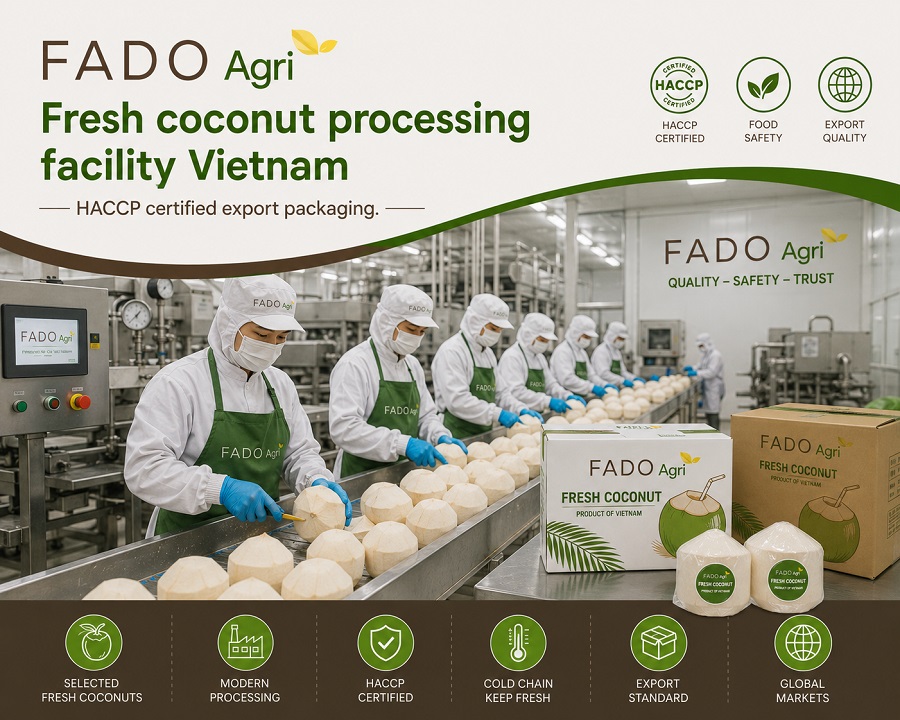
Upon arrival at the processing facility, each batch is weighed, graded by size and appearance, and logged into the traceability system. Any fruit showing bruising, discoloration, or structural damage is separated immediately.
Step 5 – Cutting & Processing to Buyer Specification
Fado Agri produces fresh coconuts in six distinct cut formats: Conical Peeling, Whole, Diamond Cut, Easy Open, Bald, and Lid On. Each format is processed to order, based on the importer’s market requirements and retail presentation standards.
Step 6 – HACCP-Compliant Processing Environment
All processing takes place in HACCP-certified facilities, with documented sanitation procedures, temperature monitoring, and worker hygiene protocols. This is a non-negotiable standard for export to the United States (FDA-compliant) and Japan.
Step 7 – Packaging & Labeling (OEM/ODM Available)
Coconuts are packed in buyer-specified cartons or nets. Fado Agri offers full OEM and ODM packaging options, importers can ship under their own brand with Fado Agri’s supply chain behind it. Label compliance for each destination market (Arabic labeling for the UAE, Japanese JAS formatting, etc.) is managed by our export documentation team.
Step 8 – Pre-Shipment Inspection & Documentation
Before any container is sealed, a pre-shipment inspection is conducted, either by a third-party inspector or Fado Agri’s internal QC team, depending on buyer preference. Export documentation is prepared in parallel: Phytosanitary Certificate, Certificate of Origin (CO), Bill of Lading (B/L), Packing List, and Commercial Invoice.
Step 9 — Container Loading & Cold-Chain Management
Fresh coconuts are loaded under controlled conditions. Fado Agri coordinates with licensed freight forwarders for FOB and CIF shipments, ensuring cold-chain continuity from the loading dock to the destination port.
Step 10 – Post-Shipment Tracking & Buyer Communication
Once the container is on the water, buyers receive tracking documentation and a dedicated contact point for any customs or arrival queries. Our four global offices, in Vietnam, UAE (Ajman), Malaysia (Penang), and Australia (New South Wales), provide regional support across time zones.
3. Certifications That Hold Up at Every Customs Checkpoint
3.1 FDA, GLOBALG.A.P, and HACCP – What They Mean for Importers
Certifications are only valuable if they match the compliance requirements of the destination market. Fado Agri holds three internationally recognized certifications that cover the world’s most demanding import markets:
- FDA (U.S. Food and Drug Administration): Required for export to the United States. Covers facility registration, labeling compliance, and food safety standards.
- GLOBALG.A.P: Farm-level certification covering responsible agricultural practices, pesticide management, and worker welfare, required by major European and Japanese retail chains.
- HACCP (Hazard Analysis and Critical Control Points): Processing-level certification governing food safety risk management throughout manufacturing and packaging.
Importers sourcing from non-certified suppliers face rejection risk at customs, recall liability, and reputational exposure. Fado Agri’s certification stack is maintained and audited annually, documentation is available on request before any purchase order is signed.
3.2 Phytosanitary Compliance by Market
Different destination markets have different phytosanitary protocols. The UAE, Saudi Arabia, and Kuwait require specific fumigation certifications. China enforces its own import registration requirements for fresh fruit. Japan requires origin-specific pest risk assessments. Fado Agri’s documentation team prepares market-specific phytosanitary packages as standard practice, not as an add-on service.
4. Markets, Lead Times, and What Serious Importers Need to Know
4.1 Where Vietnamese Coconuts Go
Fado Agri exports to 10+ internationally certified markets across four continents. Core markets for fresh coconut include the Middle East (UAE, Saudi Arabia, Kuwait), China, Japan, South Korea, Malaysia, the United States, Australia, and India. Each market has distinct sizing preferences, packaging requirements, and documentation standards, all of which are mapped in Fado Agri’s buyer onboarding process.
4.2 Lead Times as Commitments
Lead times for fresh coconut exports: minimum 5 days from confirmed purchase order to container loading. Stable supply cadence averages 2-3 days per container for repeat buyers with established sourcing agreements. These figures are operational commitments, not estimates.
For importers managing just-in-time supply chains or seasonal promotions, Fado Agri’s production planning team coordinates forward scheduling to prevent supply gaps, a service available to strategic partners within our network of 20 worldwide partners.
Read more: Vietnam Tropical Fruit to Japan: Premium Market Specifications
5. Coconut By-Products: Extending the Value Chain
The journey from farm to global shelf does not end with fresh coconuts. Vietnam’s coconut industry has developed a robust by-product sector, and Fado Agri participates in it:
- Coir fiber: Used in horticulture, landscaping, and erosion control products, exported to markets with strong agricultural and home garden sectors.
- Desiccated coconut: Processed coconut flesh, dried and graded for use in food manufacturing, bakery, and confectionery applications.
- Coconut shell products: Shell charcoal, shell-based activated carbon, and decorative products.
Buyers sourcing both fresh coconut and coconut by-products from a single supplier reduce documentation complexity and logistics overhead. Fado Agri accommodates mixed-container orders for qualified buyers.
Frequently Asked Questions
What makes Vietnamese coconuts from Ben Tre different from other origins?
Ben Tre coconuts grow in Mekong Delta alluvial soil with consistent tropical rainfall and river irrigation, conditions that produce fruit with a distinctively high water volume and balanced natural sweetness. The region’s farming culture has centered on coconut cultivation for generations, and GLOBALG.A.P-certified growers have formalized what was already strong agricultural practice. For importers supplying retail chains with quality-sensitive consumers, origin matters.
What certifications does Fado Agri hold for coconut exports?
Fado Agri holds FDA (United States), GLOBALG.A.P (farm-level), and HACCP (processing-level) certifications. These cover the compliance requirements of our primary destination markets including the USA, Japan, South Korea, the Middle East, and Australia. Full certification documentation is available prior to purchase order confirmation.
Does Fado Agri offer OEM or private label packaging for fresh coconut?
Yes. Fado Agri offers both OEM and ODM packaging options. Importers can ship fresh coconuts under their own brand identity, with Fado Agri managing supply chain, processing, and export documentation. Label compliance for destination markets, including Arabic labeling for the UAE and JAS formatting for Japan, is handled by our export team.
What is the minimum lead time for a fresh coconut order?
The minimum lead time from confirmed purchase order to container loading is 5 days. For buyers with standing sourcing agreements, Fado Agri maintains a stable supply cadence averaging 2-3 days per container. Forward scheduling is available for importers with seasonal or promotional volume commitments.
Which markets does Fado Agri currently export fresh coconuts to?
Fado Agri exports to 10+ internationally certified markets including the UAE, Saudi Arabia, Kuwait, China, Japan, South Korea, Malaysia, the United States, Australia, and India. We have regional offices in Vietnam (HQ), UAE (Ajman), Malaysia (Penang), and Australia (New South Wales) to support buyers across time zones.
Can I source coconut by-products alongside fresh coconuts from Fado Agri?
Yes. Fado Agri exports coconut by-products including coir fiber and desiccated coconut in addition to fresh coconut in six cut formats. Mixed-container orders for fresh coconut and by-products are available for qualified buyers. Contact our export team to discuss volume and documentation requirements.
The Journey Continues With the Right Partner
From the first harvest in Ben Tre’s certified groves to the moment a coconut reaches a retail shelf in Dubai, Tokyo, or Sydney, the from farm to global shelf journey is defined by decisions made at every step, which farms to source from, which certifications to maintain, which documentation to prepare, and which buyers to partner with for the long term.
Fado Agri is built to manage that entire journey on behalf of serious importers. With 500+ containers exported per year, 20 strategic partners worldwide, and offices on four continents, we don’t treat sourcing as a transaction. We treat it as a supply chain responsibility that reflects on both parties.
If you’re evaluating Vietnamese coconut suppliers and need a partner whose compliance documentation, lead-time commitments, and origin traceability can hold up at any customs checkpoint on earth, we’d like to talk.
Contact Fado Agri:
Hotline: (+84) 908 479 339
Email: [email protected]
Website: fadoagri.com