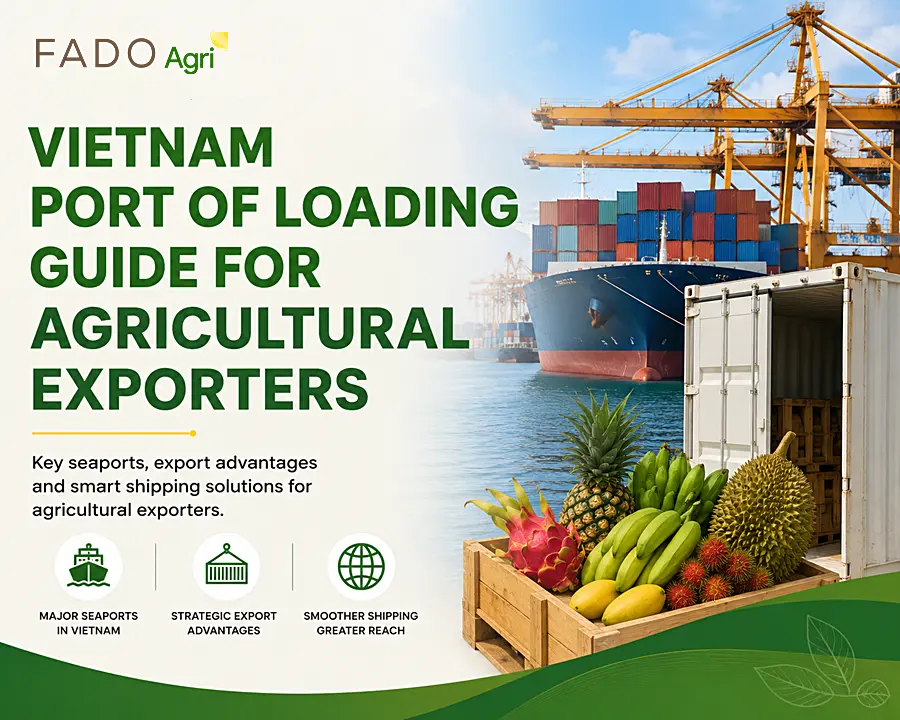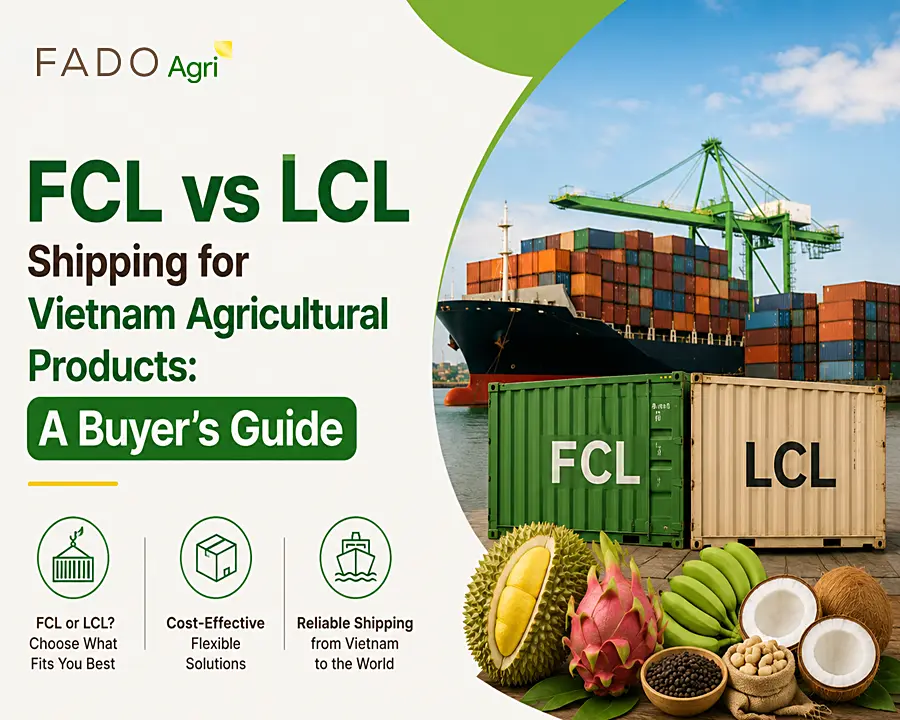

Japan receives more than 900,000 metric tons of fresh fruit imports annually, and Vietnam tropical fruit to Japan has become one of the fastest-growing trade corridors in Southeast Asian agri-export. For importers and distributors supplying Japanese supermarket chains, convenience stores, and wholesale markets, understanding Japan’s exacting entry requirements is not optional. It is the baseline for doing business.
At Fado Agri, we have been navigating these requirements since 2016, shipping 500+ containers per year across 10+ internationally certified markets, including Japan. This article covers what Japanese buyers actually need to know: the product specifications, certification requirements, phytosanitary protocols, and sourcing standards that determine whether a shipment clears customs, or gets turned away at the port.
1. Why Vietnam Tropical Fruit to Japan Is a High-Stakes Trade Corridor
Japan’s Ministry of Agriculture, Forestry and Fisheries (MAFF) and the Plant Protection Law set some of the strictest import rules for fresh produce in the world. Vietnam tropical fruit to Japan must meet pesticide residue standards that, in many cases, are more stringent than Codex Alimentarius guidelines.
1.1 Japan’s Regulatory Framework for Fresh Fruit Imports
Every fresh fruit shipment entering Japan must be accompanied by a Phytosanitary Certificate issued by the Vietnamese Ministry of Agriculture and Rural Development (MARD). This document certifies that the produce has been inspected and is free from quarantine pests, including fruit flies (Bactrocera spp.), which are a key concern for tropical species such as mango, dragon fruit, and longan.
Japan enforces a positive list system for agricultural chemicals, introduced under the Food Sanitation Act. Under this system, any pesticide not specifically listed is automatically restricted to 0.01 ppm, effectively a near-zero tolerance. For Vietnamese exporters, this means:
- All growing operations must maintain detailed pesticide application records
- Pre-harvest intervals must be strictly observed
- Residue testing must be completed by an accredited laboratory before shipment
1.2 Market Opportunity: What Japan Buys from Vietnam
Japan’s import basket from Vietnam spans a growing range of tropical species. Current high-demand categories include:
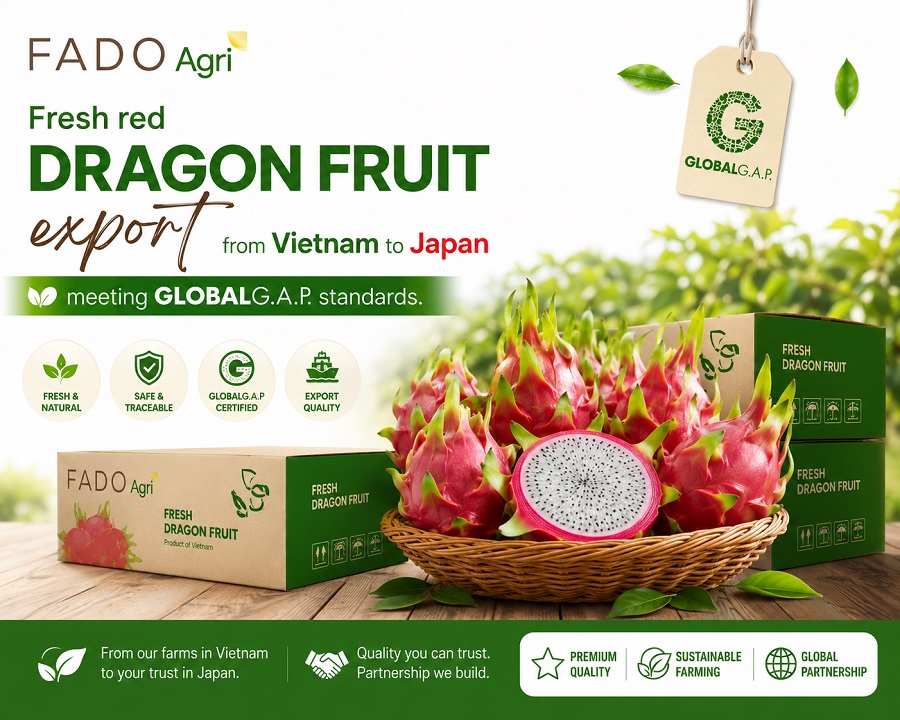
- Red Dragon Fruit, consistently popular in Japanese supermarkets due to its vibrant color, health positioning (antioxidants, fiber), and year-round availability from Vietnam’s Binh Thuan and Long An provinces.
- Cavendish Banana, a staple product where consistency of size, ripeness stage, and peel integrity are paramount for Japanese buyers.
- Seedless Lime, used in Japanese food service and retail; buyers require a thin peel, high juice content, and zero blemish tolerance.
- Taiwan Guava, gaining traction in Japanese premium fruit segments and gift-box markets
- Watermelon seasonal peaks align well with Vietnamese harvest cycles for the Japanese summer market.
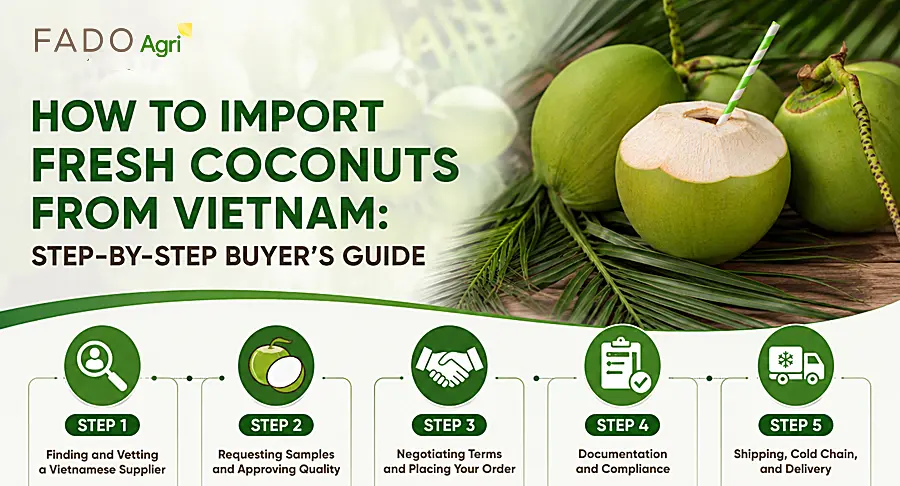
- Fresh Coconut, a growing category in Japanese health and beverage retail, available in six cut types from Fado Agri: Conical Peeling, Whole, Diamond Cut, Easy Open, Bald, and Lid On
Read more: Vietnam Coconut to India: Trade Guide & Phytosanitary Requirements
2. Premium Specifications That Japanese Buyers Require
The Japanese market does not negotiate on quality thresholds. What separates accepted shipments from rejected ones is adherence to precise physical, microbiological, and chemical specifications, before the fruit ever reaches Tokyo Bay.
2.1 Physical and Visual Grading Standards
Japanese buyers operate within a grading culture where fruit is evaluated as a premium consumer product. Typical specifications include:
- Uniformity of size and weight: size deviations exceeding ±5% are commonly rejected at distribution centers
- Color and ripeness stage: for dragon fruit, a deep magenta-red skin with firm flesh at Brix 13°-16° is the benchmark; for bananas, Japanese buyers typically specify green-tip to 3/4 yellow at port of entry
- Surface integrity: zero tolerance for cuts, bruising, fungal spotting, or sun scald, standard visual defect allowances in Japan are 2-3%, far below other Asian markets
- Packaging compliance: corrugated cartons must meet ISTA or similar drop-test standards; Japanese retailers often require bilingual Japanese-Vietnamese labeling
2.2 Certification Requirements at the Exporter Level
Buyers sourcing Vietnam tropical fruit to Japan through professional channels expect suppliers to carry internationally recognized production certifications. At Fado Agri, our supply chain is certified to:
- GLOBALG.A.P, the globally recognized standard for Good Agricultural Practices, covering pesticide management, soil health, water use, and worker welfare. Japanese importers treat GLOBALG.A.P as a baseline, not a differentiator.
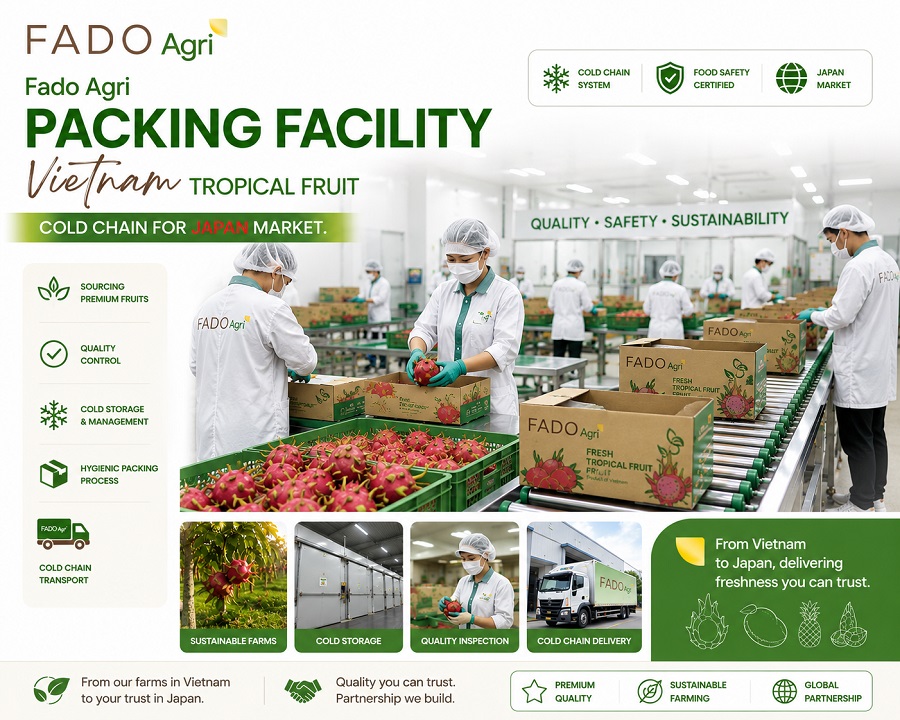
- HACCP, Hazard Analysis and Critical Control Points, applied across our packing and processing facilities to guarantee microbiological safety at every post-harvest stage
- FDA registration, for markets requiring US Food and Drug Administration compliance, with documentation that satisfies Japanese food safety analogues
2.3 Cold Chain Requirements and Lead Times
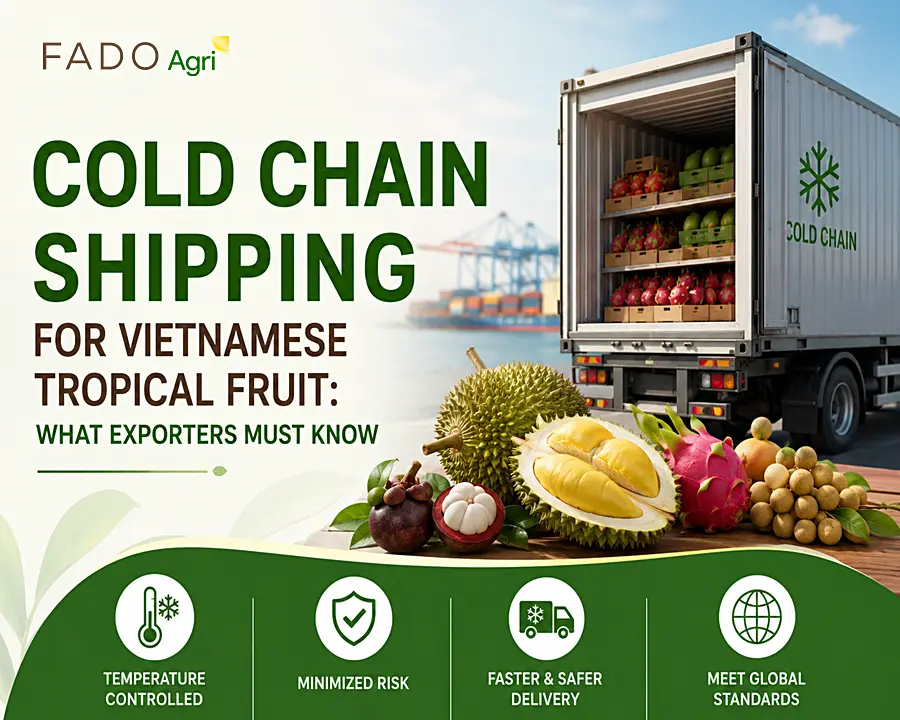
Japan’s distribution infrastructure is cold-chain-continuous. Produce that breaks the cold chain between harvest and delivery to Japanese distribution centers is commercially unacceptable. Fado Agri’s logistics framework for Japan-bound shipments requires:
- Pre-cooling to product-specific target temperatures immediately post-harvest
- Refrigerated container loading within a controlled-temperature facility
- Reefer temperature monitoring with downloadable data logs for Japanese customs inspection
- Lead times: Red Dragon Fruit and Seedless Lime ship within 4-5 days from order confirmation; Cavendish Banana within 2-3 days; Fresh Coconut within a minimum of 5 days
3. Fado Agri’s 10-Step Supply Chain: Transparent at Every Stage
Buyers often ask how Fado Agri guarantees that the certification claims on paper match what arrives in the container. The answer lies in our 10-step supply chain, a traceable, documented process that runs from farm to final destination.
- Field sourcing, direct relationships with certified farmers in Ben Tre, Tien Giang, and specialized growing zones across Vietnam.
- Pre-harvest inspection, agronomists assess pesticide residue levels, ripeness index, and pest-free status in the field, not the factory.
- Harvest scheduling, timed to export windows and Japanese buyer specifications for ripeness stage at arrival.
- First-mile transport, temperature-controlled transport from farm gate to packing facility within defined time windows.
- Receiving inspection, 100% visual grading and sampling at factory intake; lots that fail are rejected before entering the line.
- Packing and processing, conducted in HACCP-certified facilities with traceability codes assigned per carton.
- Laboratory residue testing, completed by accredited third-party labs; results are attached to the export documentation.
- Pre-shipment inspection, weight, carton integrity, and count verification by our QC team and, upon request, a third-party inspector.
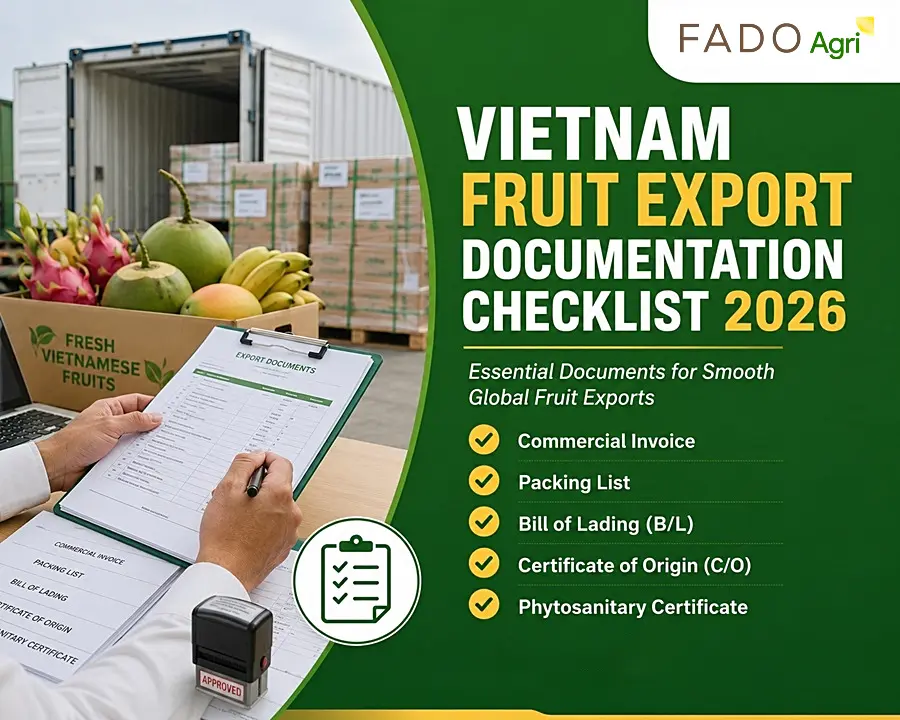
- Phytosanitary and documentation, Phytosanitary Certificate, Certificate of Origin (CO), commercial invoice, packing list, and Bill of Lading (B/L) prepared to Japanese customs standards.
- Reefer container loading and shipment, temperature set and verified; real-time monitoring data available to the buyer on request.
This process is not a claim, it is a workflow that has supported consistent export to Japan and 9 other internationally certified markets over 10+ years of operation.
4. Common Compliance Mistakes When Exporting Vietnam Tropical Fruit to Japan
Vietnamese exporters new to the Japan corridor frequently encounter the same avoidable problems. Understanding these failure points is as important as knowing the specifications.
- Incomplete pesticide records: MAFF inspectors conduct document audits, not just physical inspections. Gaps in field application records create grounds for rejection even when residue tests pass.
- Mismatched phytosanitary declarations: The commodity name, variety, and quantity on the Phytosanitary Certificate must exactly match the commercial invoice and packing list. Discrepancies trigger holds at Japanese ports.
- Under-specifying ripeness for transit time: Dragon fruit shipped at full maturity for a 7-day sea transit will arrive overripe. Ripeness stage at loading must account for total transit time plus 2-3 days of distribution buffer.
- Non-compliant labeling: Japanese law requires country of origin labeling in Japanese (日本語) on retail packs. Many Vietnamese exporters discover this requirement after the shipment arrives.
- Using non-approved fumigants: Methyl bromide is restricted under the Montreal Protocol and is monitored closely by Japanese inspectors. Alternatives must be pre-approved and documented.
Read more: Vietnam Coconut Export to China: Cross-Border Trade Guide
5. Frequently Asked Questions: Vietnam Tropical Fruit to Japan
What certifications does a Vietnamese fruit exporter need to supply the Japanese market?
At minimum, exporters need GLOBALG.A.P or an equivalent Good Agricultural Practices certification, HACCP-compliant processing facilities, and the ability to issue a valid Phytosanitary Certificate through MARD. Japanese buyers sourcing at supermarket-chain volume also expect third-party lab residue test reports for each shipment.
Which Vietnamese tropical fruits are currently approved for import into Japan?
Japan has approved several Vietnamese tropical fruits under bilateral phytosanitary protocols, including dragon fruit, banana, mango (subject to treatment requirements), longan, lychee, and guava. Fresh coconut is generally admitted without fumigation requirements. Approval status is updated periodically by MAFF, buyers should verify current permit status before contracting new products.
How does Fado Agri handle the phytosanitary documentation process for Japan shipments?
Fado Agri manages the full documentation chain: coordinating farm-level inspections with MARD-licensed inspectors, submitting residue test results from accredited labs, and completing all export paperwork. Phytosanitary Certificate, CO, B/L, packing list, and commercial invoice. aligned to Japanese customs requirements. All documents are provided digitally prior to vessel departure.
What are the standard lead times for Vietnam tropical fruit exports to Japan from Fado Agri?
Lead times vary by product. Cavendish Banana averages 2-3 days from order confirmation. Red Dragon Fruit and Seedless Lime require 4-5 days. Fresh Coconut requires a minimum of 5 days. These are commitment timelines built on stable, year-round supply agreements with our farm partners.
Can Fado Agri supply custom or private-label packaging for Japanese retail buyers?
Yes. Fado Agri offers OEM and ODM packaging services. Japanese-language labeling, custom carton design, and retail-ready pack formats. Packaging specifications are agreed during the buyer onboarding process and maintained consistently across production runs.
What is the minimum order volume for Vietnam tropical fruit shipments to Japan?
Minimum order volumes depend on product and shipment mode. FCL (Full Container Load) shipments are standard for established buyers. LCL (Less than Container Load) options are available for trial orders and market testing. Contact our team for specific volume thresholds and pricing.
Conclusion
Vietnam’s tropical fruit to Japan is one of the most demanding. and most rewarding. export corridors in Southeast Asian agriculture. Meeting Japan’s specifications requires more than good produce: it demands certified growing practices, traceable supply chains, precise documentation, and a logistics partner who understands that a single compliance gap can cost an entire shipment.
Fado Agri has been building toward these standards since 2016. With 500+ containers exported per year, GLOBALG.A.P and HACCP certifications, and a 10-step traceable supply chain that runs from Vietnam’s growing regions to the world’s most demanding markets, we are equipped to be the agricultural export partner that serious Japanese importers are looking for.
To discuss product specifications, sampling, or supply terms for the Japan market, contact the Fado Agri team directly:
- Hotline: (+84) 908 479 339
- Email: [email protected]
- Website: fadoagri.com