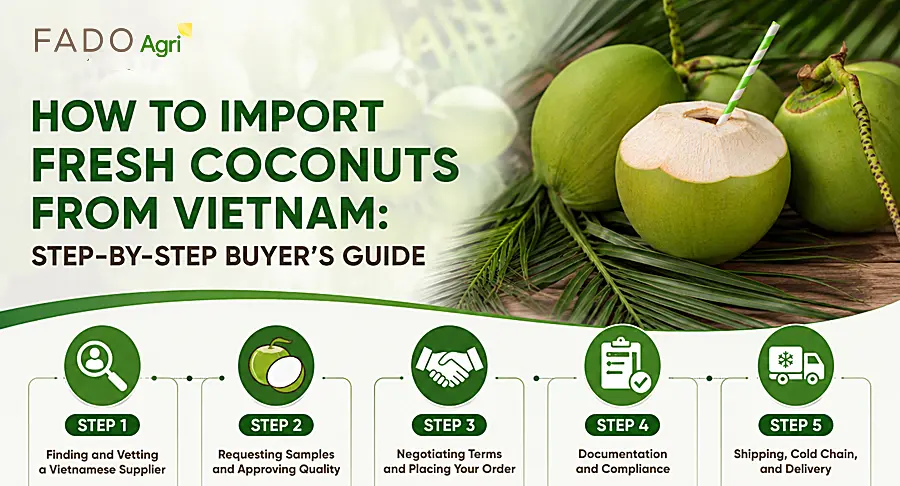

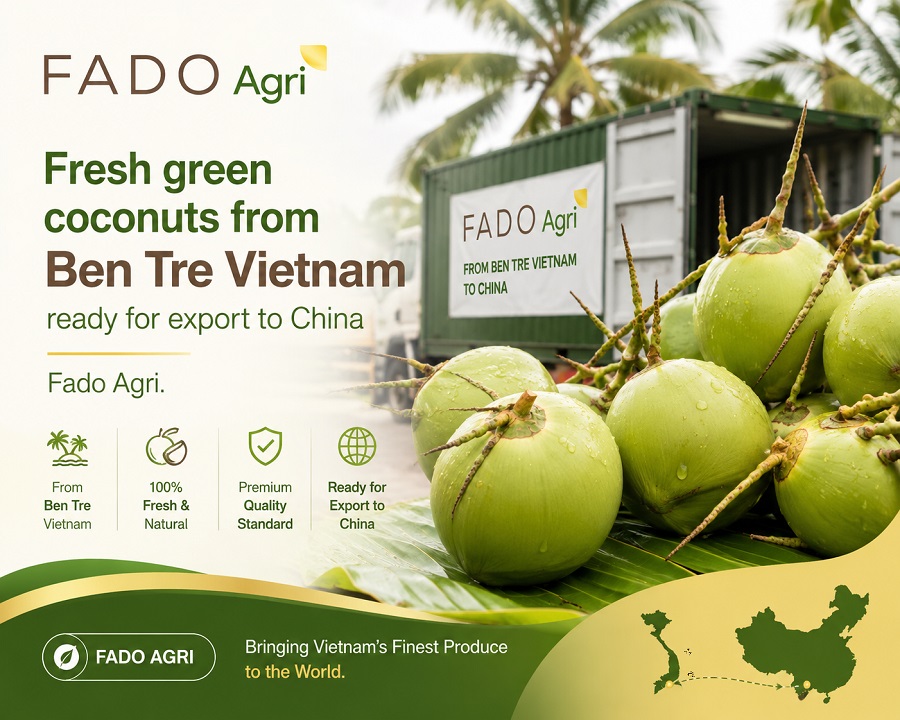
China imported over 1.5 billion fresh coconuts in a single year and Vietnam is its closest, most capable supplier. For Chinese importers navigating this trade corridor, the difference between a smooth shipment and a customs hold often comes down to documentation precision, phytosanitary compliance, and the reliability of the exporter you choose. This guide breaks down everything involved in Vietnam coconut export to China: the regulations, the paperwork, the logistics, and what a professional supply chain actually looks like on the ground.
1. Why China Sources Fresh Coconuts from Vietnam
Vietnam is not simply a convenient geographic neighbor for China, it is one of the most competitive fresh coconut sources in the world. Understanding why this trade corridor exists helps importers make better sourcing decisions.
1.1 Vietnam’s Coconut Belt: Ben Tre and Tien Giang
The provinces of Ben Tre and Tien Giang in Vietnam’s Mekong Delta account for the majority of the country’s fresh coconut output. These regions benefit from year-round tropical climate, rich alluvial soil, and decades of farmer expertise in coconut cultivation. Harvests are chemical-free, and quality control begins at the grove, not at the factory gate.
For Chinese importers, this translates into consistent product quality across shipments: uniform size, high water content, intact husks, and the shelf life required for cross-border transport.
1.2 Competitive Advantages Over Other Origins
Compared to coconut sources from Thailand, Indonesia, or the Philippines, Vietnam offers Chinese buyers several structural advantages:
- Proximity: Shorter sea freight routes mean lower logistics costs and faster transit times, critical for fresh produce.
- Volume capacity: Vietnam exports 500+ containers of agricultural produce per year through established exporters, with coconut as a core commodity.
- Price competitiveness: Lower labor and land costs in Vietnam’s growing regions keep FOB prices attractive.
- Bilateral trade infrastructure: Vietnam and China share an active agricultural trade framework with defined protocols for fresh produce, reducing administrative friction at the border.
Read more: Vietnam Fruit Supplier for Saudi Arabia: Halal-Friendly Tropical Fruit Supply
2. Regulatory Requirements for Vietnam Coconut Export to China
Compliance is non-negotiable in this trade corridor. Chinese customs authorities apply strict phytosanitary and food safety standards to all imported fresh produce, and coconuts are no exception.
2.1 Phytosanitary Certificate
Every shipment of fresh coconuts exported from Vietnam to China must be accompanied by a Phytosanitary Certificate issued by Vietnam’s Plant Protection Department (PPD) under the Ministry of Agriculture and Rural Development (MARD). This certificate confirms that the coconuts have been inspected and found free from regulated pests and diseases.
Buyers often ask whether a phytosanitary certificate can be obtained after the product leaves Vietnam. The answer is no, it must be issued prior to shipment, and inspections are conducted at the packing facility or port of origin.
2.2 Certificate of Origin (CO)
A Certificate of Origin (CO), typically Form E under the ASEAN-China Free Trade Agreement (ACFTA), allows Chinese importers to benefit from preferential tariff rates on Vietnamese agricultural goods. Importers sourcing from a compliant Vietnamese exporter should always request Form E documentation as part of the standard shipping package.
2.3 GACC Registration for Exporting Facilities
Since 2022, China’s General Administration of Customs (GACC) has required that all overseas food production facilities exporting to China be registered in its system. This means the packing house or processing facility where coconuts are graded, cleaned, and packed must hold valid GACC registration before export can proceed.
When evaluating a Vietnamese coconut supplier, confirming their GACC registration status is a mandatory due diligence step, not an optional one.
2.4 Labeling and Packaging Compliance
Coconut shipments entering China must be labeled in Mandarin Chinese, including the product name, country of origin, net weight, packing date, and name of the exporting enterprise. Pallets and outer cartons must also meet ISPM 15 standards for wood packaging material to prevent pest introduction.
3. Standard Export Documentation Package
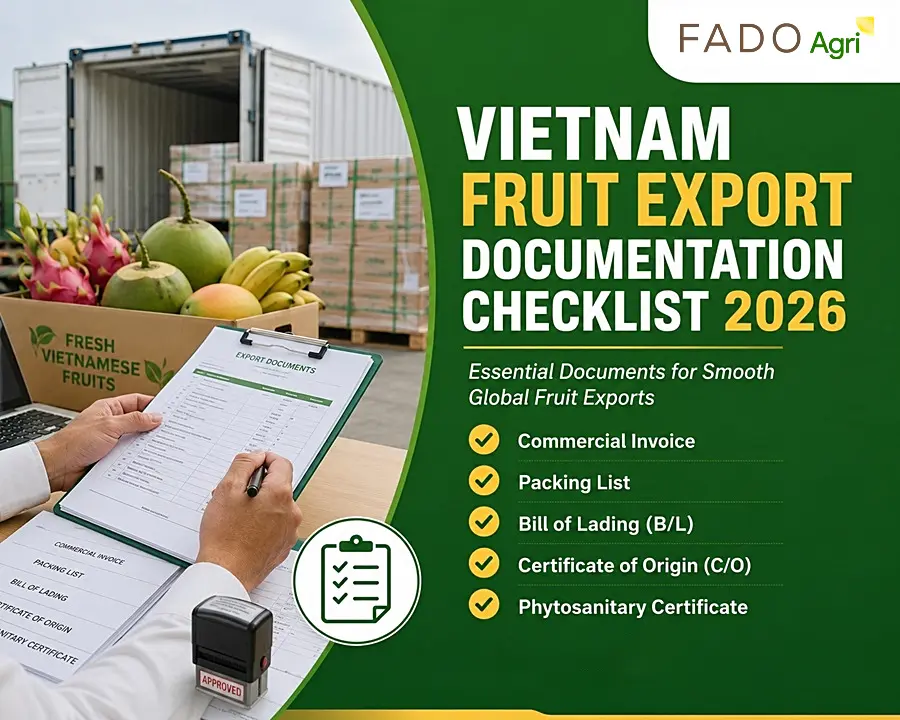
A complete, clean documentation set is what separates a smooth customs clearance from a costly delay. For Vietnam coconut export to China, the standard documentation package includes:
- Commercial Invoice, itemizing product, quantity, unit price, and total value (FOB or CIF terms)
- Packing List, detailing carton count, net/gross weight, and pallet configuration
- Bill of Lading (B/L), issued by the shipping carrier, confirming receipt of goods for transport
- Phytosanitary Certificate, issued by Vietnam’s PPD, confirming pest-free status
- Certificate of Origin (CO Form E), enabling preferential ACFTA tariff rates
- GACC Registration Confirmation, demonstrating that the exporting facility is registered with Chinese customs
- Food Safety Test Reports, pesticide residue, heavy metals, and microbiological reports from accredited labs
Experienced importers request this full package before confirming any purchase order. A supplier that cannot provide all seven documents on time is a logistics risk, not a commercial opportunity.
4. Packaging Formats and Product Specifications
Fresh coconuts are not a commodity in the traditional sense, packaging format, cut style, and size specification all affect product suitability for different Chinese distribution channels.
4.1 Available Cut Types
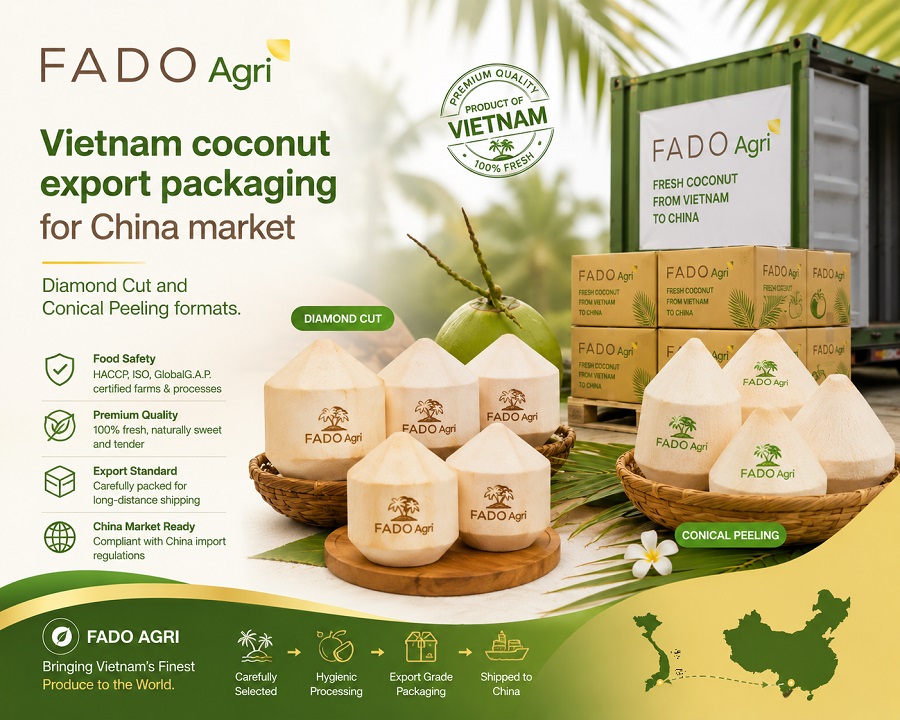
Fado Agri exports fresh coconuts from Ben Tre and Tien Giang in six standard cut formats, each suited to different retail and food service applications:
- Conical Peeling, classic husk-trimmed format, popular for supermarkets and wet markets
- Whole, full husk intact, longest shelf life, often preferred for wholesale distribution
- Diamond Cut, decorative trimmed format, favored by premium retail and hotel channels
- Easy Open, pre-scored top for convenience, popular in food service and beverage sectors
- Bald, fully husked and white, strong visual appeal for retail display
- Lid On, trimmed with a natural “lid” for easy consumer access
4.2 Size and Weight Specifications
Chinese importers typically specify coconut weight ranges by target market. Standard export sizes from Vietnam range from 600g to 1,200g per coconut, with the most common export specifications for China falling between 800g and 1,000g. Custom size specifications are available with prior confirmation.
4.3 OEM and Private Label Packaging
For Chinese distributors supplying supermarket chains or branded retail channels, OEM/ODM packaging is fully available. Fado Agri supports custom-branded cartons, net bags, and shrink-wrap formats, your brand identity, our certified supply chain.
5. Logistics and Lead Times for the Vietnam-China Corridor
5.1 Shipping Routes
Fresh coconuts from Vietnam to China are primarily transported via sea freight from ports including:
- Ho Chi Minh City (Cat Lai Port), for container shipments to Guangzhou, Shenzhen, and Shanghai
- Haiphong Port, for northern Vietnam production destined for Guangxi and Yunnan border crossings
Transit times range from 3 to 7 days depending on port pair, vessel schedule, and whether the shipment enters via sea or land border (for truck-based cross-border trade through Lao Cai, Lang Son, or Mong Cai).
5.2 Lead Times
For buyers planning procurement schedules:
- Fresh coconut minimum lead time: 5 days from order confirmation to container loading
- Stable supply average: 2-3 days per container for established accounts with scheduled orders
- Temperature management: Fresh coconuts are transported under ambient conditions (not chilled), but transit time must be factored into shelf life planning — typically 3-4 weeks from harvest date
5.3 Trade Terms Available
Fado Agri supports both FOB (Free On Board) and CIF (Cost, Insurance, and Freight) terms, giving Chinese importers flexibility based on their existing freight and insurance arrangements. New buyers often prefer CIF for the first few shipments to simplify logistics management.
Read more: Vietnam Fruit Exporter to Australia: Bio-Security & Reliable Supply
6. How Fado Agri Supports Chinese Importers
Fado Agri was established in 2016 and has spent 10+ years building a supply chain that holds up under the scrutiny of demanding international markets, including China. With certifications including FDA (US), GLOBALG.A.P, and HACCP, and a 10-step transparent supply chain from farm selection to port loading, Fado Agri is built for the requirements of serious B2B buyers.
For Chinese importers specifically, Fado Agri offers:
- Full documentation readiness, phytosanitary, CO Form E, GACC-registered facility, lab reports, all prepared in parallel with production
- Flexible order volumes, from trial containers to contracted annual volumes of hundreds of containers
- OEM/ODM packaging, Mandarin-labeled cartons and custom branding for Chinese retail channels
- Dedicated export team, with experience navigating Chinese customs requirements and proactively resolving documentation queries
- Transparent traceability, every shipment traceable back to the farm block in Ben Tre or Tien Giang
Frequently Asked Questions
What documents are required for Vietnam coconut export to China?
The core documentation set includes a Phytosanitary Certificate, Certificate of Origin (CO Form E), Commercial Invoice, Packing List, Bill of Lading, GACC facility registration confirmation, and food safety test reports. All documents should be prepared by the exporter and provided to the importer before or on the shipment date.
Does the exporting facility need to be registered with China’s GACC?
Yes. Since 2022, GACC registration is mandatory for all overseas food production and packing facilities exporting fresh produce to China. Always verify your Vietnamese coconut supplier’s GACC registration status before placing an order.
What is the minimum lead time for fresh coconut orders from Vietnam to China?
The minimum lead time is 5 days from order confirmation to container loading. For importers with scheduled purchasing programs, Fado Agri can maintain a stable supply of 2-3 days per container on an ongoing basis.
Can I request OEM packaging for the Chinese retail market?
Yes. Fado Agri offers full OEM/ODM packaging services, including Mandarin-labeled cartons and custom branding. Specifications, minimum order quantities, and lead times for custom packaging are confirmed at the order stage.
What coconut cut types are available for the Chinese market?
Fado Agri exports fresh coconuts in six cut formats: Conical Peeling, Whole, Diamond Cut, Easy Open, Bald, and Lid On. The most popular formats for Chinese supermarkets and wet markets are Conical Peeling and Bald, though all formats are available based on your channel requirements.
Does Vietnam qualify for preferential tariffs under any trade agreement with China?
Yes. Under the ASEAN-China Free Trade Agreement (ACFTA), fresh coconuts exported from Vietnam to China qualify for preferential tariff rates when accompanied by a valid Certificate of Origin Form E. Confirm this with your customs broker to determine the applicable duty rate for your import classification.
How can I verify the quality and certifications of a Vietnamese coconut supplier?
Request copies of the supplier’s certification documents (FDA, GLOBALG.A.P, HACCP), their GACC registration certificate, and recent lab test reports. A reliable exporter will share these without hesitation. On-site factory audits or third-party inspections can also be arranged prior to a first order.
Ready to Source Fresh Coconuts from Vietnam?
Vietnam coconut export to China is a well-established trade corridor, but navigating it successfully requires a supplier who treats documentation, compliance, and traceability as core competencies, not afterthoughts. Fado Agri has built its entire operation around exactly these requirements: 10+ years of export experience, FDA/GLOBALG.A.P/HACCP certification, a GACC-registered facility, and a team that understands what Chinese importers need at every stage.
Whether you are placing your first trial container or looking to build a long-term supply agreement, we are ready to work with you.
Contact Fado Agri:
- Hotline: (+84) 908 479 339
- Email: [email protected]
- Website: fadoagri.com