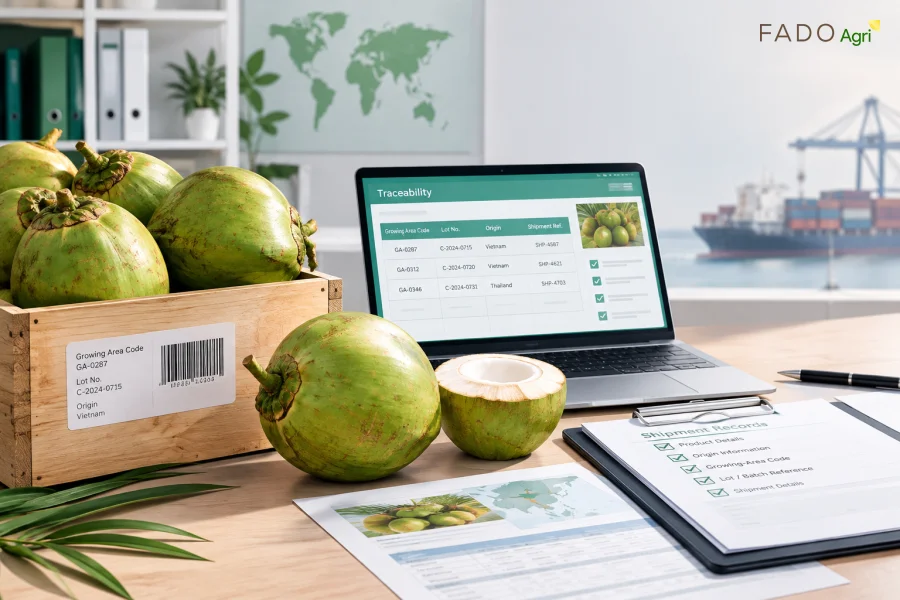

Origin names alone are not enough to establish whether two coconuts differ in nutrition or flavor. A fair comparison first identifies the product, its declared variety or trade designation, maturity, and the portion being assessed—coconut water, flesh, or both. For importers and procurement teams, the practical approach is to request comparable product information and evidence before making sourcing or positioning decisions.
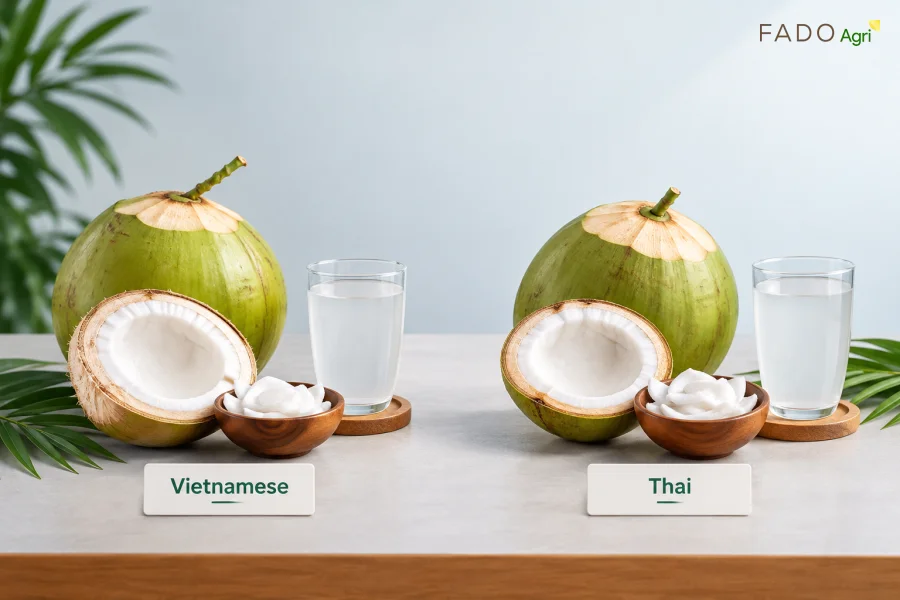
What does “Vietnamese Siam coconut” mean in this comparison?
The terms “Vietnamese Siam coconut” and “Thai coconut” do not, by themselves, identify a matched pair of products. The information available for this comparison does not define “Siam coconut” or identify a specific Vietnamese cultivar, nor does it specify a Thai variety. Buyers should confirm these details with each supplier before treating the names as evidence of botanical identity or product equivalence.
Separate origin, variety, maturity, and product format
Country of origin, declared variety or trade designation, maturity, and commercial format are separate attributes. A product described as Vietnamese may refer to its origin; “Siam” may be a variety name or a trade designation, but the name alone does not establish which. Similarly, “Thai coconut” is a broad origin description unless the supplier documents a more specific identity.
The product format matters too. A whole fresh coconut, coconut water, and coconut flesh are not interchangeable units of comparison. A buyer assessing a retail-ready coconut should identify which edible portions matter, while a buyer sourcing an ingredient may need specifications for only the water or flesh.
Before comparing offers, ask each supplier to state the exact product name, origin, declared variety or trade designation, maturity criteria, and format. If a supplier cannot substantiate a particular identity, keep the comparison at the level of the information actually provided rather than assigning a cultivar name.
How to compare nutritional value fairly
A nutrition comparison is useful only when it relates to comparable products and measurement bases. Results for coconut water should not be presented as results for coconut flesh, and values from different product forms or serving bases should not be placed side by side as if they were equivalent. No matched nutrition data for these two products are available here, so there is no sound basis to declare either origin nutritionally superior.
Match the portion and testing basis
When requesting nutrition information, specify the portion of interest: coconut water, flesh, or another clearly defined edible portion. Ask whether the figures describe the product as offered, a prepared portion, or a defined serving. If the intended use is retail, food service, or ingredient supply, make sure the information requested corresponds to that use.
For any laboratory results, ask for enough detail to understand what was tested and how the result should be interpreted. Relevant details include:
- Product identity and format, including the portion tested.
- Maturity or other product criteria used to select the sample.
- Sampling details and the relationship between the sample and the product being offered.
- Test date, laboratory identity, test method, units, and reported results.
- Any preparation or handling steps that could affect how the result applies to the offered product.
If a supplier provides results for both products, compare them only when the portion, units, and basis are sufficiently aligned. If those details differ or are missing, treat the figures as separate claims rather than a direct comparison. Do not combine numbers from unrelated sources to create a side-by-side ranking.
Read nutrition claims as evidence, not origin-based assumptions
A country name or a flavor description does not establish a nutritional profile. Likewise, a general product description should not be treated as a laboratory finding. Buyers should distinguish product-specific test results from supplier descriptions, promotional language, and assumptions about origin.
Nutrition data can support a product comparison when the tested material is clearly identified and the basis is comparable. Without that evidence, avoid claims about nutrient levels, health benefits, or nutritional superiority. A neutral description of what is documented is more useful—and more defensible—than a broad statement about all coconuts from one country.
What flavor and texture should buyers assess?
Flavor and texture can influence whether a product suits a retailer, food-service operation, or ingredient application. However, sensory observations depend on the specific samples and assessment conditions; they should not be presented as universal traits of Vietnamese or Thai coconuts without supporting evidence. Assess coconut water and flesh separately, and record how the samples were selected and compared.
Assess coconut water and flesh separately
For coconut water, buyers may choose to record sweetness, aroma, perceived freshness, and overall water character. For the flesh, they may assess texture and any product characteristics relevant to the intended use. These are dimensions to evaluate, not claims about the profile of either origin.
The assessment record should identify the samples and state whether the notes came from a structured tasting, supplier-provided description, or individual preference. That distinction helps procurement teams interpret the result: a tasting observation is not the same as a verified product specification, and a supplier description is not independent sensory evidence.
Use a consistent sensory comparison
A useful comparison begins with products selected on a comparable basis. Confirm product identity and maturity criteria where available, then use consistent serving conditions, including comparable temperature and preparation. Keep the samples identified and record the conditions so that the notes can be understood later.
Harvest, handling, maturity, and post-harvest conditions may affect the product presented to a buyer. Therefore, an observed difference between two samples should not automatically be attributed to country of origin. If the samples differ in maturity or handling history, record that limitation rather than treating the tasting as a controlled origin comparison.
A buyer’s checklist for evaluating supplier claims
A sourcing decision should start with traceable information about the actual products on offer, not broad claims about national origins. Before comparing price or preparing consumer-facing positioning, procurement teams can use the checklist below to determine whether the offers are genuinely comparable and what evidence remains unavailable.
Documents and product details to request
Request the following information for each offer, where applicable:
- Exact product name, origin, and declared variety or trade designation.
- Product format and the edible portion relevant to the intended use.
- Maturity criteria and how they are applied to the product being offered.
- Nutrition data tied to the offered product, with the tested portion, units, test basis, and date identified.
- Sensory notes with the sample identity and assessment conditions, if flavor or texture claims affect the purchase.
- Relevant post-harvest and handling information for the product under consideration.
- Supporting documents for any certification, test, or other quality claim made by the supplier.
A buyer-facing comparison sheet can help organize this information without filling gaps through assumption:
| Comparison field | What to record |
|---|---|
| Product identity | Exact name, origin, and declared variety or trade designation |
| Product and portion | Whole coconut, water, flesh, or another specified format |
| Maturity basis | Supplier’s stated criteria and any supporting detail provided |
| Nutrition evidence | Tested portion, units, method, test date, and sample details, if available |
| Sensory evidence | Assessment source, sample identity, conditions, and observations, if available |
| Supporting documents | Documents supplied for claims relevant to the purchase |
Leave fields blank when the information has not been supplied. A blank field is a clear signal that the comparison is incomplete; it is not a reason to infer that the two products are equivalent or different.
When the comparison is not yet conclusive
If one supplier provides a specific variety or maturity description and the other provides only an origin label, the products are not documented at the same level of detail. If nutrition results use different portions or units, they cannot support a direct ranking. If sensory notes come from different conditions, record them as separate observations rather than proof of a general origin-based flavor profile.
In these cases, buyers can request clarification or narrow the decision to documented factors that matter to the purchase. If the requested information is unavailable, keep the conclusion limited: the available material does not establish a like-for-like nutrition or flavor difference.
How to use the comparison in sourcing and product positioning
The useful sourcing question is not which origin is categorically better, but whether a particular product meets the buyer’s intended specification and market position. Separate product facts, sensory feedback, and marketing language so each is assessed on its own basis. This helps teams make decisions without turning an incomplete comparison into a broad claim about an entire country’s production.
Match the product to its intended channel—such as fresh retail, food service, or an ingredient application—and set acceptance criteria based on documented specifications and buyer requirements. Use product-specific evidence for any descriptions of nutrition, flavor, or texture. Avoid language that implies every coconut from a particular origin has the same profile.
If the comparison is used in a product listing or sales material, retain the basis for each claim and make sure the wording does not exceed the evidence. A documented sensory observation may describe the assessed sample; it does not, on its own, establish a fixed characteristic of all products under the same origin label.
Frequently asked questions
These answers distinguish what can be concluded from the information available from what requires product-specific evidence. For procurement purposes, the key is to resolve identity and comparison basis before treating two origin descriptions as equivalent products.
Is Vietnamese Siam coconut nutritionally better than Thai coconut?
That cannot be concluded from the information available. A fair comparison would require matched, product-specific nutrition data for the same edible portion, with a clear testing basis. Origin names alone do not establish nutritional superiority.
Do “Vietnamese Siam coconut” and “Thai coconut” refer to the same variety?
The available information does not establish that they do. Ask suppliers to document the declared variety or trade designation and avoid treating the names as equivalent without supporting product information.
What should buyers request to compare flavor?
Identify comparable products and maturity criteria, then use consistent sample preparation and serving conditions. Record whether the notes come from a structured tasting, a supplier description, or individual preference, and assess coconut water and flesh separately where both matter.
Request product information for a like-for-like comparison
A reliable sourcing decision depends on specifications for the actual product under consideration. Importers and procurement partners can contact FADOAgri to request available fresh coconut product information and a B2B quotation; the details relevant to a comparison will depend on the product and inquiry. No specific variety, laboratory report, sample, minimum order quantity, or shipment schedule is implied.
Contact FADOAgri by WhatsApp or phone at (+84) 908 479 339, by email at [email protected], or visit fadoagri.com.
Phone: 0908 479 339 · Contact us