
For a seedless lime buyer, a GlobalG.A.P. claim is meaningful only when the applicable standard and certificate scope match the supplier, production site, product, and lot being sourced. Certification can inform a review of farm-level assurance, but it should not be treated as proof of every premium-export specification, residue limit, phytosanitary requirement, or import approval. This guide sets out practical evidence checks for procurement teams and explains what to confirm separately.
What GlobalG.A.P. evidence can—and cannot—tell a lime buyer
Before comparing suppliers, establish exactly what certification is being claimed and whether the documented scope applies to the offered seedless limes. The standard and certificate details should be checked against current documentation; a general statement that fruit is “export quality” is not a substitute. Buyers should also keep certification distinct from their own product specifications and the obligations of the destination market.
Confirm the certification scope before relying on the claim
Ask the supplier to identify the applicable GlobalG.A.P. standard and version, the certificate holder, and the scope shown in the supporting documents. Check whether the production site and the product offered for purchase fall within that stated scope. If there is uncertainty about the document’s status or coverage, seek clarification from the supplier and use an appropriate verification channel where available.
The commercial offer should connect the certification evidence to the actual source of the fruit. A certificate associated with a business name alone may not answer whether a particular farm, production site, or crop is covered. Confirm those details before using the claim as a factor in supplier approval.
Keep certification, market access, and product quality claims distinct
A certification document is one part of a broader sourcing review. It does not, by itself, establish that a specific lot meets every buyer-defined grade, that applicable MRLs are satisfied, or that the shipment has the documentation required for entry into a particular market. Nor does the claim alone guarantee appearance, flavor, shelf life, or successful import clearance.
Treat these as separate questions: what assurance the stated certification scope provides; what product attributes the purchase contract requires; and what current import-market rules apply. This distinction helps procurement teams avoid relying on one document to support claims it was not intended to establish.
What to assess in seedless lime cultivation records
Once the certification claim is understood, review whether the supplier can connect production information to the seedless lime lot being offered. The aim is not to impose an assumed audit checklist, but to ask for relevant records and clarify how they relate to the supplier’s stated scope. Requirements should be confirmed against the applicable standard and sourcing agreement.
Link the farm and crop records to the offered lot
Ask how the supplier identifies the production site, crop, harvest period, and lot in its records. Then check whether the information provided for the offer can be followed through to the lot proposed for dispatch. Names, site identifiers, product descriptions, and lot references should be clear enough for both parties to understand what the documents cover.
The records requested will depend on the supplier’s certification scope, the buyer’s due-diligence process, and the contract. Rather than assuming particular forms or record-retention periods are mandatory, ask which production and harvest records are relevant and how the supplier can link them to the product being quoted.
A practical question is: “Which records show that this offered lot came from the production site identified in the certification documents?” A clear answer can help buyers identify gaps before approving an order, while a mismatch between the offer and the supporting evidence should be resolved before the sourcing decision is finalized.
Treat input and residue evidence as questions to verify
If pesticide use or residues are part of the buyer’s risk review, establish what evidence is available and which limits apply to the intended destination market and contract. MRLs can be market-specific, so buyers and suppliers should confirm the relevant current requirements rather than relying on a general certification claim.
Ask whether residue testing or other supporting information is available when it is relevant to the purchasing program. Confirm the scope, product, lot, and date covered by any evidence. Do not assume that a test result applies to a different lot, or that a cultivation certificate automatically demonstrates compliance with every applicable residue limit.
Use a practical evidence review before approving a supplier
A document review is most useful when it checks consistency across the supplier, certification scope, production site, product, and lot. The requests below are buyer verification prompts, not a representation of mandatory GlobalG.A.P. control points. Adapt them to the applicable standard, contract, and destination market.
| Review area | Buyer question | Evidence to request | What it does not establish by itself |
|---|---|---|---|
| Certification claim | Which standard and version are claimed, and what does the stated scope cover? | Current certification documents and clarification of the holder, scope, and covered production site | That every offered lot meets the purchase specification or market-entry rules |
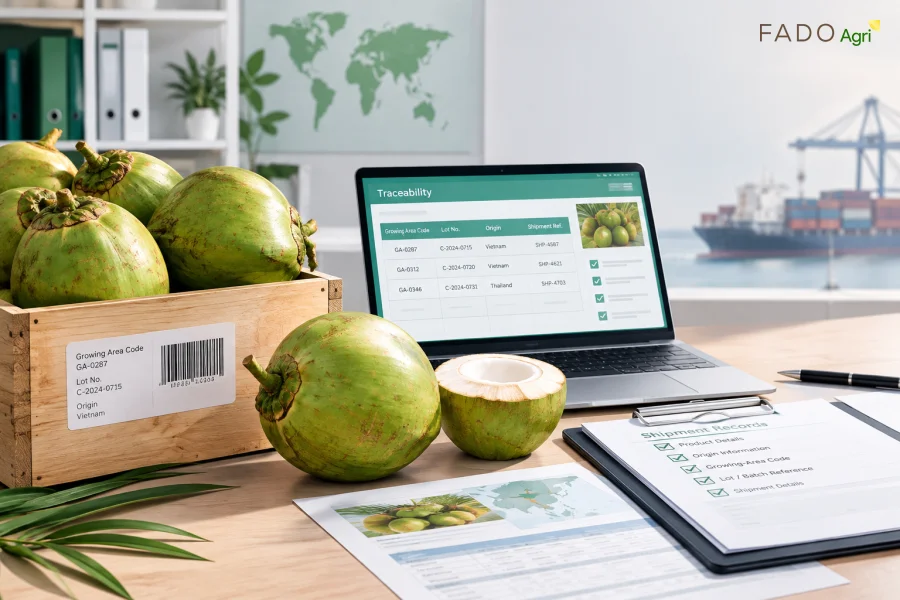
| Site and lot traceability | How is the quoted seedless lime lot linked to its production site and harvest information? | Relevant site, crop, harvest, and lot references used by the supplier | That an unrelated site or lot is covered by the same evidence |
| Product specification | What quality and packaging criteria have both parties agreed? | Written product specification and agreed acceptance or inspection process | That certification defines the buyer’s meaning of “premium” |
| Residue assurance | Which MRLs apply, and what evidence is available for the sourcing program? | Applicable requirements and relevant supporting test or supplier documentation, where requested | Compliance with other markets or lots not covered by that evidence |
| Shipment documentation | Which documents are needed for the intended market and shipment? | Applicable shipment and market documents, including a Phytosanitary certificate where required | That farm-level certification alone satisfies destination requirements |
Compare documents for consistency rather than simply counting them. Differences in supplier names, site descriptions, product identity, dates, or lot references may have a reasonable explanation, but they should be clarified before approval. Record what was reviewed and which points remain subject to the contract or market-specific checks.
Separate farm assurance from shipment and destination-market documents
Cultivation assurance and shipment documentation answer different questions. For an intended destination, the buyer and supplier should confirm the relevant SPS/TBT standards and phytosanitary requirements using current, applicable information. A Phytosanitary certificate may be required for a shipment, but its applicability and role should be confirmed for the specific market and transaction.
Similarly, post-harvest handling and Cold Chain logistics should be assessed as distinct parts of the export program. Buyers can ask how the supplier manages product handling after harvest and what shipment information is available, but should not infer those practices from a farm-level certificate unless the relevant scope and evidence explicitly support that conclusion.
Connect cultivation assurance to premium-export specifications
“Premium” is not a single, universal specification. Buyers should define the attributes that matter for their sales channel and make them explicit in the purchase agreement, alongside the certification and traceability evidence they expect. This gives the supplier a clear basis for preparing an offer and gives both parties a reference for reviewing the delivered product.
Define premium quality in the purchase specification
For seedless limes, set out the product identity and the buyer’s required quality attributes, packaging, lot identification, and acceptance process. Include any agreed grade, size, tolerance, or inspection criteria only where the buyer and supplier have specified them; these details should not be inferred from the word “premium” or from certification status.
Agree how product conformity will be assessed and how the parties will handle a discrepancy. For example, the contract can state which documents accompany the offer, how the lot is identified, and what inspection or notification process applies. Clear terms reduce the risk of interpreting a general quality claim differently at procurement and delivery stages.
Assess post-harvest and export controls separately
Post-harvest technology and Cold Chain logistics can affect how produce is handled after cultivation, so evaluate them as separate parts of the supply chain. Ask for information relevant to the agreed product and delivery plan, and avoid assuming a specific handling method, temperature regime, or shelf-life outcome without supplier documentation and agreement.
For each destination, confirm current MRLs compliance expectations, SPS/TBT standards, and phytosanitary documentation requirements with the relevant parties. The applicable obligations can depend on the destination and transaction. GlobalG.A.P. certification should not be presented as a substitute for those separate checks or as a guarantee of import approval.
Questions importers should ask before placing a seedless lime order
A short pre-order discussion can reveal whether the evidence supports the offer before commercial approval. Ask the supplier to explain the documents in relation to the specific production site and lot, then record any product or market requirements that still need agreement. These questions are a buyer workflow, not an official GlobalG.A.P. checklist.
A pre-order document and traceability check
- Which GlobalG.A.P. standard and version are you claiming, and what do the current documents say the certificate covers?
- Is the production site for the offered seedless limes within that stated scope?
- How do you connect cultivation and harvest information to the lot in this quotation?
- What product specification, packaging details, and acceptance process are proposed for this order?
- Which residue, phytosanitary, and shipment documents are relevant to our intended market, and what supporting evidence can you provide?
- How will we resolve a mismatch between the offer, certification documents, lot references, or agreed specification before dispatch?
If a response is incomplete, ask for clarification rather than filling the gap with an assumption. In particular, distinguish a document that confirms a supplier’s stated certification scope from evidence about a specific lot, a buyer-defined quality criterion, or a destination-market requirement.
Frequently asked questions
These questions address common points in a procurement review: what a certification claim can support, what to request first, and why the applicable documentation matters. The answers are intentionally limited to the distinction between farm-level assurance and other export checks.
Does a GlobalG.A.P. certificate guarantee import approval?
No. Buyers should confirm the certificate’s current scope and assess applicable product, MRLs, phytosanitary, shipment, and destination-market requirements separately. Certification alone should not be treated as proof that every requirement for a particular import transaction has been met.
What should a buyer request first from a seedless lime supplier?
Request the current certification documents and clarification of the standard, version, holder, and scope. Then ask how the production site and offered lot connect to that scope, and agree which product and market documents are needed for the order.
Can the detailed cultivation requirements be summarized without the current standard text?
Not reliably. The applicable standard, version, and scope should be checked against current official documentation. Buyers should avoid treating an informal evidence list as a complete or official audit checklist.
Discuss seedless lime sourcing requirements with FADOAgri
Importers and procurement partners can contact FADOAgri to discuss seedless lime product specifications and the documentation relevant to their sourcing requirements. Share the intended market and any buyer-defined criteria so the discussion can focus on the information needed for the proposed order; certification status and scope should be assessed from applicable documentation.
Contact FADOAgri via WhatsApp/Hotline at (+84) 908 479 339 or email [email protected] to request product details and discuss export quotation requirements.
Phone: 0908 479 339 · Website: FADOAGRI · Contact us