

Every Document You Need for a Vietnam Fresh Fruit Export Shipment in 2026
Missing a single document can hold your container at the destination port for days — or trigger a full consignment rejection. Whether you are a Vietnamese exporter preparing your first shipment or an international buyer reviewing a supplier’s compliance capability, this checklist covers every core document required for fresh fruit exports from Vietnam in 2026, who issues each one, how long it takes to obtain, and which markets impose additional requirements.
This is not a general process guide. It is a specific document-by-document reference built for people who need practical answers fast.
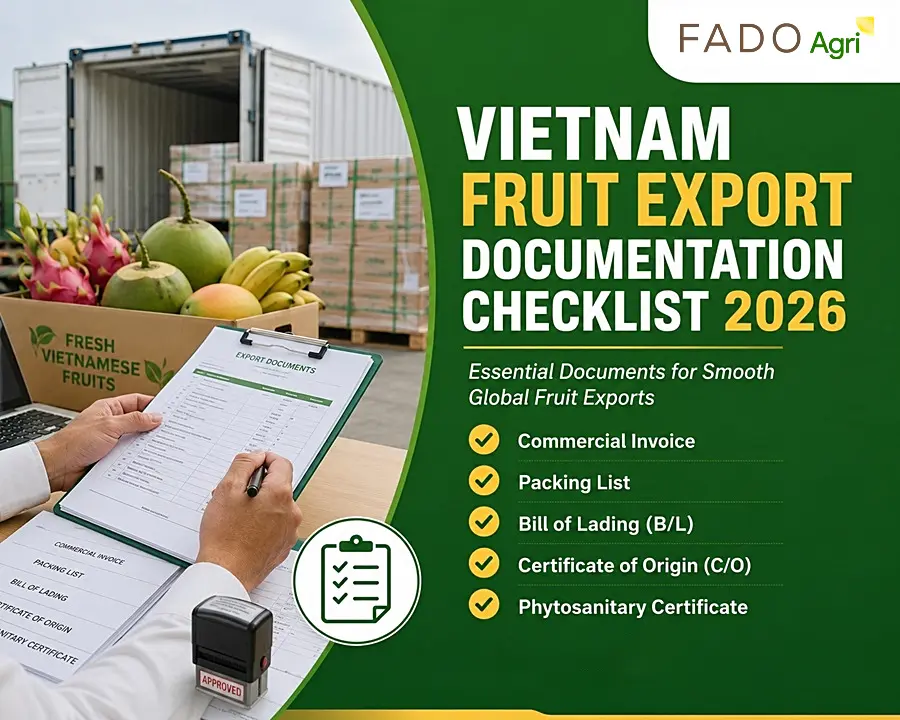
The Master Document List for Vietnam Fruit Exports
A standard fresh fruit export from Vietnam requires between six and ten documents depending on the destination market, product type, and shipping method. The table below covers every core document, followed by detailed explanations of the most complex ones.
| Document | Purpose | Issued By | Typical Timeline | Required For Markets |
|---|---|---|---|---|
| Phytosanitary Certificate | Confirms produce is free from pests and regulated plant diseases | MARD / DARD (Vietnam) | 3–7 business days | All markets (mandatory globally) |
| Certificate of Origin (C/O) | Proves country of origin for tariff preference eligibility | VCCI or Ministry of Industry and Trade | 1–3 business days | All markets; form varies by trade agreement |
| Fumigation Certificate | Certifies methyl bromide or heat treatment of packaging/product | Licensed fumigation company (Vietnam) | 1–2 days after treatment | USA, Australia, China, India, EU wooden packaging |
| Health Certificate | Confirms product meets food safety and hygiene standards | MARD / NAFIQAD | 3–5 business days | EU, South Korea, Japan, UAE, Australia |
| Commercial Invoice | States price, quantity, buyer/seller details for customs valuation | Exporter | Prepared by shipper | All markets |
| Packing List | Details carton count, weights, and item descriptions | Exporter | Prepared by shipper | All markets |
| Bill of Lading (B/L) | Shipping contract and title document for cargo | Shipping Line | Issued after vessel departure | All markets (sea freight) |
| Airway Bill (AWB) | Air freight equivalent of Bill of Lading | Airline / Freight Forwarder | Issued at departure | Air shipments only |
| Cold Chain Temperature Log | Confirms correct temperature was maintained during transit | Freight Forwarder / Reefer Container Provider | Continuous during transit | EU, Japan, South Korea, USA for perishables |
| Pesticide Residue Test Report | Lab-certified MRL compliance | Accredited lab (Vietnam) | 5–10 business days | Japan, EU, South Korea, USA |
Phytosanitary Certificate: The Non-Negotiable Foundation
A Phytosanitary Certificate is the single most important document in any fresh produce shipment — no destination country in the world accepts fresh fruit without it. In Vietnam, it is issued by the Ministry of Agriculture and Rural Development (MARD) through its regional Plant Protection Departments (DARD offices at the provincial level).
What the certificate covers
The certificate confirms that the consignment has been inspected and is considered free from quarantine pests and regulated non-quarantine pests specified by the importing country. It also confirms compliance with any additional phytosanitary requirements stated by the destination market. The document must reference the specific lot, container number, and invoice it covers — a generic certificate cannot be re-used across shipments.
Timeline and application process
Exporters should apply 5–7 business days before the container loading date to allow time for inspection and re-inspection if required. MARD inspectors typically visit the packhouse or cold storage facility to conduct a physical examination of the fruit. Any pest detection during inspection will delay issuance and may require treatment or re-grading of the consignment.
Market-specific phytosanitary conditions
Different importing countries attach specific conditions to Vietnam’s phytosanitary certificates. For example, the USA, Japan, Australia, and South Korea each publish approved import conditions for specific Vietnamese fruits — not all Vietnamese fruit varieties are approved for all markets. Before booking your first container, confirm that your specific fruit variety is on the approved list for your destination market through the relevant national plant protection authority.
For coconut-specific phytosanitary requirements, see our detailed breakdown at Breaking Down Vietnam’s Coconut Export Requirements.
Certificate of Origin: Choosing the Right Form
The Certificate of Origin (C/O) determines whether your buyer qualifies for preferential tariff rates under Vietnam’s bilateral and multilateral free trade agreements. Using the wrong C/O form — or failing to apply for one at all — means your buyer pays full Most Favored Nation (MFN) duties instead of the reduced FTA rate.
Which form applies to which market
Vietnam is a signatory to multiple FTAs, and each agreement specifies its own C/O form. Form D applies to ASEAN member states under the ATIGA agreement. EUR.1 or REX (Registered Exporter) statements apply to EU shipments under the EVFTA. Form E covers China under ACFTA. Form AK applies to South Korea under VKFTA. For markets without a preferential FTA with Vietnam — such as the USA under standard trade terms — exporters use Form B, a non-preferential origin certificate.
Who issues C/O in Vietnam
Most C/O forms are issued by the Vietnam Chamber of Commerce and Industry (VCCI) or authorized units under the Ministry of Industry and Trade (MOIT). Applications are typically lodged online via the e-COSYS portal, and processing takes 1–3 business days when documentation is complete. Last-minute C/O applications routinely delay shipments — build this into your loading schedule.
Fumigation Certificate: When Is It Required?
A Fumigation Certificate is required when wooden pallets, wooden crates, or specific fruit varieties entering a market carry a pest interception risk that mandates treatment. The ISPM 15 standard applies globally to wooden packaging — any wooden pallet or crate used in export must carry the ISPM 15 mark, and some markets additionally require a separate fumigation certificate from a licensed operator.
Markets with mandatory fumigation requirements
Australia’s biosecurity requirements are among the strictest globally — both wooden packaging and several fresh fruit categories require documented treatment. The USA requires ISPM 15 compliance on all wooden packaging and may mandate specific pest treatments for certain high-risk fruit. China requires documented fumigation for dragon fruit and several other species as part of its border quarantine protocols. For EU shipments, ISPM 15 compliance on packaging is required, but a separate fumigation certificate for the fruit itself is market- and product-specific. Always confirm current requirements with your freight forwarder or the destination country’s national plant protection organization before each shipment, as these regulations update frequently.
Health Certificate and Cold Chain Documentation
A Health Certificate confirms that a food product meets the food safety, hygiene, and residue standards of the destination country. In Vietnam, it is issued by the National Agro-Forestry-Fisheries Quality Assurance Department (NAFIQAD) under MARD.
When is a Health Certificate required?
The EU, Japan, South Korea, Australia, and several Middle Eastern markets require a Health Certificate for fresh fruit imports. The document typically certifies maximum residue level (MRL) compliance, absence of prohibited substances, and packhouse hygiene standards. Budget 3–5 business days for issuance, and note that NAFIQAD may conduct its own laboratory sampling, which can extend the timeline.
Cold chain documentation for perishable shipments
Cold chain integrity is increasingly scrutinized by import authorities in Japan, South Korea, and the EU. A complete cold chain file for a reefer shipment should include the reefer container set-point and pre-cooling records, temperature data logger reports covering the full transit period, and a handover record confirming condition at the destination port. In our experience, missing or incomplete temperature logs are one of the most common reasons buyers reject claims on damaged perishable cargo — this documentation protects both the exporter and the buyer. For a deeper look at cold chain standards in produce export, our GLOBALG.A.P certified Vietnam coconut article covers the farm-to-container quality chain in detail.
Commercial Invoice and Packing List Requirements
A commercial invoice for a fresh fruit export is a legal customs document, not simply a billing record. It must include: the full legal names and addresses of the exporter and importer, HS (Harmonized System) commodity code for the fruit, unit price and total value in the agreed currency, Incoterms (e.g., FOB Ho Chi Minh City, CIF Dubai), country of origin, and a description of goods that matches exactly the description on the Phytosanitary Certificate and Packing List.
The Packing List must detail the number of outer cartons, net and gross weight per carton, total net and gross weight of the shipment, and the container or consolidation reference. Discrepancies between the invoice, packing list, and phytosanitary certificate are a primary trigger for customs holds at destination ports.
Bill of Lading: Title Document for Your Cargo
The Bill of Lading (B/L) is simultaneously a shipping contract, a receipt of cargo, and a document of title — meaning ownership of the goods can transfer by endorsing the B/L. For fresh fruit shipments, the type of B/L matters significantly for payment security and cargo release.
A Straight B/L names a specific consignee and is non-negotiable — the named party collects the cargo. An Order B/L is negotiable and is commonly used in Letter of Credit (L/C) payment transactions where the bank holds the original B/L until payment is confirmed. For short sea routes such as Vietnam to China or Vietnam to Malaysia, Seaway Bills (which are non-negotiable) are sometimes used to speed up port release when cargo may arrive before paper originals. The B/L must confirm the refrigerated container number, seal number, set temperature, and reefer plug confirmation for cold chain shipments.
Market-Specific Documentation Requirements at a Glance
| Destination Market | C/O Form | Special Certificate Required | Import Permit on Buyer Side |
|---|---|---|---|
| USA | Form B (non-preferential) | Fumigation cert (where applicable); FDA Prior Notice | FDA registration required for importer; USDA APHIS permit for specific fruits |
| European Union | EUR.1 or REX Statement | Health Certificate; ISPM 15 on packaging | No general import license; SPS notification via TRACES NT |
| China | Form E (ACFTA) | Fumigation cert; GACC-registered facility required | Importer must be registered on GACC approved list |
| Japan | Form AJ (AJCEP) or Form VJ (VJEPA) | Health Certificate; Pesticide residue test | Plant Quarantine permit for specific fruits |
| South Korea | Form AK (VKFTA) | Health Certificate; Pesticide residue test | NPQS import permit for some fruit categories |
| UAE / Saudi Arabia / Kuwait | Form D (GSFTA) or Form B | Health Certificate; Halal cert (for some processed products) | Importer license required; some UAE categories need MOCCAE approval |
| Australia | Form AANZ (AANZFTA) | Fumigation cert; Biosecurity import permit | DAFF import permit mandatory; buyer must apply before shipment |
| Malaysia | Form D (ATIGA) | Phytosanitary cert; FAMA registration for some produce | Import license from MAFI for certain fresh produce |
What Happens When Documentation Is Incorrect or Incomplete
Incorrect documentation at the destination port triggers one of three outcomes: a customs hold while corrections are submitted, a formal Notice of Rejection from the plant protection authority, or outright destruction or re-export of the consignment at the exporter’s cost. For fresh fruit with a shelf life measured in days or weeks, even a 48-hour hold can render the cargo commercially worthless.
The most common documentation errors we see in traceable supply chain audits are mismatched lot numbers between the phytosanitary certificate and the bill of lading, incorrect HS codes on the commercial invoice triggering wrong tariff assessments, expired or missing pesticide residue test certificates for Japan and EU shipments, and failure to obtain GACC facility pre-registration before the first China shipment. Phytosanitary compliance cannot be corrected after the vessel sails — these documents must be finalized before container seal.
For buyers importing fresh coconut from Vietnam specifically, our upcoming guide at How to Import Fresh Coconut from Vietnam will detail the end-to-end buyer-side compliance process. For HACCP and FDA compliance specifics relevant to certified exporters, see HACCP and FDA Compliance for Vietnam Coconut Exports.
Frequently Asked Questions
Who in Vietnam issues the Phytosanitary Certificate for fruit exports?
The Phytosanitary Certificate is issued by the Ministry of Agriculture and Rural Development (MARD) through its network of regional Plant Protection Departments, sometimes referred to as DARD (Department of Agriculture and Rural Development) offices at the provincial level. Exporters apply at the DARD office nearest to their packhouse or cold storage facility. The inspector physically examines the consignment before issuing the certificate.
What is the difference between Form D and EUR.1 for Certificate of Origin?
Form D is the Certificate of Origin used for shipments between ASEAN member states under the ASEAN Trade in Goods Agreement (ATIGA) — it allows buyers in countries like Malaysia, Thailand, Indonesia, and Singapore to access preferential tariff rates. EUR.1 is used for exports from Vietnam to the European Union under the EU-Vietnam Free Trade Agreement (EVFTA). Using Form D for an EU shipment, or vice versa, means the buyer will not receive the preferential duty rate.
Is fumigation required for all fruit exports from Vietnam?
Not for all markets or all products. Fumigation is mandatory for wooden packaging (ISPM 15) going to virtually all export markets. Fumigation of the fruit itself is required for specific markets — Australia and some categories for China and the USA. The requirement depends on the destination country’s pest risk assessment for specific Vietnamese fruit varieties. Confirm requirements per shipment with your freight forwarder and the destination authority.
Do buyers in the destination country need to apply for any permits?
Yes, in several markets the importer must have permits or registrations in place before the shipment departs Vietnam. Australia requires a DAFF biosecurity import permit applied for by the importer. China requires the importing entity and the Vietnamese exporting facility to both be registered on the GACC approved list. Japan requires plant quarantine import permits for specific high-risk fruit. The USA requires FDA Prior Notice submission by the importer before arrival. These buyer-side requirements should be confirmed before a commercial relationship begins.
How far in advance should documentation preparation begin before shipment?
The Phytosanitary Certificate and Health Certificate typically require 5–7 business days and 3–5 business days respectively from application to issuance, and inspectors must physically access the goods. Pesticide residue laboratory tests can take 5–10 business days. In practice, document preparation should begin at least two weeks before the planned vessel departure date to allow time for any re-inspection or re-testing if initial results are unsatisfactory.
What HS code applies to fresh fruit exports from Vietnam?
HS codes for fresh fruit fall under Chapter 08 of the Harmonized System. Common codes include 0804 for coconuts and tropical fruit such as guava and mango, 0810 for dragon fruit and other fresh tropical fruit, and 0802 for other nuts. The specific 6-digit or 10-digit code depends on the exact product and destination country’s tariff schedule. An incorrect HS code is one of the most common commercial invoice errors and can result in incorrect duty assessment at the destination.
What cold chain documents are needed for reefer container shipments?
A complete cold chain document set for a reefer shipment includes: the reefer container pre-cooling verification record, the set-point temperature confirmed on the Bill of Lading, a continuous temperature data logger report covering the full transit from packhouse to destination port, and a handover inspection record at the destination confirming cargo temperature on arrival. Some markets — particularly Japan and the EU — may request these records during import inspection. Gaps in the temperature log can void cargo insurance claims in the event of temperature excursion damage.
What happens if a phytosanitary certificate has an error after the ship has sailed?
Once a vessel departs and a phytosanitary certificate contains an error — wrong lot number, incorrect spelling of a product variety, or a missing condition endorsement — the options are very limited. The exporter can contact the issuing DARD office to request an endorsement or correction letter, but the destination authority may not accept this. In serious cases, the consignment faces a hold pending a re-inspection at destination (at the importer’s cost), re-export back to Vietnam, or destruction of the cargo. This underscores why phytosanitary compliance review should be a mandatory step in every pre-shipment checklist before container seal.
Treating This Checklist as a Live Reference, Not a One-Time Read
Export documentation requirements for Vietnamese fresh fruit change regularly — market access agreements are updated, new pest interception alerts trigger additional inspection conditions, and import authorities revise their permit systems. The information in this article reflects requirements as understood in mid-2026, but we recommend verifying current requirements directly with MARD, the destination country’s national plant protection organization, and your licensed freight forwarder before each shipment cycle.
If you are sourcing fresh fruit from Vietnam — including fresh coconut, red dragon fruit, seedless lime, Cavendish banana, or Taiwan guava — and need a supplier with established documentation protocols across 10+ certified export markets, Fado Agri’s operations team works with each buyer to ensure every document in the chain is correct before the container is sealed. Reach out to discuss your specific market requirements.