

Vietnam Seedless Lime (Persian Lime) is one of Southeast Asia’s most commercially valuable citrus exports, prized by global importers for its consistent size, extended shelf life, and zero-seed convenience. Vietnam’s tropical climate, particularly in the Mekong Delta and Southern Highlands, produces Persian Lime year-round with a natural sweetness-to-acidity balance that meets the strict standards of buyers in Europe, the Middle East, Asia, and North America. This guide covers everything wholesale buyers need to know: variety profiles, harvest seasons, export specifications, pricing benchmarks, and how to source reliably from a verified Vietnamese supplier.
1. What Is Vietnam Seedless Lime (Persian Lime) and Why Is It the Top Export Variety?
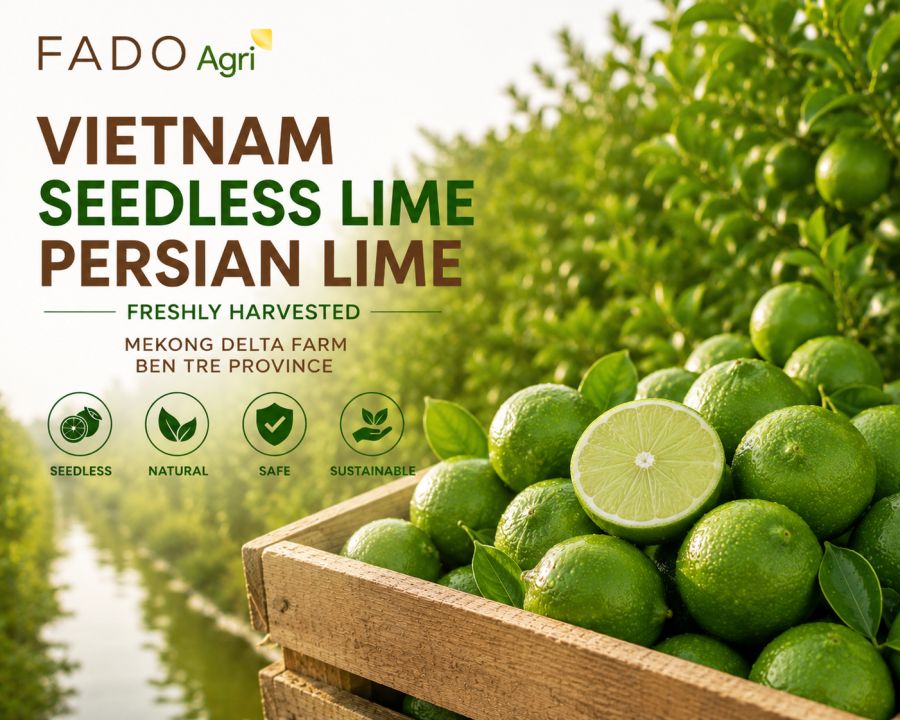
Vietnam Seedless Lime (Persian Lime) scientifically known as Citrus × latifolia, is the dominant commercial lime variety in Vietnam’s export market. Unlike the common Key Lime (Citrus aurantiifolia), the Persian Lime is larger, seedless or near-seedless, and has a thicker rind that significantly improves post-harvest durability during long-haul shipping.
Key characteristics that make it the preferred export variety:
- Size: 45–65 mm diameter (Grade A standard for export)
- Weight: 70–120 g per fruit
- Rind: Smooth, dark green to yellow-green at maturity; thick and firm
- Flavor profile: Mildly acidic, fragrant, with a clean citrus aroma
- Seeds: 0–2 seeds per fruit (commercially seedless)
- Shelf life: 3–5 weeks at 8–10°C cold chain, significantly longer than Key Lime
This combination of physical durability and sensory appeal makes Vietnamese Persian Lime competitive in premium retail channels, food service, and industrial juice processing worldwide.
Read more: From Farm to Global Shelf: The Journey of Vietnamese Coconut Exports
2. Vietnam’s Key Lime-Growing Regions: Where Does the Supply Come From?
Vietnam’s Persian Lime supply is concentrated in four core growing regions, each with distinct seasonal windows and logistical advantages.
| Growing Region | Province(s) | Peak Season | Distinguishing Feature |
| Mekong Delta | Ben Tre, Tien Giang, Hau Giang | March – July | Highest volume; alluvial soil; ideal for export scale |
| Southern Highlands | Lam Dong, Dak Lak | May – September | Cooler elevation; firm texture; strong aroma |
| Southeast Region | Binh Duong, Dong Nai | Year-round | Proximity to Ho Chi Minh City ports |
| Central Coastal | Binh Dinh, Quang Nam | October – February | Off-season supply; bridges harvest gaps |
Why multi-region sourcing matters for importers: Vietnam’s geographic spread means that a well-networked exporter can guarantee near-continuous supply across 10–12 months per year by rotating procurement between regions, a critical advantage over single-origin suppliers.
Fado Agri sources directly from grower networks across the Mekong Delta and Southern Highlands, allowing flexible volume commitments without seasonal disruption.
3. Export Specifications and Quality Grading Standards
Vietnamese Persian Lime for wholesale export is graded against both domestic standards (TCVN) and internationally aligned frameworks used by EU, UAE, and Asian buyers.
3.1 Standard Export Grades
| Grade | Diameter | Weight | Appearance | Typical Destination |
| Grade A (Premium) | 55–65 mm | 90–120 g | Uniform green, no blemish | Europe, UAE, Japan, South Korea |
| Grade B (Standard) | 45–54 mm | 70–89 g | Minor surface variation allowed | Southeast Asia, Middle East, North Africa |
| Grade C (Processing) | Below 45 mm | Under 70 g | Acceptable for juice | Juice factories, industrial buyers |
3.2 Key Export Quality Parameters
Buyers sourcing Vietnam Seedless Lime for premium markets should verify:
- Brix (sugar content): 7–9° Brix for balanced flavor
- Titratable acidity: 5–7% citric acid
- Moisture loss post-harvest: ≤ 5% at point of shipment
- Pesticide residue: Compliant with EU MRL (Maximum Residue Limits) regulations
- Phytosanitary certification: Issued by Vietnam’s Plant Protection Department (PPD)
- Cold chain: Pre-cooling to 8–10°C before container loading
3.3 Packaging Options
| Format | Unit Weight | Carton Spec | Typical Order |
| Open-mesh bag | 500 g / 1 kg | 10 kg net per carton | Retail chains |
| Bulk loose-pack | N/A | 10–15 kg carton | Food service, wholesale |
| Retail consumer bag | 300–500 g net | Display-ready box | Supermarkets |
| Custom branded | Per buyer spec | Per buyer spec | Private label |
4. Harvest Calendar: When to Order Vietnam Seedless Lime for Uninterrupted Supply
Vietnam Persian Lime is available for export throughout most of the year. Understanding the harvest calendar helps importers plan purchase orders and avoid peak-price months.
4.1 Monthly Availability by Region
| Month | Mekong Delta | Southern Highlands | Southeast Region | Central Coastal |
| January | ● Medium | ○ Low | ● Medium | ● High |
| February | ○ Low | ○ Low | ● Medium | ● High |
| March | ● High | ○ Low | ● Medium | ● Medium |
| April | ● Peak | ● Medium | ● High | ○ Low |
| May | ● Peak | ● High | ● High | ○ Low |
| June | ● High | ● Peak | ● High | ○ Low |
| July | ● Medium | ● Peak | ● Medium | ○ Low |
| August | ○ Low | ● High | ● Medium | ○ Low |
| September | ○ Low | ● Medium | ● High | ● Medium |
| October | ● Medium | ○ Low | ● High | ● High |
| November | ● Medium | ○ Low | ● Medium | ● Peak |
| December | ● Medium | ○ Low | ● Medium | ● High |
● = Active supply available | ○ = Limited or transitional
4.2 Best Ordering Months for Large Volume
- Highest volume + most competitive pricing: April–July (Mekong Delta peak)
- Premium quality, firm texture: June–August (Southern Highlands peak)
- Year-round stability: Combine Mekong Delta + Southeast Region sourcing
Buyers placing recurring monthly orders should work with a supplier who has multi-region procurement capability to avoid supply gaps in February and August.
5. Export Pricing Guide: How Much Does Vietnam Seedless Lime Cost Wholesale?
Wholesale export pricing for Vietnam Persian Lime varies based on grade, packaging, volume, Incoterms, and seasonal demand. The figures below reflect indicative FOB Ho Chi Minh City / Cai Mep Port pricing as of Q2 2025.
Note: Prices are indicative reference ranges. Actual quotes depend on order volume, packaging specification, delivery timeline, and market conditions at the time of order.
| Grade | FOB Price (USD/kg) | MOQ (kg) | Lead Time |
| Grade A Premium | USD 0.85 – 1.20 | 5,000 kg | 7–14 days |
| Grade B Standard | USD 0.60 – 0.85 | 3,000 kg | 7–14 days |
| Grade C Processing | USD 0.35 – 0.55 | 10,000 kg | 5–10 days |
Factors that affect final price:
- Packaging type (bulk carton vs. branded retail bag)
- Certifications required (GlobalG.A.P., organic, Rainforest Alliance)
- Destination port and Incoterms (FOB vs. CIF vs. DAP)
- Order frequency (spot purchase vs. annual contract)
- Season (peak harvest months offer 10–20% lower pricing vs. off-season)
For buyers committing to long-term supply agreements (12+ months), Fado Agri offers preferential pricing tiers, priority allocation during peak demand seasons, and dedicated quality assurance protocols per buyer specification.
6. Step-by-Step Export Process: How Does Fado Agri Handle a Lime Shipment?
Understanding the export process helps buyers set realistic timelines and compliance expectations. Here is Fado Agri‘s standard workflow for a Vietnam Seedless Lime export order:
- Inquiry & Specification Alignment, Buyer submits product spec, volume, destination, and Incoterms. Fado Agri confirms availability, pricing, and lead time within 24–48 hours.
- Sample Dispatch, A quality sample (2–5 kg) is shipped via express courier before contract signing. Buyers can assess fruit size, color, aroma, and rind quality firsthand.
- Purchase Order & Proforma Invoice, Once the buyer approves the sample, a formal PO is issued. Fado Agri provides a Proforma Invoice with full item description, HS code, and packaging details.
- Farm Procurement & Sorting, Fado Agri’s procurement team sources from pre-approved farms. Fruit is harvested at the optimal stage, transported to the packing house within 12–24 hours.
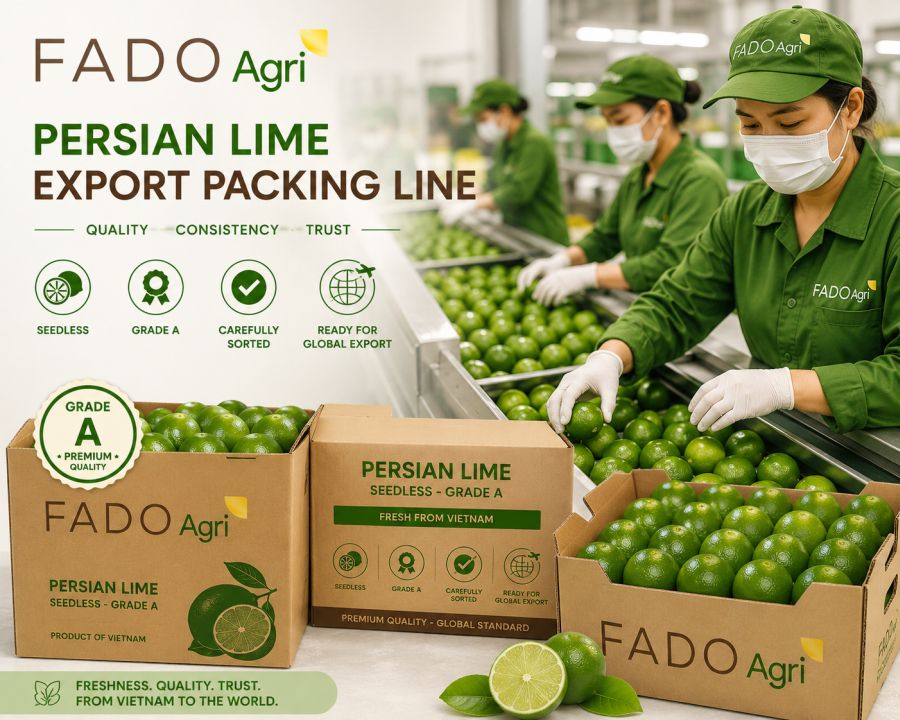
- Packing House Processing, Limes are washed, sorted by size and color, graded according to buyer spec, and packed. QC inspection is conducted at this stage.
- Pre-Shipment Inspection & Certification, Phytosanitary certificate is obtained from Vietnam’s PPD. Optional third-party inspection (SGS, Bureau Veritas) available upon buyer request.
- Cold Chain Loading, Fruit is pre-cooled and loaded into refrigerated containers (reefer) at 8–10°C. Container sealing and temperature logging are documented.
- Customs Clearance & Departure, Export customs declaration is filed. Bill of Lading, Certificate of Origin (Form D or Form EUR.1 for EU), Packing List, and Commercial Invoice are issued.
- Document Transmission, Full shipping document set is sent to the buyer via email/courier within 3 business days of vessel departure.
- Post-Shipment Support, Fado Agri tracks shipment arrival and provides responsive support for any customs queries at the destination port.
7. Certifications and Compliance: What Documentation Do Importers Need?
7.1 Standard Documents for Every Shipment
Every Fado Agri lime export includes:
- Phytosanitary Certificate, issued by Vietnam Ministry of Agriculture (MARD/PPD)
- Certificate of Origin, Form D (ASEAN), Form EUR.1 (EU), or RCEP Form
- Commercial Invoice with HS Code 0805.50 (citrus fruit, fresh/dried)
- Packing List with net/gross weight and carton count
- Bill of Lading (sea freight) or Airway Bill (air freight)
7.2 Market-Specific Compliance Requirements
| Destination Market | Key Requirement | Fado Agri Status |
| European Union | EU MRL compliance; SPS import controls | Available – EU MRL-tested farms |
| United Arab Emirates | ESMA halal/phyto compliance; Dubai Customs | Available – standard phyto + COO |
| Japan | Japan Plant Protection Law; low MRL tolerance | Available – select certified farms |
| South Korea | KAQA import standards; fumigation may be required | Available on request |
| United States | USDA APHIS import permit; strict phyto inspection | Available – consult lead time |
| Canada | CFIA fresh fruit regulations | Available – COO + phyto |
7.3 Optional Value-Adding Certifications
- GlobalG.A.P., For buyers supplying European retail chains
- Organic Certification, Available from select farms; contact Fado Agri for availability
- SMETA/SEDEX Social Audit, For buyers with ESG/supplier due diligence requirements
Read more: Red Dragon Fruit from Vietnam: Varieties, Season & Export Specifications
8. Vietnam Seedless Lime vs. Key Lime vs. Kaffir Lime: Which Should You Import?
Importers frequently compare Vietnam’s three major lime types before finalizing sourcing decisions.
| Criteria | Seedless Lime (Persian) | Key Lime (Thai Lime) | Kaffir Lime |
| Scientific name | Citrus × latifolia | Citrus aurantiifolia | Citrus hystrix |
| Seeds | 0–2 (seedless) | 10–20+ | Many |
| Size | Large (45–65 mm) | Small (25–40 mm) | Medium, bumpy |
| Shelf life | 3–5 weeks | 1–2 weeks | 2–3 weeks |
| Flavor | Mild, aromatic | Intense, tart | Leaf dominant |
| Primary use | Fresh retail, foodservice, juice | Cocktails, authentic cuisine | Leaf for cooking, rind for flavor |
| Export volume | Very high | High | Moderate |
| Price (FOB, Grade A) | USD 0.85–1.20/kg | USD 0.70–1.00/kg | USD 1.20–2.00/kg |
| Best for | Supermarkets, mass retail, processors | Restaurants, specialty grocery | Asian cuisine, aromatherapy |
Bottom line: Persian Lime is the right choice for buyers seeking high-volume, consistent supply with maximum shelf life. Key Lime suits specialty food buyers. Kaffir Lime is a niche, lower-volume product for culinary or cosmetic applications.
9. Frequently Asked Questions About Importing Vietnam Seedless Lime
What is the minimum order quantity (MOQ) for Vietnam Seedless Lime export?
The standard MOQ is 3,000–5,000 kg per shipment for Grade A and Grade B. Processing grade (Grade C) typically starts at 10,000 kg. For buyers testing a new supplier, Fado Agri can arrange trial orders from 500 kg via air freight.
How long does it take to ship Vietnamese lime to Europe or the Middle East?
Sea freight transit from Ho Chi Minh City (Cai Mep Port) takes approximately 20–28 days to Europe and 10–16 days to the UAE or Saudi Arabia. With pre-cooling and proper reefer settings (8–10°C), fruit arrives in excellent condition within these windows.
Does Vietnam Seedless Lime comply with EU pesticide MRL requirements?
Yes, Fado Agri sources from farms that follow EU MRL-compatible agrochemical protocols. Pre-shipment pesticide residue testing is available upon request through accredited Vietnamese laboratories.
Is GlobalG.A.P.-certified lime available from Vietnam?
GlobalG.A.P.-certified Persian Lime is available from select farms in Fado Agri’s network. Buyers requiring this certification should specify it at the inquiry stage, as it may affect pricing and lead time.
Can Fado Agri supply private-label or custom-branded packaging?
Yes. Fado Agri offers custom packaging including branded cartons, retail mesh bags with buyer logos, and sticker labeling. A minimum lead time of 14–21 days is required for custom packaging production.
What is the difference between FOB and CIF pricing for lime imports?
FOB (Free on Board) means the buyer takes responsibility once goods are loaded on the vessel at the origin port. CIF (Cost, Insurance, and Freight) means the seller covers freight and insurance to the destination port. Most first-time buyers prefer CIF for simplicity; high-volume importers typically prefer FOB to control freight costs.
What happens if fruit quality issues are discovered at the destination port?
Fado Agri’s quality guarantee covers documented pre-shipment inspection reports and temperature logs. In cases of verified supplier-side quality failure, we work with buyers to issue partial credit or prioritize replacement in the next shipment. Third-party inspection at origin (SGS, Bureau Veritas) is available to establish a mutually agreed quality baseline before shipping.
10. Why Source Vietnam Seedless Lime Through Fado Agri?
Fado Agri is Vietnam’s dedicated agricultural export specialist, built on a foundation of direct farm relationships, transparent traceability, and long-term B2B partnership. Here is what differentiates working with Fado Agri from a trading intermediary:
- Direct farm network, We work directly with growers across the Mekong Delta and Southern Highlands, eliminating unnecessary middlemen and ensuring better price transparency.
- Multi-region procurement, Our sourcing footprint across four growing regions supports year-round supply stability for recurring buyers.
- Quality-first process, Every shipment goes through standardized sorting, grading, and pre-shipment inspection before loading.
- Responsive communication, Dedicated export managers for each buyer account; inquiry-to-quote response within 24–48 hours.
- Full documentation support, From phytosanitary certificates to EU origin forms, our team handles all export paperwork end-to-end.
- Scalable partnership, From trial orders to full-container regular shipments, we grow with our buyers’ volume needs.
Conclusion: Your Next Step in Sourcing Vietnam Seedless Lime (Persian Lime)
Vietnam Seedless Lime (Persian Lime) remains one of the most reliable, high-margin tropical fruits available from Southeast Asia, combining year-round availability, long shelf life, and strong consumer demand across global retail and food service markets. Whether you are a first-time importer exploring Vietnamese supply or an established buyer looking to diversify your sourcing, Fado Agri offers the farm-to-port traceability, quality consistency, and export expertise your business needs.
Ready to get started?
- 📩 Request a free sample, We ship trial samples (2–5 kg) by express courier before any commitment.
- 📋 Get a wholesale quote, Submit your target volume, specification, and destination for a tailored FOB/CIF price.
- 📞 Talk to our export team, Schedule a call with a Fado Agri export specialist to discuss your supply requirements in detail.
Contact Fado Agri today to source Vietnam Seedless Lime (Persian Lime) with confidence.
Website: https://fadoagri.com/
Email: [email protected]
Hotline: (+84) 908 479 339