

Step 1 — Finding and Vetting a Vietnamese Supplier
The most reliable way to find a verified fresh coconut supplier in Vietnam is to cross-reference three independent sources: Vietnam’s Ministry of Agriculture and Rural Development (MARD) export licensee lists, trade platforms such as ITC Trade Map, and direct referrals from freight forwarders or import agents active in the region. Vietnam exported over 500,000 tonnes of fresh coconut annually in recent years [source: to be confirmed], making it one of the world’s leading suppliers — but that volume also means the market contains both professional exporters and opportunistic brokers who lack farm-level control.
How to verify a supplier is legitimate
Ask any prospective supplier for their business registration number, export license, and valid third-party certifications before any other conversation. Certifications that carry real market weight include GLOBALG.A.P (farm-level audit), HACCP (processing hygiene), and FDA registration (required for shipments to the United States). A supplier who cannot produce current certificates — ideally with audit dates and issuing body names — within 48 hours of your request is a red flag worth taking seriously.
Beyond documents, check whether the supplier owns or directly contracts farms, or whether they are purely a trading company. Farm ownership or traceable supply chain agreements mean better control over harvest timing, post-harvest treatment, and quality consistency across repeated orders. In our experience, buyers who skip this verification step often discover mid-shipment that their “exporter” is actually a middleman with no visibility into growing conditions.
Key questions to ask in your first inquiry
Your initial email or call should request the following minimum information: available coconut varieties and cut types (for example, Conical Peeling, Bald, Easy Open, Diamond Cut, or Whole), minimum order quantity (MOQ) per container, current lead time from order confirmation to vessel loading, available certifications and their expiry dates, and a recent laboratory test report for shelf life or pesticide residue. Request the supplier’s export track record — specifically which markets they currently ship to and how many containers per year. A supplier shipping 500+ containers annually across 10 or more certified markets operates at a fundamentally different quality management level than one shipping occasional small loads.
Step 2 — Requesting Samples and Approving Quality
Always request physical samples before placing a commercial order — no matter how convincing the product photographs or video calls appear. Fresh coconut quality is highly sensitive to harvest maturity, post-harvest handling, and cold chain management during sample transit, so the sample you receive tells you more than any specification sheet can.
What a proper sample request should specify
When requesting samples, provide the supplier with your exact cut preference, target shelf life requirement, and whether you need the coconuts treated (for example, with food-safe fungicide wash or wax coating for ambient transit markets). Specify your destination port and import clearance timeline so the supplier can mirror real export conditions as closely as possible. Request at minimum 6–12 coconuts per cut type, packed in the same carton format and cold chain conditions that would be used for a commercial shipment.
How to evaluate samples on arrival
Inspect samples within 24 hours of arrival. Record: shell condition (no cracks, mold, or dark spots), flesh firmness, water volume and taste, husk color and uniformity if applicable, and carton presentation. Compare the sample arrival condition against the agreed specification sheet. If you are a first-time buyer, consider engaging a third-party inspection company such as SGS or Bureau Veritas to provide an objective quality report — this report also becomes useful documentation if you need to raise a quality dispute later. Once you approve the sample, request that the supplier retain a matched reference sample from the same batch for comparison at commercial loading.
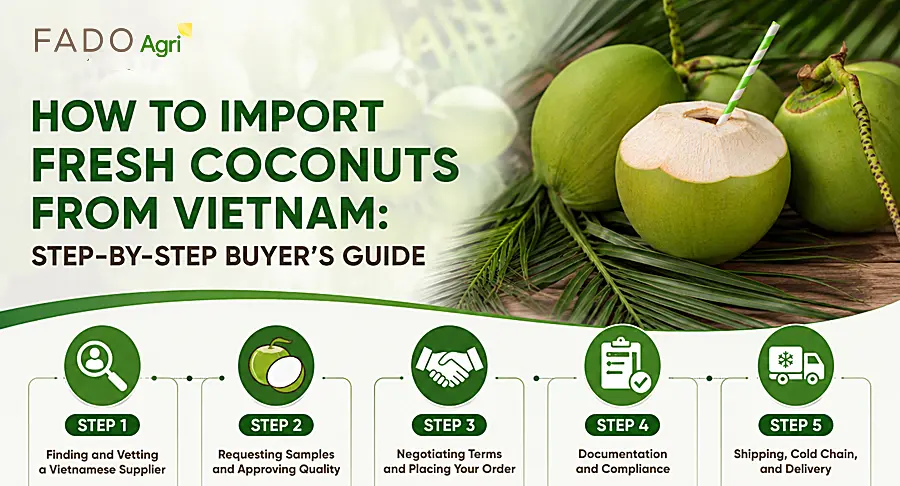
Step 3 — Negotiating Terms and Placing Your Order
Commercial terms for fresh coconut imports from Vietnam center on three main variables: Incoterms, payment structure, and packaging specification. Getting these clearly agreed in writing before issuing a purchase order prevents the majority of disputes that first-time buyers encounter.
Which Incoterms are most used for fresh coconut?
FOB Vietnam (Free On Board) is the most common Incoterm used in Vietnamese coconut exports and gives buyers direct control over freight booking, insurance, and carrier selection. Under FOB, the supplier is responsible for all costs and risks up to the point the cargo is loaded onto the nominated vessel at the origin port. CIF (Cost, Insurance, Freight) is preferred by buyers who want the supplier to manage logistics to a named destination port — this is common for first-time buyers and smaller volume orders where the buyer does not yet have established freight relationships. EXW (Ex Works) is rarely used for fresh produce because it places the entire logistics burden on the buyer from the supplier’s warehouse gate, which creates cold chain vulnerability at a critical stage.
Payment terms: what is typical?
Standard payment terms from Vietnamese coconut exporters typically follow one of three structures: 30% advance deposit with 70% paid against shipping documents (the most common for new buyer relationships); a confirmed Letter of Credit (LC) at sight, which protects both parties and is preferred for larger first orders; or open account terms (net 30–60 days) reserved for buyers with an established track record with the supplier. Wire transfer (T/T) is the dominant payment method. Buyers placing their first order should expect to pay a deposit — suppliers with legitimate operations and real farm costs cannot absorb full credit risk on new accounts.
Packaging and MOQ
Standard MOQ for a fresh coconut export order is typically one 40-foot reefer container, which holds approximately [to be confirmed] pieces depending on cut type and packing density. If you need custom coconut packaging — private label cartons, retail-ready mesh bags, or OEM branded cases — confirm this at order stage, not at loading. Lead time for custom packaging production typically adds 7–14 days to the pre-shipment timeline.
Step 4 — Documentation and Compliance
Fresh coconut export from Vietnam requires a specific set of documents, and missing or incorrectly issued paperwork is one of the top causes of shipment holds at destination ports. Every document below must be correct in name, date, and product description before the vessel departs.
Required export and import documents
| Document | Purpose | Issued By | Required For |
|---|---|---|---|
| Phytosanitary Certificate | Confirms the consignment is free from regulated pests and plant diseases | Vietnam Plant Protection Department (PPD) / MARD | All fresh produce export markets |
| Certificate of Origin (CO Form B or bilateral) | Confirms Vietnamese origin; enables preferential tariff rates | Vietnam Chamber of Commerce and Industry (VCCI) | All markets; specific form depends on FTA (e.g., RCEP, UKVFTA) |
| Commercial Invoice | States price, quantity, HS code, buyer/seller details | Exporter | Customs clearance at destination |
| Packing List | Details carton count, net/gross weight, pallet configuration | Exporter | Customs clearance and freight reconciliation |
| Bill of Lading (B/L) or Airway Bill | Title document for the cargo; required to take delivery | Shipping line / airline | Port release at destination |
| Health Certificate | Confirms product meets food safety standards of destination country | Vietnam Food Safety Authority or MARD | Markets including UAE, China, EU, South Korea |
| FDA Prior Notice (USA) | Mandatory pre-arrival notification for food shipments entering the US | Exporter or US importer (via FDA FURLS system) | USA only |
| Fumigation Certificate | Confirms wooden pallets treated to ISPM-15 standard | Licensed fumigation company | Most markets including Australia, USA, EU |
For a detailed breakdown of what each market requires, see our article on Vietnam’s coconut export requirements and our dedicated compliance guide on HACCP and FDA compliance for coconut exports.
Step 5 — Shipping, Cold Chain, and Delivery
Cold chain integrity from packing house to destination port is the single biggest determinant of fresh coconut arrival quality, and it is an area where buyers must be proactive — not passive.
Reefer vs. ambient container: which to use?
Fresh coconuts with husk intact (Whole or Conical Peeling cuts) can typically withstand ambient transit of up to 30 days under the right humidity conditions, making 40-foot dry containers viable for short-haul routes such as Vietnam to Malaysia, China, or parts of the Middle East. For longer routes — Australia, the USA, Japan, South Korea, or the EU — a refrigerated (reefer) container set at 10–13°C and 85–95% relative humidity is strongly recommended to maintain flesh quality and water volume. Husked, trimmed, or partially processed cuts (Bald, Easy Open, Diamond) are significantly more perishable and should always travel in reefer containers regardless of route distance.
Typical end-to-end timeline
| Stage | Action | Who Does It | Typical Duration |
|---|---|---|---|
| 1. Inquiry & vetting | Supplier verification, sample request, spec agreement | Buyer + Supplier | 3–10 days |
| 2. Sample evaluation | Sample shipment, inspection, approval | Buyer (+ third-party inspector) | 7–14 days |
| 3. Order confirmation | PI issued, deposit payment, packaging confirmed | Buyer + Supplier | 3–7 days |
| 4. Pre-production | Harvest scheduling, custom packaging production if applicable | Supplier | 7–21 days |
| 5. Packing & pre-shipment inspection | Grading, packing, pre-loading quality check | Supplier + optional third-party inspector | 2–4 days |
| 6. Export documentation | Phytosanitary cert, CO, health cert issuance | Supplier + Vietnam government agencies | 1–3 days |
| 7. Ocean freight | Loading to arrival at destination port | Shipping line | 5–30 days (route dependent) |
| 8. Import clearance | Customs, phytosanitary inspection at destination | Buyer + import broker | 1–5 days |
| 9. Delivery | Container to cold store or distribution center | Buyer’s logistics | 1–2 days |
For buyers shipping to the UAE or GCC markets, transit times from Vietnam’s main ports (Ho Chi Minh City / Cat Lai) to Jebel Ali typically range from 14–20 days by sea. For more on the specific process for this corridor, see our Vietnam coconut export to UAE guide. USA-bound buyers should review our Vietnam coconut to USA article for FDA-specific steps.
Quality checks at loading and at destination
At the loading stage, request a pre-shipment inspection report that documents: carton count vs. packing list, reefer temperature pre-cooling status, random sample weight and visual check, and photographic evidence of the packed container. At destination, inspect the container upon opening before signing any delivery receipt. Record reefer temperature download data (most modern reefer units log temperature throughout the voyage) and photograph any damage immediately. If quality is below the agreed specification, a clear photographic record combined with the temperature log and a third-party inspection report gives you the documentation needed to pursue a legitimate claim with the supplier or your cargo insurance provider.
Common Mistakes First-Time Buyers Make
The most costly mistake is skipping the sample stage to save time or money on an urgent first order. Fresh coconut shelf life, water content, and visual appearance vary significantly by harvest maturity and variety — a specification sheet cannot substitute for holding the actual product in hand. The second most common error is choosing a supplier based on the lowest FOB price without verifying cold chain capability, certifications, or farm traceability.
Other problems we regularly see in our experience with first-time buyers include: ordering a cut type (such as Bald or Easy Open) without confirming it is suitable for ambient container transit on long routes; not confirming phytosanitary requirements at the destination country before the order is placed; and failing to engage a licensed customs broker at the destination port, resulting in clearance delays that push fresh produce past its viable shelf life. Packaging errors — incorrect HS code on the commercial invoice, or cartons not matching the packing list — can trigger full container inspections that add days to clearance time.
Finally, many first-time buyers do not budget for pre-shipment inspection costs. Hiring an independent inspector at origin (cost: typically USD 150–400 per inspection [source: to be confirmed]) is one of the highest-return investments you can make on a first container, because catching a quality issue before loading is infinitely cheaper than receiving a substandard cargo at destination.
Frequently Asked Questions — Importing Fresh Coconuts from Vietnam
What is the minimum order quantity (MOQ) for fresh coconuts from Vietnam?
Most established Vietnamese coconut exporters set MOQ at one 40-foot container, which is the practical minimum for refrigerated sea freight to be cost-effective. Some suppliers may accept a 20-foot container for new buyers or trial orders, though the per-unit cost will be higher. Buyers with very small requirements may be able to arrange consolidation (LCL) shipments, though this is uncommon for fresh produce due to cold chain complexity.
How long does the entire import process take from first contact to delivery?
Allow 6–10 weeks from initial supplier contact to cargo delivery at your destination port for a first order, which includes time for vetting, sampling, order confirmation, pre-production, export documentation, and ocean transit. Repeat orders from an approved supplier with existing specifications and payment terms can be turned around in 3–5 weeks depending on the route.
What certifications should a Vietnam coconut supplier have for my market?
At minimum, look for HACCP (processing hygiene), GLOBALG.A.P (farm-level audit), and — if shipping to the USA — FDA facility registration. Japan and South Korea require specific pesticide residue testing to their own MRL (maximum residue limit) standards. The EU requires additional documentation under its plant health regulations. Always confirm destination-specific requirements with your import broker before placing an order.
Can I import fresh coconuts in ambient containers, or do I always need reefer?
Whole and husk-on coconuts tolerate ambient transit reasonably well for routes under 20–25 days in appropriate temperature and humidity conditions. Husked or trimmed cuts (Bald, Easy Open, Diamond) require reefer containers regardless of route. For any route over 25 days, reefer is strongly recommended for all cut types to protect water content and flesh integrity.
What is a phytosanitary certificate and who issues it in Vietnam?
A phytosanitary certificate is an official plant health document that confirms a consignment of fresh produce is free from regulated pests, diseases, and soil — it is a legal requirement for fresh coconut imports in virtually every country. In Vietnam, this certificate is issued by the Plant Protection Department (PPD) under MARD, based on a physical inspection of the consignment before export. The supplier arranges this inspection; it cannot be obtained after the cargo has sailed. For more detail, see our guide on Vietnam’s coconut export requirements.
What payment terms can I negotiate with Vietnamese coconut suppliers?
For a first order, expect to pay 30% deposit by T/T at order confirmation and 70% against the Bill of Lading or shipping documents. A confirmed Letter of Credit (LC) at sight is an alternative that protects both sides equally and is often preferred by buyers with larger order values. Open account terms are typically only offered to buyers with a track record of 3 or more successful orders and consistent payment history with that supplier.
What happens if my coconuts arrive in poor condition?
Document everything immediately: photograph the container interior upon opening, request the reefer temperature download report, and engage a licensed surveyor or third-party inspector before accepting delivery. Notify your supplier in writing within the timeframe specified in your sales contract (typically 24–48 hours of delivery). A well-structured sales contract should include a clear quality claim procedure. Cargo insurance is also strongly recommended for fresh produce shipments — confirm with your freight forwarder or insurance broker that your policy covers perishable goods.
Does Fado Agri offer private label or OEM coconut packaging?
Yes — Fado Agri offers OEM and private label services across all six coconut cut types. Custom carton printing, retail mesh bag branding, and destination-specific labeling can be arranged. Confirm packaging requirements at the order stage to avoid delays. See our detailed article on custom coconut packaging from Vietnam for options and lead times.
Ready to Start Your Vietnam Coconut Import?
Importing fresh coconuts from Vietnam is a well-established trade route with predictable timelines and clear documentation requirements — but first-time buyers who skip supplier verification, sampling, or pre-shipment inspection steps pay a disproportionately high cost for those shortcuts. The process outlined in this guide reflects what experienced importers across the UAE, Australia, Japan, South Korea, and the USA follow on every order cycle.
If you are ready to start a conversation with a verified exporter, Fado Agri’s team — based in Vietnam, UAE, Malaysia, and Australia — can walk you through specifications, certifications, sample logistics, and pricing for any of our six fresh coconut cut types. Reach out directly using the contact details below and expect a response with full supplier documentation within 48 hours.