

Cold Chain Shipping for Vietnamese Tropical Fruit: Why Getting It Wrong Is Costly
A perfectly grown dragon fruit from Binh Thuan can arrive at a Dubai supermarket looking bruised, discolored, and unsellable — not because of farming failure, but because of cold chain failure. Temperature deviation of even 2–3°C at the wrong stage can trigger premature ripening, microbial growth, or chilling injury in tropical fruit. For exporters and logistics managers sourcing Vietnamese tropical fruit, understanding the technical requirements of cold chain shipping is not optional — it is the difference between a profitable shipment and a costly rejection.
This guide covers the full technical picture: temperature settings by fruit type, pre-cooling protocols, reefer container configuration, monitoring technology, and the failure points that cause the most quality loss in transit. If you are involved in procuring or moving fresh Vietnamese fruit to international markets, this is what you need to know.
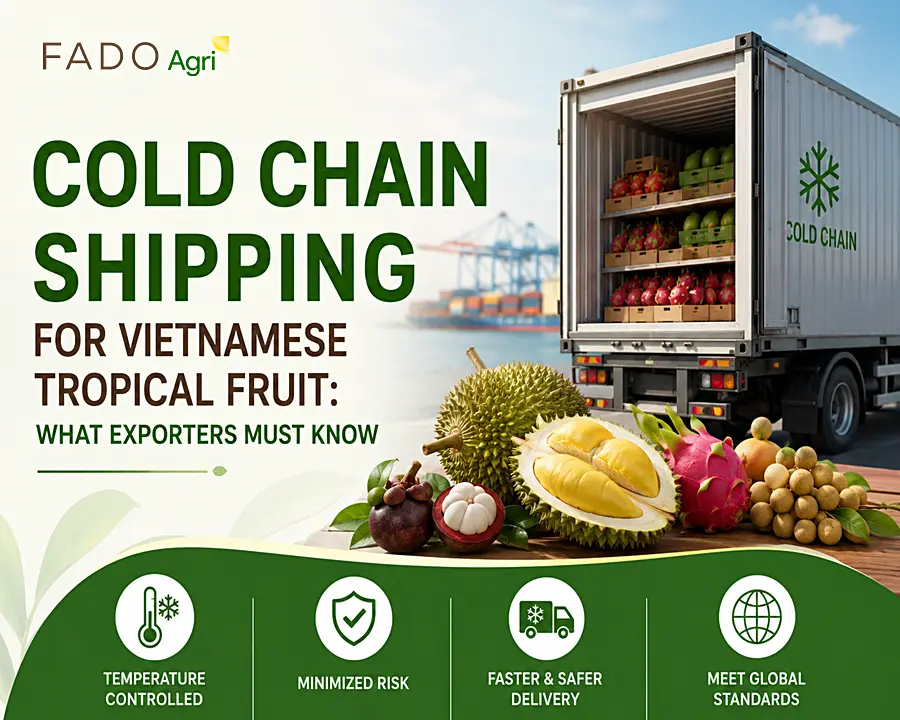
Temperature Requirements Vary Significantly by Fruit Type
Not all tropical fruits tolerate the same cold storage conditions — in fact, many are damaged by temperatures that are too low, a condition called chilling injury. Vietnamese tropical fruits span a wide sensitivity range, and using a one-size-fits-all reefer setting is one of the most common mistakes in fresh fruit logistics.
Fresh coconut, for example, is relatively hardy and can tolerate lower humidity variation, while red dragon fruit is highly sensitive to both temperature fluctuations and ethylene exposure. Longan — sourced from Vietnam’s northern and central highlands — requires tight humidity control to prevent skin browning, a major quality defect in Asian and Middle Eastern retail markets. Seedless lime demands consistent cold to preserve juice content and skin color during sea transit.
The table below consolidates the standard recommended settings for each key product Fado Agri exports. These parameters align with internationally referenced postharvest guidelines and our operational experience across 500+ containers shipped annually to 10+ certified markets.
| Fruit | Temperature (°C) | Relative Humidity (%) | Max Sea Transit (Days) | Cold Sensitivity Level |
|---|---|---|---|---|
| Fresh Coconut | 7–13°C | 85–90% | 30–35 | Low–Medium |
| Red Dragon Fruit | 5–10°C | 90–95% | 18–25 | High |
| Seedless Lime | 9–11°C | 85–90% | 28–35 | Medium |
| Cavendish Banana | 13–14°C | 90–95% | 20–28 | High (chilling injury below 12°C) |
| Longan | 1–4°C | 90–95% | 20–28 | Medium–High |
| Taiwan Guava | 8–10°C | 90–95% | 20–25 | Medium |
| Watermelon | 10–15°C | 85–90% | 21–28 | Low–Medium |
Note: These are operational benchmarks based on industry postharvest practice and Fado Agri shipping experience. Specific shipments may vary by cultivar maturity, packaging type, and destination port conditions. [source: to be confirmed against FAO/USDA postharvest guidelines]
Pre-Cooling: The Step That Determines Everything Downstream
Pre-cooling is the process of removing field heat from harvested fruit before it enters a reefer container — and skipping or rushing this step is one of the most damaging decisions in the cold chain. If warm fruit is loaded directly into a reefer, the refrigeration unit must work far beyond its designed capacity to pull down internal fruit temperature, often failing to do so evenly throughout the container.
How Pre-Cooling Works in Practice
Pre-cooling is typically achieved through forced-air cooling, where cold air is drawn through stacked fruit cartons in a dedicated cold room, typically set 2–3°C below the target transit temperature. For most Vietnamese tropical fruits, this process takes between 6 and 18 hours depending on fruit density, packaging, and initial pulp temperature. In Ben Tre and Tien Giang — Vietnam’s primary coconut provinces — post-harvest infrastructure has improved substantially in recent years, but access to well-equipped pre-cooling facilities close to farms remains a logistical challenge for smaller operations.
At Fado Agri, pre-cooling is a non-negotiable step in our farm-to-export process. Fruit that does not meet pulp temperature targets before container loading does not get loaded. This standard protects both the cargo integrity and the relationship with the consignee at destination.
The Target: Pulp Temperature, Not Air Temperature
A critical nuance that many newer exporters miss is that pre-cooling is complete only when the internal pulp temperature of the fruit reaches the target range — not just the cold room air temperature. Measuring surface temperature only can give a false sense of readiness. Handheld penetration thermometers and digital data loggers inserted into representative fruit units are the correct monitoring method before container stuffing.
Reefer Container Settings: What Logistics Managers Must Configure
A reefer container is not a passive cold box — it is an active temperature management unit with configurable parameters including setpoint temperature, ventilation rate, humidity control (on CA-equipped units), and airflow. Getting these settings correct for the specific product is essential.
For red dragon fruit on routes from Ho Chi Minh City or Cat Lai port to Dubai or Jebel Ali (approximately 18–22 days sea transit), the reefer should be set to 8°C with relative humidity at 90–95% and ventilation kept minimal to reduce moisture loss. For Cavendish banana, the critical risk is setting the reefer too cold: below 12°C triggers chilling injury, producing grey skin discoloration that is irreversible and commercially unacceptable. Longan, in contrast, tolerates near-freezing temperatures (1–4°C) and actually benefits from them for transit preservation — but the humidity must be maintained at the high end to prevent skin desiccation and browning.
Ventilation settings on reefer units are often overlooked. Opening ventilation too wide accelerates moisture loss and introduces uncontrolled external air. In tropical port environments like Ho Chi Minh City or Port Klang (Malaysia), external ambient temperatures can reach 33–38°C, making uncontrolled ventilation a serious risk to cargo integrity.
Vietnam’s Farm-to-Port Infrastructure: Honest Assessment
Vietnam’s fresh fruit export infrastructure has advanced considerably since 2016 — new cold storage facilities, improved reefer plug capacity at Cat Lai and Cai Mep terminals, and better rural road connectivity in the Mekong Delta. However, the farm-to-port segment remains the most vulnerable link in the cold chain for many exporters, particularly for smaller or newer operations.
The Mekong Delta — home to Ben Tre coconut, Tien Giang longan, and much of Vietnam’s tropical fruit production — involves waterway transport as a primary logistics mode. Refrigerated river barges are not yet standard, meaning fruit is often moved in ambient conditions for several hours before reaching a cold room. This gap is precisely where field heat accumulates and where inexperienced exporters lose the cold chain before the reefer container is even involved.
Experienced exporters compensate by scheduling harvests at early morning (lower field temperatures), deploying insulated transport covers, and prioritizing proximity of packing houses to growing regions. For buyers evaluating suppliers, asking specifically about the farm-to-packing-house cold management protocol is a revealing due diligence question. You can review required documentation and compliance checkpoints in our Vietnam fruit export documents checklist.
Temperature Monitoring Technology During Transit
Modern cold chain monitoring has moved well beyond manual temperature checks at origin and destination. Real-time or near-real-time monitoring using data loggers and IoT-connected sensors is now standard practice for serious fresh fruit exporters.
Data loggers are compact devices placed inside reefer containers (typically in multiple positions — front, middle, rear) that record temperature and humidity at set intervals, commonly every 15–30 minutes. At the end of transit, the full temperature log can be downloaded and reviewed to identify any excursions — periods where temperature fell outside the acceptable range. This documentation is increasingly required by food safety authorities and retail buyers in the EU, Japan, and Australia.
For higher-value or longer-transit shipments, GPS-integrated IoT sensors transmit live data via satellite or cellular networks, allowing the shipper to identify a temperature excursion mid-voyage and coordinate with the shipping line to investigate or adjust settings. Fado Agri uses data logger monitoring across our export containers, and this records form part of our traceability documentation under HACCP compliance standards.
Common Cold Chain Failure Points and How to Prevent Them
Cold chain failure rarely happens at a single dramatic point — it accumulates through a series of small lapses that compound into a spoiled cargo. The table below maps the most common failure points in Vietnamese fresh fruit exports, their root causes, and operational prevention measures.
| Failure Point | Cause | Prevention | Impact on Quality |
|---|---|---|---|
| Insufficient pre-cooling | Rushed loading schedule, lack of cold room access near farm | Mandatory pulp temp check before stuffing; schedule pre-cooling 12–18 hours ahead | Accelerated ripening, early decay, ethylene accumulation in container |
| Incorrect reefer setpoint | Generic temperature setting applied to all fruits | Product-specific reefer settings; written instructions to shipping line | Chilling injury (too cold) or accelerated ripening (too warm) |
| Door opening at warm ports | Customs inspection or transshipment at tropical ports | Minimize door-open time; pre-notify inspecting authority for fast handling | Moisture loss, heat shock, condensation damage |
| Poor carton stacking/airflow blockage | Incorrect palletization or overfilling of cartons | Follow reefer container airflow guidelines; maintain floor channel clearance | Uneven cooling, warm pockets, localized decay |
| Transshipment delay | Port congestion, missed vessel connections | Use direct routes where possible; factor transit buffer into max transit time | Total shelf life reduction at destination |
| Reefer unit malfunction | Mechanical failure during voyage | Inspect reefer unit before stuffing; engage Carrier’s Equipment Interchange Report | Partial or total cargo loss |
| No temperature monitoring | Data loggers not used or not placed correctly | Deploy 3+ loggers per container; retain full transit logs for dispute resolution | Inability to prove cold chain breach; claim disputes unresolvable |
Air Freight vs. Sea Freight Cold Chain: Key Differences
Air freight cold chain for fresh fruit operates on fundamentally different logic than sea freight — shorter transit times (typically 24–72 hours) reduce the total temperature exposure risk, but the transition points between cold rooms and aircraft holds introduce brief but significant ambient exposures. For ultra-perishable or high-value produce where sea transit is too long, air freight is the correct mode — but it comes at 6–10x the cost per kilogram [source: to be confirmed].
On sea freight, the reefer container itself maintains the cold environment continuously. On air freight, produce is typically packed in insulated thermal blankets or active cooling containers (known as ULDs — Unit Load Devices) and the critical failure points are the tarmac exposure at origin airport and the cold room-to-last-mile gap at destination. For most Vietnamese tropical fruits exported by Fado Agri — fresh coconut, dragon fruit, lime, longan — sea freight is the dominant and commercially viable mode, with air freight reserved for trial shipments or express orders where speed outweighs cost.
Modified Atmosphere Packaging: When and Why It Matters
Modified Atmosphere Packaging (MAP) is a technology that alters the gas composition inside packaging — typically reducing oxygen and increasing carbon dioxide — to slow respiration and extend shelf life of fresh fruit. When combined with correct cold chain management, MAP can extend usable shelf life by 20–40% depending on the product [source: to be confirmed against FAO postharvest literature].
For Vietnamese fruit exports, MAP is most relevant for red dragon fruit (highly sensitive to respiration and ethylene) and longan (where skin browning accelerates rapidly in standard air). MAP requires specific film materials, gas flushing equipment at packing house level, and trained operators — it is not yet universally adopted across Vietnamese packing facilities, but is increasingly demanded by EU and Japanese importers as a condition of supply. For coconut exports, the packaging and shelf life requirements differ by cut type, and MAP application varies accordingly.
Documentation Required for Cold Chain Compliance
Cold chain compliance in fresh fruit export is not just operational — it is documented. Buyers, certifying bodies, and customs authorities across key markets increasingly require proof of cold chain management as part of phytosanitary compliance and food safety accountability.
Core documents for cold chain compliance include: the phytosanitary certificate issued by Vietnam’s Plant Protection Department (PPD), the packing house cold storage records showing pre-cooling temperature logs, the reefer container settings confirmation from the shipping line, and transit data logger reports for the voyage. Under GLOBALG.A.P and HACCP certifications — both held by Fado Agri — traceability documentation must be maintained from farm harvest through to container sealing, enabling full recall traceability if required. For a complete export documentation framework, refer to our Vietnam fruit export documents checklist.
Frequently Asked Questions
What temperature should a reefer container be set to for red dragon fruit from Vietnam?
Red dragon fruit should be transported at 5–10°C with 90–95% relative humidity. The optimal setting for most sea routes from Vietnam to the Middle East or East Asia is approximately 8°C. Temperatures below 5°C risk chilling injury, which presents as pitting and internal discoloration that becomes visible at destination.
How long can fresh coconut survive in a reefer container at sea?
Fresh coconut is one of the more transit-tolerant tropical fruits and can maintain acceptable quality for 30–35 days under correct conditions (7–13°C, 85–90% humidity). The specific cut type affects shelf life — fully peeled or processed cuts have a shorter window than whole or bald coconuts. For detailed cut specifications, see our guide on importing fresh coconut from Vietnam.
What is chilling injury and which Vietnamese fruits are most at risk?
Chilling injury occurs when tropical or subtropical fruits are exposed to temperatures above 0°C but below their critical threshold, causing cellular damage that manifests as pitting, discoloration, water-soaked tissue, or failure to ripen. Cavendish banana is the highest-risk product — below 12°C causes irreversible grey skin damage. Dragon fruit and guava also show chilling injury below their recommended minimums.
Is pre-cooling mandatory for all fruit types before container loading?
Yes — for all commercially shipped fresh tropical fruits, pre-cooling to target pulp temperature before container loading is an essential step. Skipping pre-cooling forces the reefer unit to compensate for field heat, creates temperature gradients inside the container, and accelerates spoilage at the centre of pallet stacks where airflow is weakest. In our experience, this is the single most common failure point in first-time exporter shipments.
How do data loggers work in fresh fruit shipping and who reviews the data?
Data loggers are small electronic devices placed inside the reefer container that continuously record temperature and humidity at set intervals throughout the voyage. At destination, the data is downloaded and reviewed by the exporter, importer, and (if a claim is raised) the insurance assessor or shipping line. Temperature excursion records form critical evidence in cargo damage claims and are increasingly required by retail buyers as proof of cold chain integrity.
What is the difference between a CA container and a standard reefer for fruit?
A standard reefer container controls temperature and basic ventilation. A Controlled Atmosphere (CA) container adds active management of the oxygen, carbon dioxide, and nitrogen balance inside the container, effectively extending shelf life by slowing fruit respiration. CA containers are significantly more expensive and are primarily used for high-value or long-haul produce. For most Vietnamese tropical fruit exported to the Middle East or East Asia, standard reefer containers with correct settings and MAP at packaging level provide sufficient cold chain protection.
What happens if a reefer container malfunctions during a voyage?
If a reefer unit fails during transit, the shipping line is contractually required to notify the shipper and attempt repair or cargo transfer. In practice, cargo insurance (typically Marine Cargo Insurance with temperature deviation cover) is the financial backstop for cold chain failure during sea freight. Exporters should always specify temperature-sensitive cargo in the Bill of Lading and ensure the insurance policy explicitly covers refrigeration breakdown. Data logger records are essential for substantiating any resulting claim.
When should air freight be chosen over sea freight for Vietnamese fresh fruit?
Air freight should be considered when the product’s maximum safe transit time cannot be met by sea freight routing — for example, a highly perishable longan shipment to a market without a direct fast sea route. It is also used for trial shipments to new markets where volume does not yet justify a full container, or for premium retail orders requiring maximum freshness upon arrival. The cost premium of air freight (typically 6–10x sea freight per kilogram) means it is commercially viable only for higher-priced or time-critical produce.
Cold Chain Is a Competitive Advantage, Not Just a Technical Requirement
Exporters who invest in cold chain rigor — correct pre-cooling, product-specific reefer settings, monitoring technology, and thorough documentation — consistently outperform those who treat logistics as an afterthought. In markets like Japan, the EU, and the UAE, retail buyers and food safety authorities are raising cold chain compliance standards every year, and suppliers who cannot demonstrate chain of custody through documented temperature records are increasingly excluded from preferred supplier programs.
At Fado Agri, cold chain management is embedded across our full farm-to-global-shelf process, supported by our FDA, GLOBALG.A.P, and HACCP certifications. If you are evaluating Vietnamese fresh fruit suppliers or planning a new import program and want to understand the cold chain protocols behind our shipments, we welcome the conversation.