

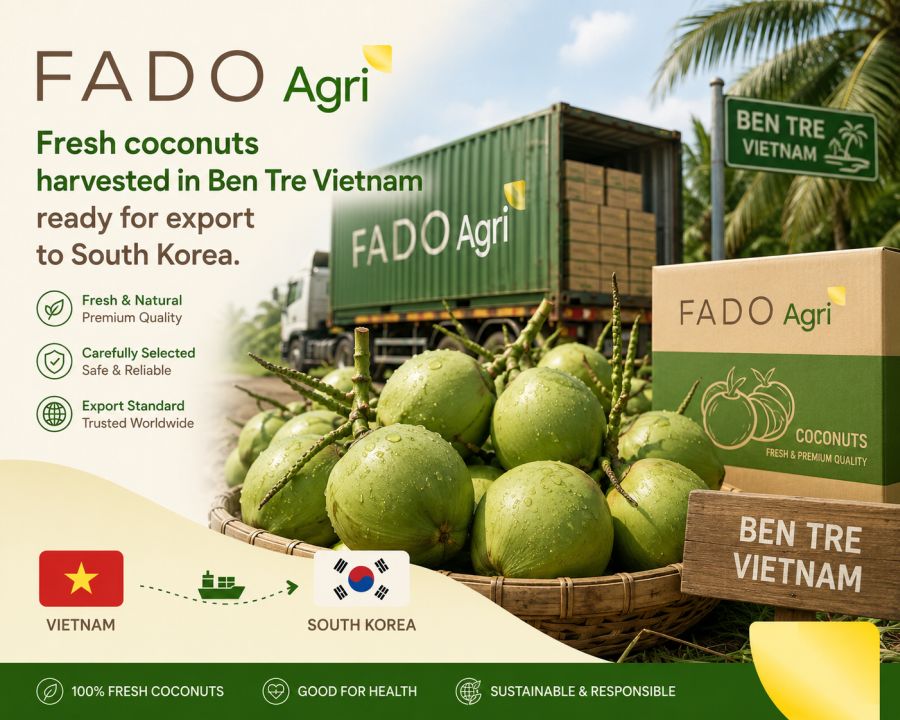
South Korea’s fresh fruit import market grew by more than 12% between 2021 and 2024, and fresh coconut has become one of its fastest-growing tropical import categories, driven by the rise of café culture, health-conscious consumers, and innovative food & beverage brands. For Korean importers sourcing Vietnam coconut to South Korea, the decision of which supplier to work with is just as important as the product itself. This guide walks through what experienced buyers actually need to know: origin quality, cut specifications, certifications, logistics and documentation.
1. Why South Korea Sources Coconuts from Vietnam
Vietnam is not simply a convenient supplier. It is, by measurable criteria, one of the world’s most competitive origins for fresh coconut export.
1.1 Ben Tre and Tien Giang: The Source of Quality
The provinces of Ben Tre and Tien Giang in the Mekong Delta are Vietnam’s primary coconut-producing regions. These areas benefit from a tropical monsoon climate, alluvial soil enriched by the Mekong River system, and generations of specialized farming knowledge. Coconuts grown here are harvested chemical-free, with quality control beginning in the field, before the fruit ever reaches a processing facility.
For Korean buyers, this origin matters because South Korea’s food safety authority (MFDS) applies strict inspection standards to imported fresh produce. Coconuts from a traceable, GAP-certified origin dramatically reduce the risk of rejection at Korean ports.
1.2 Vietnam’s Competitive Position Among Coconut Origins
Vietnam competes with Thailand, Indonesia, and the Philippines in fresh coconut exports. What sets Vietnamese coconut apart:
- Consistent fruit size and sugar profile suited to café and ready-to-drink applications
- Shorter sea freight lead time to South Korean ports (Busan, Incheon) vs. other origins
- High volume capacity: suppliers like Fado Agri export 500+ containers per year, ensuring supply stability year-round
- OEM/ODM packaging availability: Korean distributors can brand and label product to local market specifications
Read more: Vietnam Tropical Fruit to Japan: Premium Market Specifications
2. Vietnam Coconut to South Korea: What Korean Buyers Should Specify
One of the most common sourcing mistakes Korean importers make is under-specifying their product requirements. Vietnam offers multiple coconut cut types, and the right format depends entirely on the buyer’s end channel.
2.1 The Six Cut Types Available from Vietnam
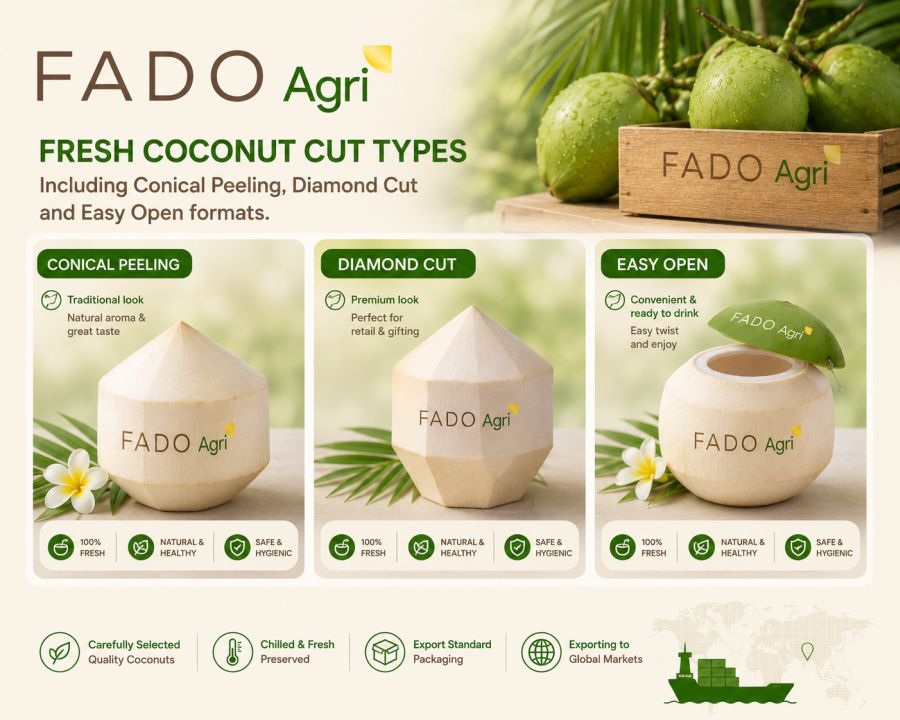
Fado Agri produces fresh coconuts in six standardized cut formats, all compliant with FDA and GLOBALG.A.P standards:
- Conical Peeling, Full husk removed to a cone shape. Popular for supermarket display and café retail.
- Whole, Fully intact coconut with husk. Preferred by wholesale markets and traditional retail.
- Diamond Cut, Husk trimmed into a diamond shape for premium retail presentation.
- Easy Open, Top pre-scored for straw insertion. Preferred for convenience stores and ready-to-drink applications.
- Bald, Fully peeled, smooth surface. Common in food service and industrial processing.
- Lid On, A pre-cut lid left in place for freshness. Ideal for premium café formats.
Korean buyers sourcing for supermarket chains should confirm which cut format aligns with their shelf planogram and target consumer before placing an order. Fado Agri’s team provides cut samples and consultation at the quoting stage.
2.2 Size and Sugar Content Specification
Beyond cut type, Korean importers should specify:
- Fruit size (by weight range or diameter): typically 0.8-1.2 kg per nut depending on application
- Water volume: for beverages, minimum 300-400 ml per nut is standard
- Maturity grade: young coconut (for water) vs. semi-mature (for both water and meat)
Buyers often ask whether Vietnamese coconuts meet Korean consumer expectations for sweetness and water clarity. The answer is yes, Ben Tre coconuts, in particular, are known for their naturally sweet, mildly fragrant water, which consistently performs well in Korean consumer taste tests.
3. Certifications and Documentation Required for Import into South Korea
Compliance documentation is non-negotiable for any Vietnam coconut to South Korea shipment. Korean customs and the Ministry of Food and Drug Safety (MFDS) require a complete set of verified documents.
3.1 Standard Export Documentation from Fado Agri
Every Fado Agri shipment is accompanied by:
- Phytosanitary Certificate, issued by the Vietnam Plant Protection Department (MARD), confirming the product is pest and disease-free
- Certificate of Origin (CO), Form D (ASEAN) or Form B (general), supporting tariff preferences under the ASEAN-Korea FTA
- HACCP Certificate, covering the processing facility’s food safety management
- GLOBALG.A.P Certificate, farm-level good agricultural practices certification, recognized by Korean buyers and retailers
- FDA Registration, for buyers also supplying the US market or requiring US compliance benchmarks
- Bill of Lading (B/L), shipping document confirming FOB or CIF terms as agreed
- Packing List and Commercial Invoice, standard trade documentation
3.2 ASEAN-Korea FTA Tariff Benefit
Under the ASEAN-Korea Free Trade Agreement (AKFTA), fresh coconuts originating from Vietnam qualify for preferential tariff rates upon presentation of a valid Certificate of Origin (Form D). Korean importers should confirm the applicable HS code with their customs broker. Fado Agri prepares Form D documentation as standard practice for all Korean shipments.
4. Logistics: Sea Freight from Vietnam to South Korea
4.1 Port-to-Port Route and Transit Time
Fresh coconuts are shipped in refrigerated (reefer) containers or ventilated containers, depending on the cut type and shelf-life requirement:
- Loading ports: Ho Chi Minh City (Cat Lai), Cai Mep
- Destination ports: Busan, Incheon
- Transit time: approximately 5-8 days depending on vessel and routing
- Minimum lead time (Fado Agri): 5 days from order confirmation for fresh coconut
Fado Agri maintains stable container availability with an average turnaround of 2-3 days per container during regular supply cycles. This is a logistics commitment, not an estimate, Korean buyers with weekly or bi-weekly replenishment cycles can plan accordingly.
4.2 FOB vs. CIF Terms
Both FOB (Ho Chi Minh City) and CIF (Busan / Incheon) terms are available from Fado Agri. Experienced Korean importers with established freight forwarder relationships typically prefer FOB for cost control. First-time buyers or those testing a new supply lane often begin with CIF to simplify the initial shipment.
Read more: Vietnam Coconut to India: Trade Guide & Phytosanitary Requirements
5. How Fado Agri Supports Korean Importers: The 10-Step Supply Chain
Understanding Fado Agri’s process helps Korean buyers assess where their sourcing risks are actively managed.
Fado Agri operates a transparent, 10-step supply chain:
- Farm sourcing, Contracted farms in Ben Tre and Tien Giang, audited for GLOBALG.A.P compliance
- Field harvest, Chemical-free harvest at optimum maturity, graded at collection
- Transport to factory, Temperature-managed transport within 24 hours of harvest
- Factory intake inspection, Visual, size, and sugar-content grading at entry
- Cutting and processing, Cut to buyer specification (six formats available)
- Food safety inspection, HACCP-controlled environment throughout processing
- Packaging, OEM/ODM available; carton weight and labeling per buyer spec
- Pre-shipment inspection, Third-party inspection available upon buyer request
- Export documentation, Full documentation set prepared (phytosanetary, CO, B/L, invoice)
- Shipping and after-sales, Real-time shipment tracking and post-delivery quality follow-up
This level of traceability is increasingly expected by Korean supermarket chains and wholesale distributors and it is what Fado Agri has built over 10+ years of export operations.
Frequently Asked Questions
What is the minimum order quantity (MOQ) for Vietnam coconut to South Korea?
Fado Agri’s standard MOQ is one 40-foot reefer container, which holds approximately 2,000-2,400 fresh coconuts depending on cut type and packaging. Buyers with smaller initial trial orders are encouraged to contact Fado Agri directly to discuss options, as some consolidated shipment arrangements may be available.
Does Vietnam coconut qualify for reduced tariffs under the ASEAN-Korea FTA?
Yes. Fresh coconuts originating in Vietnam qualify for preferential tariff treatment under the ASEAN-Korea Free Trade Agreement (AKFTA) upon presentation of a valid Certificate of Origin, Form D. Fado Agri prepares this documentation as a standard part of every Korean export shipment.
What certifications does Fado Agri hold for fresh coconut export?
Fado Agri’s coconut products are certified under GLOBALG.A.P (farm level), HACCP (processing level), and FDA (US compliance). All shipments include a Phytosanitary Certificate issued by Vietnam’s Ministry of Agriculture and Rural Development (MARD).
How long does it take to receive a fresh coconut shipment from Vietnam to South Korea?
Sea freight from Ho Chi Minh City to Busan or Incheon typically takes 5-8 days. Fado Agri’s minimum production lead time for fresh coconut is 5 days from confirmed order. Korean importers planning regular replenishment cycles should factor in 10-15 days from order to arrival.
Can Fado Agri produce OEM-packaged coconuts for Korean retail brands?
Yes. Fado Agri offers full OEM and ODM packaging services. Korean importers can specify carton design, label language, weight, and sticker requirements. OEM lead times and minimums depend on order volume; contact Fado Agri’s team for a custom quote.
What happens if coconuts are rejected at Korean customs?
Fado Agri’s pre-shipment process is designed to minimize this risk through third-party inspection, complete documentation preparation, and GLOBALG.A.P traceability. In the event of a quality dispute or customs concern, Fado Agri’s export team provides full document support and after-sales follow-up.
Sourcing Vietnam Coconut to South Korea – Final Guidance
The South Korean import market rewards suppliers who combine product quality with logistics precision and documentation reliability. For importers evaluating Vietnam coconut to South Korea, the key differentiators to assess in any potential supplier are: certified farm origin, processing compliance (HACCP/GLOBALG.A.P), documentation completeness, and capacity to support consistent supply at scale.
Fado Agri has been serving international B2B buyers since 2016, exporting 500+ containers per year across 10+ certified markets, including South Korea. We work with importers who need consistent quality, flexible OEM/ODM packaging, and export documentation that holds up at every customs checkpoint. Transparent at every stage, from Ben Tre’s farms to your Busan warehouse.
To request a product specification sheet, pricing, or a trial shipment quote, contact Fado Agri’s export team:
📞 Hotline: (+84) 908 479 339
📧 Email: [email protected]
🌐 Website: fadoagri.com