Saltwater intrusion can create risks for coconut cultivation, but the right response depends on local conditions and reliable monitoring—not a single instruction for every farm. Growers and advisers need to understand which water sources or areas may be affected, record what they observe and measure, and review any changes over time. For importers and procurement teams, clear questions about a supplier’s monitoring practices can support due diligence without implying that farm records guarantee product quality or shipment compliance.
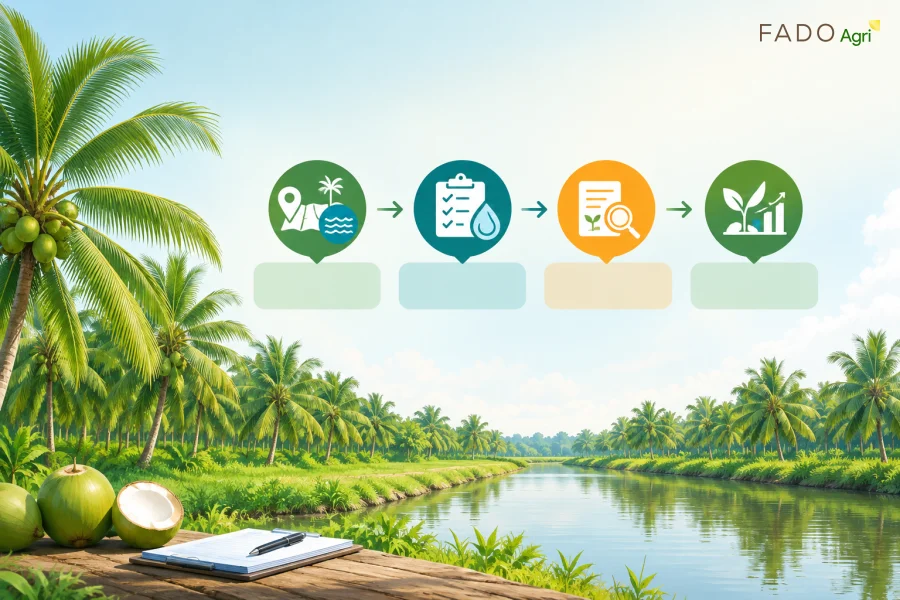
Why saltwater intrusion needs a site-specific management approach
Saltwater intrusion is the movement or presence of saline water in places where freshwater is needed or expected. Salinity describes the concentration of dissolved salts in water or soil; finding salinity in a sample does not, by itself, establish how a particular coconut planting is affected. A management decision should therefore begin with context and evidence, rather than assumptions about a whole area or crop.
Separate the presence of salinity from evidence of crop impact
A water measurement can indicate the condition of the sampled water at a particular location and time. It does not automatically show what the roots are exposed to, how long an exposure has lasted, or whether a visible change in a palm is caused by salinity. Those questions may require additional observations and interpretation by a qualified local adviser.
Keep these types of information distinct in farm records: measured water or soil conditions, observations of the crop, and conclusions about likely causes or effects. This distinction helps prevent a reading or an isolated symptom from being presented as proof of damage, recovery, yield loss or product impact.
Identify the farm and water-use context
The source and intended use of water matter. A source used for one farm activity may not be relevant to another, and conditions can differ across locations within a farm. Record which source or area is being discussed and how the information will inform a decision.
This article offers a decision framework, not an agronomic protocol. It does not set a universal salinity threshold, prescribe a sampling schedule or recommend a specific intervention. Those decisions require locally applicable guidance and evidence relevant to the farm.
Assess exposure before changing farm practices
A useful assessment creates a consistent picture of where and when saline conditions may be relevant to farm operations. A baseline also helps growers and advisers distinguish a change in conditions from a difference in sampling location or method. Avoid making a major change based only on one uncontextualized observation.
Build a farm-level salinity record
For each observation or measurement, record the location, date, water source or sampled area, intended use, method used and result. Note who collected the information and, where known, who interpreted it. If different sources or locations are involved, keep their records separate rather than combining them into one farm-wide figure.
A practical record can include:
| Record item | What to document | Why it helps |
|---|---|---|
| Location | The water source, sampling point or farm area | Keeps results tied to the place they describe |
| Date | When the sample or observation was made | Provides context for comparing records over time |
| Method | How the sample or observation was collected and assessed | Helps identify whether results are comparable |
| Intended use | How the water source or area is used in farm operations | Makes the relevance of a result clearer |
| Result and interpretation | The measured finding, plus who interpreted it | Separates a reading from a management conclusion |
| Follow-up | Any action taken and the reason for it | Connects decisions with later observations |
The table is a recordkeeping aid, not a technical sampling standard. Use methods and testing services recommended by relevant local authorities or qualified advisers. Measurements from different methods may not be directly comparable, so keep the method information with the result.
Use local guidance to interpret measurements
A number has limited value without knowing what was measured, how it was measured and what guidance applies to that context. Ask a qualified local adviser or relevant authority how to interpret results for the water source, soil and intended farm use in question. Do not apply a cutoff borrowed from another crop, location or type of measurement without evidence that it is appropriate.
Farm observations and instrument or laboratory readings are also different forms of evidence. Both may contribute to a review, but they should not be treated as interchangeable or as a diagnosis on their own.
Plan water and farm responses around verified conditions
After reviewing the available information, growers can consider whether a change is needed and what options are locally appropriate. The decision should reflect the measured conditions, the source or area involved, operational constraints and informed local advice. No single response can be assumed to work across farms with different conditions.
Evaluate water options without assuming one solution fits every farm
Review available water sources and farm water-management plans with an adviser who understands the local context. The relevant questions may include whether a source is suitable for its intended use, whether an alternative is available and what practical constraints affect a change. This is a decision process, not a recommendation to adopt a particular irrigation method, treatment or piece of infrastructure.
Before acting, clarify what evidence supports the proposed response, what limitations apply and how its effects will be assessed. If the evidence is uncertain, record that uncertainty and seek further guidance rather than treating a plausible option as a proven remedy.
Record operational changes and the reason for making them
For each change, note what was altered, when it began, which water source or farm area it concerned and why it was selected. Record the advice or information that informed the decision when available. This makes later review more useful and reduces the risk of attributing a change in crop condition to the wrong cause.
Avoid copying another farm’s approach without checking whether the underlying conditions, water sources and operational constraints are comparable. A practice that appears suitable elsewhere is not evidence that it will produce the same result on a different farm.
Track crop condition and review whether the response is helping
Follow-up turns a management decision into a process that can be reviewed and adjusted. Consistent records allow growers and advisers to compare observations with measurements and actions over time. They do not, on their own, prove that a particular intervention caused a change or will protect production.
Use consistent records to compare conditions over time
Maintain a log that connects each date and location with the relevant water or soil information, farm observations and any operational change. Use consistent descriptions where possible, and record who made an observation. If the method or location changes, note it so that differences between records are not mistaken for a real change in conditions.
Any crop-condition or productivity indicators used in a review should be defined in a way that is relevant to the farm and supported by appropriate advice. Avoid turning an informal observation into a claim about yield, nut quality or recovery without suitable evidence.
Escalate decisions when observations and measurements do not align
If farm observations appear inconsistent with measured results, or the information is difficult to interpret, pause before making further changes and seek qualified local advice. Revisit how and where information was collected, whether the records refer to the same water source or area, and whether the interpretation applies to the intended use.
A review should lead to a clear next step: continue monitoring, reassess an existing decision or obtain additional guidance. It should not be presented as a guarantee of recovery or a prediction of production outcomes.
What importers should ask suppliers about salinity management
Importers do not need to prescribe farm practices to ask useful questions about how a supplier assesses salinity-related risk. Focus on the scope and meaning of the evidence: what was monitored, where, when and how it was interpreted. This supports informed sourcing discussions without treating general farm information as proof about a specific shipment.
Use a focused supplier evidence checklist
Procurement teams can ask suppliers:
- Is salinity monitored in relevant water sources or farm areas?
- What is measured, where is it measured and how are locations identified?
- Are dates, methods and results recorded consistently?
- Who interprets the results, and what local guidance informs that interpretation?
- Are operational changes documented with their timing and rationale?
- Can the supplier explain which farms, sources or periods the records cover?
The answers help buyers understand a supplier’s process, but the scope matters. A record from one location or period should not be assumed to describe every farm or shipment. If information is not available, clarify what the supplier can substantiate rather than filling gaps with assumptions.
Keep farm-management information separate from product and shipment claims
Monitoring records, third-party verification, product specifications and shipment documentation serve different purposes. A supplier’s statement about farm management does not, by itself, establish product quality, a particular certification, MRLs compliance, phytosanitary status or export compliance. Buyers should assess each claim against evidence relevant to that claim and the transaction.
FADOAgri welcomes sourcing discussions with procurement partners seeking fresh coconut product specifications. Contact the export team at [email protected] or WhatsApp/hotline (+84) 908 479 339 to discuss product information and supply requirements.
Frequently asked questions
The following answers clarify what growers and buyers can establish from records and where local assessment remains necessary. They do not replace technical guidance for a particular farm or water source.
What salinity information should a coconut grower record?
Record the location, date, water source or sampled area, intended use, measurement method, result and who interpreted it. Link any operational change to its timing and rationale so later reviews have useful context.
Is there one salinity threshold that applies to all coconut farms?
No universal threshold is provided here. Interpretation depends on what was measured, the relevant farm conditions and applicable local guidance. Ask a qualified local adviser or relevant authority to interpret results for the specific context.
Which water-management response should a grower choose?
That depends on verified conditions, available water sources, operational constraints and locally informed advice. Evaluate options before changing practices, document the basis for the decision and monitor what follows; do not assume a response used elsewhere will fit the farm.
What evidence can an importer request from a coconut supplier?
Ask what is monitored, where and when measurements are taken, how results are recorded and interpreted, and how related operational changes are documented. Clarify the farms and periods covered by the information and whether any claim is independently verified.
Does a supplier’s salinity-management record guarantee product quality or export compliance?
No. Such a record describes the scope of the monitoring and management information it contains. Product quality and shipment compliance require evidence relevant to those separate claims and the specific transaction.
Phone: 0908 479 339 · Website: FADOAGRI · Contact us