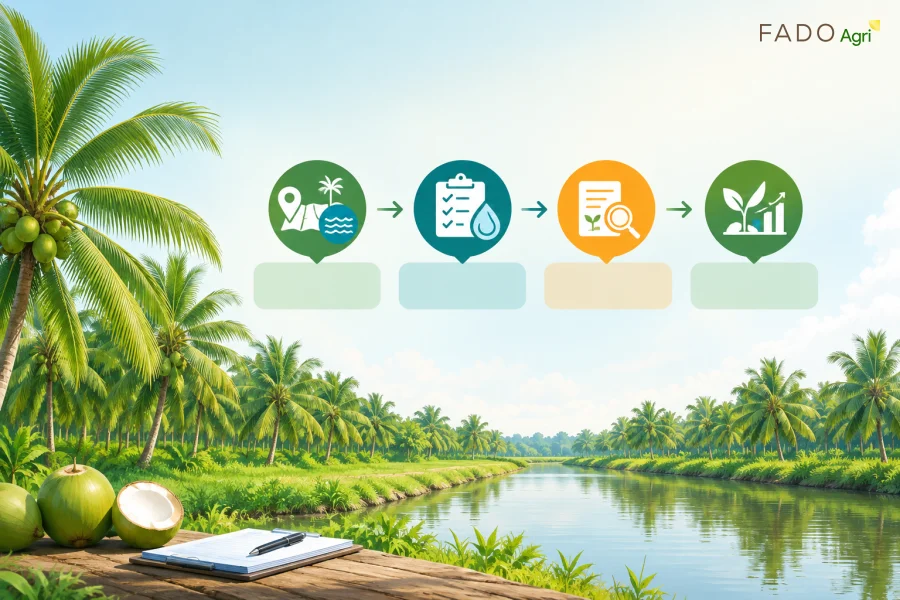

Coconut groves may be discussed as part of agroforestry and climate strategies, but the crop name alone does not establish a climate benefit. For importers and procurement teams, the key questions are how the land is managed, what emissions and removals are included, and what evidence supports the claim. This guide explains the distinction between a potentially relevant production system and a measured climate outcome, then outlines practical questions to ask suppliers.
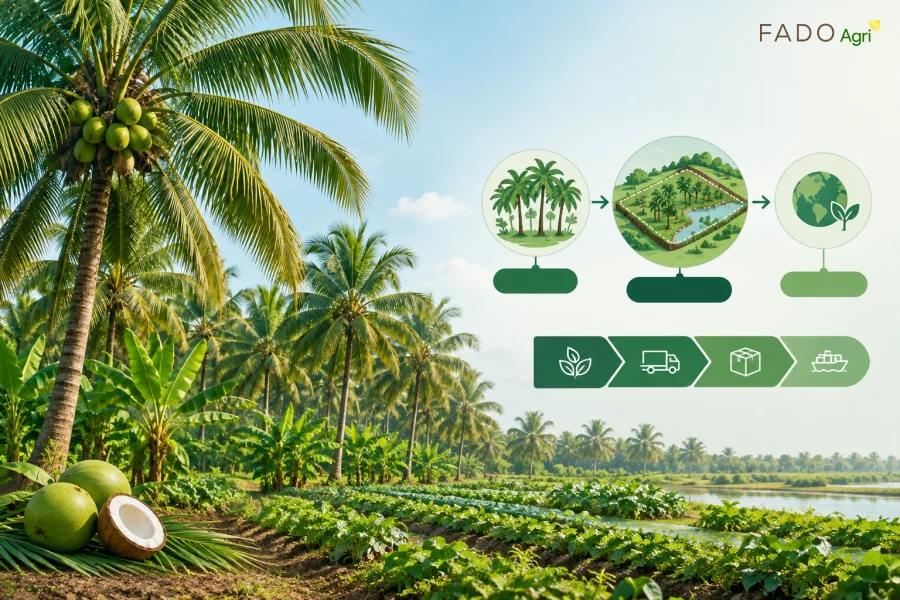
What agroforestry and net zero mean in a coconut-sourcing context
Agroforestry describes an approach to land use that combines trees with agricultural production, such as crops or livestock. Net zero is a climate claim about balancing emissions with removals within a stated boundary and period. These terms describe different things: one concerns a production system, while the other concerns an assessed climate result.
The boundary matters because a claim may refer to a grove, a farm, a project, a company, a supply chain, or a particular product. Those units are not interchangeable. A coconut grove may be part of a farm-level assessment, but that alone does not show the net impact of growing, processing, packaging, and transporting coconuts to a buyer.
The 2050 horizon in this article is the timeframe named in the topic, not a claim that every supplier follows the same pathway or that a particular coconut system has demonstrated progress toward it. Buyers should look for a clearly defined target, scope, and reporting period before comparing climate statements.
How coconut agroforestry could fit into a climate strategy
A coconut-based system can only be assessed in the context of the land and its management. A grove may be managed as a single-crop area or alongside other crops or vegetation; the specific arrangement must be documented rather than assumed. The production system is therefore a more useful starting point than the crop name alone.
Why the production system matters more than the crop name
The layout and management of a farm determine what is actually being assessed. Buyers can ask whether coconuts are grown alongside other crops or vegetation, how the land has been managed during the reporting period, and whether the assessment covers only the coconut-growing area or a wider farm boundary. The answers help clarify what a climate statement refers to without assuming that any particular arrangement is automatically beneficial.
A supplier’s description should also distinguish current practices from planned changes. A future planting or management plan may be relevant to a business’s direction, but it is not evidence of an outcome already achieved. Similarly, a general statement about tree cover does not show how much carbon is stored or how the system’s emissions have been accounted for.
Potential climate contribution is not the same as a verified result
Trees and land management can be relevant to carbon accounting, but the net result for a specific coconut system cannot be inferred from their presence. A claim about carbon stored in vegetation or soil is different from a claim about new removals over time. Both differ from avoided emissions, such as a comparison with a stated alternative. These categories should not be combined into one broad “carbon positive” statement without a clear explanation.
Results can depend on the site, management, period, and assessment boundary. For that reason, describing all coconut groves as “natural carbon sinks” would overstate what can be concluded from the crop alone. A buyer should treat that wording as a claim requiring evidence, not as a default characteristic of coconut sourcing.
What must be measured before calling a coconut system a carbon sink
A climate claim is useful for procurement only when its scope and supporting method are understandable. Buyers need to know what was measured, what was included, and how the result relates to the product or supply chain under consideration. Without those details, a figure or label may not be suitable for comparison or internal reporting.
Define the boundary, period, and method
Ask the supplier to identify the land area and activities covered, the reporting period, and whether the result applies to a farm, a project, a company, or a product supply chain. Request a description of the measurement method and the records used to prepare the result. If an external party reviewed the information, ask what was reviewed and what the review covered; do not assume that a general sustainability document represents independent verification.
The accounting should explain how emissions and removals are treated. Buyers can ask which activities are included and whether the reported result accounts for relevant emissions as well as removals. They can also ask how uncertainty, changes in land management, and the continued storage of carbon are addressed. These are evidence questions, not a claim that one particular accounting framework or standard applies.
Check what the claim includes—and what it leaves out
A farm-level result does not automatically describe an exported coconut product. The claim may exclude processing, packaging, storage, or transport, so buyers should check whether those activities are inside or outside the stated boundary. If the supplier offers a product-related claim, ask how the farm information is connected to the product and shipment being discussed.
Keep climate evidence distinct from other documents. Product specifications, traceability records, phytosanitary documentation, and evidence of compliance with destination-market requirements address different questions. None of them, by itself, establishes carbon removal or net-zero performance. Likewise, the presence of a certification should not be treated as proof of a climate result unless the certification’s scope specifically supports that conclusion.
What importers and procurement teams should request from suppliers
A structured request helps buyers distinguish a broad sustainability statement from information that can be reviewed responsibly. It also makes it easier to compare suppliers without asking them to make claims beyond the evidence they hold. The checklist below is a set of procurement questions, not a certification or legal-compliance checklist.
A practical evidence request for a coconut supplier
Ask the supplier to provide or clarify:
- Production-system description: What land and management practices are covered? Are coconuts grown alone or with other crops or vegetation?
- Claim scope: Does the information concern a farm, a project, a company, a supply chain, or a specific product?
- Reporting period: What dates or production period does the information cover?
- Measurement method and records: How was the result prepared, and what underlying records support it?
- Emissions and removals: Which are included, and how are they reported separately or together?
- Review and limitations: Was the information reviewed by another party? What uncertainties or exclusions should a buyer understand?
- Status of the information: Is it a measured result, an estimate, a current practice, or a future target?
For internal review, record whether each item is farm-specific, product-specific, or company-level. If a supplier cannot provide a requested detail, avoid filling the gap with an assumption. You can still assess the supplier on other documented business requirements while keeping the climate claim unverified or outside the decision criteria.
Connect climate claims with responsible sourcing and circular agriculture
Climate information is one part of a sourcing assessment, not a substitute for product specifications or export documentation. Buyers may also ask how coconut materials and by-products are used, while keeping resource-efficiency claims separate from claims about carbon removal. Each statement should remain tied to the evidence that supports it.
FADOAgri’s supplied company information describes the use of coconut coir, shells, and dried coconut meat in a circular-economy context. This describes an approach to using coconut materials; it does not, on its own, establish measured carbon removal, a lower-carbon product, or net-zero performance. Buyers seeking climate data should request information specifically connected to the relevant farm, product, or supply chain.
The company information also describes a FADOAgri 2030 direction involving smart agriculture and carbon-credit solutions connected to coconut gardens in Ben Tre. This should be understood as a stated direction, not as evidence of a completed, quantified, or independently verified carbon-credit outcome. Before relying on any credit-related claim, ask what activity it concerns, what documentation is available, and whether it is connected to the product being sourced.
Procurement teams can consider climate information alongside product requirements, supply continuity, Cold Chain logistics, and destination-market needs. A climate statement does not replace checks on specifications, handling, or export documentation, and those checks do not independently validate a carbon claim.
Frequently asked questions
The questions below address common points of confusion when buyers assess coconut-related climate statements. The central principle is to distinguish the production system from the evidence of a measured result.
Are all coconut groves natural carbon sinks?
No conclusion can be made from the crop name alone. A claim about a particular grove needs a defined scope, period, and supporting assessment that explains what was measured and how emissions and removals were treated.
Can coconut agroforestry by itself make a farm net zero?
Not on the basis of the production system alone. A farm-level net-zero claim needs to account for emissions and removals within a clearly stated boundary and period, with evidence supporting the reported result.
What evidence should an importer request for a coconut carbon claim?
Request a description of the production system, the claim’s boundary and reporting period, the measurement method and records, and an explanation of included emissions and removals. Also ask whether the information was reviewed and what limitations apply.
Does circular use of coconut by-products prove carbon removal?
No. Using coir, shells, or other materials may be relevant to a circular-agriculture discussion, but it does not by itself demonstrate carbon removal or net-zero performance. Those outcomes require separate, appropriately scoped evidence.
Are carbon credits the same as a lower-carbon coconut product?
No. A credit-related claim and a product’s emissions claim are different statements. Buyers should ask what the credit represents, how it is documented, and whether there is evidence connecting it to the product or shipment in question.
Discuss coconut sourcing and climate-information needs with FADOAgri
A sourcing conversation can begin with the product requirements and the climate information your team needs for internal assessment. FADOAgri can be contacted to discuss coconut sourcing and request relevant product documentation; any climate information should be assessed according to its scope and supporting evidence.
Contact FADOAgri’s export sales team at (+84) 908 479 339 by hotline or WhatsApp, or email [email protected] to discuss product specifications and the documentation relevant to your procurement review.
Phone: 0908 479 339 · Website: FADOAGRI · Contact us