
A coconut supply chain can extend beyond fresh fruit when secondary material streams are collected and processed into distinct products. For importers and procurement teams, the opportunity is worth assessing only when the product is clearly identified, its intended use is understood, and relevant specifications and documentation are available. This guide explains the coconut circular economy in practical sourcing terms and outlines questions to ask before evaluating a co-product offer.
What a coconut circular economy means for buyers
A circular approach considers whether material streams from a supply chain can remain useful rather than being treated as having value only in the primary product. For buyers, the concept is a starting point for assessing products and processes—not proof of commercial viability or environmental performance. Each material needs to be evaluated on its own terms.
Distinguish circularity from an environmental claim
The phrase “coconut circular economy” describes an approach to resource use. It does not, by itself, demonstrate that a product reduces waste, lowers emissions, qualifies for carbon credits, or produces a measurable lifecycle benefit. Those conclusions require evidence tied to the specific product, process, and claim.
It is also useful to distinguish three things during procurement:
- The material or product: What exactly is being offered?
- The intended use: What application is the buyer assessing it for?
- The claimed outcome: What evidence supports any quality, compliance, or environmental statement?
A general description of circularity cannot substitute for product documentation or a defined environmental assessment.
Start with product identity and intended use
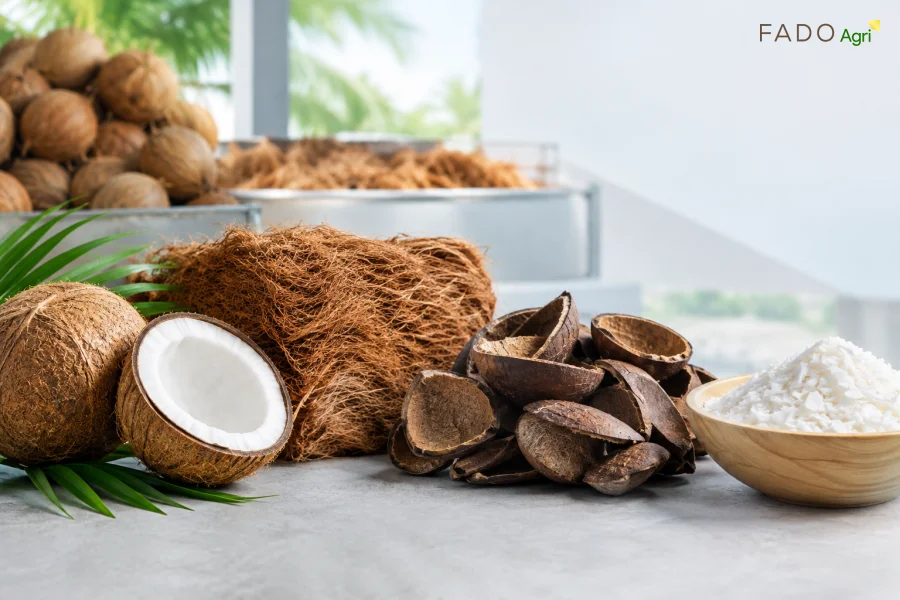
FADOAgri’s supplied company information identifies coir, coconut shells, and dried coconut meat among the coconut-related streams or products it describes. The references mention coir as an organic growing medium or green material, shells as a source of activated charcoal or biochar, and dried coconut meat as a product. They do not provide product specifications, processing details, or confirmation of current availability for each category.
For a procurement team, the first step is therefore to establish the exact product being discussed and the buyer’s intended use. A broad label such as “coconut by-product” does not establish its form, suitability, quality, or market status.
Which coconut by-product streams are identified
The categories described in the supplied company information are distinct and should not be treated as interchangeable. Their names point to different material or product forms, but further details must come from product-specific documentation. Buyers should use these categories to frame an inquiry, not as confirmation that a particular specification is available.
Coir: confirm the material form and proposed use
The company information describes coir as an organic growing medium or green material. Before assessing an offer, buyers should clarify what the supplier means by “coir,” what form is being offered, and which intended use the product is proposed for. The information provided does not specify processing methods, grades, composition, packaging, or other technical characteristics.
A buyer evaluating coir should request the applicable product description and specification, along with any processing or quality documentation available for the exact material. If the intended use has acceptance criteria, those criteria should be shared with the supplier so that the offer can be assessed against them rather than against a general category name.
Coconut shells: clarify the product being offered
The supplied references describe coconut shells as a source of activated charcoal or biochar. That wording does not establish whether a particular offer is shell material, activated charcoal, biochar, or another defined product. These labels should be clarified before a buyer compares specifications or discusses an application.
Ask for the precise product name and form, a description of any processing represented in the offer, and documentation that matches the product being evaluated. Do not apply claims or information about one shell-derived product to another without evidence. The available company information does not define processing routes, technical properties, intended applications, or commercial availability.
Dried coconut meat: assess it as a distinct product
Dried coconut meat is identified as a product in the supplied company information. It should be assessed separately from coir and shell-derived materials, with its own product description, specifications, intended use, and destination-market requirements. No particular grade, processing method, packaging format, or export status is established here.
If the buyer’s intended use or market has specific acceptance criteria, request evidence for the exact dried coconut meat product under consideration. Do not assume that information for another coconut product—or general statements about the circular economy—demonstrates suitability.
How buyers can assess the value of each stream
A material stream has practical sourcing value only when it can be matched to a buyer’s actual requirement. This assessment should begin with the intended use and continue through product identity, documentation, and commercial fit. A general description of a material is not enough to establish that it meets a particular specification.
Build a product-specific specification request
Before requesting a quotation, define what the procurement team needs to know about the product. The detail required will vary by material and intended use, so avoid assuming that one specification template will apply equally to coir, shell-derived products, and dried coconut meat.
A useful request can ask the supplier to clarify:
- The exact product name and material form.
- The intended use represented by the offer.
- The available product specification and how it applies to the offered material.
- Relevant processing and quality information.
- Available lot identification and traceability details.
- The destination market and any buyer-specific acceptance criteria that should be considered.
If a detail is not available, it should remain an open question rather than being inferred from the product category. This helps buyers compare like with like and identify gaps before approval.
Match evidence to the intended application and market
Buyer requirements depend on the product and its intended use. A requirement that is relevant to one product may not apply to another, and destination-market rules can differ. Ask which SPS/TBT standards or other requirements are relevant to the exact product and market rather than assuming a single compliance profile covers every coconut co-product.
GlobalGAP, MRLs compliance, and phytosanitary documentation should likewise be considered only where relevant to the product, supply chain, intended use, and destination requirements. Their mention here is not a statement that any specific co-product has a certification or document, or that a particular requirement applies in every case. Buyers should confirm the applicable requirements with the relevant parties for their transaction.
What documentation and claims to review
Circular-economy language may describe an intention, a business approach, or a measured result; these are not equivalent. Procurement teams should ask for evidence that corresponds to the exact product and statement being evaluated. This is especially important if the information will support supplier approval, customer communications, or an environmental claim.
Check traceability and document scope
Request the product description, available specification, processing information, and lot traceability details for the exact offer. Then review whether the documents identify the relevant product and supply-chain stage clearly enough for the buyer’s needs. Documentation for one material or process should not automatically be treated as evidence for another.
If a supplier refers to a certification, audit, or compliance status, ask for the relevant documentation and check that its scope matches the product and supplier being assessed. The supplied information does not establish that a particular certification, audit record, or regulatory document is available for any of the co-product categories discussed here.
Ask what supports environmental statements
For an environmental statement, ask what is being measured or asserted, which product or process the evidence covers, and what boundary or method was used. A general statement about making better use of coconut resources does not establish a quantified reduction in waste or carbon emissions. Nor does it demonstrate eligibility for carbon credits or a lifecycle benefit.
Keep environmental evidence separate from product-quality and traceability records. Each may help answer a different procurement question, and one does not automatically substantiate the other. If a claim lacks product-specific support, do not treat it as a verified performance outcome.
A practical pre-sourcing checklist for coconut co-products
A consistent first review can help procurement teams compare offers while keeping the differences between material streams clear. Use the checklist to identify what is known, what documentation is available, and which questions need an answer before a sourcing decision. It is a screening aid, not a substitute for destination-specific compliance review.
| Review area | Questions for the supplier |
|---|---|
| Product identity | Is the offer for coir, shell material, activated charcoal, biochar, or dried coconut meat? What exact form is being offered? |
| Intended use | What use is the product proposed for, and what buyer acceptance criteria should be considered? |
| Specifications | Is a specification available for this exact product, and does it address the buyer’s requirements? |
| Processing and quality | What processing and quality information is available for the product under review? |
| Traceability | How is the product identified and traced through the relevant supply chain and documentation? |
| Destination requirements | Which requirements apply to this product, intended use, and destination market? |
| Environmental statements | What evidence supports each statement, and what product or process does that evidence cover? |
| Commercial details | What availability, MOQ, quotation basis, and shipment details can the supplier confirm for the inquiry? |
Record any unanswered items as open procurement questions. In particular, do not treat an inquiry about MOQ or FOB/CIF terms as confirmation that a standard minimum order, price, or delivery arrangement exists. These details need to be requested and confirmed for the specific offer.
Discuss a coconut co-product sourcing inquiry with FADOAgri
A focused inquiry gives the export team the context needed to respond to a buyer’s requirements. Identify the specific material or product, its intended use, destination market, and documentation needs rather than asking about coconut co-products as a single category. This keeps the discussion grounded in the offer and evidence relevant to the buyer.
Importers and procurement partners can contact FADOAgri to request relevant product specifications, availability, and quotation details. Include any buyer-specific acceptance criteria and ask whether MOQ and FOB/CIF quotation information can be provided for the product under consideration. These are details to request, not terms confirmed by the information in this article.
- WhatsApp / Hotline: (+84) 908 479 339
- Email: [email protected]
- Website: https://fadoagri.com/
Phone: 0908 479 339 · Contact us