
Global Beverage Industry Trends: The Booming Demand for Pure Coconut Water
Pure coconut water has a visible place in the beverage conversation, but the word “booming” should be backed by dated, category-specific sales evidence—not inferred from product visibility or general interest in tropical drinks. For beverage importers and distributors, the useful question is whether demand is growing in a particular market and channel, and whether a supplier’s product matches that opportunity. This guide explains how to assess the claim and what to clarify before sourcing.

What “pure coconut water” means in the beverage market
“Pure coconut water” needs a clear working definition before market claims or supplier offers can be compared. In this article, it refers to coconut water sold as the main beverage ingredient, rather than a drink whose defining feature is added coconut flavor or a blend of multiple beverage ingredients. Product labels and market-research categories may draw these boundaries differently, so buyers should check the definition used in each case.
Separate pure coconut water from blended and flavored drinks
A product described as coconut water may be presented in different forms, including a single-ingredient beverage, a blend, or a drink with added flavors. Processing and formulation can also affect how a product is described. These differences matter commercially: figures for a broad “coconut beverage” category may include products that an importer would not consider a direct substitute for pure coconut water.
When evaluating an offer, review the product name, ingredient information, and product specification together. Do not rely on a headline, a retailer’s category label, or a broad supplier description alone. If the product has been reconstituted, blended, or otherwise formulated, clarify that directly rather than assuming the word “pure” means the same thing across brands and markets.
Check how market reports define the category
Before using a market estimate, find out what the report counts. Does it cover pure coconut water only, or a broader set of coconut drinks? Does it measure retail sales, foodservice purchases, shipments, or another indicator? A figure can be accurately reported yet still be a poor basis for a sourcing decision if its category does not match the product under consideration.
Use the report’s definition as a filter, not a footnote. If the category is broader than the buyer’s target, describe the evidence accordingly instead of presenting it as a direct measure of pure coconut water demand.
How strong is global demand for pure coconut water?
A global demand boom cannot be established from the phrase alone. To support that conclusion, buyers need recent evidence that clearly identifies the product category, geography, measurement period, and type of growth being reported. Without those details, it is more accurate to treat “booming demand” as a proposition to test than as a settled market fact.
Which indicators can support a demand claim?
Different indicators answer different questions. Retail sales data may help assess purchases in a specific market; import or shipment data may show trade activity but not necessarily final consumer sales; and search interest can signal attention without proving that people bought the product. Forecasts describe a projected outcome, not a record of sales already achieved.
For a useful comparison, look for evidence that is:
- Specific to the product: The category definition should distinguish pure coconut water from other coconut beverages where possible.
- Clear about the geography: A result for one country or retail channel should not be presented as a global pattern.
- Dated and tied to a period: The measurement dates help readers understand what the data actually covers.
- Transparent about the metric: Sales value, sales volume, imports, and consumer interest are not interchangeable.
- Comparable over time: Changes in the category definition or measurement method can make apparent growth difficult to interpret.
Evidence becomes more useful when several relevant indicators point in the same direction. Even then, keep the scope precise: growth in a particular market or channel does not by itself establish a global boom.
Why forecasts and current sales are different evidence
A forecast may help buyers consider possible future conditions, but it relies on assumptions about how the market will develop. Current sales data, if available and comparable, describe observed activity for a particular period. Neither should be substituted for the other in a report or sourcing presentation.
When a forecast is the only evidence available, identify it as a projection and check its timeframe and category definition. Buyers can use it to frame questions about a potential opportunity, but should not treat it as proof of current sales or guaranteed future demand.
What may be driving interest in coconut water?
Several factors may help explain why buyers encounter interest in coconut water, but a plausible explanation is not proof of a sales driver. Consumer motivations, retail decisions, and foodservice applications can differ by market and channel. Look for evidence that connects a proposed factor to purchases in the specific audience being targeted.
Consumer preferences need market-specific evidence
A product’s positioning may influence how consumers perceive it, but broad labels such as “natural” or “healthy” do not establish why people buy it or how often they repurchase it. Preference research, if used, should clarify which consumers were surveyed, what they were asked, and whether the findings concern stated intentions or actual behavior.
Buyers should also avoid assuming that a preference observed in one market applies everywhere. Familiarity with the product, competing beverages, pack formats, and local shopping habits may differ. Those are reasons to examine local evidence, not grounds for making universal claims.
Retail and foodservice adoption are separate demand signals
Retail placement can indicate that a product is available in a channel, but availability alone does not reveal how quickly it sells. Likewise, a foodservice listing may show that a business uses or offers the product without establishing broad consumer demand. These signals can be useful, but they should be interpreted alongside evidence of sales, reorder activity, or other relevant measures when available.
For an importer, the distinction affects the commercial question. A supermarket buyer may need evidence about retail category performance and pack suitability, while a foodservice distributor may focus on the product’s fit with its customers and operating requirements. One channel’s activity should not automatically be treated as proof of demand in another.
What global interest could mean for beverage buyers
A demand signal matters to procurement when it helps shape product requirements, supplier comparisons, or commercial planning. Broad market interest alone does not establish a product’s availability, price, shelf life, or supply reliability. Buyers should translate market evidence into a product brief and verify transaction-specific details with prospective suppliers.
Match the product offer to the intended channel
Start with the customer and channel, then define the product that would serve them. Specify whether the offer must be pure coconut water or whether a blend is acceptable. Clarify the desired formulation, package format, product information, and any channel-specific requirements before comparing quotations.
This prevents a common comparison problem: two offers can use similar category language while referring to different products. A consistent brief gives procurement teams a clearer basis for reviewing specifications and assessing whether an offer is suitable for the intended market.
Build a sourcing brief before comparing suppliers
A practical brief can keep supplier discussions focused. Include the product definition, the target sales channel, the destination market, and the packaging or specification information your business requires. Ask suppliers to provide the relevant product documentation and clarify how the product is made and described, rather than relying on assumptions based on the category name.
Destination-market requirements should be checked for the specific product and transaction. Requirements can depend on where the product is sold and how it is classified; buyers should not assume that the same rules or documentation apply in every destination. Price, availability, shelf life, shipment arrangements, and supply commitments are also transaction-specific and should be confirmed directly.
Vietnamese coconut sourcing: keep the product and offer clear
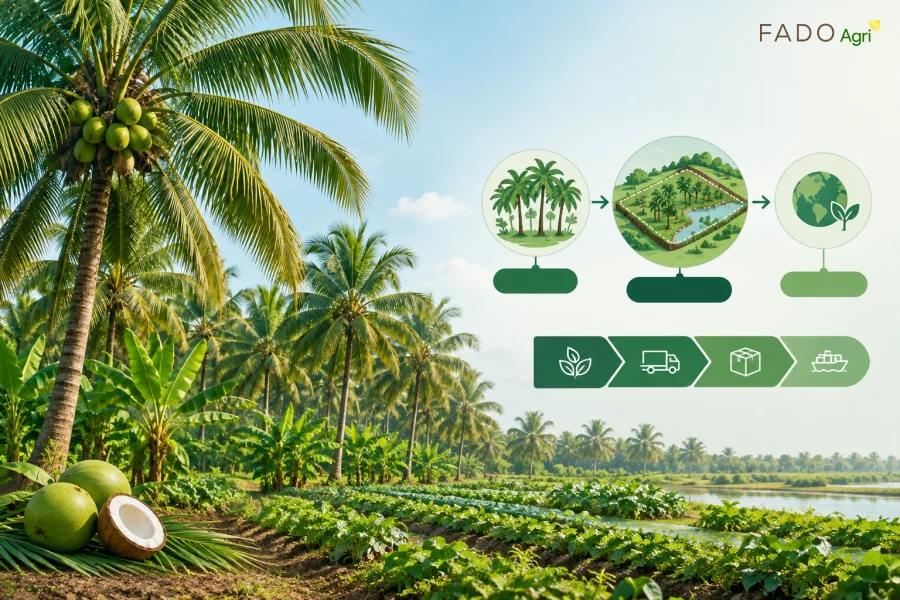
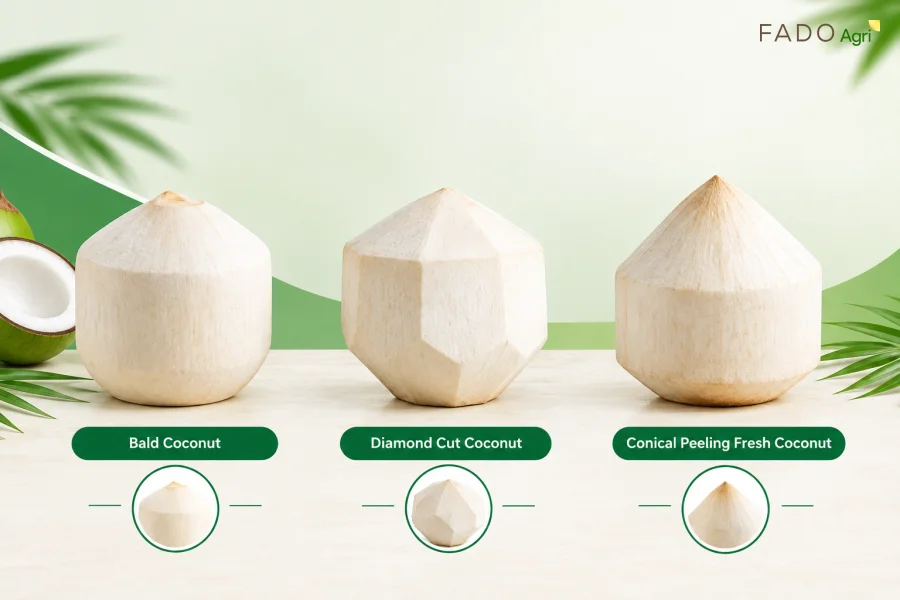
Vietnam is relevant to FADO AGRI’s sourcing context as a Vietnamese agricultural exporter, and fresh coconut is a key product category. That connection should not be confused with a packaged beverage offer: sourcing fresh coconuts does not, by itself, establish that a supplier processes, bottles, or exports pure coconut water.
Do not equate fresh coconut sourcing with bottled coconut water supply
For buyers assessing the beverage category, the distinction is important at the start of a supplier conversation. A fresh coconut supplier and a packaged coconut water supplier may offer different products and capabilities. Confirm the actual product, processing, packaging, and documentation available rather than inferring a beverage offer from a connection to fresh coconuts.
FADO AGRI is identified as a Vietnamese agricultural exporter with fresh coconut as a key product category. The available company information does not establish that it manufactures or supplies packaged pure coconut water, so buyers interested in bottled beverages should verify that capability directly rather than assuming it.
Questions buyers can raise in a fresh coconut inquiry
If the sourcing requirement is fresh coconut rather than a packaged drink, state that clearly in the inquiry. Buyers can discuss the product specifications, packaging needs, destination, and export quotation relevant to their order. Clear questions help establish whether the offered fresh product fits the buyer’s requirements without confusing it with a processed beverage.
International buyers exploring Vietnamese fresh coconut sourcing can contact FADO AGRI to discuss product specifications, packaging, and export quotations. This is a fresh-produce sourcing conversation, not a quotation for bottled coconut water.
Frequently asked questions about pure coconut water demand
These answers focus on the questions buyers need to resolve before making a category or sourcing decision. The central principle is to match each market claim to evidence about the right product, place, period, and sales measure.
Is global demand for pure coconut water really booming?
That claim requires current, category-specific evidence showing growth across a defined geography and period. A forecast, a rise in consumer attention, or a broader coconut-beverage estimate does not alone prove that pure coconut water sales are booming globally. Check the underlying category and metric before using the claim.
What should importers verify before sourcing coconut water?
Confirm the product definition, formulation, ingredients, specifications, packaging, and relevant documentation for the intended destination and channel. Compare supplier offers against the same product brief, and verify transaction-specific commercial details directly with each supplier.
Does fresh coconut sourcing mean a supplier offers packaged coconut water?
No. Fresh coconuts and packaged coconut water are different products, and fresh-produce sourcing information does not establish beverage processing or bottling capabilities. Buyers should confirm the exact product and supplier offer before proceeding.
Phone: 0908 479 339 · Website: FADOAGRI · Contact us