

Importers comparing Bald Coconut, Diamond Cut Coconut, and Conical Peeling Fresh Coconut should not treat the names alone as complete product specifications. The available product information identifies these three export formats but does not define their exact appearance, preparation, dimensions, packaging, or handling requirements. This guide sets out the details procurement teams should confirm to compare offers accurately and align an order with its receiving and destination requirements.
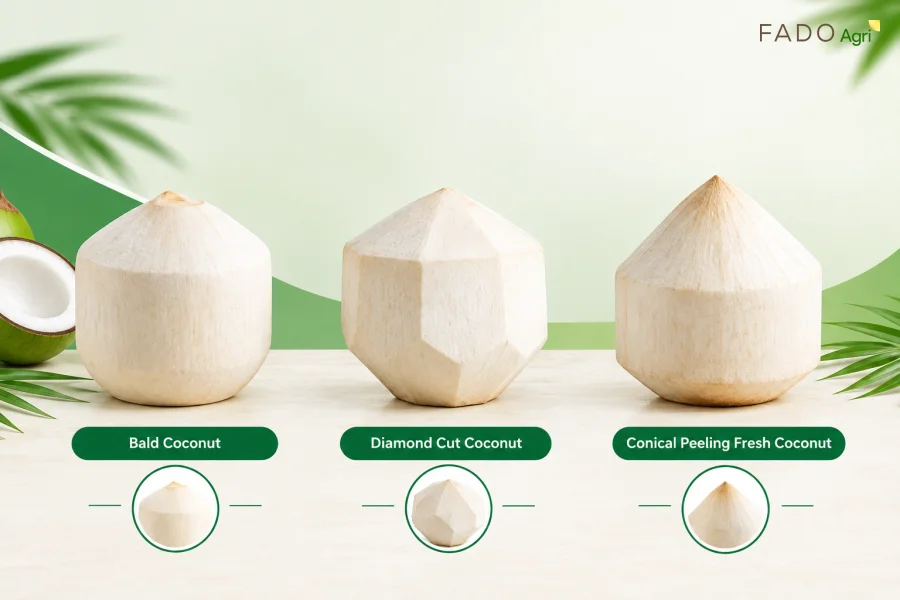
What the three fresh coconut export cuts refer to
Bald Coconut, Diamond Cut Coconut, and Conical Peeling Fresh Coconut are distinct product names in FADOAgri’s supplied range. A name may identify the format being offered, but it does not establish the exact preparation or product tolerances. Before comparing suppliers, buyers should obtain product-specific details for each name and agree which version the quotation and order cover.
A product name is not a complete export specification
The name alone does not confirm which parts of the coconut are removed or retained, the cut’s profile, the product’s dimensions, or how units are packed. Those details matter when a buyer needs goods to match an approved presentation, purchasing specification, or receiving process.
For example, two quotations that both use the term “Diamond Cut Coconut” may not be directly comparable unless the suppliers have described the offered product in the same way. This is a reason to request the specification behind each label—not evidence that suppliers necessarily use different preparation methods.
Ask the supplier to identify the exact product name and provide its current description, available images, and applicable technical details. Keep confirmed information separate from assumptions so that procurement, quality, logistics, and receiving teams are working from the same product definition.
Compare Bald, Diamond, and Conical Peeling by confirmed specifications
A useful comparison records the same fields for all three formats, then fills them with supplier-confirmed information. The table below is a working framework, not a statement of the products’ physical attributes. Leave a field open until the supplier provides a value or confirms that it does not apply.
| Comparison field | Bald Coconut | Diamond Cut Coconut | Conical Peeling Fresh Coconut |
|---|---|---|---|
| Product name on offer | Confirm exact name and specification version | Confirm exact name and specification version | Confirm exact name and specification version |
| Appearance or cut profile | Request description and current product image | Request description and current product image | Request description and current product image |
| Extent of husk removal | Confirm what is removed or retained | Confirm what is removed or retained | Confirm what is removed or retained |
| Dimensions or size grading | Request measurement basis, grade, and tolerances | Request measurement basis, grade, and tolerances | Request measurement basis, grade, and tolerances |
| Quantity basis | Confirm how units or quantities are stated | Confirm how units or quantities are stated | Confirm how units or quantities are stated |
| Packaging and carton configuration | Confirm materials, units per pack, and carton details | Confirm materials, units per pack, and carton details | Confirm materials, units per pack, and carton details |
| Product identification | Confirm names and identifiers used on order records and labels | Confirm names and identifiers used on order records and labels | Confirm names and identifiers used on order records and labels |
| Supporting document or image | Request the document or image corresponding to the offer | Request the document or image corresponding to the offer | Request the document or image corresponding to the offer |
Use the same comparison fields for all three cuts
Use the same measurement units, grading basis, quantity basis, and packaging fields when reviewing offers. If one supplier quotes by unit and another uses a different basis, ask for clarification before making a commercial comparison. Do not assume that similarly named products have equivalent dimensions, pack configurations, or tolerances.
Where available, request current product images or an approved sample specification for the exact offer. Record the version accepted by the buyer and supplier, and refer to it in the purchase order or other agreed order documents. This helps reduce ambiguity between the product discussed during sourcing and the product described in the final order.
Separate confirmed details from assumptions
A specification should make clear which details the supplier has confirmed and which remain open. If a dimension, packaging configuration, or preparation detail is not available, do not infer it from the product name or from an image alone. Ask the supplier to provide or confirm the information before treating it as an agreed requirement.
Choose a cut by buyer requirements, not by name alone
The appropriate format depends on the buyer’s intended presentation, customer specification, and receiving process. No cut-specific use cases or advantages have been provided for these three products, so buyers should define their requirements first and ask the supplier which confirmed offer matches them. This keeps the decision grounded in the actual goods rather than assumptions about a label.
Start with the receiving and presentation requirements
Before requesting a quotation, describe the requirements that matter to your business. These may include the presentation required by your customer, the dimensions or grading basis to be used, packaging expectations, and how your receiving team will identify and handle the product. The relevant fields will vary by buyer and order; they should be specified rather than presumed.
If the product will be sold through a retail or wholesale channel, use the buyer’s own approved product description and acceptance criteria as the starting point. If a receiving facility requires particular pack or identification details, include those in the request for quotation so the supplier can respond against them.
Confirm that the supplier’s offer matches the request
Ask the supplier to state which of the three product names the quotation covers and to confirm the details that define the offered version. Compare the response with your written requirements field by field. If the offer does not address a requirement, request clarification before deciding whether it is suitable.
A product can only be assessed against requirements that are clearly stated and supported by confirmed information. Do not assign a format a particular retail use, handling advantage, or suitability for a market unless that conclusion is supported by the product specification and the buyer’s own criteria.
Align the selected coconut cut with shipment and compliance checks
Selecting a format is one part of an export order; the confirmed product and packing details also need to fit the shipment plan and destination checks. Cold Chain logistics and post-harvest technology should be discussed in relation to the particular product, packaging, route, and shipment plan. This guide does not specify temperatures, transit limits, shelf life, or handling procedures for any of the three cuts.
Connect the product specification to the shipment plan
Ask the supplier and relevant logistics partners to confirm how the agreed product specification connects to the planned shipment. This may include the product identity, packaging configuration, handling responsibilities, and information needed by the receiving team. Any operating parameters should come from current, product- and shipment-specific information rather than being inferred from a general description of fresh coconut.
Check that the product name and agreed specification are used consistently in the quotation, order documents, and applicable shipment records. Resolve differences in names or descriptions before dispatch rather than relying on the assumption that two labels refer to the same prepared product.
Verify destination requirements separately
Commercial product specifications and regulatory requirements are related but separate questions. Buyers should verify the applicable SPS/TBT standards, MRLs compliance, and phytosanitary certificate requirements for the exact product, origin, and destination with the responsible authority or import partner.
Do not assume that choosing Bald Coconut, Diamond Cut Coconut, or Conical Peeling Fresh Coconut automatically establishes a destination’s requirements or proves that those requirements have been met. Requirements may depend on the shipment details and the relevant market rules; obtain current confirmation for the specific transaction.
Questions to resolve before requesting a quotation
A clear request for quotation (RFQ) gives suppliers a common basis for responding and makes offers easier to compare. Before submitting one, identify the required cut, the details you need confirmed, and the commercial terms you want the supplier to quote. The following checklist can help structure that request.
A practical RFQ checklist for importers
- Product: Which exact name is required—Bald Coconut, Diamond Cut Coconut, or Conical Peeling Fresh Coconut?
- Preparation and appearance: What description or approved image defines the required version?
- Size and grading: Which dimensions, grading basis, and tolerances should the supplier confirm?
- Quantity and packing: How should quantity be stated, and what packaging or carton configuration is required?
- Evidence: Can the supplier provide a current specification or product image corresponding to the offer?
- Commercial terms: What MOQ and FOB/CIF quotation can the supplier provide for the requested order?
- Shipment planning: What target shipment period and destination should be considered in the response?
- Documents and checks: Which documents and destination requirements must be confirmed for this specific product and market?
Request answers against the same fields for each product you want to evaluate. If a supplier cannot confirm a detail at the quotation stage, record it as unresolved rather than treating it as agreed. Confirm the final product specification and applicable order terms before placing the order.
Frequently asked questions
These answers clarify what buyers can conclude from the product names and what needs supplier or destination-specific confirmation. They are intended to support the comparison process, not to replace a current product specification or import requirements check.
Are Bald Coconut, Diamond Cut Coconut, and Conical Peeling Fresh Coconut the same product?
They are three distinct product names in the supplied range, but the names alone do not define their precise preparation or technical specifications. Ask the supplier to describe each offered format before deciding whether two quotations are comparable.
Which coconut cut should an importer choose?
Choose by matching a confirmed product specification to your presentation, customer, packing, and receiving requirements. The available information does not establish that one cut is better or more suitable for a particular channel or market.
What should a buyer request before comparing quotations?
Request the exact product name, preparation description, appearance or image, dimensions or grading basis, quantity basis, packaging details, and relevant commercial terms. Ask suppliers to answer using the same comparison fields so that differences and unanswered questions are visible.
Do the cut names define dimensions or packaging?
No dimensions, tolerances, packaging materials, or carton configurations are defined by the names in the information available here. Request those details from the supplier for the specific offer and record the agreed values in the order documentation.
Does choosing a cut determine the destination’s phytosanitary requirements?
The cut name alone does not establish the applicable requirements. Verify phytosanitary documentation and other destination-specific SPS/TBT or MRLs checks with the responsible authority or import partner for the exact product, origin, and destination.
Request specifications for your target market
A reliable comparison starts with a clear product definition and the same confirmed fields for every offer. When contacting FADOAgri, include the requested coconut cut, destination market, packaging needs, and target shipment period so the inquiry can be considered against your requirements.
Importers and procurement partners can contact FADOAgri to request confirmed product specifications, MOQ, and an FOB/CIF quotation. For inquiries, use WhatsApp at (+84) 908 479 339 or email [email protected].
Phone: 0908 479 339 · Website: FADOAGRI · Contact us