
Not all coconuts arrive at your warehouse the same way, and the cut format your supplier uses tells you more about their operation than you might expect. For B2B importers sourcing fresh coconuts from Vietnam, understanding the 6 types of Vietnamese coconut cuts is not just a product specification detail. It directly affects shelf appeal, consumer experience, logistics efficiency, and your downstream market fit.
At Fado Agri, established in 2016 with 10+ years of fresh produce export experience, we supply all six standard coconut cut formats from the premium growing zones of Ben Tre and Tien Giang, two of Vietnam’s most productive and quality-consistent coconut-producing provinces. Every format meets FDA, GLOBALG.A.P, and HACCP standards, with full documentation readiness from Phytosanitary Certificate to Certificate of Origin (CO).
This guide breaks down each cut type, its commercial purpose, and which buyer profile it fits best, so you can make sourcing decisions with confidence.
1. What Are Vietnamese Coconut Cut Types and Why Do They Matter?
A “cut type” refers to the way a fresh coconut’s outer husk is trimmed, shaped, and prepared before it is packed and exported. This is not purely cosmetic. The cut format determines:
- Consumer accessibility, how easily the end user can drink or open the coconut
- Weight and freight cost, husk removal significantly affects container load optimization
- Shelf life during transit, different cut profiles expose different surface areas to air
- Market positioning, a premium retail coconut looks very different from one destined for a wholesale fruit market
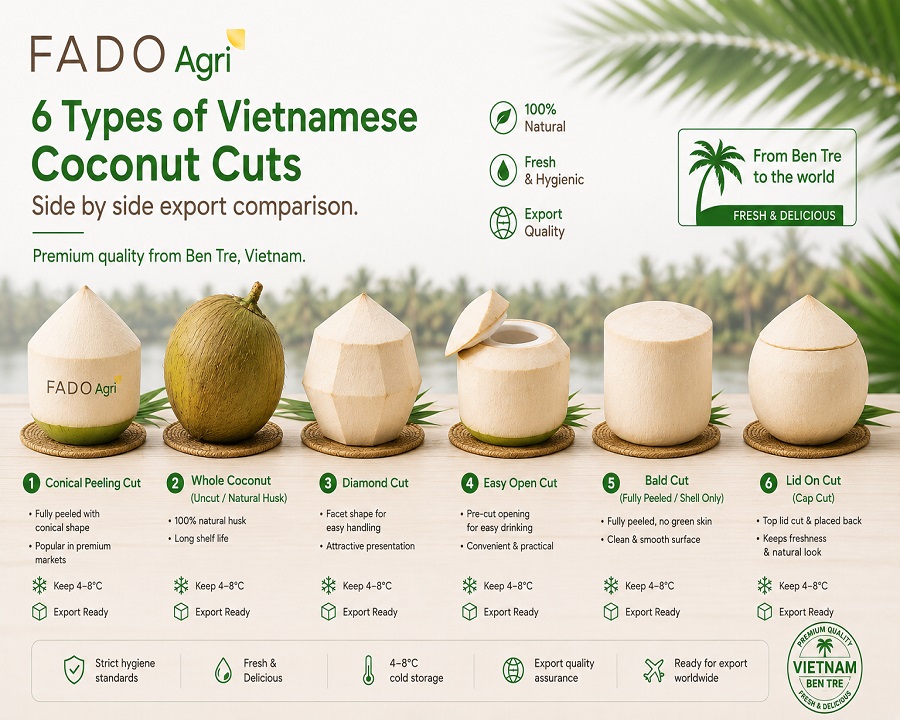
Vietnam’s coconut industry has standardized around six commercially recognized cut types. Each serves a specific trade channel, price point, and consumer demographic. Buyers sourcing from regions like the Middle East, China, Japan, South Korea, and Australia will encounter different demand profiles for each format.
Read more: Diamond Cut Coconut vs Easy Open Coconut: Which One Fits Your Market?
2. The 6 Types of Vietnamese Coconut Cuts: A Format-by-Format Breakdown
2.1 Conical Peeling Cut
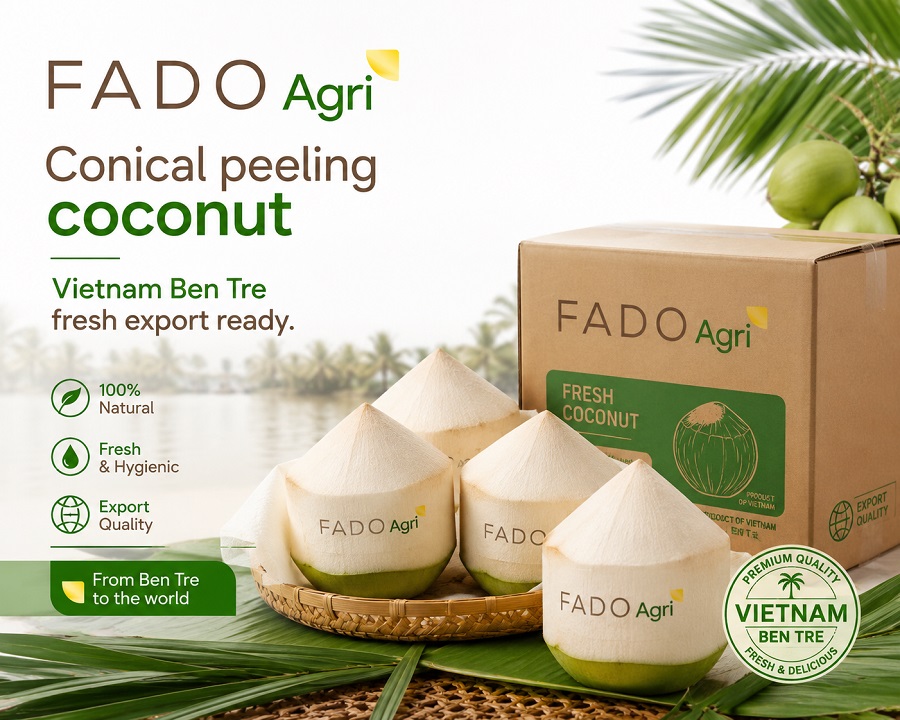
The Conical Peeling cut is the most widely recognized Vietnamese coconut format in international markets. The husk is trimmed into a smooth, pointed cone shape — a clean, tapering profile that has become the visual signature of Vietnamese coconut exports globally.
Why buyers choose it:
- Strong shelf presence in supermarkets and retail chains
- The pointed tip makes it easy for consumers to pierce with a straw
- Consistent, symmetrical appearance supports premium retail packaging
- Popular in the UAE, Saudi Arabia, Malaysia, and across East Asian markets
Export profile: High volume, suitable for all market tiers. Fado Agri exports conical peeling coconuts with a minimum lead time of 5 days.
2.2 Whole Coconut (Uncut / Natural Husk)
The Whole coconut is exported with its full natural husk intact, no trimming, no shaping. It is the most raw form of export and is often preferred by buyers in specific wholesale markets or those who process the fruit downstream.
Why buyers choose it:
- Maximum husk protection means longer shelf life during long-haul shipping
- Suitable for buyers who re-cut or repackage in destination markets
- Lower processing cost at origin = price advantage at import
Export profile: Best for bulk wholesale buyers, processing facilities, and markets where the coconut will be re-trimmed locally. Common in South Asian and Southeast Asian import channels.
2.3 Diamond Cut
The Diamond Cut involves trimming the husk into a compact, multi-faceted diamond or hexagonal shape. It is a mid-range format that balances weight reduction with a retail-friendly appearance.
Why buyers choose it:
- Reduces husk weight without fully exposing the shell, a logistics and cost advantage
- The angular shape stacks efficiently in retail displays and export cartons
- Appeals to buyers in supermarket chains who want something more visually distinct than a full husk but less processed than a conical cut
Export profile: Growing in popularity in East Asian markets and Middle Eastern retail chains as buyers look to differentiate on shelf.
2.4 Easy Open Cut
The Easy Open cut is a consumer-first format, specifically designed so the end user can open the coconut without any tools. The husk and shell are pre-cut and partially separated at the top, with only a thin layer left intact. In many markets, this format comes with a built-in straw hole or scored lid.
Why buyers choose it:
- Eliminates the need for machetes or openers, critical for food courts, hotels, and beverage kiosks
- Extremely popular in convenience retail, festivals, tourist destinations, and quick-service settings
- Supports premium retail pricing in markets like Japan, South Korea, and Australia
Export profile: Higher processing cost at origin. Requires careful packaging to prevent premature cracking. Best paired with modified atmosphere packaging (MAP) for extended shelf life.
2.5 Bald Cut (Fully Peeled / Shell Only)
The Bald cut removes the entire husk, leaving only the hard brown coconut shell exposed. It is the most minimalist of the six formats, compact, lightweight, and easy to handle.
Why buyers choose it:
- Significant weight reduction = lower freight cost per container
- Very high container load optimization, more units per box
- Long-established format for markets where consumers are comfortable opening a hard-shell coconut
- Well-suited to Chinese wholesale markets, South Asian retail, and institutional buyers
Export profile: High volume, price-sensitive channels. Fado Agri processes Bald Cut coconuts at our factory to consistent shell-diameter specifications.
2.6 Lid On Cut (Cap Cut)
The Lid On cut, also called the Cap Cut, is a premium format where the top of the husk is trimmed and shaped to create a natural “lid” that sits over a pre-cut opening. The consumer simply lifts or removes the cap to access the coconut water inside.
Why buyers choose it:
- The “lid” functions as a hygienic cap, no straw required, no exposed coconut water before purchase
- Highly photogenic and popular in premium retail, hotel hospitality, and high-end food service
- Growing demand across UAE luxury retail chains, Australian health food stores, and Japanese convenience chains
Export profile: Premium price point. Higher skill requirement during processing. Fado Agri’s factory team is trained specifically for Lid On consistency, uniform cap size and clean cut edges across every unit.
Read more: Lid On Coconut: Innovative Resealable Coconut Format from Vietnam
3. How Fado Agri Processes and Exports Each Cut Type
Understanding the cut is one thing. Knowing that your supplier can actually deliver it, consistently, at volume, with proper documentation, is another matter entirely.
3.1 From Field to Factory: The First Quality Gate
Fado Agri sources all fresh coconuts from Ben Tre and Tien Giang, two provinces that account for a significant share of Vietnam’s commercial coconut production. Harvest is chemical-free, and quality control begins in the field, not on the factory floor.
Coconuts selected for export must pass size grading, visual inspection for cracks or mold, and a water-content check before entering the processing facility.
3.2 In-Factory Processing Standards
At the factory level, our team of 500+ trained factory workers processes each cut type to defined dimensional tolerances. For export-grade coconuts:
- Conical and Diamond cuts are trimmed on standardized jigs to ensure uniform shape
- Easy Open and Lid On cuts involve scored cuts with controlled depth, our most skill-intensive formats
- Bald and Whole formats go through surface cleaning and shell inspection before packing
Every batch is processed under HACCP protocols, with temperature-controlled storage between cutting and packing.
3.3 Packing and Documentation
All six formats are packed in export cartons with food-grade liner, labeled to buyer specifications (OEM/ODM available), and shipped under a full document set: Phytosanitary Certificate, Certificate of Origin (CO), Bill of Lading (B/L), and commercial invoice aligned to FOB or CIF terms.
Minimum lead time for fresh coconut export: 5 days from confirmed order. Standard stable supply runs at 2-3 days per container for volume buyers.
4. Choosing the Right Cut Type for Your Market
Buyers often ask which coconut cut is the right choice for their market. The honest answer depends on three variables: consumer behavior, retail channel, and price sensitivity.
| Cut Type | Best Market Fit | Price Tier |
| Conical Peeling | Supermarkets, Gulf retail, Asia-Pacific | Mid-Premium |
| Whole | Wholesale, processing buyers, bulk import | Economy |
| Diamond Cut | Supermarkets, East Asia, premium wholesale | Mid |
| Easy Open | Convenience retail, F&B, tourism | Premium |
| Bald | Mass wholesale, institutional, hard-shell markets | Economy |
| Lid On (Cap) | Premium retail, hospitality, health food | Premium |
If you are unsure which format aligns with your distribution channel, Fado Agri’s team can walk you through sample options before you place an order. We work with importers across 20 strategic partnerships worldwide, and format-fit consultation is part of how we build long-term buyer relationships.
5. Frequently Asked Questions About Vietnamese Coconut Cut Types
What is the most popular Vietnamese coconut cut for export?
The Conical Peeling cut is the most widely exported Vietnamese coconut format globally. Its clean, tapered shape is recognized by consumers across the Middle East, East Asia, and Australia, making it the default choice for supermarket and retail buyers. Fado Agri exports Conical Peeling coconuts from Ben Tre and Tien Giang to 10+ internationally certified markets.
Which coconut cut type is best for long-distance shipping?
The Whole (natural husk) and Bald (fully peeled shell) formats are typically most resilient during long-haul ocean freight. The full husk provides natural cushioning; the Bald cut, though more exposed, is compact and packs tightly, reducing movement inside cartons. Fado Agri applies food-grade liner packaging across all cut types to maintain freshness during transit.
Can Fado Agri supply OEM-labeled coconut packaging for all six cut formats?
Yes. Fado Agri offers OEM and ODM packaging across all six Vietnamese coconut cut types. This includes custom branding on export cartons, sticker labeling on individual coconuts, and private-label documentation. Lead time and minimum order quantities vary by format, contact our team for specific requirements.
What certifications apply to Fado Agri’s coconut exports?
All Fado Agri fresh coconut exports are produced under FDA (United States), GLOBALG.A.P, and HACCP-certified processes. Export documentation includes Phytosanetary Certificate and Certificate of Origin, ensuring compliance at customs checkpoints across all major destination markets.
What is the minimum order for fresh coconut export?
Minimum order quantities depend on the cut type and destination market. Fado Agri operates on a per-container basis with stable supply averaging 2-3 days per container. Fresh coconut orders require a minimum 5-day lead time from confirmed purchase order. Contact us at (+84) 908 479 339 or [email protected] for specific MOQ details.
How does Fado Agri ensure consistent cut quality across large orders?
Consistency is maintained through standardized processing jigs, trained operators, and batch-level quality checks at our factory in Vietnam. Each cut format is produced to defined dimensional specifications, and all outgoing pallets are inspected before container loading. Our 10-step supply chain process is designed to eliminate variability from farm to final destination.
Conclusion: Knowing the 6 Types of Vietnamese Coconut Cuts Changes How You Source
The 6 types of Vietnamese coconut cuts, Conical Peeling, Whole, Diamond Cut, Easy Open, Bald, and Lid On, are not interchangeable. Each format carries a distinct commercial purpose, price point, and logistics profile. For B2B buyers importing fresh coconuts from Vietnam, specifying the right cut from the start means fewer returns, better shelf performance, and a cleaner logistics chain.
Fado Agri has been supplying all six formats from Ben Tre and Tien Giang since 2016, exporting 500+ containers per year to buyers across the Middle East, East Asia, and the Asia-Pacific region, with FDA, GLOBALG.A.P, and HACCP certification backing every shipment.
Rooted in the land, rigorous in standards, that’s the commitment behind every coconut we export.
Ready to specify your cut type and request a sample or quote? Contact Fado Agri today:
- 📞 Hotline: (+84) 908 479 339
- 📧 Email: [email protected]
- 🌐 Website: fadoagri.com