

Why Vietnam Is Becoming a Major Coconut Water Source
Vietnam has emerged as one of Asia’s most competitive origins for processed coconut water, combining abundant raw material supply with growing beverage manufacturing infrastructure. The country exports coconut water in multiple processed forms — NFC liquid, aseptic bulk, and retail-packaged beverages — serving importers, food manufacturers, and private label brands across more than 10 certified markets. If you are evaluating Vietnam as a sourcing origin, the fundamentals are strong: traceable supply chains, phytosanitary compliance at farm level, and a rapidly expanding cold-chain processing network.
Ben Tre and Tien Giang — the supply heartland
Ben Tre and Tien Giang provinces in the Mekong Delta account for the majority of Vietnam’s coconut cultivation and fresh fruit processing. Ben Tre alone is often called “the coconut capital” of Vietnam, with decades of specialized growing history that directly supports downstream beverage processing. The natural mineral profile of coconuts grown in this brackish-influenced delta soil — particularly the balance of potassium, magnesium, and natural sugars — gives the water a flavor profile that buyers in the Middle East, East Asia, and Western markets consistently rate highly. Processing plants that source directly from these provinces can offer greater traceability from farm to finished liquid, which is increasingly a procurement requirement in regulated import markets.
Production capacity and export readiness
Vietnam’s coconut water processing sector has invested significantly in aseptic filling technology, cold-chain infrastructure, and international certification over the past decade. Facilities serving B2B export buyers are now capable of handling both bulk ingredient orders and finished retail product runs within the same production environment. Export readiness goes beyond volume — it includes documentation management for FDA, GLOBALG.A.P, and HACCP compliance, which is non-negotiable for buyers entering the US, EU, Japan, or Australian markets. At Fado Agri, our sourcing network is anchored in Ben Tre and Tien Giang, giving us direct access to verified raw material flows that feed the processed coconut water supply chain.
Types of Coconut Water Available for Export
Vietnam exports coconut water in three primary product forms, each suited to a different buyer profile and end-use application. Understanding the differences before issuing an inquiry will save significant back-and-forth with suppliers and help you specify correctly from the start.
NFC vs concentrate
Not-From-Concentrate (NFC) coconut water is extracted directly from fresh young coconuts, minimally processed, and aseptically preserved without reconstitution. It retains a flavor and nutrient profile closest to fresh-cut coconut, making it the preferred format for premium retail brands and functional beverage applications. Coconut water concentrate (CWC) is produced by evaporating a portion of the water content to reduce volume and extend shelf life — it is reconstituted by the buyer before use, making it cost-efficient for food manufacturers and flavor ingredient buyers. NFC commands a higher FOB price but requires stricter cold-chain management during transit; concentrate is more forgiving on logistics and typically carries a longer ambient shelf life at higher Brix levels.
Aseptic bulk vs retail-ready formats
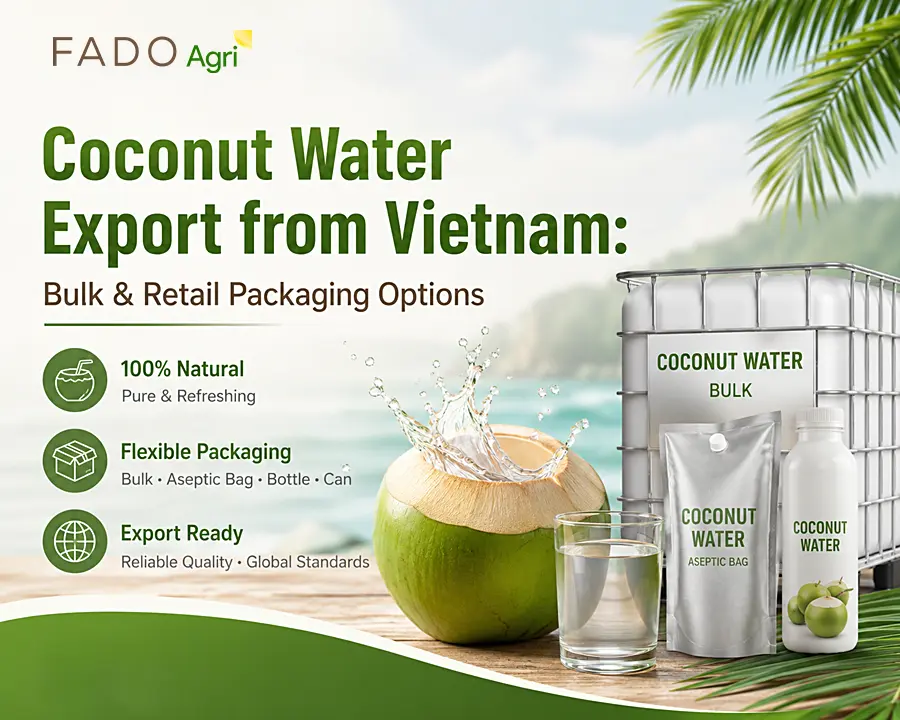
Aseptic bulk coconut water — typically supplied in bag-in-box (BIB) formats of 200L or 1,000L — is designed for buyers who will repackage or reformulate the product at their own facility. This format is popular with juice blenders, beverage co-packers, and food ingredient distributors. Retail-ready formats include Tetra Pak cartons, aluminum cans, glass bottles, and flexible pouches — all filled, sealed, and labeled at the Vietnamese processing facility, requiring only import compliance and shelf placement at destination. Buyers sourcing for private label or OEM programs will typically choose retail-ready formats; those integrating coconut water as an ingredient into their own products will favor aseptic bulk.
Packaging Options: What Buyers Need to Know
Packaging choice directly affects shelf life, shipping cost, import compliance, and consumer positioning. The table below summarizes the main formats available from Vietnamese coconut water exporters.
| Format | Typical Volume | Shelf Life | Best For | MOQ (approx) |
|---|---|---|---|---|
| Tetra Pak / Carton (aseptic) | 200ml – 1L | 12–18 months ambient | Retail, private label, e-commerce | 1 x 20ft container |
| Aseptic Bag-in-Box (BIB) | 200L – 1,000L | 12–24 months ambient | Bulk ingredient buyers, co-packers | 5–10 MT |
| Aluminum Can | 250ml – 500ml | 12–18 months ambient | Retail, convenience, foodservice | 1 x 20ft container |
| Glass Bottle | 250ml – 750ml | 12 months ambient (pasteurized) | Premium retail, HoReCa, organic brands | 1 x 20ft container |
| Flexible Pouch (spouted) | 200ml – 500ml | 9–12 months ambient | Kids’ market, travel retail, on-the-go | 1 x 20ft container |
| Drum / IBC Tote (bulk NFC) | 200L – 1,000L | 12 months (cold chain required) | Ingredient use, reformulation | 5 MT |
Tetra Pak and carton formats
Aseptic carton packaging is the most commercially recognized format for coconut water in retail channels globally. It offers ambient shelf stability without preservatives, making it compliant with clean-label positioning requirements in markets like Australia, the EU, and the UAE. Vietnamese processors equipped with Tetra Pak or equivalent aseptic filling lines can produce buyer-specified SKUs with custom label artwork — a key requirement for OEM and private label programs. If you are building a private label coconut water brand, see our dedicated overview at private label coconut manufacturing in Vietnam for program details.
Aseptic bag-in-box (BIB) for bulk importers
BIB aseptic packaging is the most freight-efficient format for large-volume ingredient buyers. A single 20-foot container can carry substantially more product in BIB format compared to retail cartons, reducing per-liter logistics cost materially. The aseptic bag maintains product sterility without refrigeration, as long as the seal is intact — once opened, the product must be used within the buyer’s own processing timeline. Buyers using coconut water as a base for smoothies, functional drinks, or food manufacturing should evaluate BIB bulk as their primary sourcing format.
Cans, glass bottles, and flexible pouches
Aluminum cans offer convenience-channel positioning and are well-suited to markets with strong RTD (ready-to-drink) beverage cultures, including South Korea, Japan, and the Gulf states. Glass bottles serve premium positioning — HoReCa accounts, organic grocery channels, and health food retailers. Flexible pouches occupy an efficient middle ground for on-the-go and kids’ nutrition segments. Each format carries different freight characteristics: glass adds weight and fragility risk, cans are stackable and durable, pouches offer the lightest per-unit weight. Buyers should evaluate landed cost per liter — not just FOB unit price — when comparing formats. For guidance on packaging customization, our article at custom coconut packaging from Vietnam covers specification requirements in detail.
Certifications and Quality Standards to Require
Any legitimate coconut water exporter shipping to regulated markets must hold verifiable third-party certifications — not just supplier-issued quality declarations. The minimum certification baseline for serious B2B buyers includes HACCP (Hazard Analysis Critical Control Points) for food safety process control, FDA registration for US-destined shipments, and GLOBALG.A.P at farm level for raw material traceability. Some buyers additionally require ISO 22000, Organic (EU or USDA), Halal, Kosher, or market-specific phytosanitary certificates depending on destination regulations.
In our experience, certification gaps are the most common reason Vietnamese coconut water suppliers fail import compliance at destination — particularly for the US FDA market, where facility registration and labeling compliance are enforced at port. Fado Agri holds FDA, GLOBALG.A.P, and HACCP certifications across our supply chain, covering both raw material sourcing and export documentation. For a detailed breakdown of what each certification requires from a Vietnamese exporter, refer to our technical guide at HACCP and FDA compliance for Vietnam coconut exports.
Buyers should also request batch-level Certificates of Analysis (CoA) covering microbiological safety (total plate count, yeast, mold, E. coli), heavy metal testing, Brix level, pH, and turbidity. Reputable suppliers will provide CoA from accredited third-party laboratories — not internal lab results only.
Vietnam vs Thailand, Philippines, Indonesia — Sourcing Comparison
Vietnam is not the only origin for processed coconut water, and buyers should understand how it compares against established competitors before making a sourcing decision.
| Criteria | Vietnam | Thailand | Philippines | Indonesia |
|---|---|---|---|---|
| Primary supply region | Ben Tre, Tien Giang (Mekong Delta) | Prachuap Khiri Khan, Ratchaburi | Quezon, Davao | North Sulawesi, East Java |
| Dominant product form | NFC, aseptic bulk, retail carton | NFC, retail carton (mature market) | NFC, concentrate, bulk | Concentrate, bulk ingredient |
| Price competitiveness (FOB) | Competitive; often below Thailand | Higher; premium brand positioning | Competitive | Typically lowest for concentrate |
| Certification maturity | FDA, HACCP, GLOBALG.A.P available | Strong; well-established | Moderate; varies by supplier | Growing; varies by facility |
| OEM / private label capability | Strong and growing | Strong; higher minimum runs | Available; capacity varies | Limited retail-ready OEM |
| Supply chain traceability | Good; improving at farm level | Good | Moderate | Moderate |
| Logistics to Middle East / UAE | Direct routes available; competitive | Well-established routes | Longer transit | Moderate transit time |
Thailand remains the most mature market for branded retail coconut water globally, but its FOB pricing reflects that maturity. Vietnam is increasingly attractive for buyers seeking competitive input cost on NFC and aseptic bulk without sacrificing certification compliance. The Philippines holds a strong position in concentrate supply. For buyers specifically importing into the UAE or Gulf markets, Vietnam’s direct shipping routes and our established operations in Ajman, UAE make logistics coordination practical — see our UAE-specific guide at Vietnam coconut exporter to UAE for market-entry detail.
Working with Fado Agri for Coconut Water Sourcing
Fado Agri has operated as a professional agricultural exporter since 2016, with over 500 containers exported per year across 10+ certified markets. Our coconut supply chain is anchored in Ben Tre and Tien Giang — the same provinces that supply the raw material for processed coconut water — giving us verified access to compliant raw material flows and established relationships with certified processing partners.
For coconut water specifically, we offer OEM and private label programs covering retail-ready cartons, cans, and pouches, as well as aseptic bulk BIB supply for ingredient buyers. Our services include full FOB/CIF export management, phytosanitary and certification documentation, and label compliance review for destination markets including the US (FDA), EU, UAE, Australia, Japan, and South Korea. MOQ structures depend on format and program type — contact us directly for a specification-matched quotation.
If you are at the early stage of evaluating Vietnam as an origin for your coconut water program, we are also happy to arrange product samples with full CoA documentation before committing to a commercial order. Reach out to our team at [email protected] or call (+84) 0908 479 339 to begin the conversation.
FAQ — Coconut Water Sourcing from Vietnam
What types of coconut water does Vietnam export?
Vietnam exports NFC (not-from-concentrate) coconut water, coconut water concentrate, and aseptic bulk liquid. Retail-ready finished product in cartons, cans, pouches, and glass bottles is also available from facilities with OEM/private label capability.
What is the typical shelf life of exported coconut water by packaging type?
Aseptic carton and BIB formats generally achieve 12–18 months at ambient temperature. Aluminum cans and glass bottles typically achieve 12–18 months depending on pasteurization process. Flexible pouches typically achieve 9–12 months. Cold-chain NFC in drums or IBC totes is typically 12 months if the cold chain is maintained throughout transit and storage.
What certifications should I require from a Vietnamese coconut water supplier?
At minimum, require HACCP for food safety process control, FDA registration for US-bound shipments, and GLOBALG.A.P for farm-level traceability. Depending on your destination market, you may also require ISO 22000, Halal, Kosher, EU Organic, or market-specific phytosanitary certificates. Always request batch-level CoA from an accredited third-party laboratory.
What is the approximate FOB Vietnam price for coconut water?
FOB pricing varies significantly by product type, packaging format, and order volume. NFC coconut water in aseptic bulk typically commands a premium over concentrate. Retail-packaged formats carry additional processing and packaging costs. We recommend requesting a specification-matched quotation rather than relying on general price estimates — contact Fado Agri at [email protected] for current pricing based on your exact requirements.
What is the MOQ for coconut water export from Vietnam?
MOQ depends on packaging format. For retail-ready formats (carton, can, pouch), the typical minimum is one 20-foot container. For aseptic bulk BIB or NFC ingredient supply, MOQ is typically 5–10 MT. OEM private label programs may carry higher minimums depending on label printing and production run economics. Confirm exact MOQ with your supplier at specification stage.
Is OEM or private label coconut water available from Vietnam?
Yes. Vietnamese processors with aseptic retail filling lines can produce buyer-specified private label products across carton, can, pouch, and glass bottle formats. OEM programs typically include label artwork accommodation, custom Brix/flavor specification, and export documentation aligned to destination market requirements. See our dedicated article at private label coconut manufacturing in Vietnam for program details.
How does NFC coconut water differ from coconut water concentrate?
NFC (not-from-concentrate) is extracted directly from fresh coconuts without removing or adding water — it retains the closest flavor and nutrient profile to fresh coconut water. Concentrate has had a portion of its water removed to increase Brix and reduce volume, making it more economical to ship and store. Buyers reconstitute concentrate with water before use. NFC is preferred for premium retail; concentrate suits food manufacturing and ingredient applications.
How do I verify a Vietnamese coconut water supplier’s legitimacy before placing an order?
Request the supplier’s original certification documents (HACCP, FDA registration number, GLOBALG.A.P certificate) and verify them directly with the issuing body. Ask for a factory audit report from a recognized third party (SGS, Bureau Veritas, Intertek). Review export records through Vietnam’s customs data or ITC Trade Map. Request product samples with full CoA from an accredited laboratory. In our experience, a credible supplier will provide all of this documentation without hesitation — reluctance or delay on documentation requests is a significant red flag.
Ready to Source Coconut Water from Vietnam?
Vietnam’s combination of quality raw material from the Mekong Delta, growing processing infrastructure, and verifiable certification compliance makes it a credible and cost-competitive origin for B2B coconut water sourcing in 2026. Whether you need aseptic bulk for ingredient use, retail-ready cartons for a private label launch, or NFC in cans for a convenience channel — the supply options exist and the export logistics are well-established.
Fado Agri’s team works with importers, distributors, and brand owners across the UAE, Australia, the US, Japan, South Korea, and the EU to structure coconut water programs that fit their volume, certification, and timeline requirements. If you are evaluating Vietnam as an origin for the first time, or looking to add a certified Vietnamese supplier to your existing sourcing panel, we welcome the conversation. Email [email protected] or call (+84) 0908 479 339 — our team responds to specification inquiries within one business day.