

Why Vietnamese Mango Is Gaining Ground in Global Fruit Markets
International buyers sourcing tropical fruit are increasingly turning to Vietnam as a serious mango origin — and for good reason. Vietnam’s diverse geography, year-round growing capacity across multiple regions, and a growing portfolio of EVFTA and CPTPP tariff advantages are reshaping where procurement teams look first. If you are evaluating fresh mango suppliers, understanding Vietnam’s variety landscape and seasonal calendar is the starting point for any successful import program.
Vietnam ranks among Southeast Asia’s top mango-producing nations, with the Ministry of Agriculture and Rural Development (MARD Vietnam) reporting over 112,000 hectares of mango cultivation as of 2024 [source: to be confirmed]. The country’s commercial export volume has grown steadily as phytosanitary compliance standards have improved and more farms have earned international certifications. In our experience working across Vietnamese tropical fruit supply chains, mango represents one of the highest-potential categories for buyers looking to diversify away from single-origin dependence on Thailand or the Philippines.
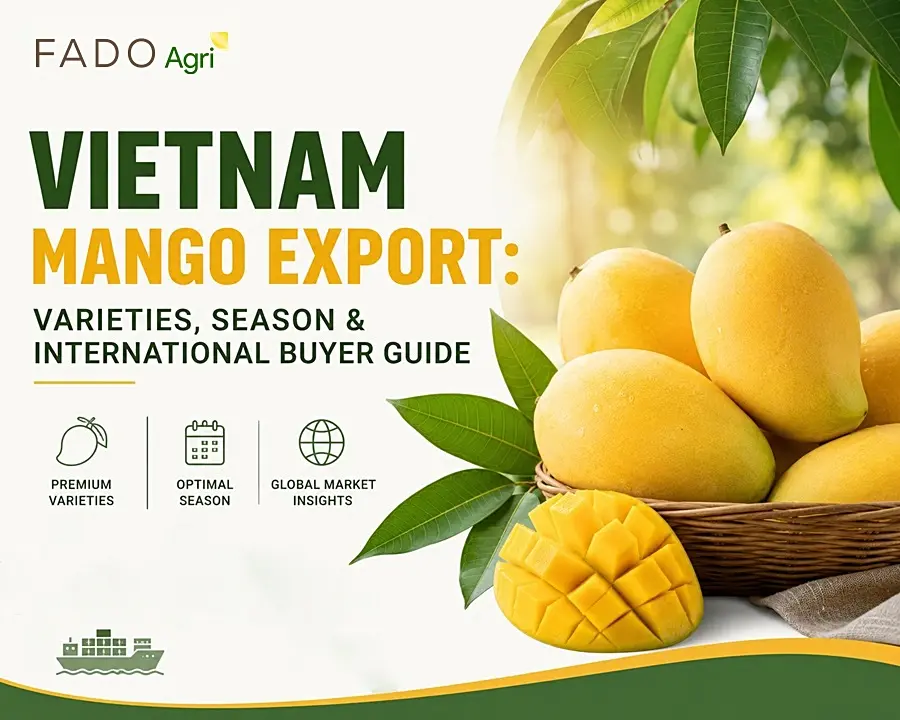
Vietnamese Mango Varieties: What the Export Market Actually Buys
Vietnam exports four commercially significant mango varieties, each with distinct flavor profiles, shelf lives, and target markets. Knowing which variety suits your customer base is the first step before discussing MOQ or pricing with any supplier.
Cat Hoa Loc — Vietnam’s Premium Export Variety
Cat Hoa Loc is the benchmark variety for Vietnamese mango export, originating from the Mekong Delta and commanding the highest FOB Vietnam price point. It is characterized by a thin, smooth yellow skin, virtually fiberless flesh, and a rich, intensely sweet flavor with low acidity. Individual fruit typically weigh between 350g and 500g, making it well-sized for retail packing formats. Cat Hoa Loc is the variety most frequently requested by buyers in China, Japan, South Korea, and premium Gulf retail channels.
Cat Chu — The Volume Export Workhorse
Cat Chu mango is smaller than Cat Hoa Loc, averaging 200g to 350g per fruit, but it offers strong flavor consistency and a longer post-harvest shelf life that suits longer ocean freight routes. The flesh is bright yellow-orange, moderately sweet, and slightly more fibrous than Cat Hoa Loc. Cat Chu is popular in markets where price competitiveness matters alongside quality — including Malaysia, the Middle East, and certain EU markets where Vietnamese mango enters under EVFTA preferential tariff rates.
Keow Savoy — The Green-Skin Market Variety
Keow Savoy (also spelled Keo Savoy or Xoai Keow) is a green-skin variety that remains green even when fully ripe — a characteristic that directly targets markets in China and Southeast Asia where green mango has strong cultural preference. Its flesh is pale yellow to cream-colored, with a balanced sweet-sour profile. Keow Savoy adapts well to consumer segments that eat mango both ripe and semi-ripe, making it a flexible SKU for importers serving diverse retail formats.
GL4 — The Newer Commercial Variety
GL4 is a hybrid variety developed through Vietnamese agricultural research programs, gaining commercial traction from roughly 2020 onward. It combines a visually attractive yellow-green skin with the fiberless flesh texture closer to Cat Hoa Loc. GL4 was partially bred to improve disease resistance and extend the harvest window, giving it growing appeal among export-oriented farms in Dong Thap and Tien Giang provinces. Some buyers targeting the Australian and EU markets have begun specifying GL4 due to its consistent sizing and packing yield.
| Variety | Peak Season | Flavor Profile | Avg. Weight | Best Export Market |
|---|---|---|---|---|
| Cat Hoa Loc | March – June | Very sweet, fiberless, rich aroma | 350g – 500g | China, Japan, South Korea, UAE |
| Cat Chu | April – July | Sweet, slightly fibrous, consistent | 200g – 350g | Malaysia, EU, Middle East |
| Keow Savoy | February – May | Sweet-sour, pale flesh, green skin | 300g – 450g | China, Southeast Asia |
| GL4 | April – August | Sweet, fiberless, attractive color | 350g – 550g | Australia, EU, Japan |
Vietnam Mango Harvest Calendar: Region-by-Region Seasonality
Vietnam’s mango harvest is not a single event — it is a rolling calendar across three distinct geographic zones that collectively enables near-year-round supply when managed with the right supplier network.
Mekong Delta — The Primary Export Zone
The Mekong Delta provinces of Dong Thap, Tien Giang, An Giang, and Vinh Long account for the majority of export-grade mango volume. The main harvest here runs from March through June for Cat Hoa Loc and Cat Chu varieties, with off-season production possible from November to January through flower-forcing techniques used by experienced growers. Dong Thap alone is estimated to produce over 100,000 tonnes of mango annually [source: to be confirmed], making it the single most important mango province for export buyers to have supply relationships in.
South Central Coast — Extended Season Buffer
Provinces including Khanh Hoa, Ninh Thuan, and Binh Thuan produce mango from May through August, effectively extending the peak season when Mekong Delta farms wind down. This zone is particularly relevant for buyers who need to maintain continuous container programs through the June-August gap. Keow Savoy and some GL4 production comes from this region.
Northwest Highlands — Off-Season and Specialty
Son La province in the Northwest Highlands has emerged as a notable mango-growing area, with harvest concentrated from June through August. Son La mango benefits from distinct day-night temperature variation that produces good sugar content. This region supplies mostly Cat Chu and GL4, primarily to China via border trade and domestic channels, though export-certified volumes are increasing.
Which Export Markets Buy Vietnamese Mango — and Why
China is by far the largest single destination for Vietnamese mango export, absorbing the majority of volume through both official customs channels and traditional border trade. The proximity, cultural preference for Vietnamese tropical fruit, and ASEAN-China FTA tariff reductions make Vietnam a logical primary mango supplier for Chinese importers. Japan and South Korea represent the premium-price markets, where Cat Hoa Loc commands the highest FOB values but requires rigorous phytosanitary compliance including vapor heat treatment (VHT) protocols.
The European Union has become an increasingly important destination since the EVFTA entered into force in 2020, with mango tariffs progressively reducing toward zero for certified Vietnamese exporters. The Middle East — particularly the UAE, Saudi Arabia, and Kuwait — represents a high-volume opportunity driven by large expatriate South and Southeast Asian communities who are familiar with and prefer Vietnamese mango varieties over those from distant origins. Australia is an emerging market where market access for Vietnamese mango has been the subject of biosecurity negotiations, with irradiation treatment as the accepted pathway for approved varieties [source: to be confirmed].
Similar supply-chain dynamics apply to other Vietnamese tropical fruits. If you are also evaluating red dragon fruit from Vietnam or Cavendish banana from Vietnam, a consolidated multi-product container approach is worth discussing with your sourcing partner.
Certifications and Phytosanitary Requirements by Market
Phytosanitary compliance is non-negotiable for mango export Vietnam — and the requirements differ significantly by destination. Buyers who have sourced from Thailand or the Philippines will find broadly similar frameworks, but there are Vietnam-specific protocols that matter.
| Market | Certification Required | Phytosanitary Treatment | Tariff Advantage |
|---|---|---|---|
| China | MARD Vietnam registration, farm code | Cold treatment or fumigation protocols | ASEAN-China FTA preferential rate |
| Japan | GLOBALG.A.P, MARD phytosanitary cert | Vapor Heat Treatment (VHT) mandatory | CPTPP — progressive reduction to 0% |
| South Korea | GLOBALG.A.P, MARD cert | Vapor Heat Treatment (VHT) | VKFTA preferential rate |
| USA | FDA registration, GLOBALG.A.P | Irradiation (USDA-APHIS approved) | Standard MFN (no FTA currently) |
| EU | GLOBALG.A.P or equivalent, HACCP | Standard phytosanitary certificate | EVFTA — reducing to 0% by schedule |
| Australia | GLOBALG.A.P, DAFF biosecurity | Irradiation (approved pathway) | CPTPP — progressive reduction |
| UAE / Middle East | GLOBALG.A.P, HACCP, halal if required | Standard phytosanitary certificate | No FTA, competitive on quality/price |
Vapor heat treatment (VHT) is the most technically demanding treatment requirement — it involves heating the fruit to a precise internal temperature to eliminate fruit fly larvae and requires certified treatment facilities in Vietnam. Buyers targeting Japan or South Korea should confirm that their Vietnamese supplier has access to approved VHT facilities before committing to a program. Irradiation, required for the US market and used for Australia, is a separate process requiring licensed irradiation centers.
How Vietnamese Mango Compares to Thai and Philippine Mango
Thai Nam Dok Mai and Philippine Carabao mango are the two main competing origins for Vietnamese mango in international markets. Thai mango has longer established export infrastructure and brand recognition, particularly in Europe and Japan. Philippine Carabao mango has strong premium positioning in certain markets due to its distinctive sweetness. Vietnamese Cat Hoa Loc, however, competes directly on flavor quality — blind tasting evaluations frequently score it comparably or higher than Nam Dok Mai in sweetness and aroma — while offering FOB Vietnam price points that are often more competitive than Thai origins due to lower farm-gate costs [source: to be confirmed].
Vietnam’s geographic advantage over the Philippines is significant for China — shorter transit times, lower freight costs, and land border access give Vietnamese mango a structural cost advantage for the world’s largest mango import market. For buyers sourcing for the EU under EVFTA, Vietnamese mango now has a meaningful tariff advantage over Thai mango (Thailand has no FTA with the EU) and Philippine mango (EU-Philippines FTA negotiations were still ongoing as of mid-2026 [source: to be confirmed]).
Post-Harvest Handling, Packaging, and Cold Chain
Post-harvest treatment and cold chain integrity are where Vietnamese mango export quality is won or lost. Reputable export-grade facilities in Dong Thap and Tien Giang apply hot water treatment at 52°C for Cat Hoa Loc to suppress fungal development, followed by forced-air cooling to bring fruit to target transit temperature before packing. Cold chain integrity from packhouse to port is essential — temperature breaks during local transport are a common source of quality failures that buyers discover on arrival rather than at origin.
Standard export packaging for fresh mango includes 3kg, 4kg, and 5kg cartons with individual foam net protection for premium grades, or single-layer tray packs for supermarket-ready formats. Some buyers specify dual-layer packing with perforated PE liner for humidity management on longer ocean routes. OEM and private label packaging — including buyer-branded cartons and stickers — are standard practice for established export programs. MOQ for fresh mango programs typically starts at one 40-foot reefer container (approximately 18–22 tonnes depending on variety and packing format), though this varies by supplier and season. Pricing is quoted FOB Vietnam and fluctuates by variety, season, and grade — buyers should request indicative quotes 8–12 weeks ahead of target arrival dates to allow for farm scheduling and treatment booking.
The same cold chain discipline that applies to mango also governs our Vietnam watermelon export and seedless lime programs — cold chain integrity is a non-negotiable standard across all Fado Agri perishable categories.
Frequently Asked Questions
What is the best Vietnamese mango variety for export to Japan?
Cat Hoa Loc is the preferred variety for the Japanese market due to its fiberless flesh, high sweetness, and premium presentation. Japan’s import protocol requires vapor heat treatment (VHT) certification, so buyers must confirm their Vietnamese supplier has access to an approved VHT facility. GL4 is also gaining acceptance in Japan as a visually consistent alternative.
Can Vietnam supply fresh mango year-round?
With careful multi-region sourcing, Vietnam can supply fresh mango for approximately 9–10 months of the year. The Mekong Delta peaks from March to June, the South Central Coast extends supply through August, and flower-forcing techniques in Dong Thap can produce off-season fruit from November to January. Buyers needing a 12-month program should discuss supply continuity planning with their sourcing partner.
What certifications are required for mango export from Vietnam?
GLOBALG.A.P farm certification and a MARD Vietnam phytosanitary certificate are the baseline requirements for most markets. The US additionally requires FDA facility registration and USDA-APHIS-approved irradiation treatment. Japan and South Korea require VHT. The EU accepts GLOBALG.A.P alongside a standard phytosanitary certificate for EVFTA tariff access.
How does Vietnamese mango compare in price to Thai mango?
FOB Vietnam prices for Cat Hoa Loc are generally competitive with or below equivalent Thai Nam Dok Mai grades, reflecting Vietnam’s lower farm-gate production costs. The price gap varies by season — during Vietnam’s peak harvest (April–May), prices are most competitive. For EU buyers, EVFTA tariff savings add a further cost advantage over Thai-origin mango which enters the EU without FTA preference.
What is the typical MOQ for a Vietnamese mango export order?
The practical minimum order quantity for a commercial fresh mango export program is one 40-foot refrigerated container, which typically holds 18–22 tonnes depending on packing format and variety. Some suppliers accept smaller trial shipments by air freight for market development purposes, though airfreight economics are only viable for premium Cat Hoa Loc targeting high-price markets like Japan or the UAE.
What phytosanitary treatment is needed for mango export to China?
Vietnamese mango exported to China requires farms and packhouses to be registered with MARD Vietnam and approved by Chinese customs authorities (GACC). Consignments must be accompanied by a MARD phytosanitary certificate, and specific treatment protocols apply depending on the registered pest risk assessment. Buyers should work with a supplier whose packhouse already holds GACC registration to avoid delays.
Which provinces produce the most export-quality mango in Vietnam?
Dong Thap and Tien Giang in the Mekong Delta are the primary export-grade mango production zones, accounting for the largest volumes of Cat Hoa Loc and Cat Chu. An Giang and Vinh Long also contribute significant commercial volumes. Son La in the Northwest Highlands is growing in importance for Cat Chu and GL4, particularly for the China market. Most export-certified packhouse capacity is concentrated in the Mekong Delta region.
Is irradiation treatment available in Vietnam for mango export to the USA?
Yes, Vietnam has USDA-APHIS-approved irradiation facilities that can treat mango for export to the United States. The irradiation pathway requires the facility to be on the approved list, and treatment must be supervised according to USDA-APHIS protocol. US-bound volumes remain relatively modest compared to Asian market flows, but they are growing as Vietnamese mango variety awareness increases among US specialty importers.
Sourcing Vietnamese Mango: A Practical Starting Point for Buyers
Vietnamese mango offers a compelling combination of variety diversity, competitive FOB pricing, improving phytosanitary compliance infrastructure, and meaningful tariff advantages in the EU and Asia-Pacific markets under EVFTA and CPTPP. For buyers currently over-reliant on a single origin, adding Vietnam to your mango supply program provides both cost leverage and supply chain resilience. The key is working with a supplier who has direct farm relationships, certified packhouse access, and demonstrated experience navigating the treatment requirements of your target market.
If you are evaluating Vietnamese tropical fruit as part of a broader fresh produce import program — whether mango, red dragon fruit, Cavendish banana, or seedless lime — Fado Agri welcomes a direct conversation about variety specifications, seasonal availability, certification status, and consolidated container planning. Our team operates across Vietnam, the UAE, Malaysia, and Australia to support buyers wherever you are based.