

Rotterdam Is Not Just a Port — It’s the Gateway Decision for Your EU Coconut Strategy
If you are sourcing fresh or processed coconuts for the European market, the port of Rotterdam is almost certainly your primary logistics hub. Handling over 14 million TEUs of container traffic annually, Rotterdam is Europe’s largest seaport and serves as the primary distribution center for agricultural goods destined for Germany, Belgium, France, Scandinavia, and Central Europe. For Vietnamese coconut exporters, understanding how Rotterdam works — not just as a transit point but as a regulatory checkpoint and commercial gateway — determines whether your shipment clears smoothly or stalls at inspection.
This guide is written for Dutch importers evaluating Vietnam as a coconut supplier, European distributors routing cargo through Rotterdam, and Vietnamese exporters preparing their first or next container for the Netherlands market. The Netherlands itself is a significant end market, particularly for ethnic retail, food service, and the growing plant-based ingredient segment. But Rotterdam’s role extends further: most coconut products entering the EU from Vietnam pass through this port regardless of the final destination country.
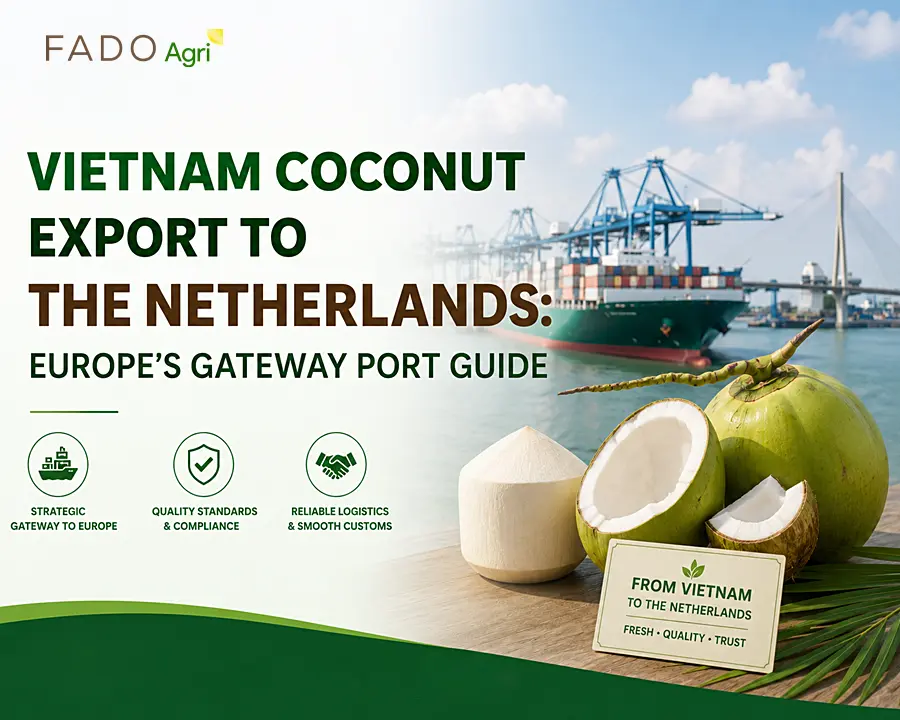
Why Rotterdam Is the Primary Entry Port for Vietnamese Coconuts Into Europe
Rotterdam dominates EU coconut import logistics for three structural reasons: deep-water berth capacity, cold storage infrastructure, and its direct rail and road connections to every major European city within 24 hours. Fresh coconut is a time-sensitive product, and port dwell time directly affects shelf life. Rotterdam’s Port of Rotterdam Authority operates Europe’s most extensive reefer plug network at its container terminals — Maasvlakte 1 and 2 — which is essential for chilled coconut shipments arriving from Southeast Asia.
Vietnamese coconut exports to Europe travel predominantly via transhipment routes through Singapore or Port Klang (Malaysia), arriving at Rotterdam in 22 to 28 days depending on the carrier and season. Direct services with fewer port calls are available on select carriers but typically add cost. In our experience, buyers at major Dutch importers tend to prefer services with Singapore or Tanjung Pelepas transhipment because of schedule reliability and fewer handling events — both factors that protect cold chain integrity for fresh product.
Rotterdam also hosts the headquarters of several major tropical produce importers and commodity trading houses, making it a commercial concentration point — not just a logistics one. If you are a Dutch importer negotiating annual supply contracts with Vietnamese exporters, proximity to Rotterdam’s customs infrastructure, inspection facilities, and cold warehousing gives you operational advantages that other European ports cannot match.
EU Food Safety Requirements for Fresh Coconut Entering at Rotterdam
Fresh coconuts arriving at Rotterdam are subject to EU Regulation (EU) 2017/625 on official controls, and the Netherlands Food and Consumer Product Safety Authority (NVWA) is the competent authority handling phytosanitary and food safety inspections at port. Every consignment of fresh coconut from Vietnam must be accompanied by a phytosanitary certificate issued by Vietnam’s Plant Protection Department (MARD) and must declare freedom from regulated pests — particularly coconut cadang-cadang viroid and lethal yellowing.
Rotterdam’s Border Inspection Post (BIP) at Maasvlakte handles documentary checks on every incoming plant product consignment. Physical inspection rates for fresh coconut from Vietnam vary by risk categorization but can range from 1% to 10% of consignments depending on Vietnam’s standing in the EU’s country-specific risk register. If Vietnam has recorded zero non-compliances in recent periods, inspection frequency typically decreases — which is one reason maintaining consistent phytosanitary compliance is commercially valuable, not just regulatory box-ticking.
For processed coconut products — desiccated coconut, coconut milk powder, coir fiber — the applicable rules shift to food safety regulations under Regulation (EC) 178/2002. Desiccated coconut, in particular, is subject to maximum residue level (MRL) checks for pesticides under EU Regulation (EC) 396/2005. Non-compliant shipments are either re-dispatched, destroyed, or held pending testing, all at the importer’s cost. Working with exporters who carry HACCP and GLOBALG.A.P certifications — as required by serious procurement teams — directly reduces the probability of these outcomes. For a detailed view of compliance documentation requirements, see our guide on HACCP and FDA compliance for Vietnam coconut exports.
EVFTA Tariff Benefits for Vietnamese Coconut Exporters Shipping to the Netherlands
The EU-Vietnam Free Trade Agreement (EVFTA), in force since August 2020, substantially reduces tariff costs for Vietnamese coconut products entering the Netherlands and the broader EU. The preferential rates apply at the point of EU customs entry — Rotterdam in most cases — and are triggered by a valid EUR.1 movement certificate or an origin declaration issued by a registered Vietnamese exporter.
| Product Category | MFN Tariff (Standard) | EVFTA Preferential Tariff (2025–2026) |
|---|---|---|
| Fresh Coconuts (HS 0801.11 / 0801.19) | 3.2% | 0% (eliminated upon entry into force) |
| Desiccated Coconut (HS 0801.11 processed) | 3.2% | 0% |
| Coconut Oil, Crude (HS 1513.11) | 3.8% | 0% (phased, [to be confirmed for 2026]) |
| Coir Fiber Products (HS 5305) | 0% | 0% |
| Coconut Shell Charcoal (HS 4402) | 0% | 0% |
The practical implication is significant: a Dutch importer buying fresh coconuts from Vietnam at FOB Vietnam prices benefits from zero EU import duty at Rotterdam, while the same product sourced from a non-EVFTA country carries a 3.2% tariff load on the CIF value. Over a full year’s supply contract — particularly on 500+ container-scale volumes — this tariff differential is commercially material. Vietnamese exporters who are registered EVFTA origin declarants give their Dutch buyers an immediate cost advantage over competitors sourcing from outside the agreement. For Vietnamese exporters seeking the full picture of export documentation requirements, this article on Vietnam coconut export requirements covers the complete process.
How Vietnamese Coconut Competes Against Dominican Republic and Sri Lanka in the EU Market
Vietnam, the Dominican Republic, and Sri Lanka are the three dominant fresh and processed coconut suppliers to the EU. Each has a distinct competitive profile, and Dutch importers increasingly make supplier decisions based on consistency, certification depth, and logistics reliability — not price alone.
| Factor | Vietnam | Dominican Republic | Sri Lanka |
|---|---|---|---|
| EVFTA / Preferential EU Access | Yes — 0% import duty | Yes — CARIFORUM EPA | GSP+ (partial benefit) |
| Transit Time to Rotterdam | 22–28 days | 14–18 days | 18–24 days |
| Fresh Coconut Supply Volume | Very high (Ben Tre, Tien Giang regions) | Moderate | Moderate to high |
| Processing Capability (Desiccated / Value-Add) | Strong — full by-product range | Limited processing | Strong |
| GLOBALG.A.P / HACCP Certification | Available from leading exporters | Varies widely | Widely available |
| OEM / Private Label Service | Yes — full OEM capability | Limited | Available from some suppliers |
| FOB Price Competitiveness | Competitive | Moderate | Competitive |
The Dominican Republic’s geographic proximity gives it a transit time advantage for time-sensitive fresh coconut. However, Vietnam compensates through superior processing depth — particularly for desiccated coconut, coir fiber, and coconut shell charcoal — and stronger OEM/private label capabilities that appeal to Dutch importers supplying branded retail. In our experience, buyers sourcing for both fresh and processed coconut under one supply relationship increasingly favor Vietnam because of its ability to handle the full product range from a single certified origin.
Dutch Distribution Channels and Who Buys Vietnamese Coconut in the Netherlands
Dutch coconut buyers operate across four main distribution channels, each with different product and certification requirements. The first is mainstream retail — major Dutch supermarket chains typically source tropical produce through specialized importers or category distributors who aggregate supply from multiple origins. Fresh coconuts on Dutch supermarket shelves are often Vietnamese product re-packed under private label or retailer brand.
The second channel is ethnic retail and wholesale, concentrated around cities including Amsterdam, Rotterdam, The Hague, and Utrecht. This segment has strong demand for specific coconut cuts — young drinking coconuts in particular — and is often more flexible on labeling format but expects consistent freshness and competitive per-unit pricing. Vietnamese young coconuts with Conical Peeling, Easy Open, or Bald cuts have particularly strong positioning in this channel.
The third channel is food service — restaurants, catering companies, and hotel chains serving Southeast Asian, South Asian, and pan-Asian cuisine. This segment prioritizes product consistency and supply reliability over price optimization and often works with mid-size importers who specialize in Asian ingredients. The fourth channel is ingredient wholesale for Dutch and Belgian food manufacturers purchasing desiccated coconut, coconut milk, and coconut oil as raw materials. This segment requires the most rigorous certification documentation — typically FSSC 22000 or BRC alongside HACCP — and runs on formal supply contracts with quality audit rights.
We do not disclose specific partner or client names, but Fado Agri’s export reach covers multiple segments across the EU market through established distributor relationships. If you are a Dutch importer evaluating supply from Vietnam, understanding which channel you serve helps determine the right product specification and certification package from your Vietnamese supplier.
Cold Chain and Labeling Requirements for the Dutch Market
Fresh coconuts shipped to the Netherlands require cold chain integrity maintained from post-harvest cooling in Vietnam through to Rotterdam unloading. The standard for young green coconuts is storage and transport at 10°C to 13°C — below this range risks chilling injury; above it accelerates spoilage. Reefer containers set at 12°C with controlled atmosphere settings are the industry standard for Vietnam-Rotterdam routes.
At Rotterdam’s cold warehouses, product typically moves into temperature-controlled distribution facilities within 24 to 48 hours of customs clearance, though delays can occur during high-volume periods. Dutch importers specify minimum remaining shelf life on arrival — typically 14 to 21 days for fresh coconut — which makes accurate harvest-to-loading timing critical. Fado Agri coordinates harvest scheduling in Ben Tre and Tien Giang to align with vessel departure windows, protecting cold chain integrity and shelf life guarantees for EU buyers.
Labeling requirements for the Dutch and broader EU market are governed by EU Regulation 1169/2011 on food information to consumers. All consumer-packaged coconut products must carry: product name, country of origin (Vietnam), net weight, best-before date, storage conditions, and importer EU address. Language requirements for Dutch retail label text include Dutch as the primary language, though bilingual labeling is accepted by major retailers. For bulk wholesale supply — pallets or master cartons — labeling requirements are less prescriptive but must still include origin and lot traceability markings to support recall procedures under EU food law.
Certifications Required for the Netherlands and EU Market Entry
Certification requirements for Dutch buyers follow a tiered logic based on product type and sales channel. At the baseline, all fresh coconut exports from Vietnam to the EU require a valid phytosanitary certificate and compliance with MRL limits under EU pesticide regulations. For access to mainstream retail or food manufacturing supply chains, buyers additionally require GLOBALG.A.P at farm level and HACCP at processing level as minimum standards.
Many Dutch retail procurement teams also request ISO 22000, BRC, or FSSC 22000 audit certification from their suppliers. Fado Agri holds FDA and GLOBALG.A.P certifications and operates HACCP-certified processing facilities, meeting the documentation requirements of the Netherlands’ major procurement channels. For the complete breakdown of which certifications apply at which export stage, see our HACCP and FDA compliance guide.
Frequently Asked Questions
What is the transit time from Vietnam to Rotterdam for coconut shipments?
Standard transit time from Vietnamese ports (Ho Chi Minh City / Cat Lai) to Rotterdam via transhipment at Singapore or Port Klang is 22 to 28 days depending on the carrier and specific service route. Some premium services with fewer port calls may offer shorter schedules, typically 20 to 24 days, at a higher freight rate.
Does EVFTA apply to all types of Vietnamese coconut products?
EVFTA covers fresh coconuts, desiccated coconut, coconut oil, and coconut by-products including coir fiber and shell charcoal. The key requirement for claiming preferential tariffs at Rotterdam is a valid EUR.1 movement certificate or origin declaration from a registered Vietnamese exporter, confirming Vietnamese origin under EVFTA rules of origin criteria.
What is the role of NVWA in Dutch coconut import inspections?
The Netherlands Food and Consumer Product Safety Authority (NVWA) is the competent authority for phytosanitary and food safety controls at Rotterdam’s Border Inspection Post. NVWA conducts documentary checks on all consignments and physical inspections at a frequency determined by Vietnam’s EU risk category. Non-compliant shipments are subject to re-dispatch, destruction, or hold pending investigation.
What cold temperature is required for shipping fresh coconuts to the Netherlands?
Young green coconuts for the Dutch market are transported in reefer containers set at 10°C to 13°C — typically 12°C as the industry standard. Lower temperatures cause chilling injury and browning; higher temperatures accelerate microbial spoilage. Cold chain integrity must be maintained continuously from post-harvest cooling in Vietnam through to Dutch distribution facilities.
Can Vietnamese coconut exporters offer private label packaging for Dutch supermarkets?
Yes. OEM and private label services — including custom cut types, packaging format, and Dutch-language label printing — are available from certified Vietnamese exporters including Fado Agri. Dutch retail buyers typically specify packaging dimensions, label language, and branding requirements in advance, and production samples are shared for approval before full production runs.
How do I verify that a Vietnamese coconut supplier meets EU food safety standards?
Request copies of the supplier’s current GLOBALG.A.P farm certification, HACCP processing certification, and any additional third-party audit reports such as BRC or FSSC 22000. Cross-check certificate validity through the relevant certification body’s online registry. Additionally, request export records showing successful clearance through EU Border Inspection Posts, which demonstrates established EU compliance history.
What labeling language is required for coconut products sold in Dutch retail?
Dutch is required as the primary language for consumer-facing labels sold in the Netherlands under EU Regulation 1169/2011. Bilingual Dutch-English labeling is accepted by most Dutch retailers. Required label elements include product name, country of origin, net weight, best-before date, storage instructions, and EU importer address. Bulk wholesale cartons require origin marking and lot traceability codes at minimum.
Is Rotterdam the only EU port option for importing Vietnamese coconuts?
Rotterdam is the dominant entry port, but Vietnamese coconut shipments can also enter the EU through Antwerp (Belgium), Hamburg (Germany), or Felixstowe (UK, post-Brexit separate customs territory). Rotterdam is preferred by most Dutch importers and pan-European distributors because of its infrastructure, inspection speed, cold storage capacity, and road/rail connections across Europe. For buyers specifically serving the Dutch domestic market, Rotterdam’s geographic position adds further logistical efficiency.
Connect with Fado Agri for Your Netherlands and EU Coconut Supply
Sourcing Vietnamese coconut for the Netherlands market involves navigating phytosanitary compliance, EVFTA origin documentation, Rotterdam inspection procedures, and Dutch retail labeling — all before the product reaches your customer. Fado Agri has been managing certified coconut exports from Ben Tre and Tien Giang since 2016, with established logistics to Rotterdam and documentation aligned with EU food safety requirements. Whether you need fresh young coconuts in specific cut formats, desiccated coconut for food manufacturing, or a full private label supply arrangement, contact us to discuss your volume requirements and product specifications. You can also explore our broader EU and Middle East export market context at Vietnam agricultural exports to EU 2026 and our UAE market guide for a comparative market perspective.