
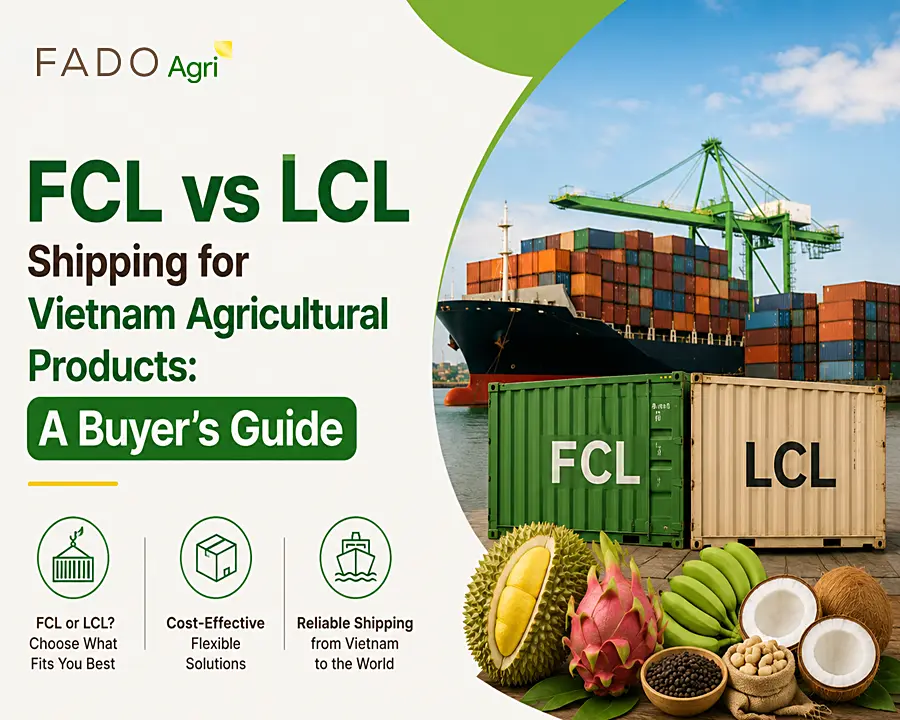
FCL or LCL? The Shipping Decision That Affects Your Produce Before It Leaves Vietnam
Choosing between FCL (Full Container Load) and LCL (Less than Container Load) is one of the most consequential decisions an agricultural importer makes — and most buyers only discover they chose wrong after a shipment arrives damaged or over-budget. For fresh and processed agricultural products from Vietnam, this choice is not just a logistics preference; it directly affects product temperature, transit time, contamination risk, and total landed cost. This guide breaks down the decision framework so you can choose the right option for your cargo type, volume, and destination market.
What Is FCL and What Is LCL? Definitions in an Agricultural Context
FCL means your cargo exclusively occupies one or more shipping containers, while LCL means your cargo shares container space with goods from other shippers. In general freight, both options are straightforward. In agricultural exports — especially fresh or perishable produce — the difference carries far greater consequences than just price per cubic meter.
How FCL works for agricultural shipments
With FCL, the exporter or buyer books an entire container, typically a 20ft, 40ft, or 40ft High Cube (HC) unit, and fills it with a single product or compatible product mix. The container is sealed at origin and opened at destination, meaning no third-party cargo contacts your produce at any point. For fresh fruit exporters like Fado Agri, FCL — specifically reefer FCL — is the standard format for markets including the UAE, China, Japan, and South Korea, where cargo integrity and cold chain continuity are non-negotiable.
How LCL works for agricultural shipments
With LCL, your cargo is consolidated at a Container Freight Station (CFS) with goods from other exporters, transported together in a shared container, then deconsolidated at the destination CFS before reaching your warehouse. The cost advantage is real for small volumes — you only pay for the cubic meters you use. However, consolidation introduces handling touchpoints, temperature exposure windows, and cross-contamination risk that make it unsuitable for many fresh agricultural products.
FCL vs LCL: Side-by-Side Comparison for Agricultural Buyers
The table below compares FCL and LCL across the criteria that matter most when shipping fresh or processed agricultural products from Vietnam.
| Criteria | FCL | LCL |
|---|---|---|
| Volume threshold | Typically 15+ CBM to break even | Best for 1–14 CBM shipments |
| Cost structure | Fixed container rate regardless of fill | Pay per CBM + CFS handling charges |
| Cold chain integrity | High — sealed reefer, no breaks | Low to moderate — CFS exposure risk |
| Transit time | Faster — direct port-to-port | Slower — CFS consolidation adds 3–7 days |
| Cross-contamination risk | None — single exporter cargo | Present — shared space with other goods |
| Minimum order quantity | Higher MOQ required (~500–1,000 cartons for fresh fruit) | Lower MOQ — suitable for trial orders |
| Customs clearance | Single Bill of Lading, faster clearance | Grouped B/L, potential delays at CFS |
| Best for | Fresh fruit, reefer cargo, large volume | Processed/shelf-stable agri products, samples, new importers |
| Flexibility | Less flexible — fixed container bookings | More flexible — book smaller volumes weekly |
Container Types Used in Vietnamese Agricultural Export
Not all containers are equal for agricultural cargo. The choice of container type determines whether your product arrives at optimal quality or compromised condition. Below is a practical reference for buyers sourcing from Vietnam.
| Container Type | External Size | Usable Capacity | Best Agricultural Use | Reefer Available? |
|---|---|---|---|---|
| 20ft Standard Dry | 20ft × 8ft × 8.5ft | ~25–28 CBM | Desiccated coconut, coconut shell charcoal, dried products | No |
| 40ft Standard Dry | 40ft × 8ft × 8.5ft | ~55–58 CBM | Coir fiber, coconut husk, packaged shelf-stable goods | No |
| 40ft High Cube (HC) | 40ft × 8ft × 9.5ft | ~65–68 CBM | High-volume dry agri products, bulky packaging | No |
| 20ft Reefer | 20ft × 8ft × 8.5ft | ~22–25 CBM | Fresh fruit trial orders — dragon fruit, lime, banana | Yes |
| 40ft HC Reefer | 40ft × 8ft × 9.5ft | ~60–65 CBM | Fresh coconut, dragon fruit, watermelon — full commercial orders | Yes |
In our experience, the 40ft HC reefer is the workhorse of Vietnam’s fresh fruit export industry. For fresh coconut shipments to markets like the UAE, China, or Malaysia, the 40ft HC reefer allows sufficient volume to achieve commercial viability while maintaining the 2–4°C cold chain required for export-grade coconuts.
When FCL Makes More Sense for Agricultural Products
FCL is the right choice when cargo perishability, volume, or regulatory requirements make an unbroken cold chain non-negotiable. For fresh tropical fruit exported from Vietnam, these conditions apply in the majority of commercial shipments.
Perishability is the primary driver
Fresh coconuts, dragon fruit, seedless limes, and Cavendish bananas have shelf lives measured in days or weeks — not months. Every extra handling touchpoint in LCL consolidation adds hours of temperature exposure. A CFS in Ho Chi Minh City operating in ambient conditions can raise carton temperatures by several degrees, accelerating ripening and microbial activity. When you are shipping fresh produce to Japan, South Korea, or the EU under strict phytosanitary compliance requirements, this risk alone justifies FCL.
Volume thresholds where FCL becomes cost-competitive
LCL rates from Vietnam typically range from USD 35–80 per CBM depending on the route and season [source: to be confirmed], plus CFS handling, documentation fees, and destination deconsolidation charges. Once your shipment reaches approximately 12–15 CBM, the total LCL cost often approaches or exceeds the FCL rate for a 20ft container. For buyers ordering 500 cartons of fresh coconut or more, FCL is almost always the more cost-efficient option per unit.
Regulatory and certification considerations
FDA-registered shipments, GLOBALG.A.P certified produce, and phytosanitary certificate requirements are tied to specific container and cargo identifiers. FCL simplifies traceability along the traceable supply chain because a single container number maps directly to a single exporter, single product batch, and single phytosanitary certificate. LCL consolidation complicates this linkage. Fado Agri holds FDA, GLOBALG.A.P, and HACCP certifications — and all fresh produce shipments are coordinated as FCL reefer to preserve the integrity of these certifications across the documentation chain.
When LCL Makes Sense for Agricultural Buyers
LCL is a legitimate and cost-effective option in specific scenarios — primarily for processed or shelf-stable agricultural products, trial orders, or buyers whose import volumes do not yet justify a full container.
Shelf-stable and processed products
Products like desiccated coconut, coconut shell charcoal, coconut coir fiber, and coconut husk carry no perishability risk. They require no refrigeration and tolerate the additional handling involved in LCL consolidation without quality degradation. For a new buyer testing a 5 CBM order of desiccated coconut before committing to a full 20ft container, LCL is the sensible entry point.
Trial orders and market entry
New importers entering a market often need to test product reception before committing to large-volume FCL orders. LCL allows you to ship a representative sample volume — say, 3–5 CBM of processed coconut products — to validate quality and market demand before scaling up. This is particularly relevant for buyers in the USA, Australia, or EU markets who are sourcing from Vietnam for the first time and want to manage their commercial risk. For guidance on the import documentation involved at this stage, see our Vietnam fruit export documents checklist.
Consolidation risk for fresh produce
If you are considering LCL for fresh fruit — particularly products requiring 2–8°C storage — you need to account for a realistic risk: your cargo will sit at the CFS alongside goods that may not require refrigeration, and the consolidation process may not maintain your required temperature continuously. LCL reefer consolidation exists, but availability is limited on many Vietnam routes, and the additional handling still introduces risk windows. In our experience, fresh produce LCL is only viable for very short routes where total transit time from origin CFS to destination warehouse stays under 10–12 days. For longer-haul routes like Vietnam to the USA or EU, fresh produce should always move as FCL reefer.
Main Vietnamese Export Ports for Agricultural Products
Vietnam’s agricultural export infrastructure is anchored by two primary port systems serving the southern growing regions where most tropical fruit originates.
Ho Chi Minh City (Cat Lai Port)
Cat Lai is Vietnam’s busiest container port and handles the majority of agricultural exports from the Mekong Delta region, including Ben Tre and Tien Giang provinces — the source of Vietnam’s premium coconut supply. Cat Lai offers extensive reefer plug infrastructure, regular sailing schedules to all major markets, and established CFS networks for LCL cargo. Most Fado Agri FCL shipments depart from this port cluster. Sailing frequencies to the UAE, China, and Southeast Asian markets are strong, with multiple weekly services from major carriers.
Cai Mep International Terminal
Cai Mep, approximately 80km from Ho Chi Minh City, is Vietnam’s deep-water port capable of handling the largest container vessels (ultra-large container vessels, ULCVs). Cai Mep is increasingly used for direct services to the USA, Europe, and Australia without transshipment at Singapore or Port Klang. For buyers in these markets, Cai Mep-origin shipments can reduce total transit time by 3–5 days compared to feeder-then-mainline routing via Cat Lai. This transit time advantage is meaningful for fresh produce FCL shipments. For detailed cold chain considerations along these routes, see our guide to cold chain shipping for Vietnam fruit.
MOQ and Lead Time: Practical Numbers for the FCL vs LCL Decision
The MOQ that typically triggers a switch from LCL to FCL depends on product type and packaging, but a practical rule for fresh fruit from Vietnam is approximately 15 CBM or 500–800 cartons. Below this volume, LCL is cost-competitive for dry goods; above it, FCL almost always wins on total landed cost per unit when you include CFS and handling fees.
Lead time differences between FCL and LCL
On the same sailing route, FCL consistently offers faster effective lead times than LCL. FCL cargo moves directly from the farm or packing facility to the port, into the container, and onto the vessel with a standard 3–5 day pre-stuffing window. LCL cargo must reach the CFS, await consolidation with other shippers’ cargo, and then move to the vessel — adding 3–7 days before the vessel even departs. At the destination, LCL deconsolidation adds a further 2–5 days before your cargo clears the CFS. For fresh fruit with a 14–21 day total shelf life, this difference can determine whether your product arrives in prime condition or already entering early-stage ripening.
Frequently Asked Questions
What is the minimum volume where FCL becomes cheaper than LCL from Vietnam?
As a general benchmark, FCL typically becomes cost-competitive with LCL at approximately 12–15 CBM for a 20ft container, when you account for all LCL fees including CFS handling, destination deconsolidation, and documentation. For a 40ft container, the break-even volume is higher — around 25–30 CBM. These thresholds vary by route and carrier [source: to be confirmed].
Can fresh fruit like coconuts or dragon fruit be shipped LCL?
Technically yes, but in practice it is not recommended for commercial volumes or long-haul routes. LCL consolidation exposes fresh produce to temperature breaks and additional handling that accelerates quality deterioration. For short regional routes under 10 days, reefer LCL may be viable for small volumes. For routes to the UAE, China, Japan, or further, FCL reefer is strongly preferred.
What container size is best for fresh coconut export from Vietnam?
The 40ft High Cube reefer is the standard format for commercial fresh coconut exports from Vietnam. It provides approximately 60–65 CBM of usable chilled space and accommodates the typical pallet or bulk loading configurations used in Ben Tre and Tien Giang packing facilities. A 20ft reefer is suitable for trial shipments or smaller-volume buyers entering a new market.
What ports in Vietnam handle reefer agricultural exports?
Cat Lai Port (Ho Chi Minh City) and Cai Mep International Terminal are the primary ports for reefer agricultural exports from southern Vietnam. Cat Lai offers higher sailing frequency to regional markets; Cai Mep provides direct deep-water services to the USA, Europe, and Australia. Both have established reefer plug infrastructure for FCL shipments.
Does LCL work for processed coconut products like desiccated coconut or coir fiber?
Yes. Processed and shelf-stable coconut by-products including desiccated coconut, coir fiber, coconut shell charcoal, and coconut husk are well-suited to LCL for smaller orders. They require no refrigeration and tolerate consolidation handling without quality impact. LCL is a practical entry point for new buyers testing these products before committing to full container volumes.
How much faster is FCL than LCL on the Vietnam-to-UAE route?
Ocean transit time on the Vietnam-to-UAE route is typically 14–18 days for both FCL and LCL. The meaningful difference is in pre-departure and post-arrival handling: FCL avoids CFS consolidation (saving 3–7 days) and avoids destination deconsolidation (saving 2–5 days). The total effective lead time advantage of FCL over LCL on this route can be 5–12 days — significant for fresh produce.
What is phytosanitary compliance and how does it relate to FCL vs LCL?
Phytosanitary certificates are issued per consignment and verify that agricultural products meet the plant health requirements of the importing country. With FCL, the certificate maps cleanly to a single container, exporter, and product batch. LCL consolidation can complicate this linkage, as multiple exporters’ cargo shares a container — potentially creating documentation complexity at customs. FCL simplifies phytosanitary compliance management for both exporter and importer.
What MOQ does Fado Agri require for fresh tropical fruit export?
MOQ depends on the specific product and destination market. Generally, fresh fruit exports from Fado Agri are structured around FCL reefer shipments, which requires sufficient volume to justify a full container booking. For buyers not yet at FCL volume, processed coconut by-products can be arranged in smaller LCL quantities. Contact our team directly to discuss the right format for your import scale and target market.
Choosing the Right Shipping Format Starts With Your Product, Not the Price List
The FCL vs LCL decision for Vietnamese agricultural products is ultimately driven by three variables: what you are shipping, how much you are shipping, and where it needs to arrive. For fresh fruit and reefer cargo, FCL protects cold chain integrity and reduces risk in ways that almost always justify the higher minimum volume. For processed or shelf-stable agricultural products and trial-volume orders, LCL offers a practical, cost-efficient entry point.
If you are evaluating a sourcing program from Vietnam — whether fresh coconut in multiple cut formats, tropical fruit, or processed coconut by-products — Fado Agri can advise on the optimal container format, port of loading, and lead time expectation for your specific destination market. With 500+ containers shipped annually across 10+ certified markets, our logistics team has navigated the FCL-LCL decision across virtually every route and product type we handle. Reach out to discuss what makes sense for your next shipment.