

Why Importers Are Turning to Vietnam for Both Fresh and Processed Jackfruit
Vietnam has quietly become one of the most reliable origins for jackfruit export, offering not just fresh whole fruit for Asian grocery channels but a sophisticated range of processed formats — chips, dried slices, canned young jackfruit, and freeze-dried product — serving Western health food and plant-based protein buyers. If you are sourcing jackfruit for retail, foodservice, or food manufacturing, understanding both supply chains from a single origin can simplify your procurement significantly. This article covers everything from variety selection and seasonal availability to certification requirements and how Vietnam compares against competing origins.
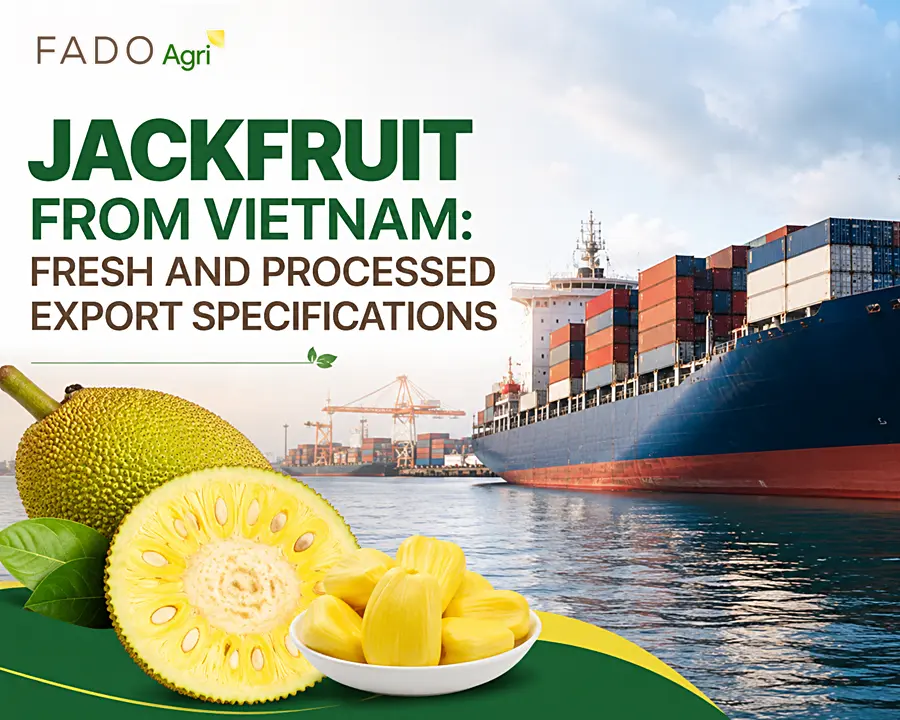
Jackfruit Varieties Vietnam Exports: Soft-Flesh vs Firm-Flesh
Vietnamese jackfruit is broadly split into two commercial categories that serve very different end markets: soft-flesh (múi mềm) and firm-flesh (múi ráo) types.
Soft-Flesh Jackfruit (Múi Mềm)
Soft-flesh varieties are highly aromatic, sweet, and commonly consumed fresh in domestic and nearby Asian export markets. The flesh is tender with a high moisture content, which makes it less suitable for long cold-chain transit but ideal for same-region distribution to China, Malaysia, and parts of the Middle East via air freight or fast reefer service. These varieties ripen quickly and require careful post-harvest handling.
Firm-Flesh Jackfruit (Múi Ráo)
Firm-flesh types — particularly the Thai-influenced and local hybrid cultivars grown in the Mekong Delta — have a firmer, crunchier texture that holds up far better during sea freight and mechanical processing. They are the preferred raw material for chip manufacturing, freeze-drying operations, and canning of young jackfruit. Firm-flesh fruit also has a longer shelf life at ambient holding temperatures, which matters significantly for export logistics. For buyers targeting the EU, USA, or Australian market, firm-flesh jackfruit is typically the appropriate specification.
Key Jackfruit-Producing Provinces in Vietnam
Vietnam’s jackfruit production is concentrated primarily in the southern and central highland regions, with each zone carrying slightly different variety profiles and seasonal windows.
The Mekong Delta provinces — including Tien Giang, Dong Thap, and Vinh Long — are the dominant commercial growing areas, benefiting from fertile alluvial soil and established cold chain infrastructure. These provinces supply the bulk of both fresh export fruit and raw material for processing factories. The Central Highlands provinces of Dak Lak and Lam Dong contribute to supply, particularly during off-season periods for the southern zones. Binh Duong and Dong Nai in the Southeast region also maintain significant jackfruit orchards, with close proximity to Ho Chi Minh City’s processing facilities and port access.
Fresh Jackfruit Export: Season, Packaging, and Transit
Fresh jackfruit from Vietnam is available year-round, but peak harvest season runs from approximately March through July, with a secondary season between September and November depending on region and variety.
Packaging Standards for Fresh Export
Whole fresh jackfruit for export is typically packed in wooden crates or corrugated carton boxes, with each fruit individually netted or wrapped to prevent surface bruising during transit. Standard commercial weight per fruit ranges from 5 kg to 20 kg, and carton sizes are normally configured to match pallet dimensions for 40-foot reefer containers. Foam padding and ventilation slots are critical — jackfruit produces ethylene during ripening, and without adequate airflow, premature softening accelerates rapidly inside sealed containers.
Cold Chain Requirements
Fresh jackfruit requires careful temperature management throughout the supply chain. Mature-green fruit destined for distant markets should be held and transported at 13°C to 15°C — lower temperatures can cause chilling injury, while higher temperatures accelerate ripening and reduce transit viability. For sea freight to markets like China, Japan, or South Korea, transit times of 7 to 21 days are typical; maintaining cold chain integrity from farm gate through port loading is non-negotiable for arrival quality. In our experience, pre-cooling the fruit within 4 to 6 hours of harvest is the single most effective measure for extending market shelf life. You can read more about how traceable supply chain protocols apply across Vietnamese tropical fruit categories in our article on from farm to global shelf.
Processed Jackfruit Formats: The Western Health Food Opportunity
Processed jackfruit represents a separate and rapidly growing commercial opportunity, particularly in markets where fresh whole jackfruit has limited consumer familiarity but demand for plant-based ingredients and tropical snacks is rising.
| Format | Shelf Life | Packaging | Target Market | Certification Needed |
|---|---|---|---|---|
| Fresh Whole Jackfruit | 14–21 days (reefer) | Wooden crate / carton, netted | China, Japan, UAE, Malaysia | Phytosanitary, GLOBALG.A.P |
| Jackfruit Chips (fried) | 6–12 months | Nitrogen-flushed pouches, bulk carton | USA, EU, Australia, Middle East | FDA, HACCP, Halal |
| Dried Jackfruit Slices | 9–12 months | Vacuum-sealed pouches, bulk bags | USA, EU, South Korea, Japan | FDA, HACCP, Organic (if applicable) |
| Freeze-Dried Jackfruit | 18–24 months | Aluminum foil pouches, drums | USA, EU, Australia, premium retail | FDA, HACCP, Organic (if applicable) |
| Canned Young Jackfruit in Brine | 24–36 months | Tin cans (400g–3kg), bulk retort pouches | USA, EU, UK, Australia | FDA, HACCP, BRC, Halal |
| Young Jackfruit in Water / Syrup (retort) | 24 months | Glass jar, retort pouch, tin can | EU, USA, specialty retail | FDA, HACCP, BRC |
Young Jackfruit and the Plant-Based Protein Market
Young (unripe) jackfruit has emerged as a significant ingredient in the global plant-based food sector, primarily because its fibrous texture closely mimics pulled pork or shredded chicken when cooked, making it a natural candidate for meat-alternative products. Market research from multiple industry analysts indicates the plant-based food category has sustained double-digit growth globally through 2024–2025 [source: to be confirmed], and young jackfruit in brine or water is now a standard listing in major EU and US natural food retailers. Vietnam’s processing sector has scaled rapidly to meet this demand, with a number of Mekong Delta factories holding BRC and HACCP certification specifically targeting Western food manufacturers and private-label buyers. If you are a food manufacturer seeking a versatile, clean-label plant-based ingredient at scale, young jackfruit from Vietnam warrants serious evaluation.
Certifications Required for Jackfruit Export from Vietnam
Export certifications depend heavily on the destination market and product format, but a baseline set of compliance documents applies across all channels.
For fresh jackfruit, a phytosanitary certificate issued by Vietnam’s Plant Protection Department (MARD) is mandatory for all export shipments. Markets including China, Japan, South Korea, and the EU each maintain specific pest and pesticide residue requirements that orchards and packing houses must satisfy to remain on approved-supplier lists. GLOBALG.A.P farm certification is increasingly required by major retail importers in Europe, Japan, and Australia. For processed formats — chips, dried, canned, freeze-dried — FDA registration is the threshold requirement for the US market, while HACCP and ISO 22000 cover food safety management across most other destinations. Halal certification is important for Middle Eastern buyers and is now routinely requested by Malaysian and Indonesian importers as well. Organic certification (USDA NOP or EU Organic) commands a significant price premium for dried and freeze-dried formats and is worth discussing with your factory partner if volumes justify it.
Which Markets Buy Vietnamese Jackfruit?
Vietnamese jackfruit exports flow to two broadly distinct buyer profiles with different product and logistics requirements.
Asian markets — China, Japan, South Korea, Malaysia, and the UAE — are the primary buyers of fresh whole jackfruit, typically sourcing through FOB Vietnam arrangements with reefer container service. China is by far the largest volume destination for fresh jackfruit from Vietnam, with border trade through Lang Son and official port shipments both contributing to total flow [source: to be confirmed]. For processed jackfruit, the USA, EU member states, the UK, and Australia represent the most commercially significant channels, driven by health food retail growth, plant-based product development, and strong diaspora demand. The Middle East is an active buyer of both fresh fruit and jackfruit chips, with UAE and Saudi Arabia in particular showing growing import volumes for tropical snack products. For context on how Vietnamese tropical fruits generally perform in international trade, see our article on Vietnam watermelon export.
Vietnam vs Thailand vs Bangladesh: Sourcing Comparison
Vietnam, Thailand, and Bangladesh are the three most commercially significant jackfruit export origins globally, but they serve different buyer profiles and market segments.
| Factor | Vietnam | Thailand | Bangladesh |
|---|---|---|---|
| Annual Production | High [source: to be confirmed] | High | Very high (world’s largest producer) [source: FAO] |
| Primary Export Format | Fresh + Processed | Fresh + Processed (established) | Primarily domestic / limited formal export |
| Processing Infrastructure | Strong and growing | Very strong, mature | Developing |
| Certifications Available | FDA, HACCP, GLOBALG.A.P, Halal | FDA, HACCP, GLOBALG.A.P, Halal, BRC | Limited, mostly domestic compliance |
| Price Competitiveness (FOB) | Competitive | Higher than Vietnam | Lower, but limited certified export supply |
| Young Jackfruit for Plant-Based | Rapidly scaling | Well-established supplier | Not commercially available at export scale |
| Sea Freight Access | Excellent (HCMC, Cai Mep) | Excellent (Laem Chabang) | Limited direct service |
| OEM / Private Label | Available | Available | Very limited |
Thailand has a more mature jackfruit processing export sector, but Vietnam offers competitive FOB pricing with rapidly improving quality standardization, particularly for processed formats. Bangladesh produces enormous volumes domestically but lacks the certified export infrastructure to serve Western retail or manufacturing buyers at meaningful scale as of 2025–2026. For buyers seeking dual sourcing of fresh and processed product from a single, certified origin with OEM capability, Vietnam represents a strong practical choice.
MOQ and Pricing Guidance for Fresh and Processed Jackfruit
Pricing for jackfruit export from Vietnam varies by product format, certifications, packaging specification, and seasonal supply conditions — the following should be treated as directional guidance only.
For fresh whole jackfruit, typical commercial export is structured as full 40-foot reefer container loads, with volume-based pricing on FOB Vietnam terms. Processed formats such as jackfruit chips and dried slices can often be sourced at lower MOQs — typically starting from 1 to 5 metric tons for bulk orders depending on factory minimums — with private-label or OEM orders requiring higher commitment to justify line setup and packaging procurement. Freeze-dried jackfruit commands the highest price point due to energy-intensive processing, while canned young jackfruit in brine tends to offer the most accessible entry-level pricing for food manufacturers. For verified pricing and current seasonal availability, direct inquiry to a certified Vietnamese exporter is the most reliable approach. Fado Agri can facilitate sourcing consultation and supplier introductions — contact details are at the end of this article.
Frequently Asked Questions
What are the main jackfruit varieties exported from Vietnam?
Vietnam exports two primary commercial categories: soft-flesh (múi mềm) varieties suited for fresh consumption in nearby Asian markets, and firm-flesh (múi ráo) types used for processing and longer-distance fresh export. Firm-flesh cultivars — including Thai-influenced hybrids grown in the Mekong Delta — are preferred for chips, freeze-drying, and canning due to their structural integrity during processing.
Which Vietnamese provinces produce the most jackfruit for export?
The Mekong Delta provinces — particularly Tien Giang, Dong Thap, and Vinh Long — are the leading commercial production zones. The Central Highlands (Dak Lak, Lam Dong) and Southeast region (Binh Duong, Dong Nai) also contribute, providing supply continuity across different seasonal windows throughout the year.
What certifications does fresh jackfruit need for export to the EU or USA?
Fresh jackfruit requires a phytosanitary certificate for all markets. For the EU, GLOBALG.A.P farm certification and Maximum Residue Level (MRL) compliance are typically required by retail importers. For the USA, FDA facility registration and compliance with FSMA import requirements apply. Processed formats additionally require HACCP, and BRC is increasingly expected for EU food manufacturing customers.
Is young jackfruit in brine the same product as fresh jackfruit?
No — young (unripe) jackfruit in brine is a distinct processed product, harvested before the fruit matures and sweetens. It is the primary ingredient used in plant-based meat alternatives due to its fibrous, shredded-meat texture when cooked. It is typically packed in cans or retort pouches and has a shelf life of 24 to 36 months, making it practical for international food manufacturing supply chains.
How does Vietnam compare to Thailand as a jackfruit source?
Thailand has a more established jackfruit processing export sector with broader BRC certification coverage, but Vietnam offers competitive FOB pricing and rapidly improving food safety compliance. For buyers seeking dual-format sourcing (fresh and processed) with OEM flexibility, Vietnam presents a strong commercial alternative. Thai pricing is generally higher than Vietnamese FOB for comparable quality specifications.
What cold chain temperature is required for fresh jackfruit during sea freight?
Mature-green fresh jackfruit should be transported at 13°C to 15°C. Temperatures below 12°C risk chilling injury, causing surface pitting and flesh discoloration on arrival. Pre-cooling within 4 to 6 hours of harvest, combined with consistent reefer management during sea transit, is essential for maintaining commercial-grade quality over 7 to 21-day voyages to Asian or Middle Eastern markets.
Can Vietnamese jackfruit suppliers handle private-label or OEM packaging for processed products?
Yes — a growing number of Vietnamese jackfruit processors offer OEM and private-label services for chips, dried slices, freeze-dried product, and canned young jackfruit. Minimum order quantities and setup costs vary by factory and format. It is advisable to verify certifications, conduct factory audits, and clarify phytosanitary compliance documentation before committing to private-label production runs at scale.
What is the best season to source fresh jackfruit from Vietnam?
The primary harvest season for Vietnamese jackfruit runs approximately from March to July, with peak volumes available from April through June. A secondary season between September and November provides additional supply windows. Because different provinces have slightly offset harvest calendars, working with a supplier that aggregates from multiple growing regions can ensure more consistent year-round supply for fresh export programs.
Sourcing Jackfruit from Vietnam: Where to Start
Vietnam’s jackfruit sector has matured significantly over the past decade, and the combination of fresh export capability and processed format diversity makes it a genuinely competitive origin for buyers across Asian grocery, health food, and plant-based protein channels. Whether you are evaluating a reefer container program for Asian supermarket distribution or seeking a certified young jackfruit in brine supplier for your plant-based product range, Vietnam can realistically meet the requirement.
Fado Agri works with certified growing regions and processing partners across the Mekong Delta and has established export infrastructure serving markets in the UAE, China, Japan, South Korea, Malaysia, Australia, and beyond. If you are researching Vietnamese tropical fruit supply chains more broadly, you may also find our guides on Vietnam watermelon export and farm-to-shelf supply chain management useful context for your sourcing evaluation. Reach out directly to discuss specifications, certifications, and current seasonal availability for jackfruit from Vietnam.