

Why VCO Sourcing Decisions Start With Extraction Method, Not Price
If you are sourcing virgin coconut oil at scale, the single most important variable is not price per metric ton — it is how the oil was extracted. Cold-pressed, wet-milled, and centrifuge-extracted VCO each produce different sensory profiles, free fatty acid levels, and shelf stability, and these differences directly affect whether your product passes import laboratory screening or satisfies cosmetic-grade specifications. Vietnam has emerged as a credible alternative origin for bulk VCO buyers who have historically defaulted to the Philippines, and understanding what separates the two supply bases is essential before you commit to a container order.
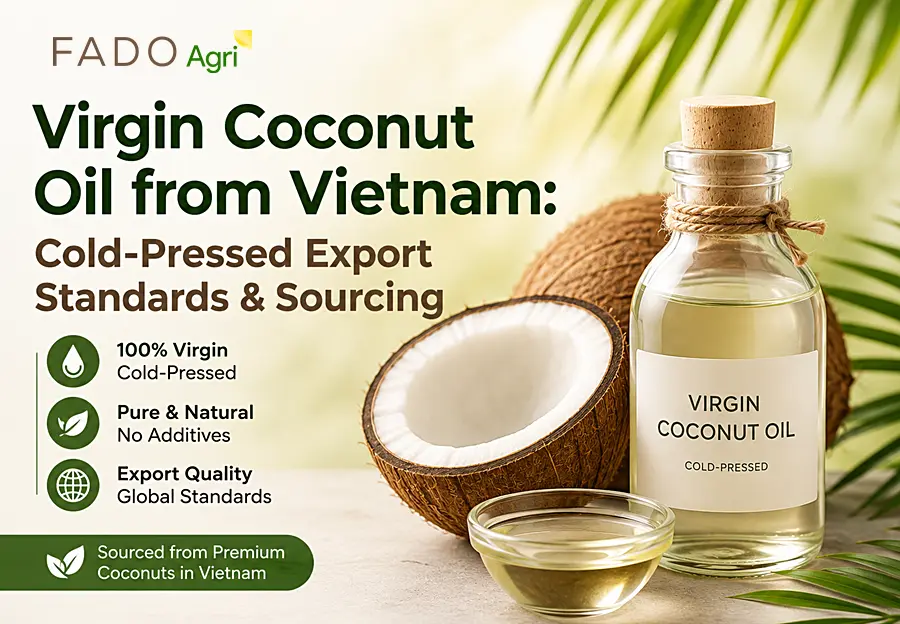
What Is VCO and How Does Cold-Pressed Differ From RBD Coconut Oil?
Virgin coconut oil is unrefined oil extracted from fresh coconut meat without exposure to high heat, solvents, or chemical bleaching agents, preserving its natural lauric acid content, aroma, and bioactive compounds. RBD coconut oil — refined, bleached, and deodorized — is processed from dried copra using industrial heat and chemical treatment, producing a neutral-tasting oil with a longer commercial shelf life but significantly fewer retained phytonutrients.
Cold-Pressed vs Other VCO Extraction Methods
Cold-pressed VCO uses mechanical pressing of fresh coconut meat at temperatures typically kept below 40–50°C, ensuring minimal thermal degradation of medium-chain fatty acids (MCFAs) and polyphenols. Centrifuge-extracted VCO starts with fresh coconut milk and uses high-speed separation to isolate oil, which typically yields a cleaner, more neutral flavor profile and very low moisture content. Wet-milled or fermentation-extracted VCO is another traditional method, though it carries higher risk of microbial contamination if not processed under strict hygiene protocols. For nutraceutical and premium food brands, cold-pressed and centrifuge methods are the accepted benchmarks; your specification sheet should define which process you require before requesting samples.
Quality Parameters That Define Premium VCO
Premium VCO is defined by a narrow set of measurable chemistry benchmarks, and any reputable supplier should provide a Certificate of Analysis (CoA) against these parameters for every batch.
| Parameter | Standard Grade | Premium Grade | Organic Grade |
|---|---|---|---|
| Free Fatty Acid (FFA) | ≤ 0.5% | ≤ 0.2% | ≤ 0.2% |
| Moisture & Volatile Matter | ≤ 0.2% | ≤ 0.1% | ≤ 0.1% |
| Peroxide Value (mEq/kg) | ≤ 10 | ≤ 3 | ≤ 3 |
| Lauric Acid Content | ≥ 45% | ≥ 48% | ≥ 48% |
| Color (Lovibond 5¼”) | < 1.5R | < 1.0R | < 1.0R |
| Saponification Value | 250–264 | 250–264 | 250–264 |
| Iodine Value | 4.1–11.0 | 4.1–8.5 | 4.1–8.5 |
Free fatty acid percentage is the most critical indicator of raw material quality and process hygiene — elevated FFA signals oxidized or improperly handled coconut meat. Peroxide value measures oxidative degradation and is especially important for cosmetic-grade buyers, since higher peroxide values accelerate rancidity in finished formulations. In our experience, batches failing on moisture are almost always traceable to inadequate fresh-fruit handling or improper storage between pressing and filling.
Food Grade vs Cosmetic Grade VCO — What Is the Difference?
The distinction between food grade and cosmetic grade VCO is less about the oil itself and more about documentation, microbial testing requirements, and the regulatory pathway in the destination market.
Food Grade VCO Requirements
Food grade VCO must comply with CODEX STAN 210 (Codex Standard for Named Vegetable Oils) and typically requires full microbiological testing, heavy metal screening, and aflatoxin testing for regulated markets like the EU, USA, and Japan. FDA registration at the processing facility is the baseline expectation for US-bound shipments. HACCP-certified production lines are the standard — for more detail on how Vietnamese coconut facilities achieve this, see our guide on HACCP and FDA compliance for Vietnam coconut exports.
Cosmetic Grade VCO Requirements
Cosmetic grade VCO is evaluated on purity, peroxide value, and absence of adulterants rather than microbiological food safety parameters, though reputable cosmetic ingredient suppliers still conduct full microbiological panels. EU cosmetic buyers require compliance with EC Regulation 1223/2009, which demands full ingredient traceability and Safety Data Sheets (SDS). The peroxide value specification for cosmetic use is typically stricter than food grade — many formulators require ≤ 3 mEq/kg to prevent product instability in creams and serums. Buyers sourcing for personal care applications should also confirm absence of mineral oil adulterants using FTIR (Fourier Transform Infrared) spectroscopy testing.
Vietnam vs Philippines VCO — Quality and Price Comparison
The Philippines holds the largest global market share in VCO export, but Vietnam’s supply base — anchored in the coconut provinces of Ben Tre and Tien Giang — offers a genuinely competitive alternative with some structural advantages that are worth examining carefully.
| Comparison Factor | Vietnam VCO | Philippines VCO |
|---|---|---|
| Primary Growing Region | Ben Tre, Tien Giang (Mekong Delta) | Quezon, Davao, Laguna |
| Coconut Variety | Tall variety (Ben Tre local) | Mixed tall and dwarf varieties |
| Typical FFA (cold-pressed) | 0.1–0.2% | 0.1–0.3% (varies by processor) |
| Organic Certification Availability | Growing — select farms certified | Widely available |
| Price Competitiveness (FOB) | Generally 5–12% lower | Benchmark pricing |
| Supply Volume Scalability | Moderate to high (growing capacity) | Very high (established infrastructure) |
| Halal Certification | Available through certified bodies | Widely available |
| EU Export Readiness | GLOBALG.A.P available, growing | Established EU pathways |
| Traceability to Farm | Traceable supply chain via cooperatives | Variable by supplier |
Vietnam’s primary advantage is price: FOB Vietnam VCO is typically priced at approximately USD [to be confirmed] per metric ton for standard cold-pressed grade, with organic-certified batches commanding a premium of 20–35% depending on certification body and season — buyers should request current offers directly. The Philippines retains an advantage in total volume availability and brand familiarity in Western markets, but buyers who require a traceable supply chain with farm-level documentation often find Vietnamese producers more transparent, partly because production is geographically concentrated in the Mekong Delta rather than dispersed across thousands of small island processors.
Certifications That Matter for VCO Export
Certification requirements for VCO differ significantly by destination market and end-use category, and missing a single document can result in customs hold or rejection at the port of entry.
Key Certifications by Market
For the US market, FDA facility registration and a phytosanitary certificate issued by Vietnam’s Plant Protection Department are the non-negotiable baseline. Organic certification recognized in the US requires USDA NOP compliance from an accredited certifying agent. For the EU, EU Organic Regulation (2018/848) certification is required for organic claims, and some buyers also require GLOBALG.A.P at the farm level — Fado Agri holds GLOBALG.A.P certification, which you can review further in our article on GLOBALG.A.P certified Vietnam coconut. Halal certification issued by a recognized body (such as JAKIM-accredited certifiers) is required for Middle East markets and is increasingly expected in Malaysia and Indonesia. Japan-bound VCO must comply with Japan’s Food Sanitation Act, with particular attention to pesticide MRL compliance on raw material inputs.
Packaging Formats for Bulk VCO Export
Packaging choice for bulk VCO affects both freight efficiency and oil integrity during transit, and the right format depends on your downstream processing setup and volume commitment.
Bulk and Retail Packaging Options
Standard bulk export formats include 200-liter HDPE or food-grade steel drums, 1,000-liter IBC (Intermediate Bulk Containers) for mid-scale importers, and flexitanks for large-volume orders where per-unit freight cost is the priority. Retail and semi-retail formats — 250ml, 500ml, and 1-liter glass or PET bottles — are available through OEM and private label arrangements. Cold chain integrity during ocean freight is important for VCO: the oil is semi-solid below approximately 24–25°C and should be stored and shipped in temperature-stable conditions to prevent repeated cycling between solid and liquid states, which accelerates peroxide development. Fado Agri handles FOB Vietnam export logistics including phytosanitary compliance documentation for all packaging formats.
MOQ, Shelf Life, and Lead Time for VCO Orders
Minimum order quantities for Vietnamese VCO suppliers typically start at 1 metric ton for non-organic cold-pressed grades, with organic-certified VCO often requiring a minimum of 3–5 metric tons due to segregated production run requirements. Properly processed and sealed VCO in drums has a shelf life of 18–24 months from the date of manufacture when stored below 30°C and away from direct light. Lead times from order confirmation to FOB Vietnam vessel loading are typically 15–25 working days for standard grades, with organic runs requiring additional scheduling lead time depending on certified raw material harvest cycles. Buyers sourcing at container scale (20-foot FCL = approximately 18–20 MT depending on packaging) should plan procurement cycles to align with Ben Tre’s peak coconut season, which runs roughly from November through April.
How to Test and Verify VCO Quality Before Bulk Purchase
Quality verification should be structured as a three-stage process: pre-shipment sample testing, container loading inspection, and destination port testing for high-value or regulated markets.
Sample Testing Protocol
Request a minimum 500ml sealed sample from the actual production batch — not a standard showroom sample — accompanied by the CoA from an accredited third-party laboratory. Key parameters to test independently include FFA, peroxide value, moisture content, fatty acid profile (to confirm lauric acid percentage and verify the oil is not adulterated with palm kernel oil, which has a similar fatty acid composition), and sensory evaluation for aroma and clarity. FTIR analysis is the fastest and most cost-effective method for adulterant detection. Engage a third-party inspection company (SGS, Bureau Veritas, or Intertek) for container-loading inspection if your order exceeds 5 metric tons or if you are entering a new supplier relationship. For complementary sourcing on other coconut-derived ingredients, see our pages on desiccated coconut from Vietnam and coconut milk OEM services.
Frequently Asked Questions
What is the difference between virgin coconut oil and extra virgin coconut oil?
Unlike olive oil, there is no internationally standardized definition that distinguishes “extra virgin” from “virgin” coconut oil — the term extra virgin coconut oil is a marketing descriptor used by some producers to indicate cold-pressed, unrefined processing from fresh coconut meat, but it carries no additional regulatory weight under CODEX standards. Buyers should focus on the measurable CoA parameters (FFA, peroxide value, moisture) rather than label terminology when evaluating quality claims.
Can I source organic-certified VCO from Vietnam?
Yes, organic-certified VCO is available from Vietnam, though supply is more limited compared to conventional VCO. Certified farms in Ben Tre province have achieved EU and USDA NOP organic certification through accredited certifying bodies, but MOQs for organic runs are typically higher and lead times are longer due to segregated handling requirements. Buyers should confirm current certified volume availability directly with the supplier at the time of inquiry.
What is the typical FOB Vietnam price range for bulk VCO?
FOB Vietnam pricing for cold-pressed VCO fluctuates based on global coconut commodity cycles, season, and certification status. Standard cold-pressed VCO is generally positioned at a 5–12% discount to Philippines FOB benchmark pricing. For current pricing with your specific volume and specification requirements, contact Fado Agri directly — published price lists are less useful than live offers given commodity price volatility in the coconut sector.
How does Halal certification work for VCO export from Vietnam?
Halal certification for VCO from Vietnam is issued by accredited domestic certifying bodies that are recognized by importing country authorities — JAKIM in Malaysia, ESMA or relevant authorities in the UAE, and SFDA in Saudi Arabia. The certification covers the production facility, raw material sourcing, and packaging line. Buyers importing into Gulf markets should confirm that the Vietnamese certifying body is recognized by their local Halal authority before signing a purchase contract.
Is Vietnamese VCO suitable for cosmetic manufacturing?
Yes, provided the supplier can demonstrate a peroxide value consistently at or below 3 mEq/kg, low FFA (≤ 0.2%), and absence of mineral oil or palm kernel oil adulterants through third-party FTIR analysis. Cosmetic buyers should also request microbial testing results (Total Plate Count, Yeast and Mold) even though VCO is inherently antimicrobial, as some destination regulatory frameworks require full microbiological panels for cosmetic raw materials.
What is the shelf life of bulk VCO and how should it be stored?
Properly processed and hermetically sealed VCO in food-grade drums or IBCs has a shelf life of 18–24 months from date of manufacture under recommended storage conditions: below 30°C, away from direct light, and in a dry environment. VCO naturally solidifies below approximately 24–25°C — this is normal and does not indicate quality degradation. Repeated melting and re-solidification cycles should be minimized, as thermal cycling can accelerate peroxide development over time.
What documentation is required to import VCO into the EU?
EU VCO imports require a Certificate of Origin, phytosanitary certificate, health certificate, Certificate of Analysis from an accredited laboratory, and — for organic-labeled products — a Certificate of Inspection (CoI) issued under EU Organic Regulation 2018/848. Importers must also ensure the product is listed in the EU’s approved goods database and that pesticide residue levels comply with EU MRL (Maximum Residue Levels) regulations. Working with an experienced export partner who understands phytosanitary compliance requirements significantly reduces documentation error risk.
Can Fado Agri provide private label or OEM VCO packaging for retail brands?
Fado Agri offers OEM and private label services for coconut-derived products. For VCO, this includes custom label design, bottle sizing from 250ml to 5-liter retail formats, and co-packing coordination. Buyers interested in building a branded VCO product line should discuss specification requirements, target markets, and volume commitments at the inquiry stage so that the correct certification pathway and packaging configuration can be structured from the outset.
Working With a Verified VCO Supplier From Vietnam
The Vietnamese VCO supply chain is maturing rapidly, and buyers who establish sourcing partnerships now — with suppliers who hold credible certifications, maintain documented CoA records, and offer transparent farm-to-vessel traceability — are well positioned as demand for functional food ingredients and clean-label cosmetic bases continues to grow through 2026 and beyond. Fado Agri operates with FDA, GLOBALG.A.P, and HACCP certifications across its coconut supply chain, and our team can support buyers from specification development through phytosanitary compliance and container loading. If you are evaluating Vietnamese VCO for the first time or looking to diversify your existing Philippines supply, reach out to discuss current availability, sample requests, and FOB pricing for your volume and specification.