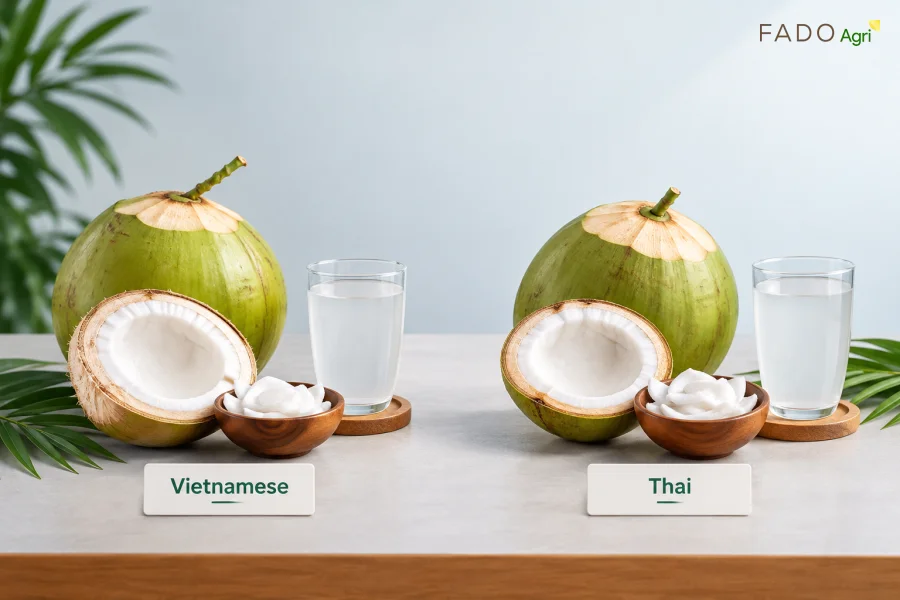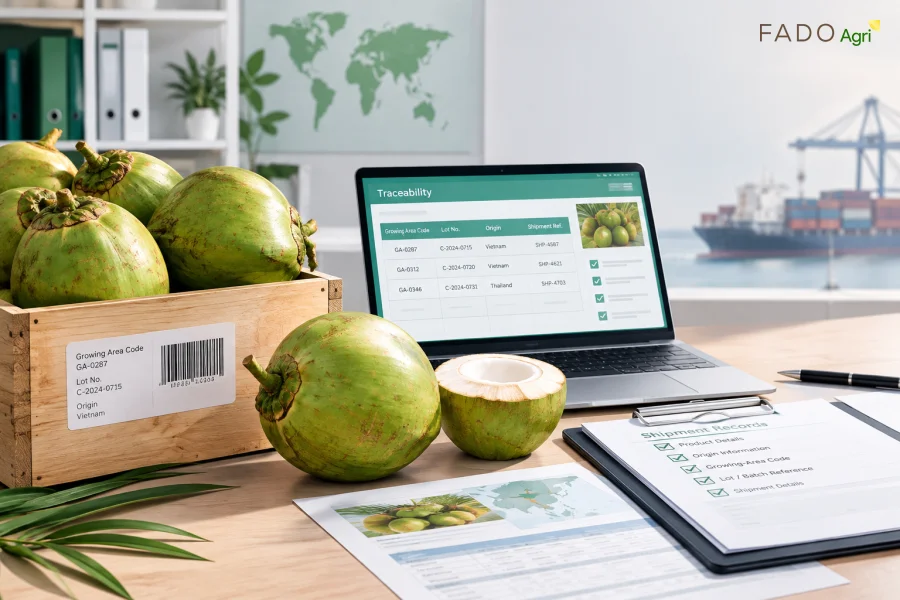

Retailers and food-service buyers want products that are convenient to handle without losing the qualities that make fresh coconut appealing. Easy-open coconuts address part of that need by making access to the fruit simpler for consumers and operators. For importers, the opportunity depends on more than the opening feature: product specifications, food safety documentation, packaging, and cold-chain arrangements all need to fit the target market.
FADOAgri includes Coconut Easy Open among its fresh coconut product formats. The exact opening design, packing configuration, shelf life, and export specifications should be confirmed for each order before procurement.

Why convenience matters in fresh coconut sourcing
Fresh coconut can serve retail, hospitality, and food-service channels, but preparation may require tools, staff time, and a suitable work area. An easy-open format is designed to reduce that effort at the point of use. Depending on the product design, it may be suitable for consumers who want ready access to coconut water and flesh, or for businesses seeking a simpler service workflow.
Convenience can also affect how a product is merchandised and used. Buyers may assess whether an easy-open coconut fits:
- Grab-and-go retail and chilled beverage displays
- Hotels, cafés, restaurants, and catering operations
- Retailers looking to offer fresh tropical products with simpler preparation
- Food-service settings where handling time and consistency matter
These are potential use cases, not a guarantee of performance in every channel. Buyers should evaluate the product format with their own customers, handling procedures, and local requirements in mind.
What “easy-open” means for buyers
“Easy-open” describes a product intended to make opening more convenient than a conventional whole coconut. The specific method can vary by supplier and product. It may involve a prepared opening area or another opening feature, but the exact construction should not be assumed from the product name alone.
Before placing an order, importers should request a technical specification sheet and confirm:
| Specification | What to confirm |
|---|---|
| Product format | Exact coconut type, preparation, and opening method |
| Size and weight | Available grades, tolerances, and unit-weight range |
| Packaging | Primary and outer packaging, pack count, and handling requirements |
| Storage | Required temperature and handling conditions throughout transit and storage |
| Shelf life | Supplier-declared shelf life and the conditions on which it depends |
| Food safety documents | Available records and certificates for the product and shipment |
| Export documents | Phytosanitary certificate and other documents required for the destination |
| Commercial terms | MOQ, seasonal availability, lead time, and FOB or CIF quotation |
The values and documents available can differ by product, shipment, and destination. Confirm them directly with the supplier and verify local import requirements before contracting.
Convenience must work with product quality
An opening feature is only valuable if the overall product meets the buyer’s requirements. Importers should assess the coconut’s appearance, freshness, consistency, and packaging alongside ease of use. If the product will be sold chilled or transported over long distances, the handling plan should also account for the agreed storage conditions and the full Cold Chain logistics route.
A practical evaluation can include:
- Reviewing a representative sample. Assess the product format and opening experience using the intended handling process. Confirm whether the sample reflects the commercial specification.
- Checking packaging integrity. Review how the product is protected during packing, loading, transport, and retail handling. Confirm any buyer-specific packaging requirements.
- Testing the intended use. Ask relevant retail or food-service teams to evaluate preparation, serving, and disposal under realistic operating conditions.
- Confirming documentation. Match product and shipment documents to the destination market’s applicable SPS/TBT standards, food-safety rules, and import procedures.
- Agreeing acceptance criteria. Set out the specification, inspection method, tolerances, and process for addressing non-conformity before shipment.
These checks help buyers assess whether the format suits their channel. They do not replace destination-market compliance checks or an agreed quality-control plan.
Cold-chain and export planning
Fresh produce exports require coordination between product preparation, packaging, loading, transport, and destination handling. A Reefer container may be part of the shipping plan, but the appropriate transport setup depends on the product specification, route, carrier requirements, and buyer’s instructions. Do not assume a temperature setting or transit limit without confirming it for the specific product and shipment.
For procurement planning, buyers should align with the supplier on:
- The product’s required storage and transport conditions
- Packing and loading procedures
- Shipment schedule and seasonal availability
- Inspection arrangements and document deadlines
- Responsibilities for monitoring and handling at each handover
FADOAgri describes its export operations as using an integrated farm-to-container cold-chain approach. Importers should request the relevant process details and shipment-specific documentation when assessing whether the arrangement fits their own logistics and compliance requirements.
Compliance and documentation for destination markets
Import rules differ by country and can change. Buyers should verify current requirements with the relevant authorities, customs broker, or qualified compliance partner for the destination market. Depending on the shipment and destination, requested documentation may include a Phytosanitary certificate and records relevant to food safety, traceability, or pesticide-residue controls, including MRLs compliance where applicable.
Do not assume that a particular certificate, audit, or approval applies to every product or shipment. If GlobalGAP status or another certification is a procurement requirement, confirm its scope, validity, covered farms or facilities, and relevance to the product being purchased. The buyer and supplier should agree which documents will be provided before shipment.
Questions to ask before placing an order
A structured inquiry helps procurement teams compare offers on a like-for-like basis. Ask the supplier to confirm:
- Which Coconut Easy Open specification is available, including the opening design
- Product grade, size range, unit weight, and packaging configuration
- Seasonal availability, MOQ, production lead time, and shipment frequency
- Storage and transport requirements, with supporting product information
- Available quality, food-safety, and export documentation for the intended market
- Inspection options, acceptance criteria, and handling of quality concerns
- Quotation basis, currency, shipment port, and applicable FOB or CIF terms
Request the current catalog and shipment-specific details rather than relying on a product name alone. If the importer has a retail label, pack format, or private-label requirement, that should be discussed early, since feasibility and lead time need supplier confirmation.
Frequently asked questions
What is an easy-open coconut?
It is a coconut product prepared with a feature intended to make opening more convenient. The design and preparation can vary, so buyers should confirm the exact format in the supplier’s specification.
Is Coconut Easy Open suitable for retail and food service?
It may suit channels where simpler preparation is useful, including some retail and food-service settings. Suitability depends on the product format, buyer requirements, handling process, and customer response.
What documents should an importer request?
Ask for the product specification and the shipment documents required for the destination market. Depending on the shipment, these may include a Phytosanitary certificate and relevant food-safety or traceability records. Confirm requirements with the appropriate destination-market authorities or compliance partner.
How should an importer confirm shelf life and storage conditions?
Request supplier documentation for the specific product and packaging, including the conditions under which any stated shelf life applies. Confirm the handling plan with the supplier and logistics partners before shipment.
What should buyers confirm about GlobalGAP?
If GlobalGAP is required, ask for evidence that confirms the certification’s validity and scope and that it covers the relevant supply chain. Do not infer certification status from a product description.
Request product specifications and an export quotation
For procurement teams assessing easy-open coconuts, the next step is to compare the confirmed product specification with destination-market requirements and channel needs. Contact FADOAgri’s export sales team to request the current catalog, product details, seasonal availability, MOQ, and an FOB or CIF quotation.
Phone/WhatsApp: (+84) 908 479 339
Email: [email protected]
Editorial verification required before publication: Confirm the current Coconut Easy Open specification, opening design, packaging options, storage conditions, shelf-life documentation, certification scope, and availability with FADOAgri. Confirm any destination-specific compliance statements and commercial terms for the intended market.