For coconut importers, a promise of “smart farming” is useful only when it can be connected to production records, lot traceability, and verifiable sustainability evidence. By 2030, IoT and AI may play a larger role in how farms collect and use information, but the tools and their results will vary by supplier. This guide explains possible applications and offers practical questions procurement teams can use to distinguish an ambition from an operational, documented system.
What smart coconut farming could mean by 2030
Smart farming uses digital information and analysis to inform agricultural decisions. In coconut production, that could involve collecting information about growing conditions or organizing farm records, but the exact tools and workflows depend on the operation. The 2030 timeframe is a forward-looking context, not proof that any particular system is already in place.
IoT gathers information; AI may help interpret it
The Internet of Things (IoT) refers broadly to connected devices that collect or transmit information. Depending on the farm and its objectives, possible examples could include devices that record selected growing conditions or digital tools used to maintain production records. These are illustrative possibilities, not confirmed features of a particular supplier’s operation.
Artificial intelligence (AI) may be used to analyze information and help identify patterns or support decisions. Its usefulness depends on the quality, relevance, and coverage of the underlying data, as well as how people apply the analysis. Calling a system “AI-enabled” does not, by itself, explain what data it uses or what decisions it supports.
A 2030 direction is not evidence of current implementation
FADOAgri’s supplied company information describes a 2030 direction that includes smart agriculture integrating IoT and AI, as well as carbon-credit solutions from Ben Tre coconut orchards. This is a stated direction; the information provided does not establish that a specific system is currently deployed, that it has produced measured results, or that carbon credits have been issued.
For procurement teams, the distinction matters. A roadmap can help explain a supplier’s intended priorities, while an operational claim needs evidence about its status, scope, and records. Buyers should ask whether an activity is planned, in a pilot phase, or operational—and what documentation supports that description.
Where digital tools may support coconut-farm management
Digital tools may be relevant when they help organize information about farm activities or support review of production conditions. Their procurement value depends on whether records are consistent, understandable, and connected to the products being purchased. The examples below describe possible applications, not confirmed FADOAgri systems or results.
From farm records to a buyer-relevant traceability trail
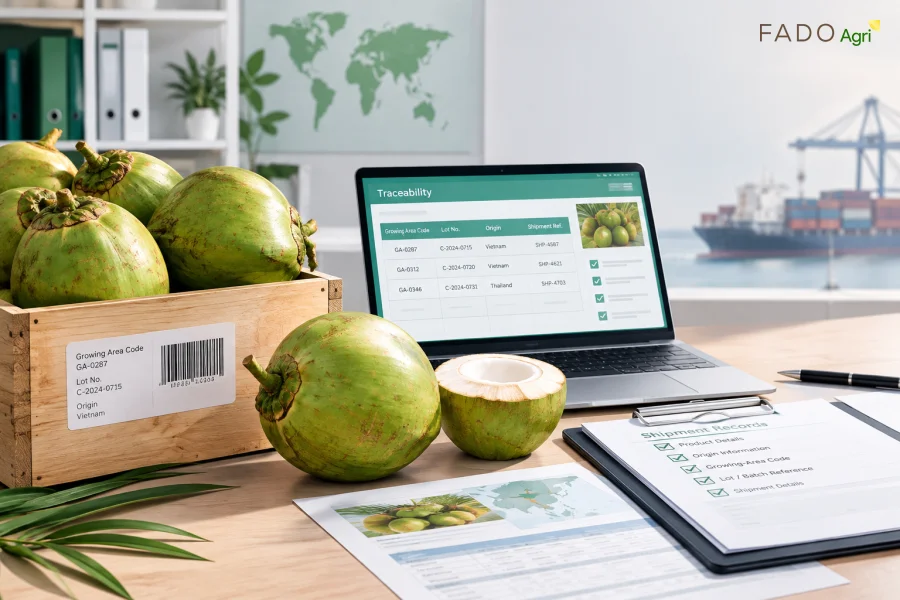
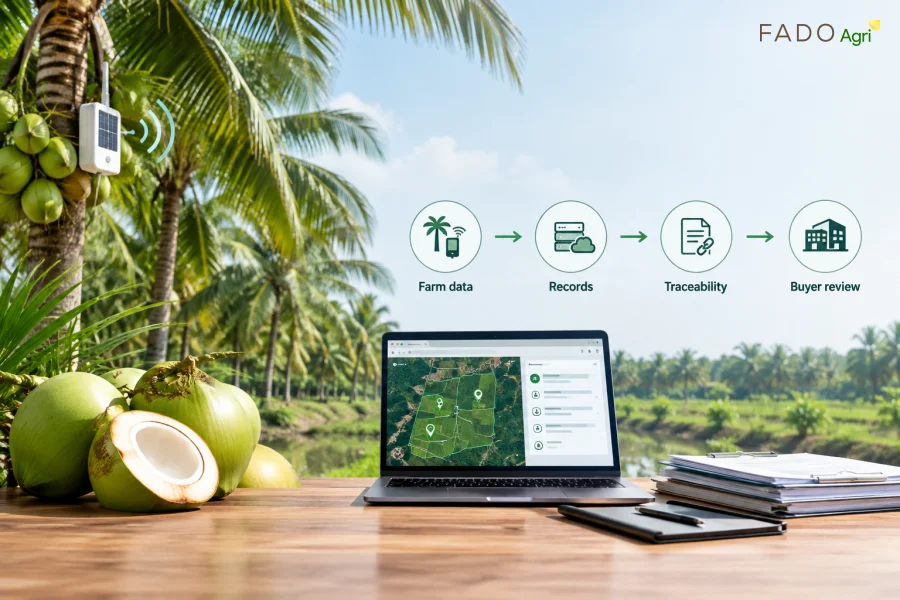
A digital recordkeeping process could, in principle, help organize information about a production area, farm activity, or harvest. If the supplier has a process for linking those records to harvested coconuts and subsequent lots, it may help buyers understand where relevant information comes from and how it relates to a shipment.
The practical question is not simply whether records are digital. Buyers should understand how a production area is identified, who enters or maintains the information, how changes are handled, and whether a harvest lot can be connected to the relevant records. The supplier should also explain what the buyer can review and what information is outside the system’s scope.
A digital record is not automatically a complete traceability system. The connection between farm records, harvest lots, packing or handling records, and shipment documentation must be described and verified for the specific supply arrangement. The level of detail available may differ across suppliers and products.
What digital monitoring can—and cannot—demonstrate
Information collected over time could support planning or review, depending on what is recorded and how it is used. For example, a farm might use records to review changes in selected growing conditions or to organize the timing of agricultural activities. Whether that is practical or useful must be assessed in the context of the actual farm and system.
Digital monitoring alone does not establish higher yields, better product quality, fewer losses, lower input use, or more reliable supply. Those are outcome claims and require relevant evidence, a defined scope, and an appropriate basis for comparison. Buyers should also distinguish the adoption of technology from the agricultural practices and results it may be intended to support.
What importers should verify before relying on smart-farming claims
A procurement decision should be based on information that is relevant to the product, production area, and shipment—not on technology terminology alone. The questions below can help importers assess whether a supplier’s description is specific enough to inform sourcing decisions. The evidence needed will depend on the intended market and the buyer’s own requirements.
| Claim or topic | Evidence to request | Procurement relevance |
|---|---|---|
| System status | A clear description of whether the activity is planned, in a pilot phase, or operational, with the period covered | Helps distinguish a roadmap from an active process |
| Coverage | The farms or production areas included, and any exclusions | Shows how broadly the claim applies to the supply |
| Data and records | A description of the information recorded, who maintains it, and how updates are handled | Helps buyers assess whether records are understandable and maintained consistently |
| Lot connection | An explanation of how relevant farm or harvest records connect to a product lot and shipment | Clarifies whether information can be traced to the goods being sourced |
| Reported results | The result being claimed, its scope and period, and the supporting records or method | Allows buyers to assess outcome claims without treating technology adoption as proof |
| Sustainability or carbon claims | The claim boundary, supporting documentation, and any applicable monitoring or verification details | Helps prevent broad environmental language from being mistaken for verified impact |
Questions on coverage, records, and lot traceability
Start with questions that define the claim: Which production areas are covered? What activities or information are included? Who is responsible for maintaining the records? Can the supplier show how a specific harvest lot is connected to the relevant production information?
Then clarify access and accountability. Ask what records can be shared with procurement partners, in what form, and whether they relate to a defined product, period, and shipment. If a supplier reports an outcome, request an explanation of how it was measured and what the claim does not cover. These questions help make a technology discussion concrete without assuming that every supplier needs the same system.
Separate digital-system evidence from export-compliance documents
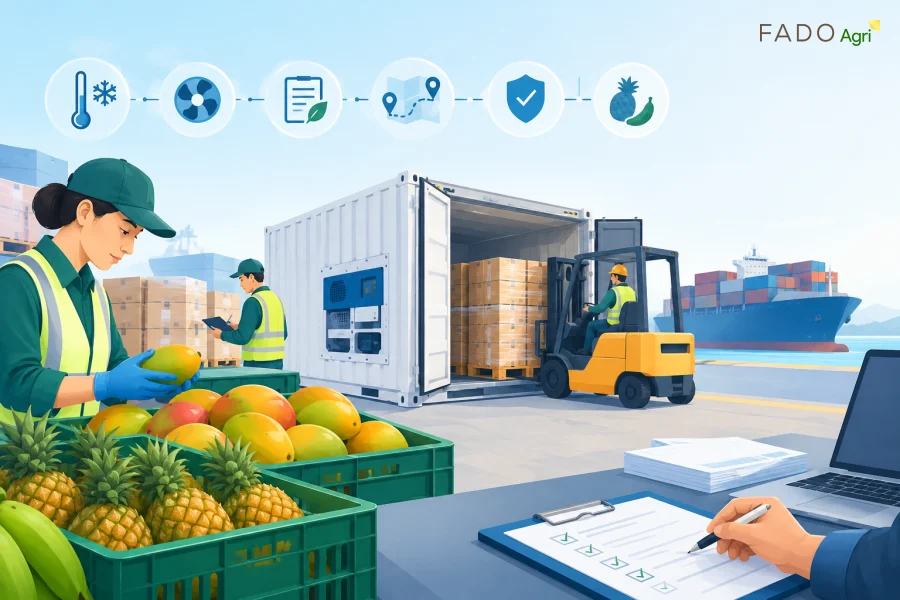
Digital records and export-compliance documents serve different purposes. Where relevant to the product and destination market, buyers may need to review evidence related to GlobalGAP, MRLs compliance, applicable SPS/TBT standards, or a Phytosanitary certificate. The applicable requirements should be confirmed for the particular market, product, and transaction.
The presence of a certificate or compliance document does not, by itself, prove that IoT or AI is used on a farm. Equally, digital records do not replace required export or phytosanitary documentation. Procurement teams should assess each type of evidence for the claim it is intended to support and confirm requirements with their own compliance teams or relevant authorities.
Connecting IoT, AI, and sustainability claims responsibly
Digital tools may provide information that helps buyers understand agricultural practices, but technology adoption is not the same as a verified environmental outcome. This distinction is especially important when a supplier discusses carbon credits or emissions-related benefits. Clear boundaries and supporting documentation are needed before such claims can inform a sourcing decision.
Technology is not the same as verified environmental impact
A digital tool is a way to collect, organize, or analyze information. An agricultural practice is an action taken on a farm. An environmental outcome is a result that needs to be assessed using an appropriate method and evidence. A carbon-credit claim has its own scope and documentation needs; it should not be inferred merely from the use of sensors, software, or AI.
FADOAgri’s stated direction includes carbon-credit solutions from Ben Tre coconut orchards. The supplied information does not establish a project’s methodology, status, measured impact, verification, or issuance of credits. Buyers considering such claims should request documentation that explains the project scope, the basis for the claim, the monitoring approach, and any verification details that apply. Do not assume that a particular methodology or verifier is involved unless the supplier provides evidence.
More broadly, sustainability statements should identify what is being claimed and what evidence supports it. Aspirations around smart agriculture or circular agriculture may indicate a direction of travel, but they should not be presented as proven benefits without substantiation. For procurement, a carefully bounded claim is more useful than a broad label that cannot be connected to a product, place, or period.
Questions buyers may ask about smart coconut farming
These brief answers address common uncertainties, while leaving supplier-specific details open for verification. The status of any system and the documents needed for a purchase depend on the supplier, product, and destination market.
Does IoT or AI automatically prove a coconut supply is sustainable?
No. IoT and AI describe tools or analytical approaches, not sustainability outcomes. Buyers need evidence about the relevant practices and any claimed results, including their scope and supporting documentation.
What should an importer request first?
Ask the supplier to describe the system’s status and coverage, then explain how relevant production or harvest records connect to the product lot. If an outcome is claimed, request the evidence and method behind that specific claim.
Does a 2030 roadmap confirm current deployment?
No. A roadmap describes an intended direction. To establish current implementation, ask whether the activity is planned, in a pilot phase, or operational, and request information that supports the stated status and scope.
Discuss coconut sourcing requirements with FADOAgri
For importers assessing coconut supply, the next step is to define the product, destination market, and documentation relevant to the sourcing decision. FADOAgri’s export sales team can discuss product specifications and sourcing requirements; buyers can identify the records or compliance information they need for their own review. Availability of particular technology records or sustainability documentation should be confirmed for the specific offer.
Contact FADOAgri to discuss your requirements:
- Email: [email protected]
- WhatsApp: +84 908 479 339
You can request product specifications and discuss the documentation relevant to your intended market and shipment.
Phone: 0908 479 339 · Website: FADOAGRI · Contact us