
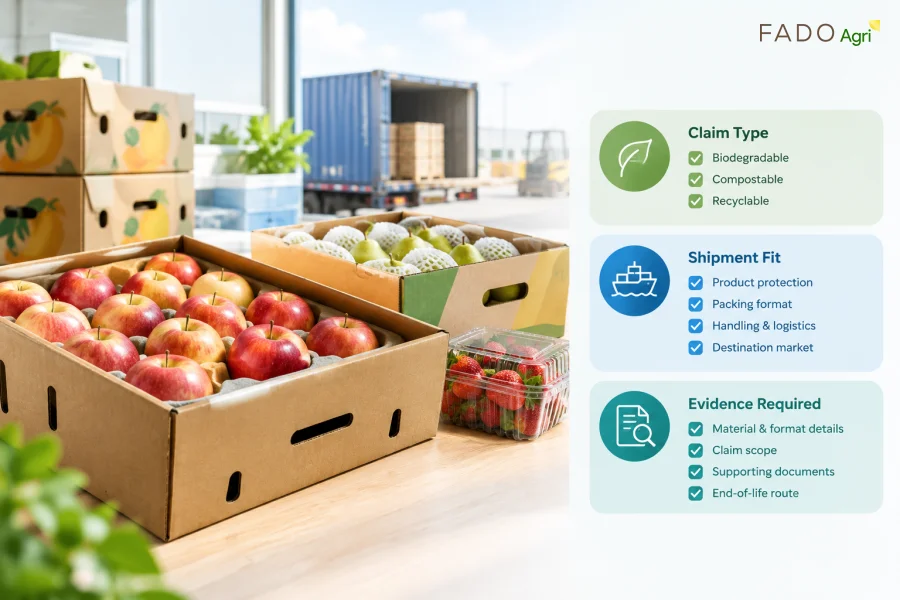
Choosing sustainable packaging for fruit export is not simply a matter of replacing one material with another. Importers and procurement teams need to consider product protection, packing and shipment requirements, destination-market expectations, and the evidence supporting each environmental claim. This guide explains the distinctions between common claims and offers a practical way to review supplier proposals without assuming that one format suits every fruit or route.
Why packaging choices matter in fruit exports
Packaging is part of the export specification, not just an environmental statement. A proposed option needs to work for the product and the agreed shipment process, while also meeting the buyer’s requirements for documentation and destination-market review. Evaluating these factors together can help prevent a broad sustainability claim from obscuring practical gaps.
For fresh fruit, buyers should begin with the product, order specifications, handling process, and intended destination. The packaging’s role may include containing or separating products and supporting handling, but the requirements depend on the specific fruit and pack format. Do not assume that a material described as eco-friendly will provide the protection or operational fit required for a particular order.
Environmental claims also need to be assessed separately from shipment suitability. A claim does not, by itself, establish that packaging is appropriate for export, accepted in a destination market, or supported by a suitable end-of-life route. Buyers should identify what is being claimed, which part of the pack it applies to, and what evidence is available.
What biodegradable, compostable, and recyclable packaging claims mean
These terms describe different properties or intended outcomes, so they should not be used interchangeably in purchasing specifications. Their meaning and relevance can depend on the specific product, the conditions involved, the evidence provided, and the destination. Ask suppliers to explain the exact claim rather than relying on a label alone.
Keep the claims distinct
“Biodegradable” generally describes material that can break down through biological processes, but the term alone does not tell a buyer the conditions, timeframe, or end result involved. Without those details, it is difficult to assess what the claim means for the packaging after use.
“Compostable” refers to packaging intended to break down through composting under particular conditions. A supplier should clarify what conditions and processing route the claim assumes, and whether those are relevant to the intended market. The word alone does not establish that a suitable facility is available where the packaging will be discarded.
“Recyclable” indicates that packaging may be capable of being collected and processed for recycling, but the claim should be considered in the context of the actual packaging format and the destination’s arrangements. Buyers should not assume that a material can be recycled in every market or through every collection system.
These are practical distinctions for procurement, not a substitute for reviewing applicable definitions or requirements in a destination market. Where a buyer intends to use a claim in customer-facing material, its wording and supporting evidence may need separate review.
Ask what evidence supports the claim
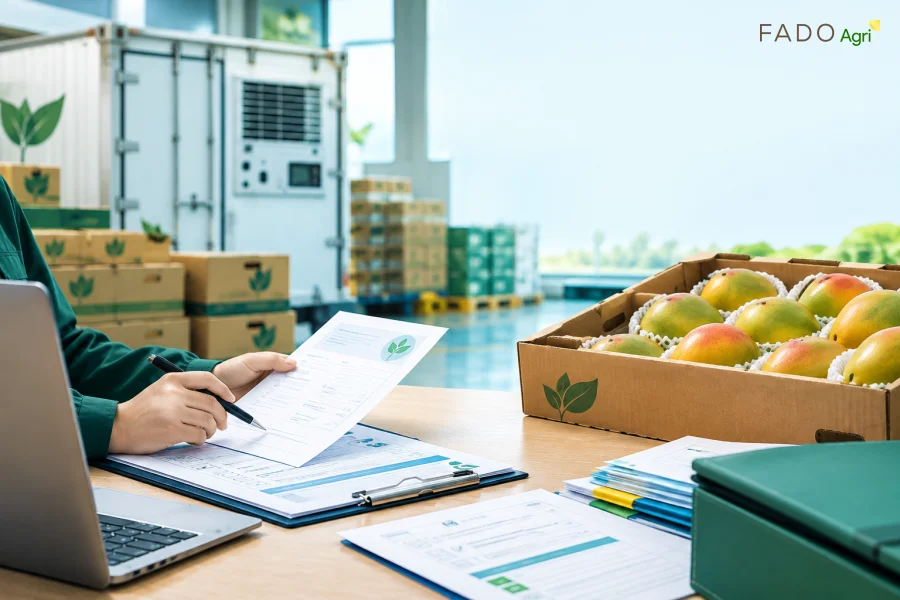
Request documentation that identifies the packaging being offered and states exactly which claim it supports. Confirm whether the evidence covers the complete pack or only a component, and whether it refers to the same format and specification as the export order. A general supplier statement or an environmental label, without context, may not answer these questions.
Packaging options buyers may encounter—and how to assess them
Suppliers may propose fiber-based, recycled-content, or bio-based packaging, among other formats. These are categories to evaluate, not automatic indicators of export suitability or environmental benefit. A useful comparison focuses on the specific pack, its intended use, and the evidence available for the buyer’s market and shipment.
| What to assess | Questions for the supplier | Why it matters |
|---|---|---|
| Material and format | What is the packaging made of, and what is the offered format? | A broad material label may not describe every component of the pack. |
| Claim scope | Which environmental claim applies, and does it cover the full pack or selected parts? | Buyers need to communicate claims accurately and avoid extending them beyond the evidence. |
| Product and handling fit | What use and handling conditions is the packaging designed for? | Requirements vary by fruit, packing arrangement, and shipment process. |
| End-of-life assumptions | What collection or processing route does the claim assume? | The intended route may not be available or relevant in the destination market. |
| Documentation | Which specifications and supporting documents apply to the offered pack? | Buyers need a basis for internal review and order-level records. |
Assess the complete packaging format rather than focusing on a single component. A pack may include several parts, and a claim applying to one part should not be presented as covering the rest unless the evidence supports that interpretation. Ask the supplier to identify each relevant component clearly.
Compare proposals against the same criteria. Without product-specific information and destination context, there is no reliable basis for ranking one broad material category above another. A packaging option that appears preferable on one criterion may require further review on operational fit, documentation, or its intended end-of-life route.
How to evaluate packaging for a fresh-fruit export shipment
A packaging change may affect packing operations and shipment handling as well as the material specification. Buyers should define acceptance criteria before approving a proposal, then review it with the suppliers and logistics partners responsible for the relevant parts of the order. This is particularly important when fruit, packing format, or destination differs between shipments.
Define product and shipment requirements first
Start with the fruit, order specification, packing format, and destination. State what the packaging needs to do within the agreed process, and identify any handling requirements that the supplier should address. Avoid relying on a generic environmental description as a substitute for those operational requirements.
Ask what information supports the supplier’s statements about product protection and handling. Do not assume a new packaging format will reduce damage, extend shelf life, or produce another shipment outcome unless relevant evidence is provided for the particular use. If a change may affect product presentation or packing arrangements, include that in the review before finalizing the order specification.
Check operational fit and supporting evidence
Confirm whether the proposed format can be used in the intended packing operation and whether its specifications are clear to the teams handling the order. Where relevant, discuss compatibility with post-harvest handling and Cold Chain logistics with the packing and logistics partners. Treat compatibility as something to assess—not a benefit that follows automatically from an environmental claim.
Keep packaging requirements distinct from other export documentation and compliance evidence. The importer should identify which destination-market requirements apply and consult the appropriate adviser or partner when necessary. This article does not establish the rules for any particular market or product.
Finally, agree how the packaging will be identified and documented for the order or lot. Consistent product descriptions and records can help the buyer and supplier confirm that the delivered packaging matches the reviewed specification. Make sure any claim used downstream remains within the scope of the supporting information.
A buyer checklist for reviewing supplier packaging proposals
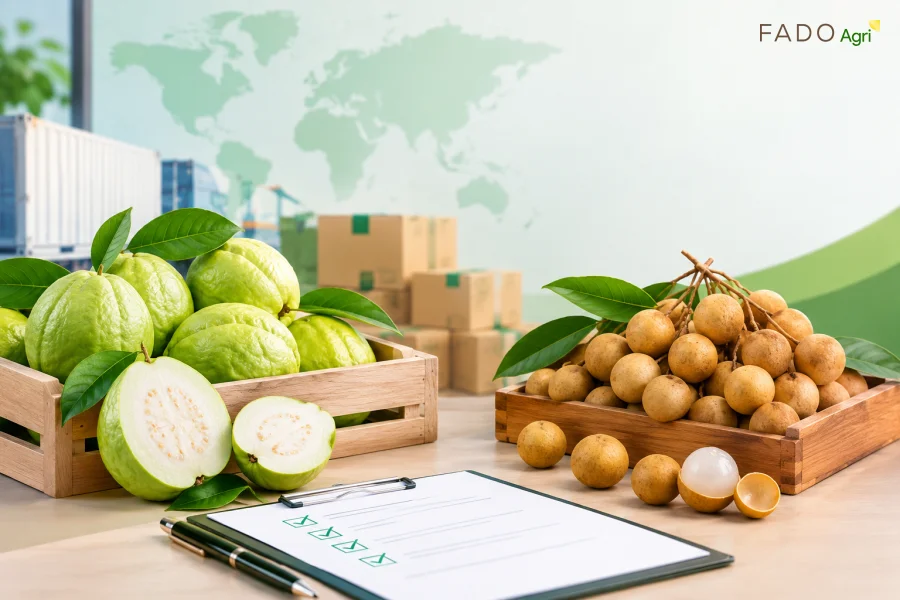
A structured request helps buyers compare proposals without relying on vague sustainability language or an unsupported single score. Adapt the questions below to the fruit, destination, packing arrangement, and procurement process. Ask suppliers to answer for the exact packaging they are offering, rather than for a general material category.
Questions to include in a packaging specification request
- What is the packaging? Request the material description, format, and identification of the pack’s components.
- What claim is being made? Ask whether the claim is biodegradable, compostable, recyclable, or another specific claim, and request its precise scope.
- What supports the claim? Request documentation that relates to the offered packaging and clarifies any conditions or assumptions.
- What is the intended end-of-life route? Ask what collection or processing route the supplier’s claim assumes, then assess whether it is relevant to the destination.
- How is it intended to be used? Request the applicable product and handling specifications, without presuming performance that has not been demonstrated.
- Will it fit the order’s operations? Discuss packing-line and shipment-handling considerations with the relevant supplier and logistics partners.
- What needs destination-specific review? Identify requirements that the importer, market adviser, or other qualified partner should assess before approval.
- How will the shipment be documented? Agree how the approved packaging format and any supported claims will be recorded for the order.
When comparing offers, use a common checklist or specification template. This makes differences in documentation, claim scope, and operational assumptions easier to see. If evidence is missing, treat the point as unresolved rather than assuming that a broad claim answers it.
Frequently asked questions
The answers below provide a starting point for procurement discussions, not a determination that any packaging is suitable for a specific fruit, shipment, or destination. Buyers should review the offered format and supporting information in context.
Does biodegradable packaging automatically mean compostable?
No. The terms are distinct, and “biodegradable” alone does not explain the conditions or outcome involved. Ask the supplier to define the exact claim and provide evidence for the packaging being offered.
Is recyclable packaging always the better export choice?
There is no universal answer based on the claim alone. Assess the packaging’s role, the shipment requirements, the destination’s relevant collection or processing arrangements, and the supplier’s supporting documentation before comparing options.
Can a claim for one packaging component be applied to the whole pack?
Not unless the supporting evidence covers the whole pack. Confirm which components and formats are included in the claim, and keep any buyer-facing wording within that scope.
What should importers request from a packaging supplier?
Request the material and format description, applicable specifications, documentation for each environmental claim, and information about the assumptions behind its end-of-life route. Also discuss how the packaging is intended to fit the product, packing operation, and shipment.
Should packaging changes be assessed alongside Cold Chain planning?
Yes, as a compatibility and handling question. Discuss the proposed format with the relevant packing and logistics partners, and request evidence for any claimed shipment outcome. Do not assume that a packaging change improves Cold Chain performance without supporting information.
Discuss packaging requirements for your next export order
A productive packaging review starts with the fruit, destination, order specification, and evidence your procurement team needs. Share those requirements with FADOAgri’s export sales team to discuss available product specifications and shipment planning. Any packaging claim or format should be confirmed for the specific order rather than assumed from a general description.
Contact FADOAgri by WhatsApp or phone at (+84) 908 479 339, or email [email protected], to discuss product information and a B2B quotation.
Phone: 0908 479 339 · Website: FADOAGRI · Contact us