Why Coir Fiber from Vietnam Is Gaining Ground in Global Supply Chains
Buyers sourcing coir fiber and coconut husk products are increasingly looking beyond traditional suppliers like Sri Lanka and India — and Vietnam is emerging as a serious alternative with scale, consistency, and competitive FOB pricing. Vietnam’s Mekong Delta, particularly Ben Tre and Tien Giang provinces, produces an estimated 1.3 billion coconuts annually [source: to be confirmed], generating a vast volume of husk and fiber as processing by-products. For horticulture companies, erosion-control engineers, and substrate manufacturers, this supply depth matters.
This article covers the full range of coir and coconut husk products that Vietnam exports, their technical specifications, key applications, and how Vietnam compares with other major origin countries. If you are evaluating a new coir supplier from Southeast Asia, the details below will help you make a structured sourcing decision.
Coir Product Types Vietnam Exports
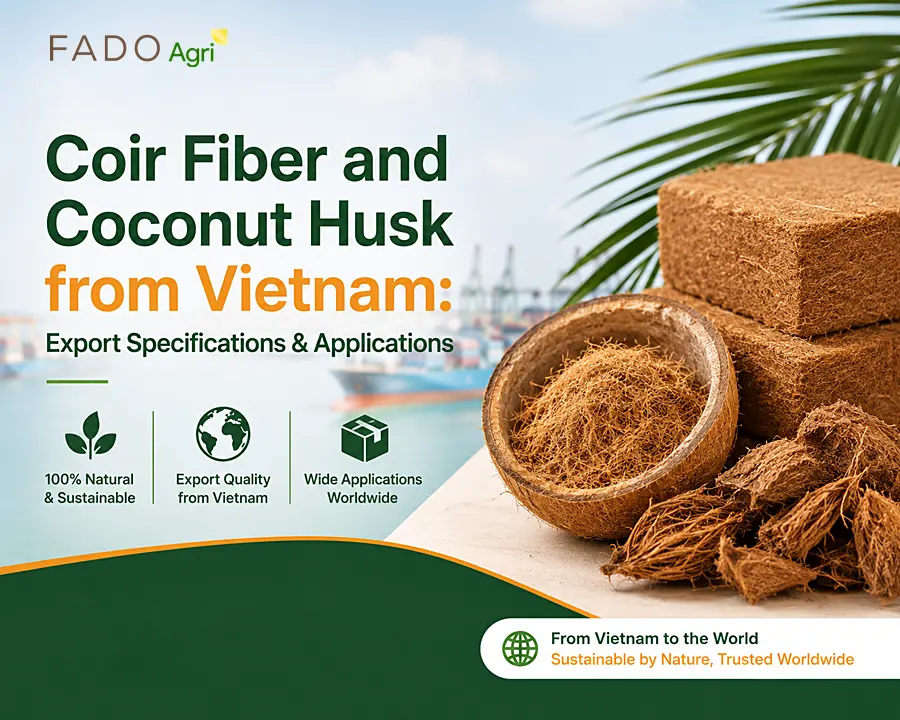
Vietnam exports at least six distinct coir and coconut husk derivative products, each suited to different industrial or agricultural end uses.
Brown Coir Fiber
Brown coir fiber is extracted from mature coconut husks after a retting process and is the most commonly traded form. It is coarser, stronger, and more durable than white fiber, making it suitable for geotextiles, erosion blankets, mattress filling, and coir rope manufacturing. The fiber length typically ranges from 100mm to 250mm depending on processing method and grade.
White Coir Fiber
White coir fiber is derived from immature green coconuts after a longer retting period, often six to ten months in water. The result is a finer, softer fiber used primarily in brush manufacturing, upholstery, and specialty horticultural mats. White fiber commands a higher price but is less commonly produced in Vietnam compared to Sri Lanka, where the traditional brackish water retting infrastructure is more established.
Coco Peat (Coir Pith)
Coco peat — also called coir pith or coir dust — is the spongy material that remains after fiber extraction from the husk. It is the fastest-growing coir export segment globally, driven by the hydroponics and controlled environment agriculture industries. Vietnam produces both raw coco peat and washed/buffered grades to meet substrate standards. Standard export specifications include: EC below 0.5 mS/cm (washed grade), pH 5.5–6.5, moisture content below 20% for compressed blocks.
Coir Rope
Coir rope is twisted or braided from brown coir fiber and used in erosion control, landscaping, packaging, and traditional applications. Vietnam exports coir rope in diameters ranging from 6mm to 50mm, with natural twisted and braided options available. It is 100% biodegradable, which is a significant advantage for temporary erosion-control installations where removal is impractical.
Coir Erosion Blankets and Geotextile Mats
Coir geotextiles — including erosion control blankets, slope stabilization mats, and woven netting — are produced by weaving or stitching coir fiber into open-mesh structures. These products are widely specified by civil engineering and land rehabilitation projects due to their UV resistance, tensile strength, and biodegradability over a 3–5 year lifespan. Vietnam’s manufacturing capacity for these products is growing, supported by the available raw fiber supply in the Mekong Delta.
Raw Coconut Husk
Unprocessed coconut husk, stripped from the shell, is exported in bulk for use in mushroom cultivation substrates, biochar feedstock, or as raw material for downstream coir processing in the importing country. It is the lowest value-per-ton product but benefits from minimal processing cost. For related by-products from the coconut shell itself, see our article on coconut shell charcoal from Vietnam.
Product Specification Table
| Product | Raw Material | Key Specification | Main Application | MOQ |
|---|---|---|---|---|
| Brown Coir Fiber | Mature coconut husk | Fiber length 100–250mm, moisture <17% | Geotextiles, rope, mattress filling | 1 x 20ft container |
| White Coir Fiber | Immature husk (retted) | Finer grade, lower tensile strength | Brushes, upholstery, specialty mats | 1 x 20ft container |
| Coco Peat (Compressed Block) | Coir pith post-fiber extraction | EC <0.5 mS/cm, pH 5.5–6.5, moisture <20% | Hydroponics, substrate growing | 500 kg (trial), 1 FCL standard |
| Coco Peat (Loose/Raw) | Coir pith, unwashed | EC 1.0–3.0 mS/cm, pH 5.8–7.0 | Soil conditioning, mulch | 1 x 20ft container |
| Coir Rope | Twisted brown coir fiber | Diameter 6–50mm, tensile strength varies by grade | Erosion control, landscaping, packaging | 500 kg |
| Coir Erosion Blanket | Woven/stitched coir fiber | Weight 400–900 g/m², open weave mesh | Slope stabilization, geotextiles | [to be confirmed] |
| Raw Coconut Husk | Whole stripped husk | Moisture <25%, no visible mold | Mushroom substrate, downstream processing | 1 x 20ft container |
Vietnam vs Sri Lanka vs India: How Do They Compare?
Sri Lanka and India have dominated global coir exports for decades, but Vietnam’s position has strengthened considerably since 2018 as Mekong Delta processing infrastructure has improved. The comparison below reflects general industry-level observations rather than claims specific to any single exporter.
| Factor | Vietnam | Sri Lanka | India (Kerala) |
|---|---|---|---|
| Annual coconut production | ~1.3B nuts [source: to be confirmed] | ~2.7B nuts [source: to be confirmed] | ~21B nuts [source: to be confirmed] |
| White fiber availability | Limited | Strong — traditional specialty | Moderate |
| Coco peat output | Growing rapidly | Established, premium pricing | Largest global volume |
| FOB price competitiveness | Competitive, lower labor cost | Premium — brand premium applies | Competitive for volume |
| Lead time to Middle East | ~18–22 days via Ho Chi Minh | ~12–15 days via Colombo | ~10–14 days via Cochin/Chennai |
| Phytosanitary compliance | MARD-issued certificates, FDA, GLOBALG.A.P | Well-established NPPO system | Well-established NPPO system |
| Supply chain traceability | Improving; regional farm partnerships | Strong cooperative networks | Variable by exporter |
In our experience, buyers who have worked exclusively with Sri Lankan or Indian coir suppliers often find Vietnam’s value proposition strongest for large-volume brown fiber, compressed coco peat blocks, and coir rope — categories where Ben Tre’s processing capacity is well developed. For specialty white fiber or highly branded coco peat, Sri Lanka retains a quality perception advantage that some end markets still value.
Coco Peat EC and pH: Why the Specifications Matter
Coco peat EC (electrical conductivity) is one of the most critical quality parameters for hydroponic and substrate buyers, and it is also the most frequently misrepresented specification in low-cost supply chains. High EC in unwashed coco peat indicates residual salt content from the coconut processing environment, which can damage root systems in sensitive crops such as tomatoes, strawberries, and cannabis.
Washed and buffered coco peat from a reliable Vietnam coir supplier should achieve EC below 0.5 mS/cm (1:1.5 v/v dilution method). pH should fall between 5.5 and 6.5 — the optimal range for most hydroponic nutrient solution uptake. Moisture content in compressed export blocks is typically kept below 20% to prevent fungal growth during shipping and storage. Always request a Certificate of Analysis (CoA) covering EC, pH, moisture, and bulk density before committing to a container order.
For context on how Vietnam’s coconut growing regions influence raw material quality, our article on why Ben Tre coconuts stand apart covers the soil and climate factors at the source.
Applications Across Industries
Hydroponics and Controlled Environment Agriculture
Compressed coco peat blocks and coir grow bags are now standard substrate inputs in commercial tomato, cucumber, and berry cultivation across the Netherlands, Australia, North America, and the Middle East. Vietnam’s growing export volume to UAE, Australia, and South Korea reflects strong demand in these markets. Coco peat’s water retention, aeration, and renewability profile make it a preferred alternative to rockwool for growers transitioning to more sustainable production systems.
Erosion Control and Slope Stabilization
Coir erosion blankets and biodegradable coir netting are specified in road construction, riverbank rehabilitation, and mine site restoration projects globally. Unlike synthetic geotextile materials, coir degrades naturally over 3–5 years — precisely the time frame in which pioneer vegetation establishes and self-sustains. The tensile strength and UV resistance of brown coir fiber make it suitable for medium-to-steep slope applications.
Horticulture and Landscaping
Coir fiber mats, coir pots, and hanging basket liners are standard horticultural inputs in the European and Australian retail garden markets. Coir pots are fully biodegradable and can be planted directly into the ground, reducing transplant shock. Vietnam’s coir processing industry supplies both OEM-manufactured and bulk material formats for these applications.
Rope, Twine, and Packaging
Traditional coir rope and twine remain significant export categories for use in agriculture (trellis support, nursery ties), fishing, and rustic-style packaging. Coir twine is also commonly used in Christmas tree and decorative retail packaging, creating a seasonal demand pattern that buyers should account for in their lead time planning.
Packaging Formats and Lead Times
Coir products are exported in several formats depending on product type and destination use. Compressed coco peat blocks (standard 5kg block expands to approximately 70–75 liters) are the most common export format, palletized and shrink-wrapped for container loading. Brown coir fiber is baled using hydraulic presses to densities of 100–150 kg/m³, significantly reducing container volume requirements. Coir rope is coiled and bundled in specific weight or length units per buyer specification.
Standard lead time from order confirmation to container loading at Ho Chi Minh City or Cat Lai Port is typically 3–5 weeks for regular production items. For custom specifications — specific EC ranges, OEM packaging, or non-standard block weights — allow 4–6 weeks. Fado Agri provides FOB Vietnam pricing with full export documentation including phytosanitary certificates, packing lists, and CoA upon request.
Certifications and Quality Standards for Coir Export
Coir and coconut husk products intended for horticultural use must meet import country phytosanitary requirements, which vary by destination. Key certifications and compliance requirements include phytosanitary certificates issued by Vietnam’s Ministry of Agriculture and Rural Development (MARD), fumigation certificates for raw husk and fiber products entering markets including Australia and the USA, and CE or relevant national standards for erosion control geotextile applications in the EU. Fado Agri holds FDA, GLOBALG.A.P, and HACCP certifications across its coconut supply chain, and full documentation support is standard for all export shipments. For a broader view of how our traceable supply chain operates from farm to container, see our supply chain overview.
FOB Vietnam Price Range
FOB Vietnam pricing for coir products varies significantly by product type, specification grade, and order volume. As of mid-2026, indicative price ranges are: compressed coco peat blocks (washed grade) at USD [to be confirmed]/MT FOB; brown coir fiber bales at USD [to be confirmed]/MT FOB; coir rope at USD [to be confirmed]/MT FOB depending on diameter and twist specification. Buyers should request formal quotations that specify moisture content, EC grade, packaging format, and loading port, as these variables significantly affect the landed cost calculation. Contact Fado Agri directly for a current quotation based on your target volume and specification.
Frequently Asked Questions
What is the difference between brown coir fiber and white coir fiber?
Brown coir fiber comes from mature coconut husks and is stronger, coarser, and more durable — it is the standard grade for geotextiles, rope, and erosion control applications. White coir fiber is extracted from immature husks after extended water retting, producing a finer and softer material used in brushes and upholstery. Vietnam produces brown fiber at scale; white fiber production is more limited compared to Sri Lanka.
What EC level should I specify for hydroponic coco peat?
For professional hydroponic use, specify EC below 0.5 mS/cm using the 1:1.5 volume dilution method. This washed grade ensures residual salts from coconut processing have been removed. Raw or unwashed coco peat may have EC values of 1.0–3.0 mS/cm or higher, which is acceptable for soil amendment but not for direct hydroponic substrate use.
Is Vietnam coir competitive with Sri Lanka or India on price?
For brown coir fiber and compressed coco peat blocks at volume, Vietnam is generally price-competitive or lower than Sri Lankan origin pricing. India offers the highest raw volume globally and competes closely on coco peat pricing. Vietnam’s advantage is increasingly in supply chain reliability, logistics from Ho Chi Minh City, and growing certifications infrastructure rather than solely on price.
What MOQ applies to coir products from Fado Agri?
Standard MOQ for most coir fiber and coco peat products is one 20-foot container. For trial orders or new buyers evaluating product quality, smaller sample quantities of 500 kg can be arranged for coco peat blocks. MOQ for coir rope and erosion blankets varies by specification — contact our team for a product-specific quotation.
Which regions in Vietnam produce coir fiber?
Ben Tre and Tien Giang provinces in the Mekong Delta are the primary coir fiber producing regions in Vietnam, accounting for the majority of national coconut husk processing output. Ben Tre alone is known as Vietnam’s coconut capital with a centuries-old cultivation tradition. Other delta provinces including Tra Vinh and Vinh Long contribute additional processing volume during peak harvest periods.
Do coir products require fumigation for export to Australia or the USA?
Yes — raw coconut husk and unprocessed coir fiber typically require heat treatment or methyl bromide fumigation to meet DAFF (Australia) and USDA APHIS (USA) biosecurity requirements. Processed products such as compressed coco peat blocks are generally lower risk but still require phytosanitary certification. Fado Agri manages full phytosanitary compliance documentation as standard for all export shipments.
What packaging formats are available for compressed coco peat blocks?
The most common export format is the 5 kg compressed block (expanding to approximately 70–75 liters when hydrated), shrink-wrapped and palletized. Other available formats include 650g mini blocks, 25 kg grow bags, and loose bulk coco peat in woven polypropylene bags. OEM packaging with buyer branding is available under Fado Agri’s private label service — minimum quantities apply.
How long does shipping take from Vietnam to the Middle East or Australia?
Transit time from Ho Chi Minh City or Cat Lai Port to UAE (Jebel Ali) is approximately 18–22 days by sea. Shipping to Australia (Sydney or Melbourne) typically takes 12–18 days depending on carrier routing. Production lead time before container loading is 3–5 weeks for standard items, so buyers should plan total lead time of 5–8 weeks from order to delivery for most destinations.
Sourcing Coir Fiber from Vietnam: Next Steps
Vietnam’s coir and coconut husk sector offers real supply depth for buyers who invest the time to identify the right processing partner and specify their quality requirements precisely. The combination of Mekong Delta raw material volumes, competitive FOB pricing, and improving phytosanitary compliance infrastructure makes it a sourcing origin worth evaluating seriously — whether you are importing for hydroponics, erosion control, or rope and geotextile manufacturing.
Fado Agri has built its coconut by-product export capability alongside its fresh coconut and tropical fruit operations since 2016, with a traceable supply chain anchored in Ben Tre and Tien Giang. If you are ready to request specifications, samples, or a formal FOB quotation for coir fiber, coco peat, or related products, reach out to our export team directly.