

Why Singapore Is the Smart Entry Point for Vietnamese Fruit into ASEAN
Singapore is not just a destination market — it is the most efficient re-export gateway for Vietnamese tropical fruit into Southeast Asia and beyond. With its world-standard cold chain infrastructure, transparent regulatory environment, and strategic position at the heart of ASEAN trade routes, Singapore allows Vietnamese exporters to reach multiple markets through a single, reliable hub. For fresh fruit logistics, that combination is difficult to match anywhere in the region.
Vietnam and Singapore share a relatively short maritime corridor — approximately 1,200 nautical miles — making sea freight transit times competitive compared to suppliers from further afield. In our experience, Vietnamese exporters who establish a Singapore distributor partnership often find it accelerates market entry into Malaysia, Indonesia, Thailand, and the Philippines simultaneously. This article covers the full picture: Singapore Food Agency requirements, logistics economics, buyer expectations, and which Vietnamese fruits are gaining the most traction in 2025–2026.
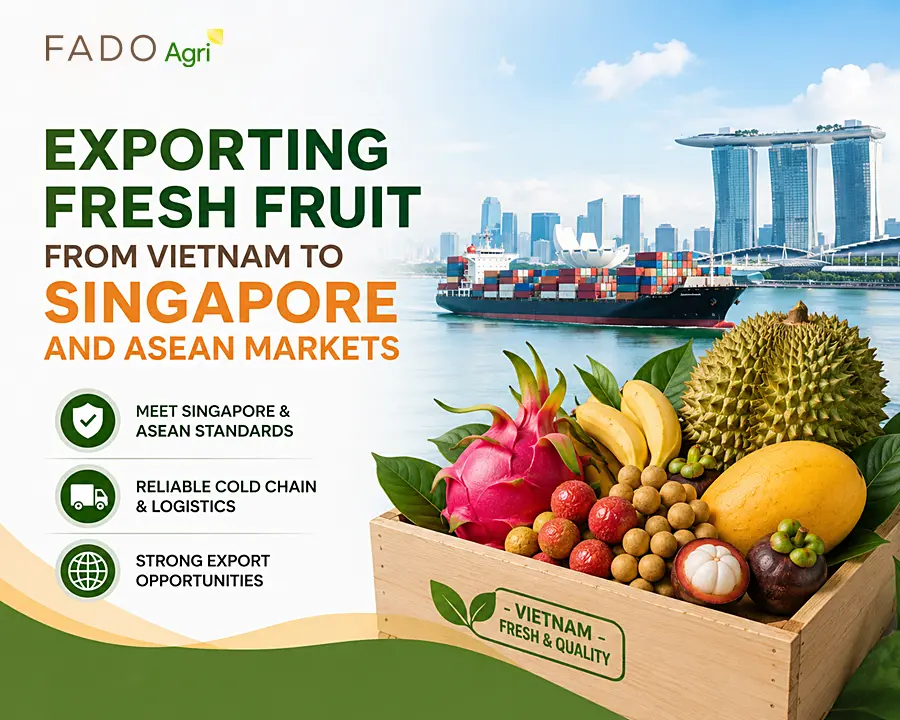
Singapore Food Agency (SFA) Requirements for Vietnamese Fresh Fruit
Any fresh fruit entering Singapore must be registered with and approved by the Singapore Food Agency (SFA), the central authority governing food safety and import compliance. Vietnam is an accredited source country for a range of fresh fruits under SFA’s import framework, but exporters must meet specific documentation and phytosanitary compliance standards before shipments are cleared at the port.
Core Documentation SFA Requires
Every fresh fruit shipment from Vietnam to Singapore must be accompanied by a phytosanitary certificate issued by Vietnam’s Plant Protection Department (PPD) under the Ministry of Agriculture and Rural Development (MARD). SFA also requires a valid import permit obtained by the Singapore importer before the goods arrive. Shipments without pre-registered permits are subject to hold or rejection, so coordination between the Vietnamese exporter and Singapore trading partner must happen well in advance of the vessel departure date.
Pesticide residue testing is a firm requirement. SFA conducts Maximum Residue Level (MRL) checks aligned with Codex Alimentarius standards, and non-compliant consignments are destroyed or re-exported at the importer’s cost. Vietnamese exporters should ensure their farms and packing facilities operate under documented GAP (Good Agricultural Practice) protocols to substantiate MRL compliance — GLOBALG.A.P certification, which Fado Agri holds, directly supports this requirement.
Certifications Singapore Buyers Expect from Vietnamese Suppliers
Beyond the regulatory baseline, commercial buyers in Singapore — including supermarket chains, hotel procurement teams, and HORECA distributors — expect suppliers to hold internationally recognized certifications. The most commonly requested are GLOBALG.A.P, HACCP, and where applicable, FDA registration for suppliers targeting the premium segment or re-exporting into markets like the USA or Australia. SFA does not mandate HACCP for fresh whole fruit, but most Singaporean importers use it as a shortlisting criterion when evaluating new suppliers.
Cold chain integrity documentation — time-temperature records from packhouse to vessel — is increasingly required by large-format retailers in Singapore. Exporters who can provide traceable supply chain documentation from farm to port are significantly more competitive than those offering produce-only without process records.
Which Vietnamese Fruits Have the Highest Demand in Singapore
Fresh coconut, red dragon fruit, seedless lime, and longan consistently rank among the highest-demand Vietnamese fruits in the Singapore market. Each occupies a distinct channel — coconuts dominate food service and convenience retail, while dragon fruit and longan are strongly represented in wet markets, Asian grocery chains, and premium supermarkets.
Fresh Coconut
Vietnamese young coconuts — particularly from Ben Tre and Tien Giang provinces — are well established in the Singapore market. The demand spans hawker stalls, bubble tea supply chains, and modern trade retail. Singapore buyers prefer coconuts with extended shelf life packaging, which is why peel-cut formats such as the conical peeling, easy open, and bald cuts are gaining ground over whole raw coconuts. Fado Agri supplies six standard fresh coconut cut formats specifically designed for different retail and food service applications. If you are evaluating fresh coconut sourcing options, our guide on Vietnamese fruit supply for Gulf markets also covers packhouse and cold chain standards applicable to Singapore-bound product.
Red Dragon Fruit
Vietnam is the world’s leading exporter of red-flesh dragon fruit [source: to be confirmed], and Singapore is an active consumption and re-export market. The fruit’s visual appeal drives strong performance in premium retail, while the red-flesh variety commands a consistent price premium over the white-flesh type. Singapore buyers generally specify fruit in the 350g–500g per piece range with consistent skin coloration and minimal bract damage.
Seedless Lime and Longan
Seedless lime from Vietnam has carved a clear niche in Singapore’s food service sector, particularly in beverage and cocktail applications where seed-free yield matters operationally. Indonesian longan — and Vietnamese longan during peak season — moves through Singapore’s Chinatown wet market ecosystem and into Malaysian and Indonesian distribution networks. Longan shelf life under ambient conditions is short, making cold chain integrity from Vietnam to Singapore a critical factor in maintaining acceptable quality at the retail counter.
Logistics Advantage: Vietnam to Singapore Shipping Time and Cost
Sea freight from Ho Chi Minh City (Cai Mep or Cat Lai terminal) to Singapore’s Tanjong Pagar or Pasir Panjang terminals typically takes 3–5 days transit time, depending on the carrier and whether the service is direct or transshipment via Port Klang. This short transit window is a meaningful competitive advantage for fresh produce compared to origin countries with longer sailing times to Singapore.
Reefer container costs from Vietnam to Singapore are influenced by global shipping rates, seasonal demand, and container availability at origin. In our experience, FOB Vietnam pricing combined with Singapore’s efficient port clearance process makes the total landed cost highly competitive relative to sourcing from more distant suppliers. CIF pricing is also available for Singapore buyers who prefer a delivered-price structure — Fado Agri provides both FOB and CIF full-service export arrangements.
Air freight is used selectively for high-value, time-sensitive products such as fresh longan during peak harvest, where the additional transport cost is offset by the price premium the product commands in the Singapore market. For volume fresh coconut and dragon fruit, sea reefer remains the economically rational mode.
Singapore as a Re-Export Gateway: ASEAN Market Reach
Singapore’s port infrastructure, bonded warehouse network, and free trade agreement coverage make it a practical re-distribution hub for Vietnamese produce entering multiple ASEAN markets simultaneously. Importers operating bonded storage in Singapore can hold produce and redirect it to multiple Southeast Asian destinations based on live market demand — a flexibility that direct bilateral export often cannot match.
| Country | Transit Days from Singapore | Key Distribution Channels | Key Vietnamese Products |
|---|---|---|---|
| Malaysia | 1–2 days (sea) / same day (truck) | Wet markets, hypermarkets, HORECA | Fresh coconut, dragon fruit, longan |
| Indonesia | 2–3 days (sea) | Modern trade, traditional markets | Dragon fruit, seedless lime, coconut |
| Philippines | 3–4 days (sea) | Supermarkets, fruit importers | Dragon fruit, watermelon, guava |
| Thailand | 2–3 days (sea) | Specialty retail, HORECA | Seedless lime, dragon fruit |
| Vietnam (reverse) | 3–5 days (sea) | N/A — origin market | N/A |
| Myanmar / Cambodia | 4–6 days (sea) | Wholesale importers, wet markets | Coconut, banana, watermelon |
The land corridor through Johor Bahru into peninsular Malaysia is particularly fast — road freight from Singapore to Kuala Lumpur takes under 5 hours under normal conditions, making same-day or next-day delivery of temperature-sensitive produce entirely feasible. Vietnamese exporters who route through a Singapore trading partner can effectively serve the Malaysian market without establishing a separate bilateral supply chain.
Vietnam vs Thailand: How Singapore Buyers Compare Their Options
Singapore buyers regularly benchmark Vietnamese and Thai suppliers against each other, particularly for coconut, tropical fruit, and citrus. The competitive picture is nuanced — Vietnam leads on price and fresh coconut volume, while Thailand holds brand recognition advantages in certain premium categories. Understanding where Vietnam is genuinely competitive helps exporters position correctly rather than competing on every dimension.
| Criteria | Vietnam | Thailand |
|---|---|---|
| Fresh coconut supply volume | High — Ben Tre/Tien Giang as dedicated belts | Moderate — smaller dedicated export volume |
| FOB price competitiveness | Generally lower for coconut and dragon fruit | Higher on average for premium tropical fruit |
| Red dragon fruit | Vietnam is dominant global exporter | Minimal Thai export volume |
| Mangosteen / durian | Emerging, smaller volumes | Established premium supplier |
| GLOBALG.A.P / HACCP availability | Available from certified exporters | Widely available |
| Traceable supply chain documentation | Available from professional exporters | Generally strong |
| Transit time to Singapore (sea) | 3–5 days | 3–5 days (comparable) |
| OEM / private label capability | Available — including custom cut formats | Available in select categories |
For Singapore buyers specifically looking for fresh young coconut at scale, Vietnam is the more reliable sourcing option. Thailand’s coconut production is largely domestic-consumption oriented, with export volumes insufficient to support large-format retail programs in Singapore at consistent pricing. Vietnamese exporters targeting the Singapore modern trade channel should position on price transparency, phytosanitary compliance documentation, and cold chain delivery records — not simply on origin marketing.
Packaging and Labeling Standards for Singapore Retail
Singapore’s retail market has clear labeling expectations governed by SFA’s Sale of Food Act and associated food labeling regulations. Pre-packed fresh produce must carry the country of origin, net weight, importer name and Singapore address, and a best-before or use-by date where applicable. For fresh whole fruit sold loose (non-pre-packed), the country of origin must be displayed at the point of sale by the retailer — exporters should confirm with their Singapore buyer how this is communicated at the shelf level.
Retail-ready packaging for Singapore supermarkets increasingly requires barcodes (EAN-13), product traceability codes, and in some cases QR codes linking to origin farm data. Premium retailers in Singapore — particularly Japanese-managed supermarkets operating there — apply the highest specification requirements, similar to the standards described in our Vietnam tropical fruit to Japan export guide. Exporters targeting mid-market channels have more flexibility, but clean, moisture-resistant packaging with bilingual (English/Chinese) labeling is standard practice for the Singapore Chinese consumer base.
How to Find a Singapore Distributor for Vietnamese Produce
The most effective route to the Singapore market for Vietnamese fresh fruit exporters is through an established importer-distributor with existing cold storage infrastructure and retail or HORECA buyer relationships. Singapore’s fresh produce import trade is concentrated among a relatively small number of specialist distributors operating out of the Pasir Panjang Wholesale Centre — the central hub for fresh produce distribution to retailers, wet markets, and food service operators across the island.
Trade exhibitions such as Food & Hotel Asia (FHA) held in Singapore provide direct access to buyers and distributors in a structured setting. Vietnam’s MARD and the Vietnam Trade Promotion Agency (VIETRADE) periodically organize national pavilions at regional trade shows that include Singapore-targeted events — participating exporters gain credibility and market visibility simultaneously. For exporters looking to position in both Singapore and broader Gulf markets, our Vietnam fruit supplier guide for Saudi Arabia covers certification stacking strategies that apply equally to multi-market programs.
Fado Agri’s regional office network — including our Malaysia-Penang office — provides proximity to the Singapore market for distributors and buyers who prefer to meet in person before committing to a supply program. Interested parties can contact us directly to discuss MOQs, product specifications, and sampling arrangements.
Frequently Asked Questions
Does Singapore require a specific import permit for Vietnamese fresh fruit?
Yes. The Singapore importer must obtain a valid SFA import permit before the shipment arrives. The permit application is submitted through Singapore’s TradeNet system and must be in place prior to vessel departure from Vietnam. Vietnamese exporters should confirm their Singapore buyer has completed this step as part of the pre-shipment coordination process.
What is the transit time for fresh fruit shipped from Ho Chi Minh City to Singapore?
Sea freight from Cai Mep or Cat Lai terminals in Ho Chi Minh City to Singapore typically takes 3–5 days, depending on the shipping line and whether the service is direct or routes via Port Klang. Air freight is available for premium or highly perishable products and reduces transit to under 24 hours, but at significantly higher cost per kilogram.
Which Vietnamese fruits are most in demand in Singapore in 2025–2026?
Fresh young coconut, red dragon fruit, seedless lime, and longan consistently show strong demand in Singapore across wet market, modern trade, and HORECA channels. Cavendish banana and watermelon also move in volume through Singapore’s wholesale distribution network. Taiwan guava from Vietnam is gaining interest in the premium segment.
Does Vietnam-Singapore fruit trade benefit from ASEAN trade agreements?
Yes. Under the ASEAN Trade in Goods Agreement (ATIGA), most fresh fruit traded between Vietnam and Singapore qualifies for zero or near-zero import tariff treatment, provided the certificate of origin (Form D) is correctly issued by Vietnam’s Ministry of Industry and Trade. This tariff advantage strengthens the price competitiveness of Vietnamese produce relative to suppliers outside ASEAN.
Can Singapore distributors re-export Vietnamese fruit to Malaysia or Indonesia?
Yes, and this is one of the primary reasons Singapore is valued as a hub market. Bonded warehouse operators in Singapore can receive, hold, and redistribute fresh produce to Malaysia (by road or sea), Indonesia, the Philippines, and other ASEAN markets. The destination country’s own import requirements — including phytosanitary certificates from the origin country — still apply to re-exported consignments.
What certifications do Singapore buyers require from Vietnamese fruit suppliers?
At minimum, Singapore buyers expect a phytosanitary certificate from Vietnam’s PPD/MARD and SFA-compliant MRL testing results. Commercially, GLOBALG.A.P and HACCP are standard requirements from supermarket buyers and large HORECA distributors. For exporters targeting the premium segment or multi-market programs including Japan and South Korea — as covered in our Vietnam coconut to South Korea guide — FDA registration adds further credibility.
How does Vietnam’s fresh coconut compare to Thai coconut in the Singapore market?
Vietnamese fresh young coconut is price-competitive and available in high export volumes, with Ben Tre and Tien Giang provinces providing consistent year-round supply. Thailand’s coconut export volumes to Singapore are comparatively limited, making Vietnam the more dependable source for large-format retail or food service programs. Vietnamese exporters can also offer a wider range of prepared cut formats than typically available from Thai suppliers.
What is the minimum order quantity (MOQ) for fresh fruit export from Vietnam to Singapore?
MOQ varies by product and exporter. For fresh coconut, one 40-foot reefer container is the standard commercial unit. For mixed fruit programs, some exporters consolidate LCL (Less than Container Load) shipments, though this increases complexity and cost. Fado Agri handles full FCL programs as standard and can discuss specific MOQ requirements with Singapore buyers directly — contact details are below.
Ready to Source Vietnamese Tropical Fruit Through Singapore?
Singapore is one of the most structured and efficient markets for establishing a fresh fruit import program from Vietnam. Whether you are a Singapore-based importer building a direct supply chain, a distributor looking to expand your ASEAN reach, or a Vietnamese exporter exploring the hub market model, the fundamentals are in your favor — short transit times, strong cold chain infrastructure, zero ASEAN tariffs, and proven demand for core Vietnamese tropical fruits.
Fado Agri has been exporting fresh fruit from Vietnam since 2016, with FDA, GLOBALG.A.P, and HACCP certifications and active programs serving buyers across 10+ certified markets. If you are evaluating Vietnam as a supply origin for your Singapore or ASEAN distribution business, we are available to discuss specifications, pricing, and logistics in detail. Reach out to our team to request a product catalogue or arrange a sample consignment.