

Vietnam ships millions of fresh coconuts every year to buyers in the Middle East, China, Japan, South Korea, Australia, and beyond and for good reason. The coconut-growing belts of Ben Tre and Tien Giang consistently produce fruit with high water content, thick flesh, and natural sweetness that meets the quality bar of supermarket chains and premium wholesale markets worldwide. If you’re exploring how to import fresh coconut from Vietnam, this guide walks you through every stage: the sourcing-to-shipment process, the documentation checklist, realistic lead times, and what drives the final landed cost.
Fado Agri has been managing coconut exports from Vietnam since 2016. With 500+ containers shipped per year and active buyers across 10+ internationally certified markets, we’ve built this process from the ground up and we share it openly, because transparency is part of how we work.
1. Why Vietnam Is the Right Source for Fresh Coconut Imports
Before getting into process mechanics, it helps to understand why Vietnam and specifically Ben Tre and Tien Giang, stands apart from other origins.
1.1. Geography and Growing Conditions
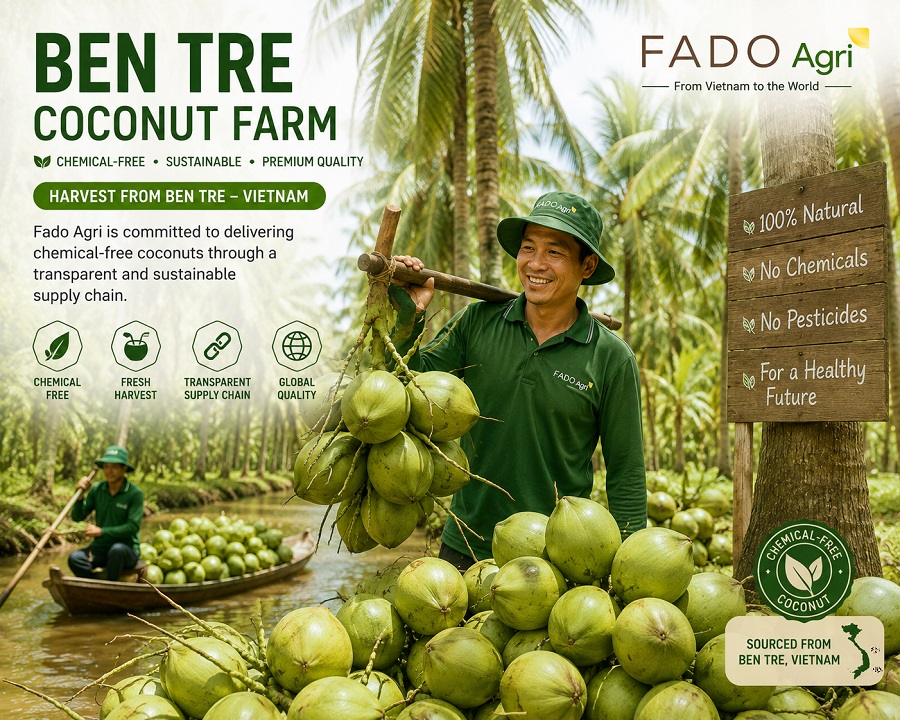
Ben Tre province sits at the mouth of the Mekong Delta, where the river’s mineral-rich freshwater meets a tropical climate with consistent rainfall and over 2,500 hours of sunlight per year. These are not incidental advantages, they directly determine the coconut’s water volume, shell strength, and shelf life during transit. Tien Giang, adjacent to Ben Tre, provides complementary growing zones that allow Fado Agri to maintain supply continuity regardless of seasonal variation in any single area.
1.2. Scale and Certification
Vietnam’s fresh coconut industry operates at industrial scale while maintaining farm-level traceability. Fado Agri sources from partner farms certified under GLOBALG.A.P standards, with full supply chain compliance to FDA (USA) and HACCP requirements. This combination, volume at scale, certification at farm level, is what makes Vietnamese coconuts viable for regulated markets that many other tropical origins cannot serve.
1.3. Six Cut Formats for Market-Specific Demand
Fresh coconuts from Fado Agri are available in six processing formats, each suited to specific retail or food service requirements:
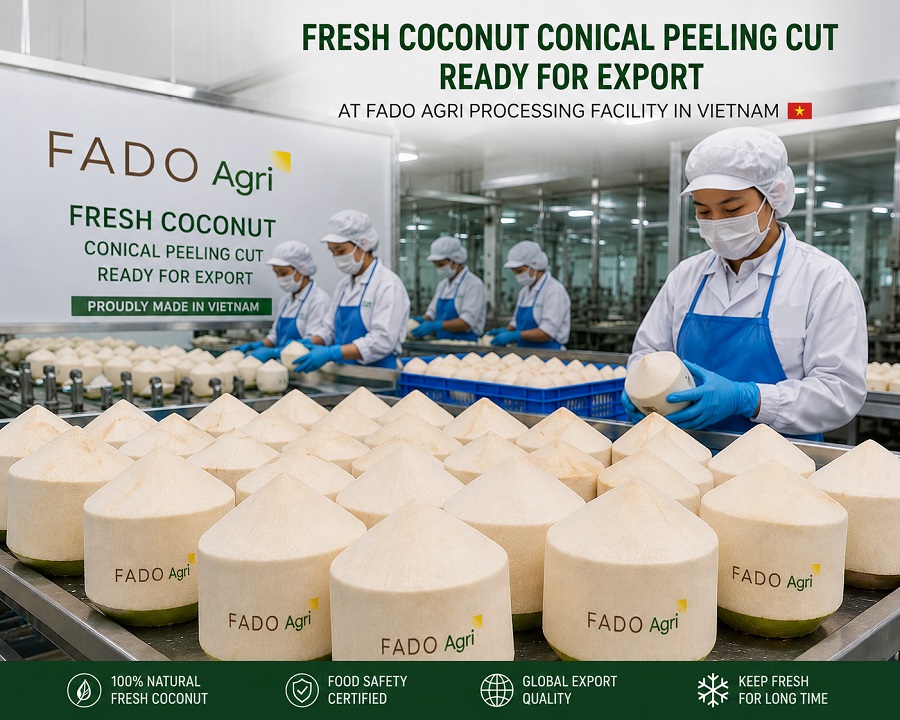
- Conical Peeling the standard export cut, maximizing container fill efficiency
- Whole unpeeled, for markets that prefer natural presentation
- Diamond Cut angled top for display appeal, popular in Gulf supermarkets
- Easy Open pre-scored for direct consumer use
- Bald fully dehusked, white flesh visible, premium shelf presence
- Lid On partial peeling with a lid retained, designed for quick opening at point of sale
2. How to Import Fresh Coconut from Vietnam: Step-by-Step Process
Understanding how to import fresh coconut from Vietnam starts with knowing how the supply chain actually functions, not just in theory, but as a practiced, documented workflow.
Fado Agri operates a 10-step transparent supply chain from farm to port. Here is how that translates into the buyer’s journey:
2.1. Step 1 – Initial Inquiry and Product Specification
The buyer contacts Fado Agri with target market, desired cut type, weekly or monthly volume, and destination port. At this stage, Fado Agri confirms product availability, current pricing (FOB or CIF), and any market-specific certification requirements.
2.2. Step 2 – Sampling and Approval
A pre-shipment sample can be arranged for new buyers. Fado Agri ships sealed sample boxes via express courier so buyers can evaluate freshness, size uniformity, and packaging before committing to full container orders.
2.3. Step 3 – Proforma Invoice and Contract
Once specifications are agreed, Fado Agri issues a Proforma Invoice detailing product specs, volume, price (FOB/CIF), payment terms, and packaging requirements. OEM labeling or custom packaging can be incorporated at this stage, Fado Agri supports both OEM and ODM orders.
2.4. Step 4 – Production and Quality Control at Source
Coconuts are harvested from Ben Tre and Tien Giang partner farms, transported to the processing facility, inspected, cut to specification, and packed. Quality control operates at three checkpoints: field harvest, processing floor, and pre-loading inspection.
2.5. Step 5 – Phytosanitary Inspection and Export Licensing
All fresh coconut shipments must pass Vietnam’s official phytosanitary inspection, conducted by the Plant Protection Department (PPD) under the Ministry of Agriculture and Rural Development (MARD). Fado Agri coordinates this inspection as part of standard export preparation.
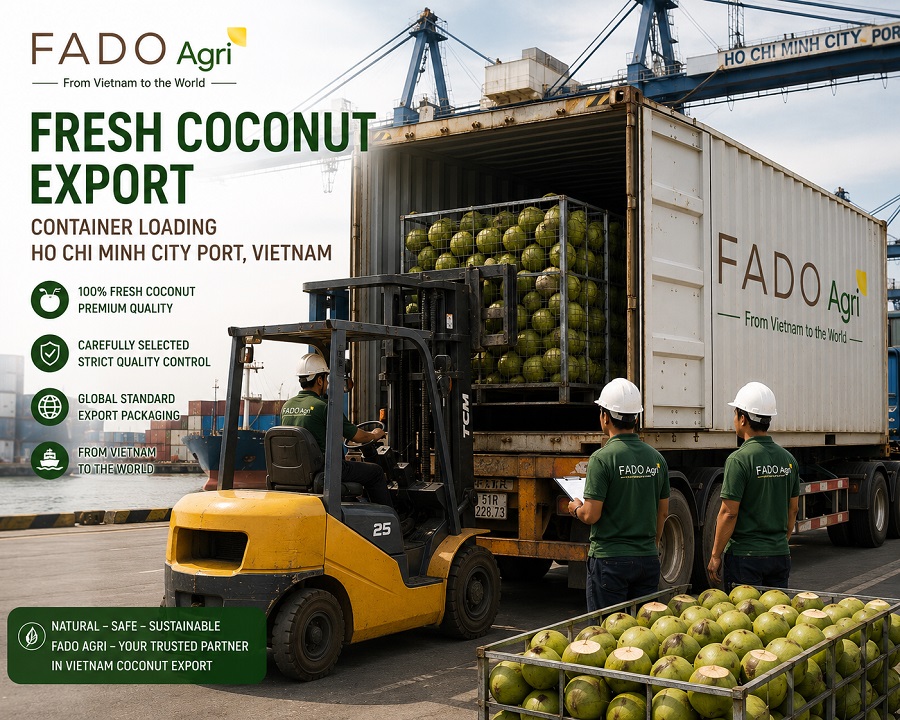
2.6. Step 6 – Loading and Container Seal
Coconuts are loaded into refrigerated (reefer) or standard containers depending on destination distance and buyer specification. Container temperature for fresh coconuts is typically maintained between 10-13°C for extended transit routes.
2.7. Step 7 – Documentation Package Issued
Full export documentation is compiled and transmitted to the buyer (details in Section 3 below).
2.8. Step 8 – Shipment Departure and Tracking
The container departs from Ho Chi Minh City (Cat Lai port) or Cai Mep International Terminal. Fado Agri provides the Bill of Lading and shipment tracking reference to the buyer immediately upon vessel departure.
2.9. Step 9 – Customs Clearance at Destination
The buyer (or their customs broker) handles import clearance using the documentation package provided. Fado Agri’s documentation consistently meets customs requirements across the Middle East, East Asia, and Western markets.
2.10. Step 10 – Post-Delivery Follow-Up
Fado Agri conducts a post-delivery quality review with buyers. Any quality discrepancies are assessed with reference to the pre-shipment inspection record, maintaining full accountability from origin to destination.
3. Required Documents for Importing Fresh Coconut from Vietnam
Buyers often ask about the documentation burden when importing fresh produce. For fresh coconuts from Vietnam, the standard export documentation package includes:
- Commercial Invoice – issued by Fado Agri, detailing product, quantity, unit price, and total value
- Packing List – carton count, net weight, gross weight, container load plan
- Bill of Lading (B/L) – issued by the shipping line; the primary document of title for the shipment
- Certificate of Origin (CO), Form D or others – issued by the Vietnam Chamber of Commerce and Industry (VCCI) or relevant authority, required for preferential tariff treatment under ASEAN FTAs and bilateral trade agreements
- Phytosanitary Certificate – issued by Vietnam’s PPD; mandatory for fresh plant products entering all markets
- Health Certificate / Food Safety Certificate – required by certain destinations including the Middle East, China, and the USA
- FDA Prior Notice (for USA-bound shipments) – submitted electronically through the FDA’s Prior Notice System Interface (PNSI)
- Fumigation Certificate – required by some markets for wooden packing materials
Fado Agri prepares and verifies this full documentation set as standard. The documentation package is transmitted digitally to buyers prior to or on the vessel’s departure date, allowing importers to begin customs filing without delay.
4. Lead Times and Shipping Options
4.1. Production Lead Time
The minimum production lead time for fresh coconut orders is 5 days from order confirmation. This covers field harvest, processing, packing, phytosanitary inspection, and container loading. For large-volume orders or OEM packaging requests, lead times should be confirmed with the Fado Agri team at the inquiry stage.
For buyers operating recurring import programs, Fado Agri’s stable supply capacity averages 2-3 days per container for scheduling purposes, meaning buyers with high-frequency needs can plan weekly container arrivals with predictable turnaround.
4.2. Ocean Transit Times
Transit times from Ho Chi Minh City vary by destination:
| Destination | Estimated Ocean Transit |
| UAE (Jebel Ali, Dubai) | 18-22 days |
| Saudi Arabia (Jeddah) | 20-25 days |
| China (Shanghai, Guangzhou) | 5-8 days |
| Japan (Tokyo, Osaka) | 7-10 days |
| South Korea (Busan) | 7-9 days |
| Malaysia (Port Klang) | 4-6 days |
| Australia (Sydney, Melbourne) | 12-16 days |
Buyers targeting the Middle East, Fado Agri’s primary export market, should plan for a total cycle of 25-30 days from order placement to port arrival, including production lead time.
5. Cost Structure: What to Budget When Importing Vietnamese Coconuts
5.1. Product Pricing: FOB vs CIF
Fresh coconut pricing is quoted on either FOB (Free On Board) or CIF (Cost, Insurance, and Freight) terms. Under FOB, the buyer arranges and pays for ocean freight and insurance. Under CIF, Fado Agri includes freight and insurance to the destination port in the price.
Buyers new to Vietnam sourcing often prefer CIF for the first shipment for simplicity; established buyers with freight contracts typically work on FOB terms for better cost control.
5.2. Key Cost Components
The total landed cost of importing fresh Vietnamese coconuts comprises:
- Product cost – determined by cut type, size grading, and volume; quoted per kilogram or per carton
- Packaging – standard Fado Agri packaging is included; custom OEM/ODM packaging carries a per-carton tooling or printing surcharge for first orders
- Ocean freight – varies by destination, container type (reefer vs. dry), and market rate at time of booking
- Origin handling and documentation – covered by Fado Agri under standard terms
- Import duties and taxes – determined by destination country tariff classification (HS code 0801 for fresh coconuts) and applicable trade agreements (ASEAN FTAs often reduce duties significantly for eligible countries)
- Destination port charges – terminal handling, customs broker fees, and inland delivery if applicable
Fado Agri recommends buyers confirm HS code classification and applicable duty rates with their customs broker before finalizing sourcing decisions, particularly for first-time importers entering a new market.
6. Why B2B Buyers Choose Fado Agri as Their Fresh Coconut Supplier
There are many coconut exporters in Vietnam. What distinguishes Fado Agri is not a vague promise of quality, it is a documented, repeatable system that holds up at every customs checkpoint and every supermarket receiving dock.
Fado Agri is established in 2016 and has grown to serve 20 strategic partners worldwide, exporting 500+ containers per year across more than 10 internationally certified markets. The company operates four offices, Vietnam (HQ), UAE (Ajman), Malaysia (Penang), and Australia (NSW), giving buyers in-region support rather than a distant factory relationship.
Certifications are current and market-specific: FDA compliance for the USA, GLOBALG.A.P for European and Japanese buyer requirements, and HACCP for food safety systems across all processing operations.
We work with importers who need consistent quality, flexible OEM/ODM packaging, and export documentation that holds up at every customs checkpoint. That is the standard Fado Agri builds to, not as a marketing statement, but as a daily operational reality.
FAQ: Importing Fresh Coconut from Vietnam
1. What is the minimum order quantity (MOQ) for fresh coconut from Vietnam?
Fado Agri’s standard minimum order is one full container (FCL). A standard 40-foot container holds approximately 20-22 metric tons of fresh coconut depending on cut type and packing format. For buyers exploring smaller initial volumes, contact the Fado Agri team to discuss options.
2. Can I import fresh coconut from Vietnam with my own brand label?
Yes. Fado Agri offers full OEM and ODM packaging services. Buyers can supply their own label artwork, and Fado Agri will apply custom branding to cartons or individual packaging at the processing facility. Tooling and printing requirements for first orders should be discussed during the Proforma Invoice stage.
3. What certifications does Fado Agri hold for fresh coconut exports?
Fado Agri’s fresh coconut supply chain is certified under FDA (USA), GLOBALG.A.P, and HACCP standards. All shipments are accompanied by a Phytosanitary Certificate issued by Vietnam’s Plant Protection Department, along with destination-specific documentation such as Health Certificates and FDA Prior Notice for US-bound shipments.
4. How long does it take to receive fresh coconuts from Vietnam?
The minimum production lead time for fresh coconut is 5 days from order confirmation. Ocean transit times range from 4-6 days to Malaysia, 7-10 days to Japan and South Korea, and 18-25 days to the UAE and Saudi Arabia. Total time from order to port arrival for Middle East buyers is typically 25-30 days.
5. What is the best port of departure in Vietnam for coconut exports?
Most Fado Agri fresh coconut shipments depart from Ho Chi Minh City, either via Cat Lai Port or Cai Mep International Terminal. Both ports offer direct or transhipment services to all major import destinations.
6. What HS code is used for fresh coconut imports from Vietnam?
Fresh coconuts are classified under HS code 0801 (specifically 0801.11 for desiccated coconut, 0801.12 for coconut in the inner shell, and 0801.19 for other). Buyers should confirm the correct sub-heading with their customs broker, as applicable duty rates and trade agreement preferences vary by sub-classification and destination country.
7. Does Fado Agri provide pre-shipment quality inspection?
Yes. Every Fado Agri shipment goes through a three-checkpoint quality control process: at the farm during harvest, on the processing floor, and during pre-loading inspection before container sealing. Buyers may also request independent third-party inspection by agencies such as SGS or Bureau Veritas at the buyer’s cost.
Ready to Import Fresh Coconut from Vietnam?
The process of importing fresh coconut from Vietnam is straightforward when you work with a supplier who has managed it at scale, across multiple regulated markets, for nearly a decade. From sourcing in Ben Tre and Tien Giang to full documentation compliance and on-time container departures, Fado Agri brings the operational infrastructure that removes uncertainty from your supply chain.
If you’re ready to explore a sourcing partnership, whether you’re placing your first container or scaling an existing import program, the Fado Agri team is ready to respond with product specs, pricing, and a sample arrangement.
Contact Fado Agri:
- 📞 Hotline: (+84) 908 479 339
- 📧 Email: [email protected]
- 🌐 Website: www.fadoagri.com
Rooted in the land, rigorous in standards – from Vietnam’s growing regions to the world’s demanding markets.