
Vietnam exported over 600 million fresh coconuts in a single year, and that number is still climbing. If you’ve noticed Vietnamese fresh coconuts appearing on supermarket shelves in Dubai, Tokyo, Seoul, or Sydney more often than before, there’s a precise set of reasons behind it. Understanding why Vietnamese fresh coconuts are dominating global markets in 2026 is not just an academic exercise, it’s a practical guide for importers who want to secure a resilient, certified, and scalable tropical fruit supply chain.
At Fado Agri, established in 2016 and now exporting 500+ containers of fresh produce per year to 10+ internationally certified markets, we sit at the center of this transformation. This article breaks down the structural advantages driving Vietnam’s coconut dominance, and what it means for serious B2B buyers worldwide.
1. Why Vietnamese Fresh Coconuts Are Dominating Global Markets in 2026: The Core Drivers
Vietnam’s rise as the world’s leading fresh coconut supplier didn’t happen by accident. It is the result of geography, agricultural investment, and an export infrastructure that has matured significantly over the past decade.
1.1 Ideal Agronomic Conditions in Ben Tre and Tien Giang
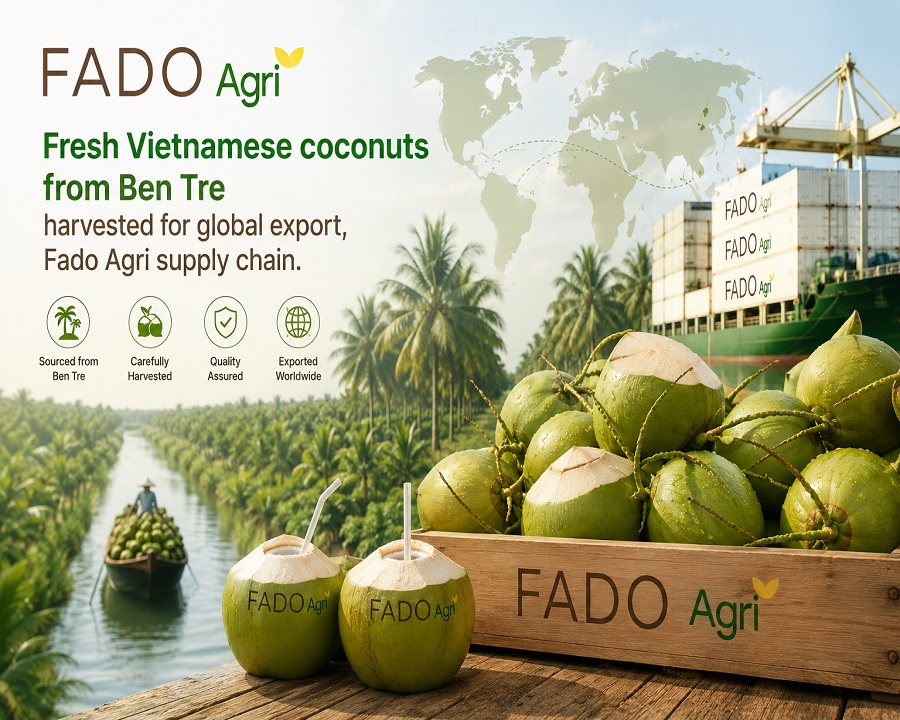
Vietnam’s two primary coconut-producing provinces, Ben Tre and Tien Giang, sit in the Mekong Delta, where the combination of alluvial soil, consistent tropical humidity, and access to freshwater irrigation creates near-perfect growing conditions for coconut cultivation. Ben Tre alone is home to more than 70,000 hectares of coconut cultivation, accounting for a significant share of the country’s total output.
The fruit produced in these regions is notable for its high water content, naturally sweet flavor profile, and consistent size, characteristics that align directly with what premium buyers in markets like the UAE, Japan, and South Korea demand. Our coconuts are sourced from Ben Tre’s specialized growing zones, where harvest is chemical-free and quality control begins in the field, not the factory.
1.2 Six Cut Formats Built Around Market Preferences
One of the most overlooked competitive advantages of Vietnamese fresh coconut exporters is the processing versatility available at the source. Fado Agri supplies fresh coconuts in six internationally recognized cut formats: Conical Peeling, Whole, Diamond Cut, Easy Open, Bald, and Lid On, each adapted to different retail environments, consumption habits, and transport requirements.
A Middle Eastern hypermarket has different display needs than a Japanese convenience chain or an Australian fresh food distributor. Vietnamese processors, particularly those working within certified supply chains, have invested in the machinery and labor skill to deliver this flexibility at scale.
Read more: Vietnam Coconut Exporter to UAE: Shipping, Documentation & Distribution
2. Certification and Compliance: The Real Barrier Other Origins Can’t Clear
Buyers often ask whether Vietnamese fresh coconuts can pass the documentation requirements of their target markets. The answer is unambiguous: Yes, but only when working with suppliers who have invested in the right certifications.
2.1 FDA, GLOBALG.A.P, and HACCP as Standard, Not Optional
Fado Agri holds certifications from the U.S. Food and Drug Administration (FDA), GLOBALG.A.P (the globally recognized on-farm standard for Good Agricultural Practices), and HACCP (Hazard Analysis and Critical Control Points), the food safety framework mandatory for entry into Japan, South Korea, and the European Union.
These are not marketing labels. They represent active compliance obligations: regular audits, traceability documentation, pesticide residue testing, and post-harvest handling protocols. Exporters who cannot demonstrate this level of compliance are effectively locked out of premium markets in 2026, where customs scrutiny has increased substantially.
2.2 Phytosanitary Certification and Full Export Documentation
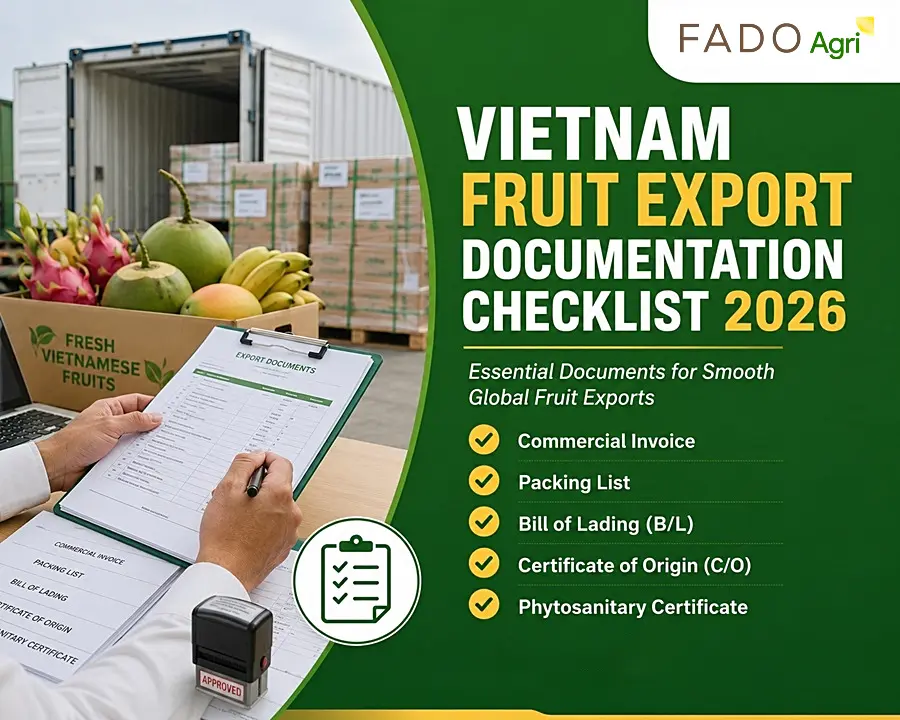
Every shipment from Fado Agri is accompanied by a complete documentation package: Phytosanitary Certificate issued by Vietnam’s Plant Protection Department, Certificate of Origin (CO), Bill of Lading (B/L), commercial invoice, and packing list, all prepared to the destination country’s import authority specifications.
This is what transparent at every stage means in practice. Buyers importing to the UAE, Saudi Arabia, Kuwait, or Malaysia don’t encounter customs delays because of missing paperwork. That operational reliability is, increasingly, a core reason why experienced importers shift volume to Vietnam.
3. Supply Chain Speed and Consistency at Scale
3.1 A 10-Step Transparent Process from Farm to Port
Fado Agri’s supply chain for fresh coconuts follows a verified 10-step process:
- Field sourcing, direct procurement from certified growing zones in Ben Tre and Tien Giang
- Pre-harvest quality assessment, fruit graded by Brix level, size, and external condition
- Chemical-free harvest, hand-picked to avoid bruising
- Field-to-factory transport, chilled logistics to preserve freshness
- Incoming inspection, factory quality team checks each batch
- Cutting and trimming, processed into the buyer’s specified cut format
- Washing and surface treatment, food-grade processing under HACCP protocols
- Packing, in buyer-specified packaging (OEM/ODM available)
- Pre-shipment inspection, third-party or buyer-nominated inspector available
- Export documentation and loading, FOB or CIF terms, container loading at Vietnamese port
This structured process is not theoretical. It is the daily operational reality behind 500+ containers shipped annually to 20 strategic partners worldwide.
3.2 Lead Times That Importers Can Actually Plan Around
Fresh coconut has a lead time of minimum 5 days from order confirmation to container loading at port. Stable ongoing supply runs at an average of 2–3 days per container for established accounts. This predictability matters enormously for buyers managing retail shelf commitments, a late or inconsistent shipment of fresh coconuts creates downstream losses that compound quickly.
Fado Agri’s team of 150 global staff members and 500+ factory workers is structured specifically to maintain this throughput without quality variance. Our offices in Vietnam (HQ), UAE (Ajman), Malaysia (Penang), and Australia (New South Wales) allow for timezone-aligned communication with buyers across every major import region.
4. Market Demand: Where Vietnamese Coconuts Are Winning and Why
4.1 Middle East: The Volume Market
The UAE, Saudi Arabia, and Kuwait represent some of the highest per-capita fresh coconut consumption markets outside of Asia, driven by a large South and Southeast Asian expatriate population and growing health-food retail culture. Vietnamese fresh coconuts arrive with the visual consistency, extended shelf life, and halal-compatible processing documentation that Middle Eastern distributors require.
4.2 East Asia: The Premium Market
Japan and South Korea import fresh coconuts as a premium lifestyle product, purchased in specialty grocery chains and health-food retailers. In these markets, the GLOBALG.A.P certification and pesticide residue documentation are non-negotiable. Vietnamese suppliers who meet these standards, including Fado Agri, command consistent long-term contracts precisely because the certification barrier filters out less compliant origins.
4.3 China, Malaysia, and Australia: High-Growth Channels
China’s fresh fruit import market has expanded rapidly, with fresh coconuts becoming a staple in tier-1 city fresh markets. Malaysia’s established distribution networks create efficient re-export pathways across ASEAN. Australia’s multicultural urban consumer base drives steady retail demand. All three markets are active destinations for Fado Agri’s fresh coconut shipments, and all three have distinct labeling, inspection, and documentation requirements that our export team manages as standard workflow.
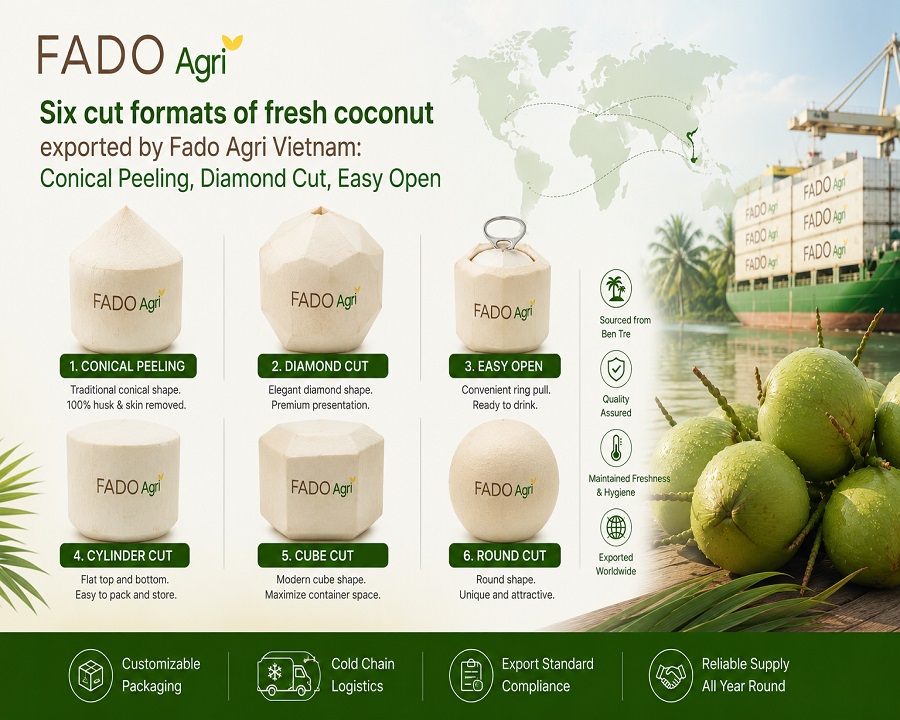
Read more: 6 Types of Vietnamese Coconut Cuts: Visual Guide for Buyers
5. What B2B Buyers Should Look for in a Vietnamese Fresh Coconut Supplier
Not every Vietnamese coconut exporter operates at the same level. If you’re evaluating suppliers, these are the criteria that separate reliable long-term partners from opportunistic traders:
- Active certifications, FDA, GLOBALG.A.P, and HACCP should be verifiable, not claimed
- Cut format flexibility, can they supply your specific format (Conical Peeling, Easy Open, Diamond Cut, etc.) at your required volume?
- OEM/ODM packaging capability, can they pack under your brand with compliant labeling?
- Documentation readiness, phytosanitary certificate, CO, B/L, and inspection reports prepared without delays
- Direct sourcing transparency, can they name the provinces, farms, and growing practices behind their fruit?
- Office presence in your region, local account management reduces miscommunication and response time
Fado Agri meets every item on this list. We work with importers who need consistent quality, flexible packaging, and export documentation that holds up at every customs checkpoint.
Frequently Asked Questions
What makes Vietnamese fresh coconuts better than those from Thailand or Indonesia?
Vietnam’s coconut-producing provinces, Ben Tre and Tien Giang, produce fruit with consistently high water content and natural sweetness driven by specific soil and climate conditions in the Mekong Delta. Vietnamese exporters who hold FDA, GLOBALG.A.P, and HACCP certifications can meet the documentation requirements of premium markets like Japan and the UAE, which is not uniformly available from all origins. Buyers report strong shelf life performance and retail visual consistency from certified Vietnamese suppliers.
What cut formats are available for Vietnamese fresh coconuts exported by Fado Agri?
Fado Agri supplies fresh coconuts in six cut formats: Conical Peeling, Whole, Diamond Cut, Easy Open, Bald, and Lid On. Each format is available with OEM/ODM packaging, buyers can specify their own brand labeling, retail packaging dimensions, and pallet configurations. Lead time for fresh coconut orders is a minimum of 5 days from order confirmation.
Which certifications should a Vietnamese fresh coconut supplier hold for export to the United States, Japan, or the EU?
For the United States, FDA registration and compliance with FSMA (Food Safety Modernization Act) import requirements are essential. For Japan and South Korea, HACCP certification and documented pesticide residue testing are mandatory. GLOBALG.A.P certification is widely recognized across the EU and premium Asia-Pacific markets. Fado Agri holds FDA, GLOBALG.A.P, and HACCP certifications across its fresh coconut supply chain.
What are typical lead times for fresh coconut orders from Vietnam?
Fresh coconut orders from Fado Agri have a minimum lead time of 5 days from order confirmation to container loading at a Vietnamese port. For established accounts with a stable supply agreement, the average supply cadence is 2–3 days per container. FOB and CIF terms are both available depending on the buyer’s preference.
Can Vietnamese coconut exporters supply private-label or OEM-branded packaging?
Yes. Fado Agri offers full OEM and ODM packaging services for fresh coconuts, including custom printed cartons, branded sticker labels, and retail-ready formats. Buyers importing for supermarket chains or wholesale distribution commonly use this service to maintain brand consistency across their produce category.
How do I verify that a Vietnamese coconut supplier’s certifications are current?
Request the certification number and issuing body from the supplier, then verify directly with the certifying organization, GLOBALG.A.P certificates can be checked via the GLOBALG.A.P database at globalgap.org. FDA registration for foreign food facilities is searchable via the FDA’s online portal. Fado Agri provides all certification documentation as part of standard pre-shipment paperwork.
Conclusion
The question of why Vietnamese fresh coconuts are dominating global markets in 2026 has a clear, evidence-based answer: it is the result of superior growing conditions in Ben Tre and Tien Giang, processing versatility that meets diverse retail needs, rigorous certification compliance that clears demanding import markets, and a logistics infrastructure capable of delivering 500+ containers per year with documented traceability at every step.
For importers looking to build a reliable fresh coconut supply chain, whether into the Middle East, East Asia, or Western markets, Vietnam is not a speculative bet. It is the established, certified, scalable answer. And within Vietnam, the partners who can consistently deliver at this level are those who have invested in the full stack: the farms, the certifications, the factories, and the people.
If you are evaluating Vietnamese fresh coconut suppliers or want to understand whether Fado Agri is the right fit for your procurement needs, we welcome the conversation.
Fado Agri – Rooted in the land, rigorous in standards.
📞 Hotline: (+84) 908 479 339
📧 Email: [email protected]
🌐 Website: fadoagri.com