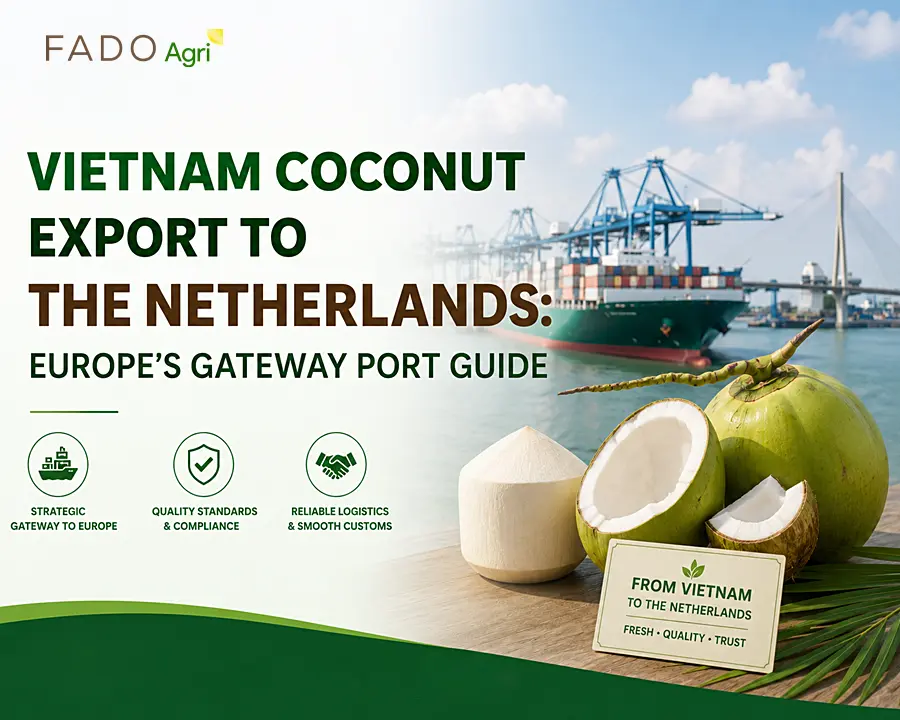

Every container of fresh Vietnamese produce that reaches a port in Dubai, Tokyo, Seoul, or Sydney carries more than fruit. It carries a documented trail from the exact farm where it was harvested, through certified processing facilities, across a cold chain, and into a container loaded to meet the customs requirements of its destination country. That trail is what Fado Agri calls its process, and transparency in that process is the foundation every long-term buyer relationship is built on.
This article takes you inside The Fado Agri Process: Behind the Scenes from Farm to Container, a 10-step supply chain refined over 10+ years, 500+ containers exported per year, and partnerships across 10+ internationally certified markets.
1. What Makes the Fado Agri Supply Chain Different
Most agricultural trading companies operate as intermediaries: they source from brokers, add a margin, and arrange logistics. Fado Agri is structured differently. Established in 2016, Fado Agri operates as a vertically integrated export brand, meaning it maintains direct relationships with farming households and cooperatives across Vietnam’s key growing regions, particularly Ben Tre and Tien Giang for coconuts, and specialized agricultural zones for Red Dragon Fruit, Seedless Lime, Cavendish Banana, Watermelon, Taiwan Guava, and Indonesian Longan.
This direct structure matters to B2B importers for three concrete reasons:
- Traceability: Every batch can be traced to its source farm, harvest date, and field location, not just to a broker invoice.
- Consistency: Direct farm relationships mean fewer quality surprises between orders. Fado Agri’s average supply readiness is 2-3 days per container, with minimum lead times of 5 days for fresh coconut and 4-5 days for Seedless Lime and Red Dragon Fruit.
- Compliance depth: When a market requires a Phytosanitary Certificate, Certificate of Origin (CO), or Bill of Lading (B/L) with specific declarations, Fado Agri’s documentation team handles this in-house, not outsourced to a freight forwarder who may not understand the produce.
Buyers often ask whether Fado Agri can guarantee consistent volume alongside consistent quality. The answer is yes, backed by 150 global staff, 500+ factory workers, and 20 strategic partners worldwide.
Read more: About Fado Agri: Vietnam Agriculture Expert Since 2016
2. The Fado Agri Process: Behind the Scenes from Farm to Container – Step by Step
The 10-step Fado Agri supply chain is the operational core of every export order. Here is what happens between farm harvest and container seal.
2.1 Steps 1-3: Farm Selection, Scheduled Harvest, and Field-Level Pre-Sorting
Step 1 – Farm Sourcing & Qualification
Fado Agri works exclusively with farms and cooperatives that meet baseline agronomic and chemical-use standards. In Ben Tre and Tien Giang, coconut farms are assessed for soil health, irrigation practice, and pesticide protocol before any procurement agreement is signed. This is not a one-time audit, it is an ongoing qualification maintained across growing seasons.
Step 2 – Scheduled Harvest Coordination
Harvest is coordinated with Fado Agri’s field procurement team, not left to the farm’s discretion. Timing is calibrated against the export order’s required ship date, working backward from container loading to determine the optimal harvest window. Coconuts harvested too early or too late lose the moisture content and shelf life that importers in humid and arid climates both depend on.
Step 3 – Field-Level Pre-Sort
Before produce leaves the farm, a first-pass visual and tactile inspection is conducted by Fado Agri’s field agents. Undersized, damaged, or otherwise non-conforming units are rejected at the source. This pre-sort step reduces waste at the processing stage and protects the integrity of the lot before it enters the cold chain.
2.2 Steps 4-6: Factory Intake, Processing, and Grading
Step 4 – Factory Intake & Batch Registration
Produce arrives at Fado Agri’s processing facilities, where each incoming batch is logged against the farm source, harvest date, and field agent report. This intake record becomes part of the traceable documentation package that travels with the shipment.
Step 5 – Processing by Product Type
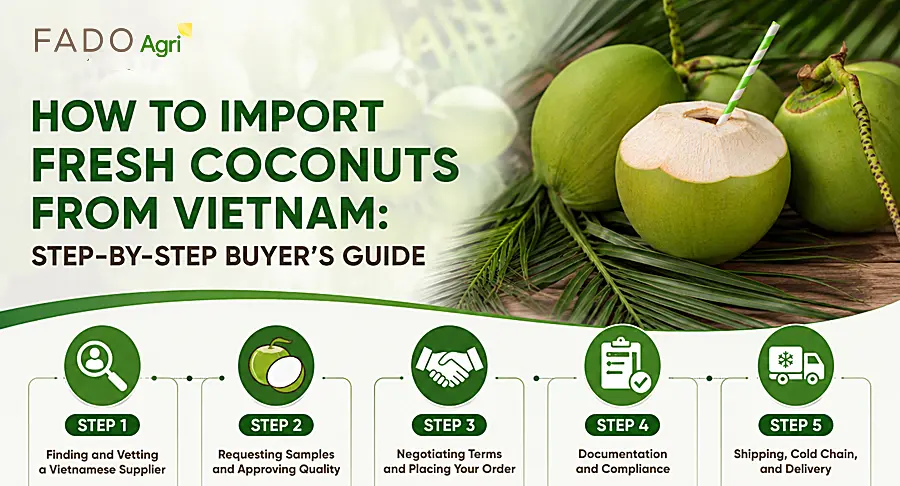
Processing procedures vary by product. Fresh coconuts, for example, are available in six cut formats, Conical Peeling, Whole, Diamond Cut, Easy Open, Bald, and Lid On, and each requires a different cutting and cleaning protocol. Red Dragon Fruit and Seedless Lime are graded and packed according to size specifications agreed with the buyer at order placement. OEM and ODM packaging is executed at this stage for buyers operating under their own brand.
Step 6 – Multi-Point Quality Grading
Every lot passes through a multi-point grading line calibrated to the destination market’s import standards. For the US market, this means FDA compliance. For European and Japanese buyers, GLOBALG.A.P standards apply. HACCP protocols govern food safety across all production lines regardless of destination. Lots that do not meet specification are flagged, isolated, and either reworked or rejected, they do not move forward.
2.3 Steps 7-10: Cold Chain Management, Packaging, Documentation, and Container Loading
Step 7 – Cold Chain Entry
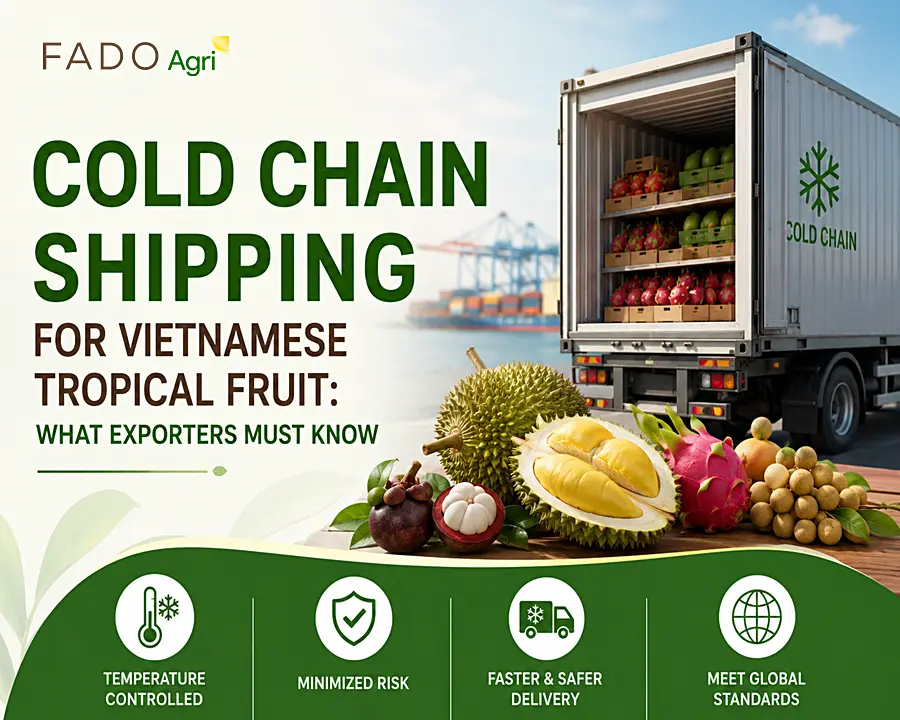
Processed and graded produce enters cold storage immediately following quality clearance. Cold chain temperature parameters are set by product: fresh coconuts, tropical fruits, and lime each require different storage conditions to preserve moisture content, skin integrity, and Brix levels during the transit window.
Step 8 – Packaging & Labelling
Final packaging, carton size, label language, bar code format, country-of-origin declaration, is completed in accordance with the buyer’s specifications and the destination country’s import labelling requirements. Fado Agri’s packaging team works with buyers in the UAE (Ajman office), Malaysia (Penang office), and Australia (New South Wales office) to ensure that labelling is pre-approved before container loading begins.
Step 9 – Export Documentation
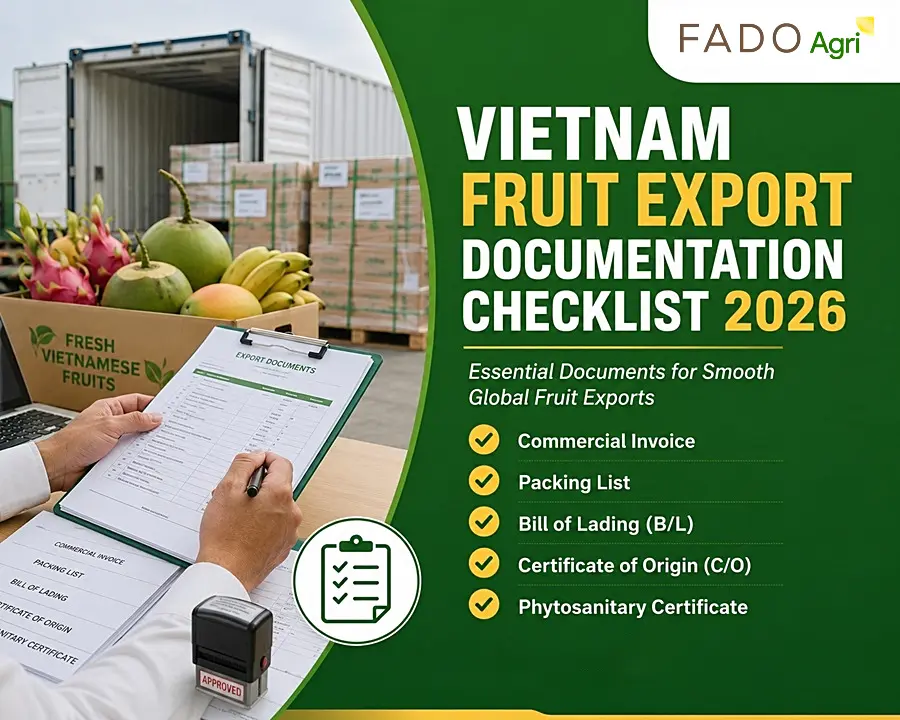
This step is where many agricultural exporters lose time and buyer trust. Fado Agri’s documentation team prepares and verifies: the Phytosanitary Certificate, Certificate of Origin (CO), commercial invoice, packing list, Bill of Lading (B/L), and any destination-specific declarations required for customs clearance. Shipments are offered under both FOB (Free on Board) and CIF (Cost, Insurance, and Freight) terms depending on the buyer’s preference.
Step 10 – Container Loading & Seal
Container loading is conducted under Fado Agri supervision, with carton stacking verified against the packing list. Before seal, a final count and temperature check is performed. Container seal number, loading photos, and the completed documentation package are sent to the buyer within the agreed timeline, typically the same business day as loading.
3. Quality Checkpoints That Protect Your Import Cycle
3.1 Certification Standards in Practice
Fado Agri operates under three internationally recognized certification frameworks:
- FDA (United States Food and Drug Administration), required for all shipments destined for the US market
- GLOBALG.A.P, applied to farm-level practices, covering food safety, environmental impact, and worker welfare
- HACCP (Hazard Analysis and Critical Control Points), factory-floor food safety protocol applied to all processing lines
These certifications are not background credentials. They are active compliance frameworks that shape day-to-day decisions on the farm, in the factory, and in the documentation process. Buyers importing into regulated markets, Japan, South Korea, UAE, Saudi Arabia, Kuwait, Australia, rely on these certifications to clear customs without delay.
3.2 Documentation Readiness as a Competitive Advantage
Experienced importers know that the weakest link in an agricultural supply chain is often paperwork, not produce. A shipment of flawless coconuts held at port because of a missing phytosanitary endorsement costs a buyer more than a quality variance ever would. Fado Agri’s in-house documentation team treats paperwork as a product, prepared with the same precision as the fruit it accompanies.
4. Lead Times, OEM Options, and What Buyers Can Expect
Fado Agri operates on committed lead times, not estimates:
| Product | Minimum Lead Time |
| Fresh Coconut (all 6 cut types) | 5 days |
| Seedless Lime | 4-5 days |
| Red Dragon Fruit | 4-5 days |
| Stable supply (general) | 2-3 days per container |
For buyers requiring OEM or ODM packaging, custom brand labels, specific carton configurations, or private-label product lines, Fado Agri accommodates these requests from Step 5 of the supply chain onward. Minimum order quantities and customization lead times are discussed at the inquiry stage and confirmed in the purchase agreement.
Fado Agri ships under FOB and CIF terms. Buyers who prefer to manage their own freight use FOB pricing out of Vietnamese ports. Those who prefer a delivered-price model opt for CIF, with Fado Agri coordinating insurance and freight to the destination port.
Read more: Vietnam Fruit Exporter to Australia: Bio-Security & Reliable Supply
5. Why Importers Across 10+ Markets Trust This Process
Since 2016, Fado Agri has built export relationships across more than 10 internationally certified markets, including the UAE, Saudi Arabia, Kuwait, China, Japan, South Korea, Malaysia, the United States, Australia, and India. The common thread among buyers in these markets is not price. It is process confidence: the assurance that each container will arrive on specification, with documentation ready for customs, and a contact person at Fado Agri who can answer questions before, during, and after shipment.
Fado Agri currently maintains 20 strategic partners worldwide and exports 500+ containers per year, a volume that reflects not growth for its own sake, but a supply chain built to scale without sacrificing traceability.
Rooted in the land, rigorous in standards, this is not a marketing line. It is an operational reality that begins in the coconut groves of Ben Tre and ends at the unloading dock of a supermarket distribution center on the other side of the world.
Frequently Asked Questions
What is The Fado Agri Process: Behind the Scenes from Farm to Container?
The Fado Agri Process is a 10-step supply chain framework that covers farm selection, scheduled harvest, field pre-sorting, factory processing, quality grading, cold chain management, OEM packaging, export documentation, and supervised container loading. It is designed to give B2B importers full traceability and documentation readiness for every shipment.
Which certifications does Fado Agri hold for export compliance?
Fado Agri operates under FDA (for US-bound shipments), GLOBALG.A.P (farm-level food safety and environmental standards), and HACCP (factory-floor hazard control). These certifications apply to all core products, including Fresh Coconut, Red Dragon Fruit, Seedless Lime, and Cavendish Banana.
What are Fado Agri’s lead times for fresh coconut exports?
The minimum lead time for fresh coconut, available in six cut formats: Conical Peeling, Whole, Diamond Cut, Easy Open, Bald, and Lid On, is 5 days. For Seedless Lime and Red Dragon Fruit, the lead time is 4-5 days. General stable supply averages 2-3 days per container.
Does Fado Agri offer OEM or private-label packaging?
Yes. Fado Agri offers both OEM (buyer’s branding applied to Fado Agri’s product) and ODM (customized product formulation or configuration) options. OEM/ODM customization is executed at the packaging stage within the 10-step supply chain. Lead times and minimum order quantities are confirmed at the inquiry stage.
What shipping terms does Fado Agri offer?
Fado Agri ships under both FOB (Free on Board) and CIF (Cost, Insurance, and Freight) terms. FOB pricing is available out of Vietnamese ports; CIF covers freight and insurance to the buyer’s destination port. Term preference is confirmed in the purchase agreement.
Which markets does Fado Agri export to?
Fado Agri exports to 10+ internationally certified markets including the UAE (Ajman), Saudi Arabia, Kuwait, China, Japan, South Korea, Malaysia, the United States, Australia, and India. The company maintains global offices in Vietnam (HQ), UAE, Malaysia (Penang), and Australia (New South Wales).
How does Fado Agri ensure consistent quality across 500+ containers per year?
Consistency is maintained through direct farm relationships in Ben Tre and Tien Giang, multi-point grading at HACCP-certified processing facilities, and an in-house documentation team that prepares every export package, including Phytosanitary Certificates, Certificates of Origin, and Bills of Lading, without outsourcing.
Ready to See the Process in Action?
The Fado Agri Process: Behind the Scenes from Farm to Container is built for importers who have been let down by inconsistent sourcing, slow documentation, or suppliers who disappear after the first shipment. If you are sourcing fresh tropical produce for distribution in the Middle East, Asia-Pacific, or beyond, Fado Agri’s 10-step supply chain, three international certifications, and in-house team across four global offices are ready to be your supply chain backbone.
Reach out to discuss lead times, OEM options, and your first trial container:
- Hotline: (+84) 908 479 339
- Email: [email protected]
- Website: fadoagri.com