
India imports over 700 million coconuts annually to meet a domestic demand that its own production, the world’s third largest, still cannot fully satisfy. For Indian importers and distributors, sourcing Vietnam coconut to India is no longer an emerging opportunity; it is a well-established trade corridor backed by bilateral agricultural agreements and a growing demand for premium, export-grade tropical fruit. What separates a smooth import from a costly customs delay, however, comes down to one thing: documentation precision.
This guide covers everything a B2B importer needs to know about bringing Vietnamese fresh coconuts into India, from phytosanitary requirements and APEDA norms to port logistics and supplier selection standards.
1. Why Indian Importers Are Turning to Vietnam for Coconuts
Vietnam is the world’s fifth-largest coconut producer, and its export-grade fresh coconuts, primarily sourced from Ben Tre and Tien Giang provinces, carry characteristics that Indian wholesale markets consistently demand: uniform size, high water content, long shelf life post-harvest, and compliance with international food safety standards.
1.1 Vietnam’s Coconut-Growing Advantage
Ben Tre, often called the “Kingdom of Coconuts,” produces fruit from specialized growing zones where the combination of alluvial river delta soil, high humidity, and chemical-free cultivation methods results in coconuts with a naturally extended shelf life of 30-45 days post-harvest under refrigerated conditions. This matters enormously for long-haul trade routes like Vietnam-India, where sea freight typically takes 10-18 days depending on the port pair.
Unlike coconuts sourced from some competing origins, Vietnamese export coconuts from certified suppliers carry full traceability documentation, field records, harvest logs, and processing batch codes, which satisfies India’s increasingly rigorous import inspection standards.
1.2 Current Trade Volume and Market Signals
Vietnam’s agricultural exports to India have grown steadily over the past five years, supported by the ASEAN-India Free Trade Agreement (AIFTA), which has progressively reduced tariff barriers on agricultural goods. Fresh coconuts currently attract a basic customs duty of approximately 100% in India, but AIFTA preferential rates for Vietnamese-origin goods bring certified shipments to a significantly lower effective rate, making origin documentation (Certificate of Origin Form D) a commercial priority, not just a compliance formality.
Read more: Vietnam Coconut Export to China: Cross-Border Trade Guide
2. Vietnam Coconut to India: Phytosanitary Requirements Explained
Phytosanitary compliance is the single most critical checkpoint in the Vietnam coconut to India trade lane. The Plant Quarantine Division under India’s Directorate of Plant Protection, Quarantine & Storage (DPPQS) governs all fresh plant product imports, and coconut falls squarely under its inspection mandate.
2.1 What Is a Phytosanitary Certificate?
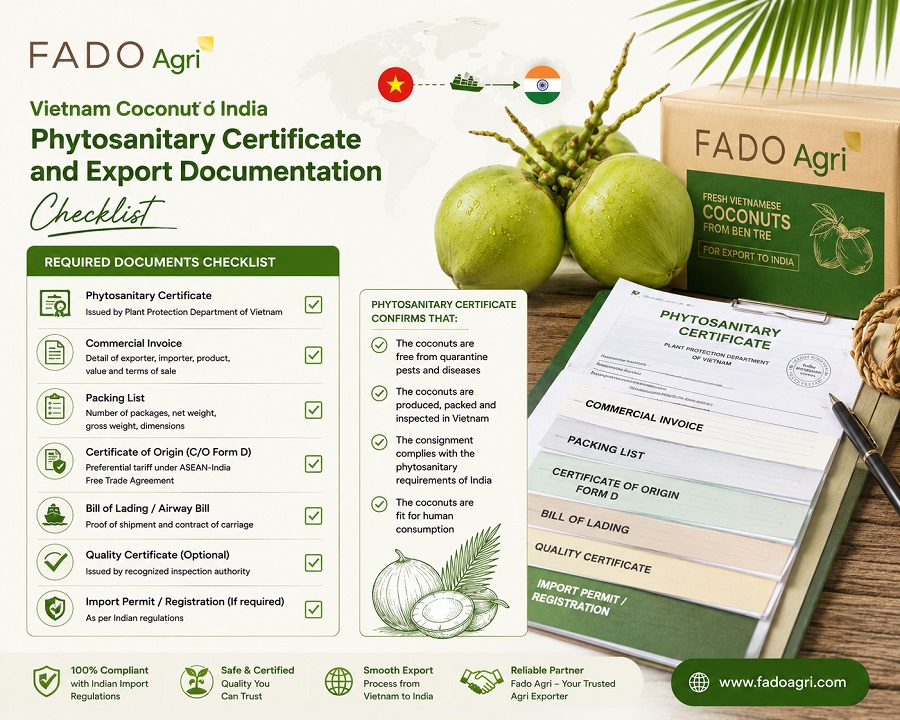
A Phytosanitary Certificate (PC) is an official document issued by Vietnam’s Plant Protection Department (PPD) under the Ministry of Agriculture and Rural Development (MARD). It certifies that the consignment has been inspected, is free from quarantine pests and diseases, and complies with the phytosanitary import requirements of the destination country, in this case, India.
For fresh coconut exports from Vietnam to India, the Phytosanitary Certificate must include:
- Scientific name of the commodity (Cocos nucifera)
- Country of origin and growing region (e.g., Ben Tre, Vietnam)
- Quantity and packaging description
- Means of conveyance and expected port of entry in India
- A declaration that the consignment meets India’s specific import conditions
2.2 India’s Specific Import Conditions for Fresh Coconuts
India’s DPPQS has published import conditions for fresh coconuts from Vietnam. Key requirements include:
- Pest-free certification: The consignment must be free from Brontispa longissima (coconut leaf beetle), Raoiella indica (red palm mite), and Thaumastocoris peregrinus, all listed as quarantine pests of concern to Indian agriculture.
- Pre-shipment inspection: The consignment must be inspected at the point of origin by an authorized Vietnamese phytosanitary officer.
- Port of entry inspection: Upon arrival, all fresh coconut shipments are subject to phytosanitary inspection at Indian ports. Approved ports for fresh tropical fruit include Nhava Sheva (Mumbai), Chennai, Kolkata, and Kochi.
- Treatment documentation (if applicable): If any quarantine pest risk is identified, India may require methyl bromide fumigation or equivalent treatment records before release.
- Packaging compliance: Coconuts must be packed in clean, new packaging materials that do not present independent phytosanitary risk.
2.3 APEDA Registration and Import Licensing
Indian importers must hold a valid Import Export Code (IEC) issued by the Directorate General of Foreign Trade (DGFT). For fresh horticultural produce, registration with the Agricultural and Processed Food Products Export Development Authority (APEDA) is strongly recommended for B2B distributors, as it facilitates smoother customs clearance and access to import facilitation schemes.
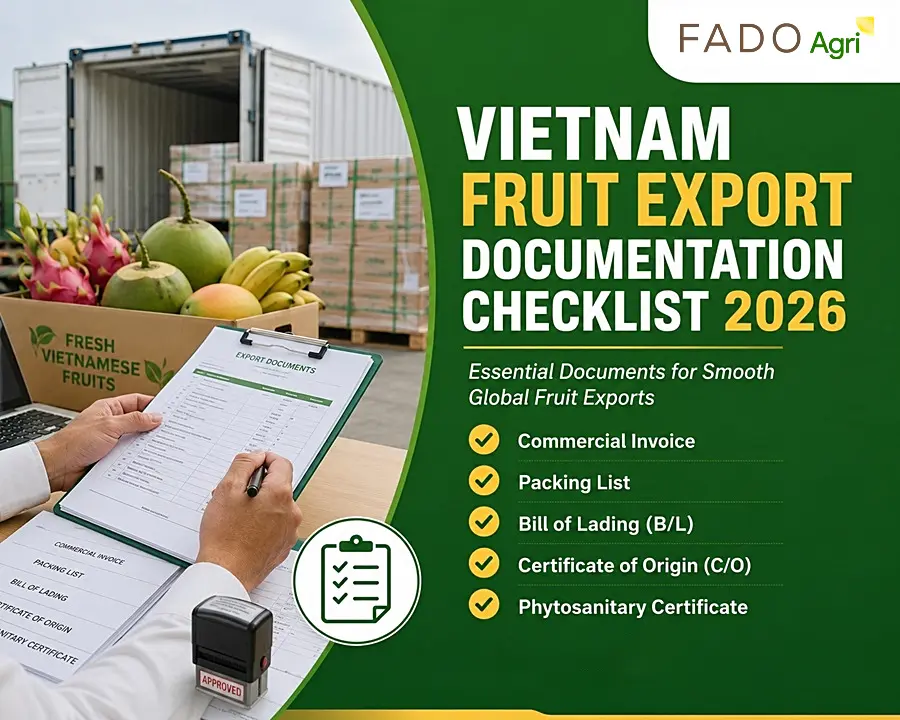
3. Full Documentation Checklist for Vietnam Coconut Imports to India
Buyers often ask what paperwork is required end-to-end. Here is the complete documentation set for a compliant fresh coconut shipment from Vietnam to India:
Export-side documents (Vietnam):
- Phytosanitary Certificate, issued by Vietnam PPD/MARD
- Certificate of Origin (Form D), issued by Vietnam Chamber of Commerce (VCCI) for AIFTA preferential tariff
- Commercial Invoice, must state HS Code 0801.19 (fresh coconuts)
- Packing List, with net/gross weight per carton and total container count
- Bill of Lading (B/L), sea waybill from nominated carrier
- Health Certificate / Food Safety Declaration, from processing facility (HACCP-certified preferred)
Import-side requirements (India):
- Import Export Code (IEC)
- Customs Entry (Bill of Entry) filed via ICEGATE portal
- Phytosanitary Inspection clearance from DPPQS at port of entry
- FSSAI import clearance for food products, under Food Safety and Standards Authority of India regulations
A shipment that arrives without a valid Phytosanitary Certificate, or with a PC that does not match the cargo description, will be held at the port of entry, with costs borne by the importer. Fado Agri prepares all export documentation in advance and cross-checks every consignment against the destination country’s current import conditions before container loading.
4. How Fado Agri Supplies Fresh Coconuts to India
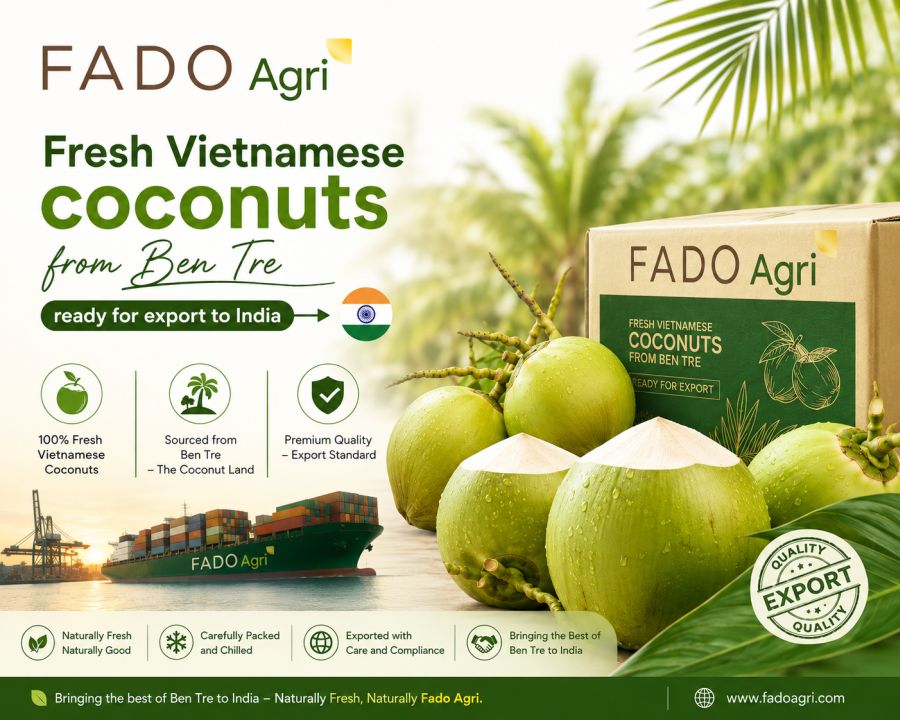
Fado Agri, established in 2016 and exporting 500+ containers per year to 10+ internationally certified markets, has been supplying fresh coconuts to B2B partners in India as part of its broader Asia-Pacific distribution network.
Our coconuts are sourced exclusively from Ben Tre and Tien Giang, Vietnam’s two premier coconut-producing provinces. Harvest is conducted without synthetic pesticides, and each batch is processed in our HACCP-certified facilities where size grading, surface cleaning, and packaging are completed to export specification.
Available cut formats for India-bound shipments:
- Conical Peeling
- Whole (with husk)
- Diamond Cut
- Easy Open
- Bald (fully husked)
- Lid On
Minimum lead time for fresh coconut orders is 5 days, with average stable supply of 2-3 days per container for established partners. We ship on FOB and CIF terms, with OEM/ODM packaging available for importers who supply retail chains under their own brand.
Our team includes trade documentation specialists who prepare phytosanitary application files, coordinate with Vietnam’s PPD for export certification, and liaise directly with Indian customs agents to ensure arrival clearance proceeds without delays.
5. Selecting the Right Vietnamese Coconut Supplier for the Indian Market
Not all Vietnamese coconut exporters are equipped to meet India’s documentation requirements. Buyers often encounter problems when suppliers:
- Cannot provide a valid, compliant Phytosanitary Certificate from Vietnam’s PPD
- Lack HACCP or food safety certification at the processing level
- Offer no Certificate of Origin, forfeiting AIFTA preferential tariff benefits
- Cannot confirm the specific growing zone or pest-free field records
When evaluating a Vietnamese coconut supplier for the Indian trade lane, verify the following:
- Certifications on file: FDA (US-market compliance signals overall food safety standards), GLOBALG.A.P, and HACCP are the minimum credible benchmarks.
- Phytosanitary track record: Ask how many India-bound shipments the supplier has cleared, and whether they have received any rejection or treatment orders from Indian ports.
- Traceability depth: Can the supplier provide field-level harvest records and batch codes that match the packing list?
- Documentation turnaround: Can all required export documents be prepared within your lead time window?
Fado Agri’s supply chain is built on a 10-step transparent process, from field-level sourcing to loading at Vietnamese ports, giving Indian importers the audit trail they need for both customs clearance and downstream retail compliance.
Read more: Vietnam Fruit Supplier for Saudi Arabia: Halal-Friendly Tropical Fruit Supply
Frequently Asked Questions: Vietnam Coconut to India
What is the HS Code for fresh coconut imports from Vietnam to India?
Fresh coconuts are classified under HS Code 0801.19 in India’s customs tariff schedule. This applies to fresh coconuts in shell, whether whole or cut. Desiccated coconut falls under a separate HS Code (0801.11) and carries different import conditions and duty rates.
Does India allow fresh coconut imports from Vietnam?
Yes. India permits fresh coconut imports from Vietnam subject to phytosanitary clearance from the DPPQS at the port of entry. The consignment must be accompanied by a valid Phytosanitary Certificate issued by Vietnam’s Plant Protection Department and must be free from listed quarantine pests including Brontispa longissima and Raoiella indica.
What customs duty applies to Vietnam coconuts imported into India?
The standard basic customs duty on fresh coconuts is approximately 100%. However, under the ASEAN-India Free Trade Agreement (AIFTA), Indian importers holding a valid Certificate of Origin (Form D) from Vietnam can access preferential tariff rates, significantly reducing landed costs. Importers should consult their customs broker for the current applicable preferential rate.
Which Indian ports accept fresh coconut shipments from Vietnam?
Approved ports of entry for fresh tropical produce include Nhava Sheva (JNPT, Mumbai), Chennai Sea Port, Kochi Sea Port, and Kolkata. Nhava Sheva and Chennai are the most common ports for Vietnam-India agricultural trade lanes due to vessel frequency and cold chain infrastructure availability.
How long does sea freight take from Vietnam to India for fresh coconuts?
Transit time varies by origin port in Vietnam and destination port in India. Typical transit ranges from 10 to 18 days. From Ho Chi Minh City (Cat Lai port) to Nhava Sheva, transit is commonly 12-15 days. Given fresh coconut shelf life of 30-45 days under refrigerated conditions, this transit window is commercially viable for B2B distribution.
What certifications should a Vietnamese coconut exporter hold for the Indian market?
At minimum, look for: HACCP certification at the processing facility (food safety baseline), a valid Phytosanitary Certificate track record with India’s DPPQS, and GLOBALG.A.P certification for field-level good agricultural practices. FDA compliance (required for US exports) is an additional indicator of documentation rigor.
Can I source OEM-packaged coconuts from Vietnam for the Indian retail market?
Yes. Suppliers like Fado Agri offer OEM and ODM packaging services, allowing Indian distributors to brand coconuts under their own retail label while sourcing from a certified Vietnamese supply chain. Lead times and minimum order quantities depend on packaging specifications and volume.
Conclusion
The Vietnam coconut to India trade corridor is well-established, commercially attractive, and supported by bilateral trade agreements, but it demands precise documentation and a supplier with verifiable compliance credentials. From phytosanitary certification and AIFTA origin documents to FSSAI import clearance and DPPQS port inspection, every step requires preparation, not improvisation.
Fado Agri, rooted in Vietnam’s Ben Tre and Tien Giang growing regions and rigorous in international standards, is equipped to serve as a long-term supply partner for Indian importers who need consistent quality, complete documentation, and a supply chain that is transparent at every stage.
To discuss your coconut import requirements, request a product specification sheet, or get a CIF/FOB quotation for India-bound shipments, contact the Fado Agri export team directly.
Hotline: (+84) 908 479 339
Email: [email protected]
Website: fadoagri.com