
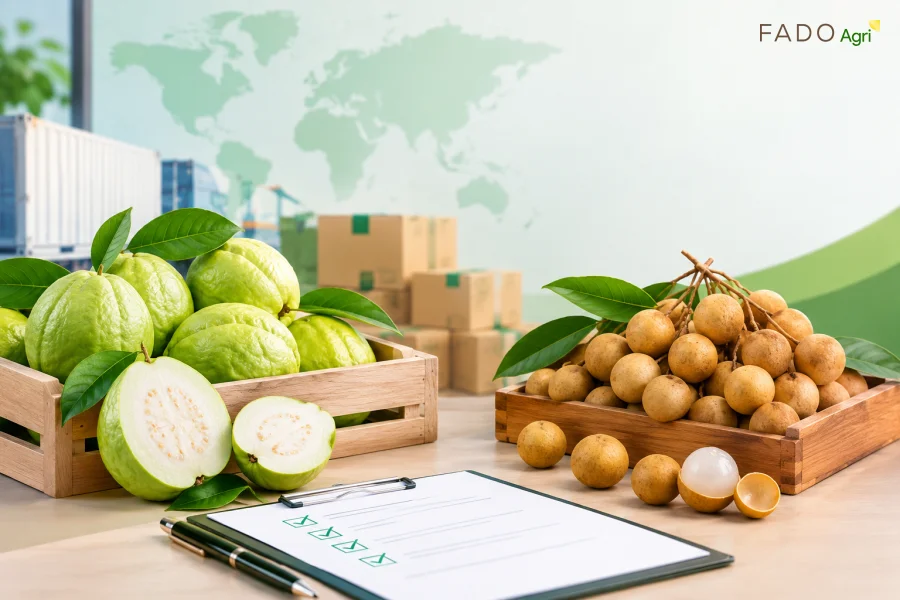
Vietnamese guava and longan can be positioned credibly for higher-value international markets only when each offer is clearly defined and supported by evidence buyers can assess. For importers and procurement teams, the work starts with the product, destination, and intended sales channel—not with a premium claim. This guide sets out how to shape separate propositions, check the evidence behind them, and clarify market-specific requirements before making a sourcing commitment.
What high-value positioning means for Vietnamese guava and longan
A higher-value position is a commercial objective, not a fact established by country of origin or promotional language. Buyers need to know what product is being offered, who it is intended for, and which claims can be substantiated. Defining those points first makes it easier to assess market fit without assuming a particular price premium, demand trend, or export eligibility.
Separate the value proposition from claims that need proof
A value proposition explains why an offer may suit a particular buyer or channel. It might be based on confirmed product specifications, a suitable presentation, reliable documentation, or a supply plan that matches the buyer’s procurement needs. Each element still requires confirmation for the actual product and transaction.
Claims about certification, origin, shelf life, production practices, residue compliance, or access to a destination market require supporting evidence. For example, a statement that fruit is traceable should be backed by records that connect the product to its relevant source and handling stages. Do not treat an intended positioning statement as proof that the underlying attribute exists.
Define the target buyer and channel first
A wholesaler, supermarket buyer, and food-service purchaser may assess different product details and commercial conditions. Before selecting a position, specify the intended customer, product presentation, order expectations, and destination. These are screening questions—not evidence that any channel currently has demand for Vietnamese guava or longan.
Build separate propositions for guava and longan
Guava and longan are distinct products and should have separate specifications, evidence files, and shipment discussions. The information provided here does not establish their varieties, grades, available forms, or product attributes. Buyers should therefore request current details for each fruit rather than carrying assumptions from one product to the other.
Define the guava offer from confirmed specifications
For Guava, ask the supplier to state the variety or product identity, grade, size range, maturity criteria, packaging options, and intended use, where these details are applicable and available. The figures and tolerances should come from the supplier’s current specification and be agreed with the buyer; they should not be inferred from a general product description.
A buyer-facing proposition can then summarize confirmed attributes in language relevant to the intended channel. If the offer is meant for retail, for example, buyers may need to assess presentation and pack details alongside product criteria. That is a procurement consideration, not a claim that a particular retail format is available or preferred.
Define the longan offer without borrowing assumptions
Longan needs its own product description and commercial specification. Request the applicable product form, grade criteria, size or maturity parameters if defined, packaging details, and intended use. Confirm which characteristics are contractual requirements and which are descriptive information.
Do not transfer Guava’s handling assumptions, specifications, or buyer criteria to Longan. Any statements about taste, shelf life, harvest timing, or suitability for a specific route should be supported by product-specific information. If an origin claim such as “single-origin” is used, clarify its scope and request traceability records that support it.
Match the offer to a target market and buyer channel
A product proposition is useful only when it fits a defined route to market and the applicable import conditions. North America, Europe, the Middle East, and Asia—including China—may be considered as candidate regions, but their inclusion does not establish that either fruit is currently eligible for import there. Screen the destination and channel before making market-specific claims or planning a shipment.
Screen destination and channel fit
Use a consistent set of questions for each product and candidate market:
- Who is the intended customer, and which sales channel will serve them?
- What product form, presentation, and order conditions does that channel require?
- Which import, labeling, and documentation rules apply to this product from this origin?
- Can the proposed logistics route and shipment plan meet the buyer’s agreed requirements?
- Which commercial terms, order quantities, and timing need to be confirmed?
Wholesale, retail, and food-service are possible channels to assess, not confirmed demand segments for either fruit. A buyer should use their own market research and partner discussions to determine whether a channel is commercially appropriate.
Keep regulatory access separate from commercial acceptance
SPS/TBT standards and import conditions must be checked for the exact product, origin, and destination. A product’s commercial appeal does not establish regulatory access, while meeting a regulatory requirement alone does not guarantee buyer acceptance. Confirm the applicable rules with appropriate authorities or import partners before committing to a sourcing plan.
Build the evidence buyers need to evaluate an export offer
A procurement-ready offer connects each material claim or requirement to a record and a responsible party. The matrix below is a practical way to identify what is known, what applies to which fruit, and what still needs confirmation. It does not imply that any specific certificate, compliance record, or shipment document is already available.
| Buyer review area | What to request or clarify | Scope to confirm |
|---|---|---|
| Product specification | Current product description and agreed criteria for grade, size, maturity, and presentation, where applicable | Separate specification for Guava and Longan |
| Traceability and origin | Records supporting the stated source and traceability scope | Farm, supplier, lot, or other applicable level |
| Certification | Certificate details and evidence of its validity and scope, if certification is claimed | Relevant farm, facility, product, or other scope |
| MRLs compliance | Applicable requirements and supporting evidence for the product and destination | Exact fruit, origin, lot, and destination |
| Phytosanitary documentation | Required documents and the party responsible for arranging them | Applicable destination and shipment |
| Post-harvest and Cold Chain logistics | Description of handling and shipment planning, plus records agreed with the buyer | Fruit-specific plan and route |
Verify compliance and shipment documents for the transaction
GlobalGAP, MRLs compliance, phytosanitary documentation, post-harvest technology, and Cold Chain logistics are topics to verify—not proof that a supplier, farm, lot, or shipment meets a particular standard. If GlobalGAP is cited, request documentation that shows its scope and applicability to the offer being considered. Likewise, confirm the relevant residue and phytosanitary requirements for the exact destination and shipment rather than relying on a generic statement.
Agree quality criteria with the supplier and buyer separately from mandatory regulatory checks. Ask who will provide each record, when it will be available, and how it will relate to the product or shipment. For handling and logistics, request a fruit-specific plan; no temperature, transit, or shelf-life values are established here.
Turn positioning into a practical sourcing and launch plan
Once the proposition and evidence requirements are defined, buyers can reduce ambiguity before requesting a quotation or placing an order. Keep the process product-specific so that details for Guava are not assumed to apply to Longan. Availability, documentation, commercial terms, and logistics arrangements all need confirmation for the intended transaction.
Prepare a product-specific request for quotation
A clear inquiry should identify the fruit, destination market, intended channel, and any product criteria already set by the buyer. Ask the supplier to confirm available specifications, packaging options, relevant certification scope, minimum order quantity (MOQ), seasonal availability, and quotation terms such as FOB or CIF. These details are not provided here and should not be assumed.
If the buyer uses a sample or qualification process, agree its scope and terms with the supplier first. A sample or preliminary review can help parties assess a defined offer, but it does not replace checks on destination requirements or shipment documentation.
Align specifications, documents, and shipment planning
Before commitment, compare the supplier’s confirmed specification with the buyer’s requirements and the destination’s applicable rules. Discuss the proposed reefer container and Cold Chain logistics plan for each fruit and route, including who is responsible for the relevant shipment arrangements and records. Do not assume one handling plan or timetable fits both products.
Frequently asked questions
These questions focus on decisions importers should resolve before treating Vietnamese Guava or Longan as a high-value sourcing opportunity. The answers depend on the specific supplier, product, shipment, and destination, so buyers should seek evidence for the transaction under review.
Are Vietnamese Guava and Longan eligible for every high-value export market?
No general eligibility claim can be made for every market. Import conditions can depend on the product, origin, and destination. Check the applicable requirements with relevant authorities or import partners before planning a shipment; a candidate market is not proof of market access.
What should an importer request before sourcing either fruit?
Request separate, current specifications for Guava and Longan, along with information about packaging, traceability, and the documentation relevant to the intended destination. Clarify MOQ, availability, quotation terms, and the proposed shipment plan directly with the supplier.
Does a supplier’s mention of GlobalGAP prove that a shipment is certified?
No. Ask for the certificate details and confirm its scope and applicability to the relevant farm, facility, product, or shipment. A general reference to GlobalGAP does not establish the status of a particular lot or transaction.
How should buyers assess MRLs and phytosanitary requirements?
Identify the rules applicable to the exact fruit, origin, and destination, then request the supporting evidence and shipment documents needed for that transaction. Do not assume that requirements are identical across destinations or between Guava and Longan.
Can the same Cold Chain plan be used for Guava and Longan?
That should not be assumed. Ask for a product-specific handling and logistics plan for each fruit and route, then compare it with the buyer’s requirements and applicable shipment conditions. Confirm the relevant parameters with the supplier rather than relying on generic values.
What should a buyer include in a first request for quotation?
State the fruit, destination, intended channel, required product criteria, expected order needs, and any documentation requirements already identified. Ask the supplier to confirm current specifications, availability, MOQ, packaging options, and FOB/CIF terms.
Discuss a product-specific sourcing inquiry with FADOAgri
A focused inquiry helps scope the response to the buyer’s product and intended destination. Importers can request current product information and commercial terms for Guava or Longan without assuming availability, certification, or market access. Include the destination market and documentation needs so the discussion can address the intended transaction.
Contact FADOAgri by phone or WhatsApp at (+84) 908 479 339, or email [email protected], to request product specifications, MOQ, and an FOB/CIF quotation.
Phone: 0908 479 339 · Website: FADOAGRI · Contact us