

For importers sourcing Vietnamese dragon fruit, irradiation and other post-harvest treatments should be assessed against the destination market’s current rules, the buyer’s product specification, and records tied to the shipment. No single treatment can be assumed to apply to every market or order. This guide explains what to confirm before approving a treatment plan and how to keep regulatory status, process evidence, and product quality as separate purchasing decisions.
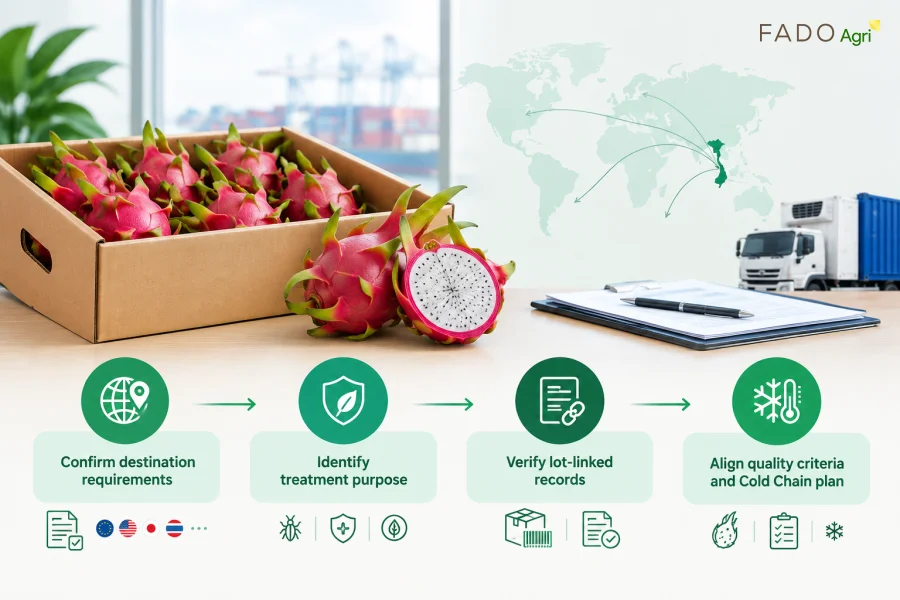
Why treatment decisions need to start with the destination market
A treatment plan that appears suitable for one destination may not meet the conditions for another. Before comparing options, buyers need to identify the market, product, and transaction scope that govern the decision. This establishes what needs to be confirmed before a supplier makes commitments about treatment or shipment documentation.
Separate legal admissibility from buyer preference
An importing authority’s requirements and a buyer’s private specification are different things. A retailer or procurement team may request a treatment as part of its own program, but that request does not establish that the treatment is required by law or that it satisfies the destination’s import conditions. Conversely, a treatment being acceptable under a buyer’s specification does not, by itself, establish compliance with official requirements.
Ask the supplier to distinguish any stated regulatory condition from a commercial or customer-requested condition. If the treatment is proposed to address an official import requirement, confirm that requirement through an appropriate current official source or qualified regulatory adviser before shipment planning. Do not infer the rule from another country’s requirements or from a previous shipment.
Define the exact product and shipment scope
Confirm the destination country and, where relevant, the intended sales channel, product form, and shipment route. The description “fresh dragon fruit” may not be sufficiently specific for a regulatory review or a purchase specification. Make sure the product being assessed is the same as the product offered, packed, documented, and shipped.
SPS measures, technical regulations and standards, phytosanitary requirements, and buyer specifications can all affect an import review, but they are not interchangeable. A phytosanitary certificate, for example, is a separate document from evidence describing a post-harvest process. Buyers should identify which requirement each document or record is intended to address.
What irradiation and post-harvest treatment claims need to establish
A treatment name alone does not show whether a process is suitable for an order. Buyers need to understand what the supplier means by the proposed treatment, its stated purpose, who is responsible for it, and what records support the claim. Keep the treatment’s intended purpose, its regulatory status, and any product-quality outcome as separate questions.
Ask what the treatment is intended to address
Irradiation is a post-harvest process involving exposure to ionizing radiation under controlled conditions. Other post-harvest treatments can involve different methods and purposes. The name of a method does not establish that it is authorized for a particular product or destination, nor does it prove a specific effect on pests, quality, food safety, or shelf life.
Ask the supplier to describe the proposed method in clear, non-promotional terms. Confirm the intended purpose, the product and lot covered, and the entity responsible for the process. If a claim concerns a particular pest, hazard, or quality outcome, request evidence relevant to the dragon fruit and the applicable market rather than relying on a general statement about the treatment.
Keep process evidence separate from outcome claims
A record showing that a process was applied can support the buyer’s understanding of what happened to a lot. It does not automatically prove that the process meets a destination requirement or achieved a claimed result. Those conclusions require evidence appropriate to the specific requirement or outcome being assessed.
Do not infer pest-control efficacy, shelf-life extension, food-safety results, or preservation of product quality from a treatment name alone. Likewise, irradiation should not be treated as a replacement for phytosanitary documentation, traceability, applicable MRLs compliance, or agreed Cold Chain handling. Each addresses a different part of the buyer’s review and should be checked on its own terms.
Build a treatment evidence file for the offered lot
The most useful supplier records connect a stated process to the product being purchased and the shipment being planned. Ask for evidence that can be checked against the order and lot identity instead of relying only on a general assurance about supplier practice. The documents needed will depend on the destination and transaction.
Trace the process to the order and shipment
Ask who carries out the proposed treatment and whether it is performed by the supplier or another service provider. Request a written description of the process and clarify which product or lot it covers. Where applicable, ask what records identify the relevant dates and connect the process record to the shipment.
The purpose is to create a reviewable chain of information: the product in the purchase specification, the lot offered, the process described, and the shipment documents. If a record uses different product names, lot references, or shipment details, ask for an explanation before approving the order. Do not assume that a document relating to one lot or transaction applies to another.
Review document scope and consistency
Confirm which documents the importer needs for internal compliance review and which must accompany the shipment or be available to the relevant parties. Check the scope of each document as written. A certificate or process record should not be taken as proof of a claim it does not explicitly cover.
Review treatment records alongside, but separately from, applicable phytosanitary documentation, traceability records, and any relevant MRLs evidence. These are distinct checks, not interchangeable proofs. If a document is missing, unclear, or inconsistent with the offered lot, request clarification before dispatch rather than assuming the gap is immaterial.
Assess product quality and Cold Chain handling separately
Regulatory acceptability does not, by itself, demonstrate that the fruit will meet the buyer’s quality specification on arrival. Treatment review should therefore sit alongside defined condition-at-dispatch and arrival-assessment criteria. This helps procurement teams evaluate compliance evidence and product condition without treating one as a substitute for the other.
Set buyer acceptance criteria before shipment
Agree on the product specification before confirming the treatment plan. Define the relevant characteristics and how the buyer will assess them at dispatch and arrival. Avoid relying on broad terms such as “export quality” unless the parties have agreed what they mean for the order.
If the supplier has product- or process-specific evidence about fruit condition before and after treatment, ask to review it and confirm what it actually covers. Do not assume that a treatment guarantees a particular appearance, maturity, shelf life, or arrival condition. If no relevant evidence is available, base the purchase decision on the specification and controls the parties can document.
Connect treatment planning with the shipment’s handling plan
Review how the proposed treatment fits with packing, handling, storage, and the planned Cold Chain logistics. Ask which shipment and product requirements underpin the proposed handling plan, and ensure the plan is consistent with the purchase specification. Do not use generic transport assumptions in place of product- and shipment-specific information.
Reefer container planning should also be based on confirmed requirements for the order. Buyers should not assume a particular setpoint or handling instruction without supporting product-specific guidance. Agree how the shipment’s condition will be assessed on arrival and how any difference from the agreed specification will be recorded and raised.
Use a pre-order checklist before approving a treatment plan
A documented review can uncover unanswered questions before a buyer commits to a shipment. Use the checklist as a decision aid, not as a replacement for destination-market confirmation or technical advice. If a key item remains unresolved, request clarification or pause approval rather than relying on an assumption.
- Destination and product: Is the importing market identified, and does the product description match the offered dragon fruit and purchase specification?
- Treatment purpose: Has the supplier explained what the proposed treatment is intended to address and which product or lot it covers?
- Market status: Has any relevant requirement, restriction, or authorization question been confirmed using an appropriate current source for the destination?
- Responsible party: Is it clear who carries out the process and what records can be provided for the offered lot?
- Evidence scope: Do the available records support the specific claims being made, without being treated as proof of unrelated outcomes?
- Separate compliance checks: Have phytosanitary documentation, traceability, and any relevant MRLs evidence been reviewed as distinct items?
- Product and logistics plan: Does the treatment plan align with the purchase specification, packing arrangements, and agreed Cold Chain logistics?
- Arrival assessment: Are acceptance criteria and the process for documenting discrepancies agreed before dispatch?
- Open questions: Have unresolved regulatory or technical issues been referred to an appropriate official or qualified source?
Discuss Vietnamese dragon fruit export requirements with FADOAgri
Once the destination, product specification, and evidence requirements are defined, a supplier discussion can focus on whether the proposed order can be documented and planned accordingly. Keep the inquiry specific to the market and shipment; do not assume that one treatment or document set fits every transaction.
Share the destination market, requested product specification, intended shipment timing, and any treatment or documentation requirements that have already been confirmed. You can also request product specifications and shipment-relevant documentation for review before finalizing an order. Any treatment capability or destination-specific approval should be confirmed for the particular transaction rather than assumed.
Contact FADOAgri’s export team by WhatsApp/Hotline at (+84) 908 479 339 or email [email protected] to discuss your Vietnamese dragon fruit sourcing requirements and request the information relevant to your shipment.
Phone: 0908 479 339 · Website: FADOAGRI · Contact us